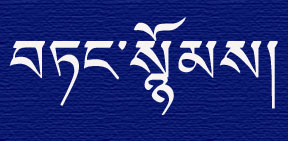
 One of the Four Immeasurable Qualities is ‘Equanimity‘. In the Tibetan language, it is ‘Tang Nyom‘. Tang Nyom is the practice and aspiration to perceive all beings in the same way rather than with the bias of the labels ‘friend’ or ‘enemy’. Seeing them otherwise is due to a lack of understanding of the true nature of reality. Therefore, it is important to train the mind to perceive all beings with a benevolent attitude and cultivate the authentic quality of Equanimity, or Tang Nyom, towards all beings.
Blog Archives
The Four Immeasurable Qualities: Equanimity
Flag of the Yungdrung Bon

The flag of the Yungdrung Bön with each of the colors of the five elements and the golden chakshing with 2 turquoise-colored yungdrungs as held by Buddha Tönpa Shenrap Miwoche
The Mighty Task of Preserving Ancient Knowledge

H.E. Menri Lopön Rinpoche, head teacher of Menri Monastery, is nearing completion of an Encyclopedia of the Bön Religion.
Lopön Rinpoche’s new encyclopedia contains more than twelve thousand different entries, which include a comprehensive set of articles and definitions used in the Yungdrung Bön religion by Bönpo practitioners, as well as entries explaining cultural terms and concepts unique to Bön. Even the largest reference works currently available in Tibetan or English do not include much of the information that will be available in this new work. Entries include:
- Tibetan and Zhang Zhung words and terminology specific to the Bön religion
- Biographies of Bonpo scholars and practitioners, both historical and contemporary
- Descriptions of significant places in Bon history
- Descriptions of Bon religious symbols, images and objects
- Names and descriptions of Bon deities
Scholars of Tibetan culture regularly have problems correctly understanding the language in texts of the Yungdrung Bön religion because such texts use words that are often different, or familiar words that have different meanings, than the terminology used by Tibetan Buddhists.
A work of this scope on Bön has never been published before. The Bön Encyclopedia is in the Tibetan language, but after initial publication, Lopön Rinpoche hopes to have it translated into English. They have begun collecting donations to help with translating and publishing this book in English. Any amount would be a great help and greatly appreciated. Donations can be sent to Menri Lopön’s Khyungdzong Wodsel Ling center in the United States at the following address or use the PayPal button on their website KWLING.ORG.
Dika Ryan
1977 N. New Hampshire Ave
Los Angeles, CA 90027
(This article originally appeared at http://kwling.org/projects/encyclopedia-of-bon/)
The Twelve Deeds of the Buddha Tonpa Shenrap Miwoche

The enlightened being, Tönpa Shenrap Miwoche, was born into this world over 18,000 years ago. There are three sources for his hagiography, a short, a medium and a long version. The short version is commonly known as the Do Dü. This is a single volume with twenty-four chapters. This is the earliest written source and was translated from the ancient language of Zhang Zhung into Tibetan by the sage and scholar Lishu Taring. The medium length version is commonly known as the Zer mik. This is two volumes with eighteen chapters. This text is focused primarily upon the twelve deeds of the Buddha. The long version is commonly known as the Zi Ji. This text has twelve volumes with sixty-one chapters. Within this text are teachings of the Nine Ways of Bön in the form of a conversation between Buddha Tönpa Shenrap and a disciple.
The Twelve Deeds of Tönpa Shenrap Miwoche:
1. The Deed of Birth
2. The Deed of Spreading the Teachings
3. The Deed of Taming Sentient Beings
4. The Deed of Guiding Sentient Beings
5. The Deed of Marriage
6. The Deed of Manifesting Progeny
7. The Deed of Conquering
8. The Deed of Victory
9. The Deed of Awareness
10. The Deed of Solitude
11. The Deed of Liberation
12. The Deed of Complete Accomplishment
The Truth is Unchanging and Unceasing

The founder of the Yungdrung Bön tradition is the Buddha Tönpa Shenrap Miwoché. His right hand is in the mudra of subduing the earth and holds a chakshing. The chakshing has two yungdrungs which represent the unchanging and unceasing nature of the absolute truth. These qualities also refer to the true nature of the mind that is beyond concepts and is indestructible.
 Nine Ways