
A crowd gathers for an empowerment ceremony in Khyungpo, Tibet
A crowd gathers for an empowerment ceremony in Khyungpo, Tibet

Location: The full name of this monastery is Yanggon Tongdrol Phuntsok Ling, Temple of the Yangtön Lineage, Land of Complete Fulfillment that Liberates upon Seeing. However, it is commonly referred to simply as Yanggon Monastery. At 14,160 ft above sea level, it is located in the highest village within the remote area of Dolpo, Nepal. This is the village of Charka (Tsarka in Tibetan. Charka is the common Nepali pronunciation.) It is located at the junction of two rivers appropriately named The Big River and The Small River. The monastery complex consists of the first temple which is now in ruins, the second temple which was originally built in the mid-nineteenth century and later moved in the early 90’s and consolidated with the third temple which was built in 1988 by the current head lama, Yangtön Lama Tashi Gyaltsen.
 The village of Charka
History: The history of the Yangtön lineage is closely interwoven with the history of the Yungdrung Bön tradition itself. It is said that two of Buddha Tönpa Shenrap’s disciples were Yangtön lamas. And during the reign of the first Tibetan king, Nyatri Tsenpo in the second century B.C., the official priest for the king and the kingdom was a Yangtön lama. The original seat of the family was at Taktsé Jari in Upper Tsang, Western Tibet. The great lama, Yangtön Sherab Gyaltsen was the first to travel away and eventually settled in Mustang, Nepal where he established a hermitage. Another lama, known as Lama Ngakpa, settled in Mustang for a time but then made his way to Dolpo. Because all of his children died at a young age, he brought a boy to Dolpo from the original family seat of Taktsé. This prompted the rest of the family to follow and settle in Dolpo. It was this boy, Yangtön Gyaltsen Rinchen, who founded the nearby monastery of Samling. He was also a teacher to the esteemed Dru Gyalwa Yungdrung who wrote a practice manual for the Oral Transmission of the Zhang Zhung Dzogchen teachings.
 Yangtön Lama Tashi Gyaltsen
Currently: The head lama of the monastery is Yangtön Lama Tashi Gyaltsen. He was the first of the Yangtön lamas to receive his Geshe, Doctorate of Religion and Philosophy, from Menri Monastery in Dolanji, India. His younger brother soon followed and is now the head teacher of the monastery, His Eminence Menri Lopön Thrinley Nyima Rinpoche. Their nephew, Yangtön Geshe Tenzin, has also received his Geshe degree and, like his uncles, he travels throughout the world teaching as well as spending time in the village of Charka organizing building projects and offering rituals and teachings to the villagers. In addition to his activities of building and preserving the family temples, monks’ living quarters and building projects, Yangtön Lama Tashi is also responsible for the teaching and spiritual guidance of a small group of young monks.
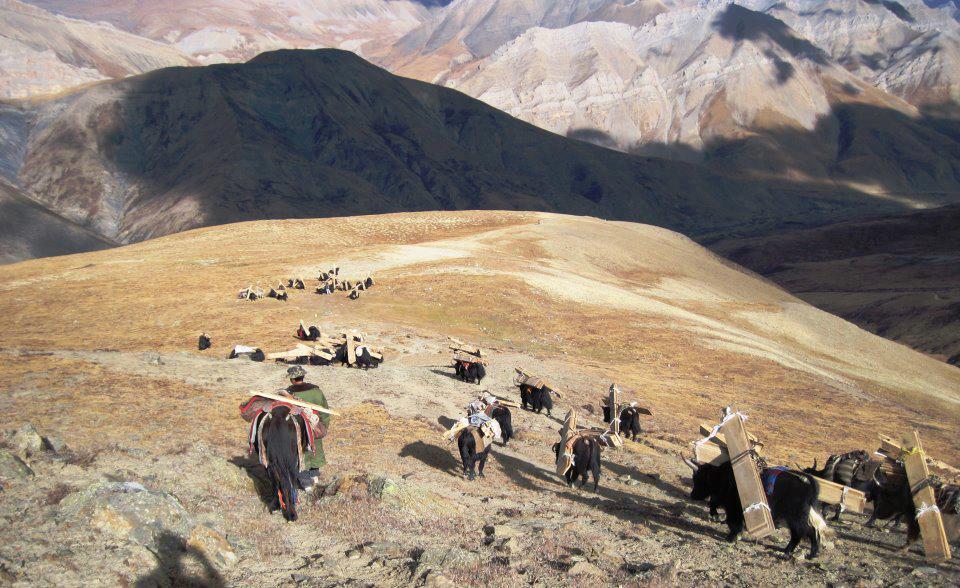 Yaks carrying lumber
Because of the remoteness of the village, all supplies for building must be carried in on foot. This is a slow and arduous process. Building supplies must be brought by animal from Jomsom, Mustang via a narrow, single-track path. This can take up to seven days. Large beams for construction must be carried by humans from Tibet. The cost of getting the supplies to the remote village can average 4-5 times the actual cost of the supplies themselves. Rocks for a building’s foundation can only be gathered in Winter because they are located on the opposite side of the river and it is necessary to wait until the river freezes enough to be walked across. In recent years, in spite of the difficulty, the Yangtön lamas have been able to build and begin to establish a much needed medical clinic in the village that will serve the 500-600 villagers. The clinic is located on monastery grounds and is supervised by the monastery. Before the establishment of the clinic, the nearest medical support was over a hundred miles away. Common medicines were rare and infection from minor cuts and injuries easily became life threatening. Infant mortality was over 50%. Construction of the free healthcare clinic began in 2009. Three people are being trained as doctors who will staff the clinic. One is learning Western medicine, one is learning traditional Tibetan medicine and a third is specializing in being a midwife. In addition to medical intervention, the staff will also educate the local population about hygiene and first aid.
 Medical Clinic in the village of Charka
For more information about Yanggon Monastery, http://www.yanggon.org/
For more information about the free healthcare clinic and its current needs, http://kwling.org/projects/clinic/
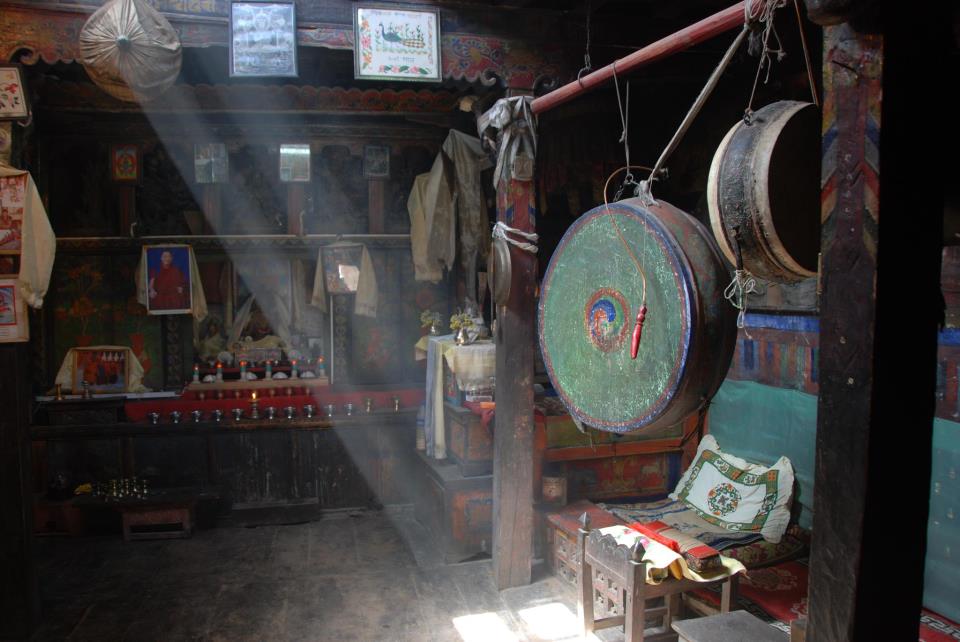
This Yungdrung Bön temple is located in the village of Jomson in Mustang, Nepal.
For more on Yungdrung Bön in Mustang, see the documentary film Mustang to Menri.

The official name of this monastery is Tashi Gégye Thaten Ling. However, it is commonly referred to as the Dorpatan Monastery. This was the first Yungdrung Bön temple in exile. It is located in Nepal, south of Dolpo, in the village of Dorpatan. In addition to the monastery, there is also a medical clinic which serves the local population. The settlement is now roughly divided into an area inhabited by the Bönpo and an area inhabited by the Buddhists, mostly Kagyu. However, the religious practices and festivals are predominantly Yungdrung Bön.

In the early 1960’s after the Chinese invasion, a refugee camp for the Bönpo was established in Dorpatan by The Red Cross. At that time, the spiritual head of the Bönpo and 32nd Abbot of Menri Monastery, Kündun Sherap Lodro, was staying in Kathmandu after having fled Tibet. He traveled to Dorpatan and initiated the construction of a temple. Kündun Sherap Lodro later went to India and management of the temple was taken over by Tsultrim Nyima. He was the father of the current abbot of Triten Norbutse monastery in Kathmandu, Khenpo Tempa Yungdrung Rinpoche. Tsultrim Nyima was strongly devoted to his work with the temple but was unfortunately killed at a relatively young age. At that time, management of Dorpatan Monastery was taken over by Sonam Gyaltsen. After his death, Geshe Tenzin Dargye was appointed as the abbot and continues in this position until today.
 (Khenpo Tenzin Dargye, also called Khenpo Tamdin, is the current abbot of Dorpatan Monastery.)
Khenpo Ratsa Geshe Tenzin Dargye was born in 1966 in Jomsom Mustang, Nepal. His father, Yungdrung Gyal, is the 36th in the Phong la Ratsa lineage of East Amdo. His mother, Konchok Dolmo, is of the Amchi lineage, a Tibetan doctor. Khenpo Tenzin Dargye was tutored at home by his father until the age of nine and then sent to study in India. At the age of sixteen, he decided to become a monk. In 1996, he received his Doctorate of Religion and Philosophy, or Geshe Degree, from the Dialectic School of Menri Monastery. After this, he worked as the organizer of the Bön Children’s Welfare Center and the medical dispensary for seven years. In 1996, he was asked by the 33rd Menri Trizen to transfer and to become the abbot of Dorpatan Monastery. Over the years, Khenpo Tenzin Dargye has worked to improve the monastery. Together with Dr. Tsultrim Sangye, they established a medical clinic in order to provide much needed medical services to the local and surrounding area. Khenpo regularly travels and teaches throughout Asia, the United States, Mexico and Europe.
In the region surrounding Dorpatan Monastery, the main agriculture consists mostly of potatoes although there has been an effort to establish apple trees. During the summer, there is also a great deal of animal husbandry. During the Winter, many people migrate south and trade potatoes for salt, rice and wheat.
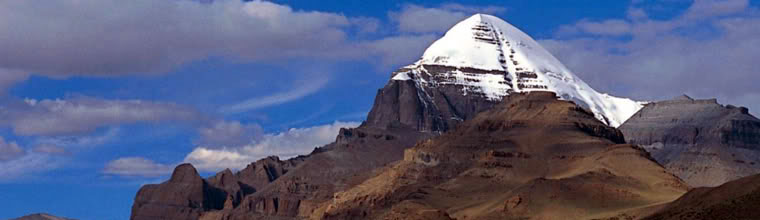 (Southern Face of Mount Tisé, also known as Mount Kailash)
It is the seat of Shiva according to Hindus. Many Jains believe it to be the holy site where the founder of the Jain religion, Lord Rishabhdev, attained liberation. It is the place where Milarepa lived and practiced according to Buddhists who call the mountain Gang Rinpoche, Precious Snow Mountain. And according to the Bönpos, it is Mount Tisé, sacred dwelling place of deities, the place where Buddha Tönpa Shenrap Miwoché taught and meditated, and where many sages after him, such as the great lama Drenpa Namkha, Choza Bönmo and Lishu Taring, practiced the teachings of the Yungdrung Bön. For all of them, to make a pilgrimage to this place and to circumambulate the mountain has great spiritual significance. “Whoever visits Gang Tisé will achieve liberation after three lifetimes.” And, “If you cleanse with the purification waters of the four directions (of the mountain), you will be reborn in a pure realm.”
In Sanskrit and on most English language maps, it is called Mount Kailash. It is located in far Western Tibet in the Ngari region which is a remote and arid landscape only spotted with vegetation. With no source of wood, campfires are fueled with goat and horse dung. Reaching the area through a pass of over 16,000 feet in altitude, the air is thin and the light intensely reflects upon every object in the landscape. Until recent history, there were no roads in to this region. The mountain has a 22,028 foot peak that is topped with snow year round. Each of the four sides of the mountain are distinctively different. It has never been climbed. For the devout, that would be an unthinkable desecration. In 1980, Reinhold Messner was given permission to climb it by the Chinese. However, he declined. In 2001, a Spanish team led by Jesus Martinez Novas was given permission to climb the mountain. However, due to international disapproval, the Chinese reversed their decision and banned all attempts to ever climb the mountain.
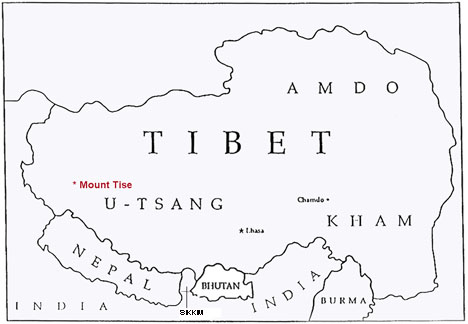
Mount Tisé was at the center of the ancient kingdom of Zhang Zhung. Tisé is a Zhang Zhung word referencing the mountain as the source of many waters. It was the soul mountain of both the Zhang Zhung king and the kingdom and was considered the center of the world. The Zhang Zhung deity, Walchen Gekho and his 360 emanations, reside at its summit. It is described in many historical Yungdrung Bön texts in great detail. “In the center of the phenomenal world is Mount Tisé, the Nine-storied Yungdrung Mountain. From it, four rivers flow towards the four directions.” These four great rivers which originate in the area surrounding the mountain are the Karnali, also known as the Ganges which flows Southward, the Sutlej also known as the Punjabi which flows Westward, the Brahmaputra which generally flows Eastward, and the Indus which generally flows to the Northwest from the area. The texts say that Mount Tisé will survive the fires that will destroy the world at the end of the current eon. The texts describe it further: “It looks like a crystal chorten. It’s four sides are like four equal squares in the four directions.” And, “It has the four kinds of qualities: peaceful, expansive, powerful and wrathful. It is an immeasurable shrine with great blessings”
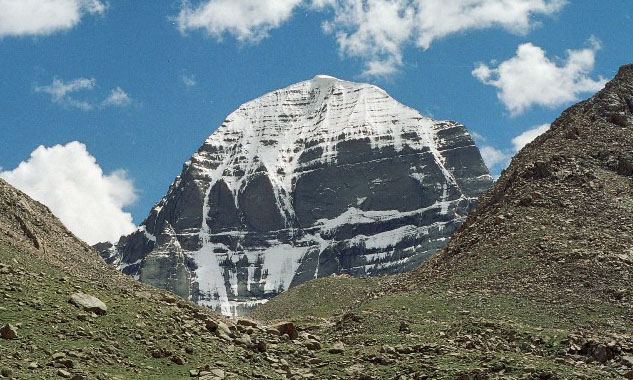 (Northern face of Mount Tisé)
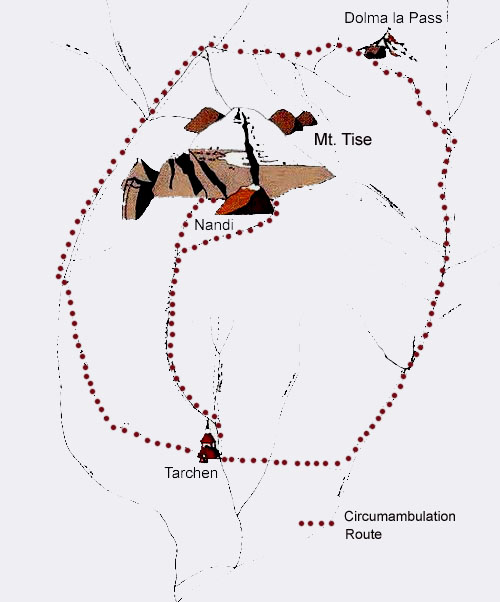
Pilgrimage season is generally May-September. The circumambulation, or korwa, begins at Tarchen, a small settlement on the South-side of the mountain. Until the Chinese invasion, it was a major center for the region’s trade. Now, although the summer continues to be the busy trade season, it is much diminished from the past. By the time a pilgrim reaches this starting point, it is possible that they have spent years getting here, often prostrating the entire journey. Once here, if a pilgrim is unable to undergo the hardship of the korwa, here at Tarchen someone can be found to be sponsored to go in their place. In that case, the merit generated by the virtuous activity is shared between the sponsor and the one actually doing the korwa. For the Bönpo and the Jain, the korwa is counter-clockwise. For Buddhists and Hindus, it is clockwise. The path is marked by many sacred places of veneration where great sages meditated or where the power and blessings of deities reside. There are also four places designated for prostrations along the way. These are areas large enough for the pilgrims to stop and spend time prostrating and paying homage to the sacred mountain. However, there are those practitioners who choose to perform full prostrations the entire length of the thirty-two mile circuit around the mountain. Doing this, a single circuit takes about two weeks. These pilgrims must carry their provisions with them and wear thick, leather aprons and mittens to protect their body from the stoney ground. For those who walk around the mountain, most choose to finish within three days. Others choose to begin hours before dawn so that they can complete the journey in a single 13-15 hour day. The pilgrim’s path rises in the thin air to an altitude of 18,500 feet at the Dolma la Pass, the highest point of the route.
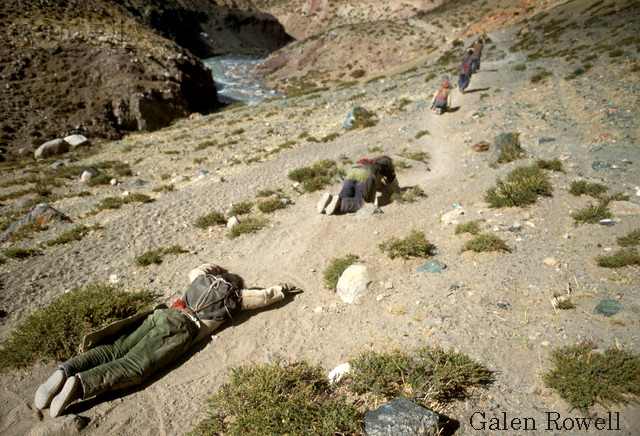 (Pilgrims prostrating around the mountain.)
In general, pilgrims perform three circumabulations of the mountain. If the pilgrim is completing the circuit in a single day, they will take a day of rest in between the three korwa of the mountain. Some make a commitment to complete 1o8 circuits. This takes two pilgrimage seasons. From the starting point at Tarchen, there is also an inner korwa. Several miles North of Tarchen past a couple of monasteries, there is a smaller mountain, called Nandi, whose korwa brings the pilgrim close to the very face of Mount Tisé. This inner korwa is forbidden until one has completed at least thirteen circumambulations of the outer korwa.
Just seeing the mountain is a blessing. And undergoing the arduous task of its korwa is said to purify one’s negativity. It is vitally important in the history of Yungdrung Bön. According to the text, “Mount Tisé, the crystal chorten, soul mountain of Yungdrung Bön, is like nine stacked yungdrungs. Externally, it is like a chorten made of crystal snow. Internally, it is like the palace of the three tutelary deities. Secretly, it is the vast and profound gathering place for the mother and sister khandro.” “Having washed away karmic traces by purifying oneself with the healing waters, you will be reborn in a joyous realm of the gods. Having reversed obstacles and adverse circumstances by performing the korwa through prostrating, you will be able to live out the full extent of your lifespan.” Thus it is said.
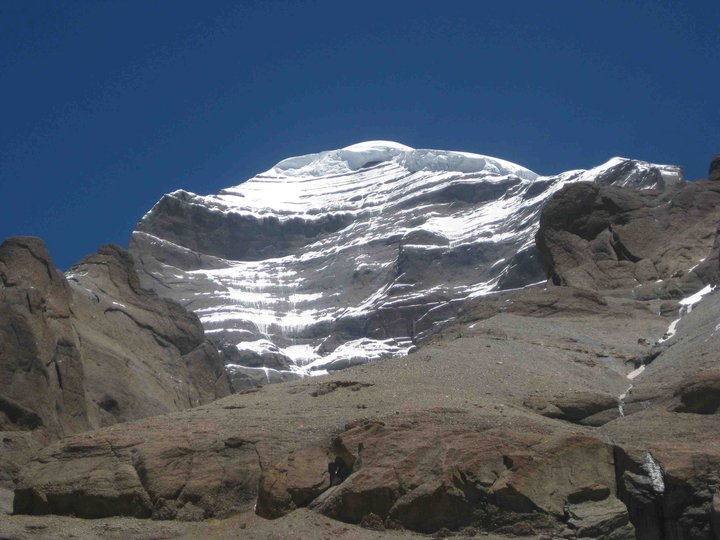 (Eastern Face of Mt. Tisè. Photo by Rikzin Lama)
To read more about Mount Tisé see Sacred Landscape and Pilgrimage in Tibet by Geshe Gelek Jinpa and Charles Ramble. The Light of Kailash by Chogyal Namkhai Norbu Rinpoche. Or The Sacred Mountain of Tibet by Russell Johnson and Kerry Moran. And in Tibetan, Gangs Tise’i sKor by HE Menri Yongdzin Tenzin Namdak Rinpoche.
 Nine Ways