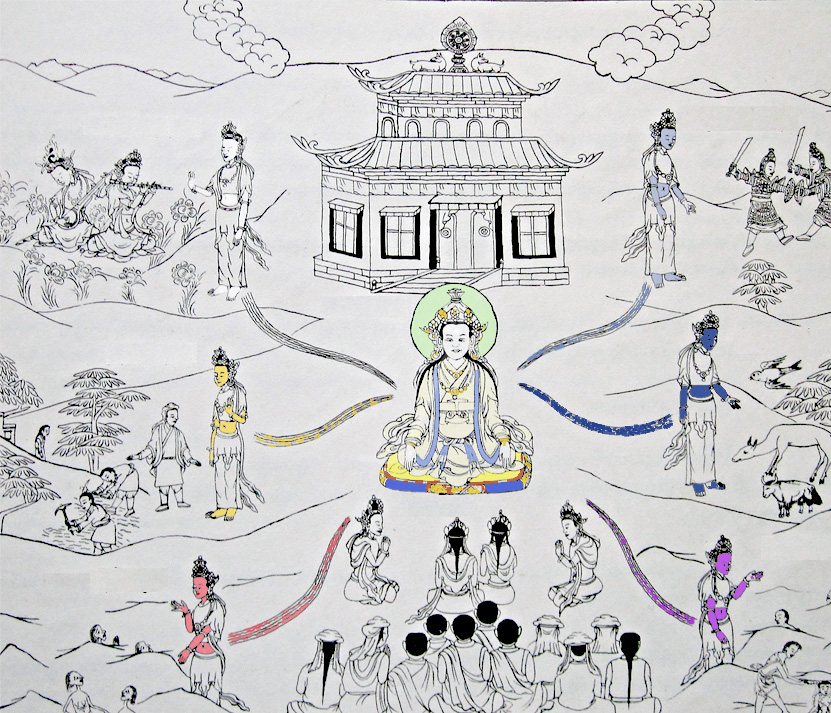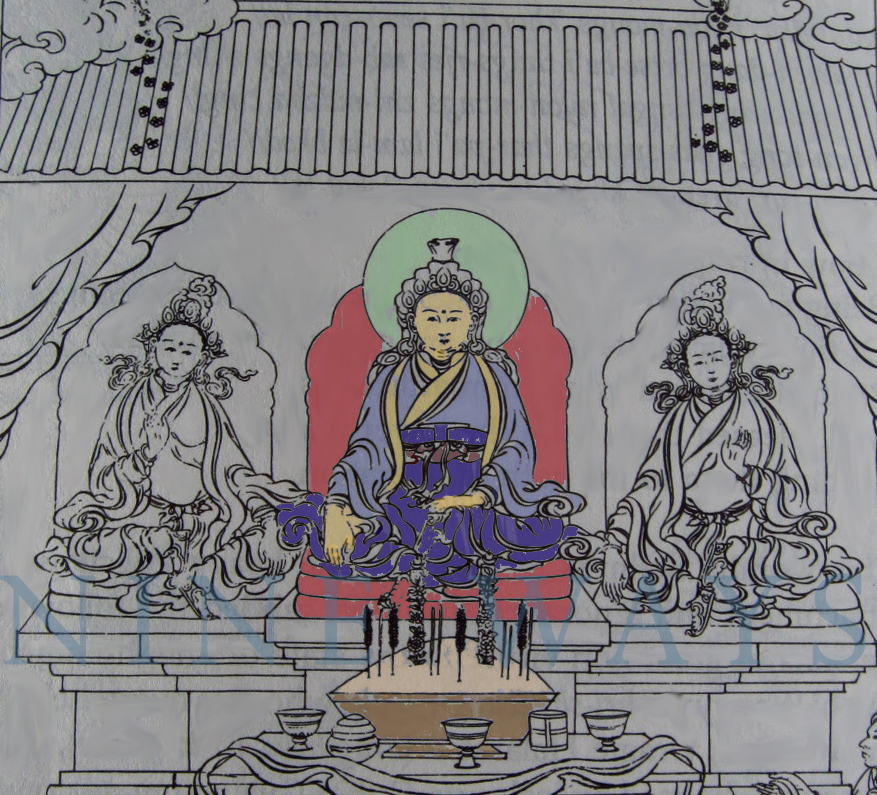
During the time that the Buddha Tonpa Shenrap Miwoche was teaching his many disciples the Four Doors of Bon and the Fifth which is the Treasury, the King of Ho Mo Yul along with his entourage came to invite the Teacher to his country. Not having finished the teaching, the Buddha was unable to accept the king’s invitation. However, he sent one of his three main disciples as an emissary. The disciple, Yikyi Khyechung, returned to Ho Mo Yul with the king. Arriving, both humans and non-humans came to pay their respect and to receive teachings. Then, Yikyi Khyechung took up the life of an ascetic and retreated to a cave to meditate. After a time, the queen of Ho Mo Yul was struck with a violent illness. A diviner was consulted and she informed the king and queen that only the Buddha Tonpa Shenrap could cure the illness. The king returned to the Buddha in person and requested his help. Having finished his current teachings, the Buddha went to the country of Ho Mo Yul and cured the queen of her illness. The grateful queen offered her daughter, Hoza Gyalme ma, as a bride for Tonpa Shenrap. Previously, the god Indra had implored the Buddha to take a wife so that he might have children to continue his lineage. At that time, the Wise, Loving Mother of all of the buddhas, Sherap Chamma, emanated ten different manifestations of herself as princesses in royal households so that Buddha Tonpa Shenrap could accept them as wives. In this way, Hoza Gyalme ma was the first of these ten manifestations of Yum Chen Sherap Chamma.
Blog Archives
Buddha Tonpa Shenrap’s Fifth Deed: The Deed of Marriage
Buddha Tonpa Shenrap’s Fourth Deed: The Deed of Guiding
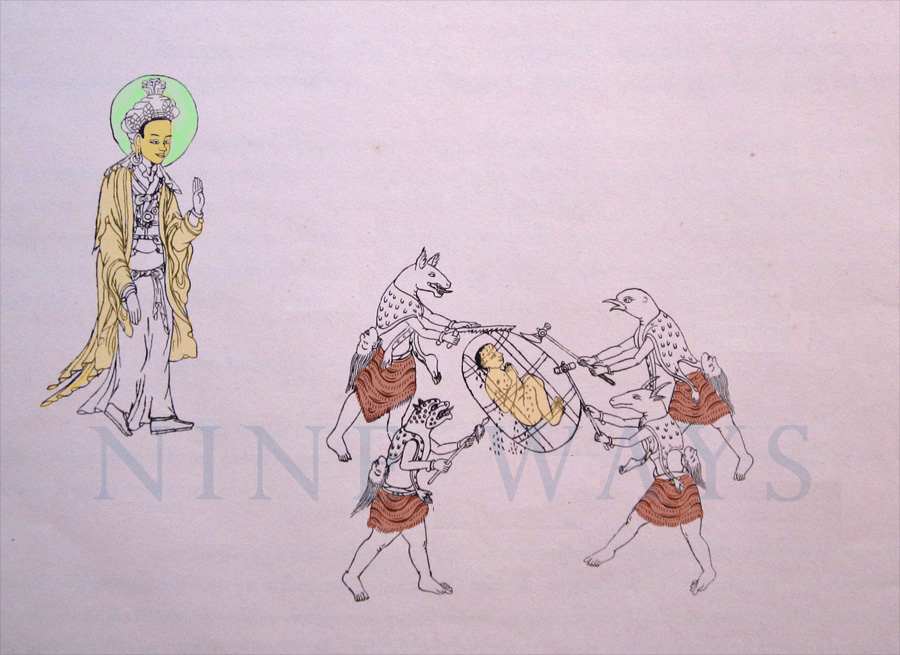 As the Buddha Tönpa Shenrap Miwoché was teaching his disciples, a messenger came to him with a request for help from the deity Sangpo Bumtri. In the land of Öma Jamkya there was an evil minded prince, named Tobu Dödé, that was slaughtering many living beings including humans. The deity Sangpo Bumtri respectfully requested the Buddha’s help to tame the mind of this evil minded prince.
As Buddha Tönpa Shenrap accompanied by some of his disciples arrived to help, Tobu Dödé incited his army to rise up and kill all of them. Remaining in his golden chariot, the Buddha emanated rays of light into the four main directions which manifested as flaming, wrathful deities. Each of these deities was dark blue having nine heads, four legs, and eighteen arms each holding a different weapon. Upon seeing these deities, many fainted and Tobu Dödé feared for his life. Falling upon his knees before Buddha Tönpa Shenrap, he begged for mercy and vowed to stop killing and to practice virtue. However, even though the evil minded prince had made a vow and had received teachings from the Buddha, his mind remained filled with hatred and anger.
Sometime later, Tobu Dödé fell seriously ill and began to have visions of hell. He cried out for the Buddha to help him and then died. Due to his previous actions, he was reborn into the realm of hell and was tortured. His cries of pain were heard by the Buddha and, due to His great compassion, He descended into hell. Calling out with the mantra “A KAR A ME DU TRI SU NAKPO ZHI ZHI MAL MAL!” both the Lord of death and Tobu Dödé recognized him. The Buddha told him that although the realm of hell was only a manifestation of his own mind, it had now taken form due to his previous karma. The Buddha instructed him regarding the nature of karma and the essence of meditation. When Tobu Dödé’s understanding had changed and his mind developed, even though he continued to be in the realm of hell, the heat and cold no longer harmed him.
Meanwhile, the family and companions of Tobu Dödé, fearing for the consequences of their own negative karma after their death, approached the Buddha and asked for his help. In order to teach beings, He invoked the deities and made offerings on behalf of Tobu Dödé. After seven days, he was freed from the realm of hell. However, because his negative karma continued to ripen, he was successively born into each of the realms of cyclic existence. At the same time, Buddha Tönpa Shenrap Miwoche continued to supplicate the deities and make offerings. Being released from the hell realm, Tobu Dödé was reborn into the realm of the hungry ghosts. After seven days, he was released and was reborn into the realm of animals. After seven days, he was released and reborn into the realm of human beings among barbarians. After seven days, he was released and reborn into the realm of the demi-gods. After seven days, he was released and reborn into the realm of the gods. Although the realm of the gods is filled with leisure and happiness, it remains within cyclic existence and is impermanent. However, due to the continued offerings and supplications of the Buddha, Tobu Dödé was reborn as a human being in the purest land of Olmo Lungring. In this way, Buddha Tönpa Shenrap Miwoche showed a method for releasing the suffering of negative karma.
Buddha Tonpa Shenrap’s Third Deed: The Deed of Taming
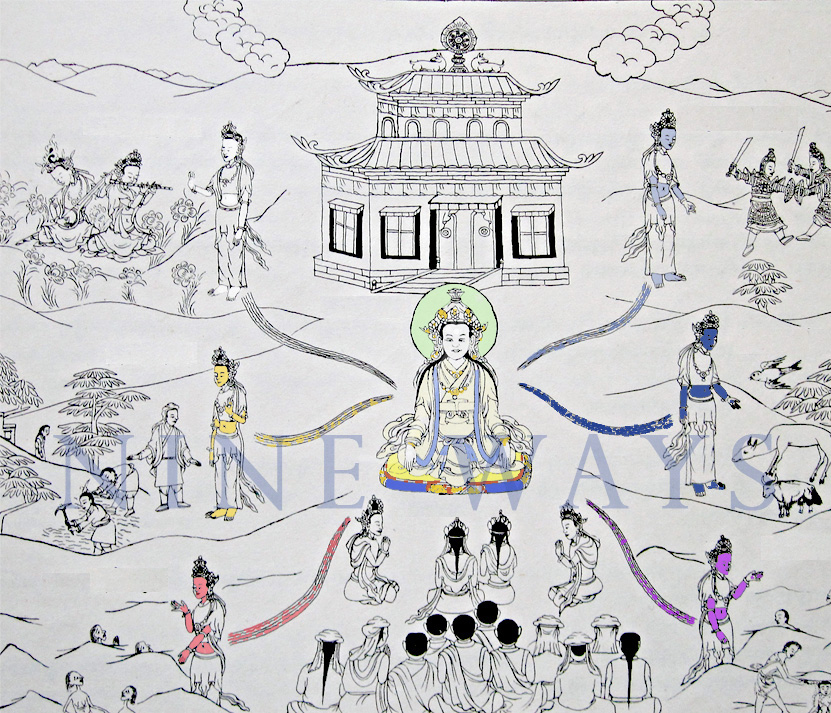
Buddha Tönpa Shenrap Miwo Emanating Buddhas into each of the six realms of cyclic existence
In order to guide sentient beings out of their suffering and to realization and liberation, Buddha Tönpa Shenrap emanated countless manifestations of himself throughout all the realms of existence. Although these emanations appeared in different forms according to sentient being’s understanding, his mind remained unchanged.
In the Yungdrung Bön tradition, it is believed that until a being reaches that state of buddhahood, they are bound to be reborn again and again throughout the six realms of cyclic existence. These six realms of cyclic existence, or six destinies, are from the lowest to the highest: the hell realm, the hungry ghost realm, the animal realm, the human realm, the demi-god realm and the god realm. (Here, god refers to beings that can have great power and meditative realization but who are still bound by karma.) Because of this, the Buddha emanated six enlightened beings from his mind into each of these realms. These six enlightened beings are of one essence but due to the specific suffering and obstacles of the beings within each realm, they each emphasize a particular quality for the predominant suffering related to that realm.
Because the predominant suffering related to the hell realm arises from hatred, this Buddha emphasizes teachings of love. Because the predominant suffering related to the hungry ghost realm arises from greed, this Buddha emphasizes teachings of generosity. Because the predominant suffering related to the animal realm arises from ignorance, this Buddha emphasizes teachings of wisdom and awareness. Because the predominant suffering related to the human realm arises from jealousy, this Buddha emphasizes teachings related to openness. Because the predominant suffering related to the demi-god realm arises from pride and envy, this Buddha emphasizes teachings of peacefulness. Because the predominant suffering related to the god realm arises from contentment and laziness, this Buddha emphasizes teachings of diligence.
What are the Nine Ways of Bon?
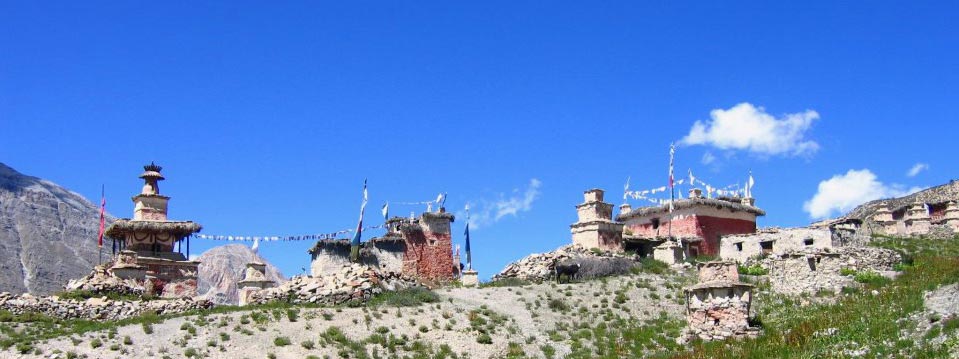
(Samling Monastery in Dolpo, Nepal)
There are three hagiographies of Buddha Tönpa Shénrap Miwoché’s life. They are commonly known as the Do Düs, the short version which has only one volume. The Zer Mik is the medium length version with 2 volumes. The Zi Ji is the long version and has 12 volumes containing a total of 61 chapters. All of these texts are classified within the Kangyur. It is within the longer version, the Zi Ji, that the teachings of Yundgrung Bön are explained by the Buddha within the context of nine different ways, or vehicles. The 1st, 2nd, 3rd and 4th Ways are classified as The Causal Ways, or the Bön of Causes. The 5th, 6th, 7th, and 8th Ways are classified as the Ways of the Result, or the Bön of the Fruit. The 9th Way contains the teachings of the Great Perfection, or Dzogchen. From the 1st to the 9th Way, the view, or perspective, of the methods and teachings becomes increasingly higher. However, even though one is a practitioner of a higher ‘Way’, this does not exclude the practice of one or more of the lower ‘Ways’ should the need arise. Although the methods differ, all of the Nine Ways have compassion as their base.
In centuries past, during times of persecution, the Bönpo would hide their texts rather than have them destroyed. Later, after the political environment had changed and they were no longer in danger, the texts would be searched for and brought out from their hiding places. In this way, there came to be three different classifications of the Nine Ways of Bön according to the region in which the texts were found after being hidden. These three are referred to as The Southern Treasures, The Northern Treasures, and The Central Treasures.
In 1961, the Rockefeller Foundation gave funds to various universities who had established Tibetan studies programs in order to allow them to invite Tibetan scholars for a 3 year period. Yongdzin Tenzin Namdak Rinpoche, Geshe Lungtok Tenpa’i Nyima Rinpoche, the future abbot of Menri Monastery, and Geshe Samten Karmey were invited to England by David Snellgrove. During this time, Yongdzin Rinpoche suggested the translation of excerpts of the Nine Ways based upon the Southern Treasures. Yongdzin Rinpoche personally selected the passages that David Snellgrove translated. In 1967, these excerpts were published as The Nine Ways of Bön. At that time, very little was known about the Yungdrung Bön tradition among Western scholars. There was a great deal of theorizing and conjecture. So, although Snellgrove’s translation of the text is quite accurate, his own personal conclusions as to the origins and influences of the Yungdrung Bön should be taken within the context of the time in which he was writing. However, to-date, his translation remains the only extended translation of the Nine Ways that is available.
(en español: https://losnuevecaminos.wordpress.com/about/)
The Nine Ways of Bön according to the Southern Treasures:
1. The Way of the Shen of Prediction: This Way includes divination, astrology, various rituals, and medical diagnosis.
2. The Way of the Shen of the Phenomenal World: This Way includes rituals dealing with communication with external forces such as rituals of protection, invocation, ransom of the soul and life-force, and of repelling negative or harmful energies.
3. The Way of the Shen of Manifestation: This Way includes venerating a deity or master and then applying mantra and mudras in order to accomplish a goal such as requesting assistance from natural energies.
4. The Way of the Shen of Existence: This Way is primarily focused upon rituals for the dead and methods to promote longevity for the living.
5. The Way of the Virtuous Lay Practitioners: This Way specifies the proper conduct of lay person taking vows.
6. The Way of the Fully Ordained: This Way specifies the proper conduct for those who are fully ordained practitioners.
7. The Way of the White AH: This Way is primarily focused upon tantric practice using visualization.
8. The Way of the Primordial Shen: This Way is primarily focused upon higher tantric practice.
9. The Unsurpassed Way: This Way is primarily focused upon the practice of Dzogchen, or The Great Perfection. This Way does not rely upon antidotes of any kind, ritual or practice with a meditational deity. It is concerned with the realization of the true nature of one’s own mind.
 Nine Ways