Category Archives: Uncategorized

Yungdrung Bön History in a Broader Context

Restored Yumbu Lhakhang, Palace of the kings in the Yarlung Valley of Tibet

In 1842, His Holiness the 23rd Menri Trizen Nyima Tenzin Rinpoche [1813-1875 C.E.] composed The Chronology of the Buddha, A Necklace of Amazing Jewels. The chronology begins at the start of the current eon when the lifespan of human beings was 100,000 years and Buddha Nangwa Rangjung Tükjé had appeared in order to guide sentient beings. Moving forward in time, he details the appearance of each buddha until reaching Buddha Tönpa Shenrap who was born in the land of Tazik when the human lifespan had deteriorated to be only 100 years long. The chronology then lists his major life events and teachings. Such as,

“For three hundred years after taking monastic vows until the Wood Dragon year of his 34th shen year, he performed the three kinds of hardships in order to set an example for his disciples. Through meditative stabilization which is like the sky, he demonstrated the way to actualize buddhahood.”

Excerpt from The Chronology of the Buddha, A Necklace of Amazing Jewels

According to Nyima Tenzin Rinpoche’s calculation, 6,731 years after the parinirvana of Buddha Tönpa Shenrap in the Wood Rat Year of 1136 B.C.E, the otherworldly being of Nyatri Tsenpo is chosen to be Tibet’s first king in order to unify the minor kingdoms into a single principality. During this time, the teachings of Yungdrung Bön flourish. Elsewhere in 1136 B.C.E. and during the 12th century B.C.E., the ten-year-long Trojan war occurs, Babylonia is a newly established sovereign state, and the Olmec civilization of Mesoamerica begins to flourish. (For more information about the kings of Tibet, see previous article: https://ravencypresswood.com/2016/12/11/tibetan-kings-of-the-yarlung-dynasty-the-yungdrung-bon/)

In the Wood Dragon Year of 1076 B.C.E., the great yogi, scholar, and translator Tongyung Tüchen is born in the ancient land of Zhang Zhung. He is known as one of the four scholars. The son of the 8th Tibetan king who suppressed Bön ascends the throne as the 10th Tibetan king and requests the help of Tongyung Tüchen to perform the necessary rites in order to restore harmony in Tibet and reestablish the Yungdrung Bön religious tradition. Tongyung Tüchen translates over 10,000 texts from the language of Zhang Zhung into Tibetan, and spreads many of these teachings throughout Tibet. Some sources state his lifespan was 537 years. Other sources state that it was much longer. Elsewhere in 1076 B.C.E. and during the 11th century B.C.E, the Zhou Dynasty rules China, and the Phoenician alphabet is developed.

In the Fire Garuda Year of 683 B.C.E., the 8th king of Tibet, Drigum Tsenpo, begins the first suppression of the Yungdrung Bön religion. Elsewhere in 683 B.C.E. and the 7th century B.C.E, Athens holds the 24th Olympic Games, the empire of Japan is established, and Babylon becomes the largest city in the world.
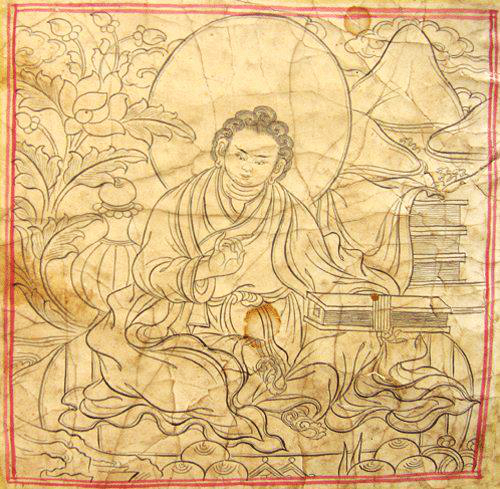
Blockprint of the Lishu Taring

In the Earth Monkey Year of 552 B.C.E, the great yogi and scholar Lishu Taring brings over 10,000 Yungdrung Bön texts from Tazik to Tibet. He accomplishes this by using his magical powers to enlist the help of birds such as vultures and cranes to carry the texts. At that time, he is 1,200 years old. He passes away at the age of 2,500 years. Elsewhere in 551 B.C.E. and the 6th century B.C.E., the Chinese philosopher Confucius is born, Cyrus the Great establishes the Persian Empire and goes on to conquer Babylon, and Shakyamuni attains enlightenment and establishes Buddhism in India.

In the Earth Ox Year of 749 C.E., King Trisong Detsun begins persecution of Yungdrung Bön. Scriptures and images are destroyed. Yungdrung Bön practitioners are given the choice of execution, suicide, exile, or conversion to Buddhism. In order to protect the teachings, scriptures and sacred objects are either hidden or sent to outlying regions. Elsewhere in 749 C.E. and the 8th century C.E., vikings from Scandinavia are raiding the European coasts, and the Maya Civilization begins to decline. Japan is in the midst of the Nara period characterized by the common people following the Shinto religion while the upper classes aspire to emulate Chinese culture and are therefore adhering to Chinese Buddhism.

In the Iron Garuda Year of 913 C.E., three Nepali acharyas who have traveled to Tibet in search of gold find a heavy box in the temple of Samyé and carry it away. Discovering it is not gold and instead filled with Yungdrung Bön texts, they trade the box for food. Eventually, the box finds its way to Bönpo lamas. The box is said to contain 340 different Bön texts. Because these texts were found and distributed in the Northern regions, they became known as the Northern Treasures. This discovery and distribution of texts begins a widespread revival of Bön and rediscovery of texts during a time when Buddhism’s influence was declining. Elsewhere in 913 C.E. and during the 10th century, Byzantine forces capture Crete, vikings settle in northern France, and lions become extinct in Europe.

Mural of Tertön Shenchen Luga at Sikkim Monastery

In the Fire Monkey year of 996 C.E., the renowned tertön Shenchen Luga is born into the Mu Shen lineage of Buddha Tönpa Shenrap. He was prophesied as being an emanation of Tongyung Tüchen. He becomes the main revealer of hidden texts in the Yungdrung Bön tradition. He passes away in 1035 C.E. Elsewhere in 996 and during the early 11th century, the Norse colonize Greenland and Newfoundland, France invades Burgundy, and the Normans conquer England.

In the Fire Monkey year of 1356 C.E., Nyammé Sherap Gyaltsen is born in Gyalrong, Tibet. He became abbot of the famed Yeru Wensaka Monastery and later established Tashi Menri Monastery becoming its first abbot. He united the lineages of sutra, tantra, and dzogchen and is known as the second buddha. (For more information about Nyammé Sherap Gyaltsen, see previous article: https://ravencypresswood.com/2022/03/06/666th-birth-celebration-of-the-second-buddha-h-h-the-1st-menri-trizin-nyamme-sherap-gyaltsen-rinpoche/) Elsewhere in 1356 C.E. and during the 14th century, the Holy Roman Empire establishes an electoral college, and the bubonic plague kills almost a third of the European population.

In the Fire Monkey year of 1776 C.E., the esteemed scholar Sherap Wangyal Rinpoche becomes the 19th abbot of Menri Monastery. Elsewhere in 1776 C.E. and during the 18th century, the United States declares independence from the British Empire, the Russian and Swedish empires are at war, and the mercury thermometer is invented.

In the Iron Horse year of 1810 C.E., the esteemed scholar Sonam Lodro Rinpoche becomes the 22nd abbot of Menri Monastery. He is renowned for his knowledge, realization, and many compositions. He is the root lama of the author of this chronology, His Holiness the 23rd abbot of Menri, Nyima Tenzin Rinpoche. Elsewhere is 1810 C.E. and during the beginning of the 19th century, the Napoleonic wars begin, Mexico gains independence, and Andrew Jackson begins a military campaign against the Creek Nation in the Southeastern United States which leads to the Indian Removal Act and their forced relocation to Oklahoma.

Translations from Tibetan by Raven Cypress Wood ©All Rights Reserved. No content, in part or in whole, is allowed to be used without direct permission from the author.

Don’t want to miss a post? Scroll to the bottom and click “Follow this blog.”

Want to join the mandala of Nine Ways supporters? It’s easy with Paypal, Zelle, or Venmo using Raven’s email address RCW108@gmail.com.

Or follow this link https://ravencypresswood.com/donate/
Update from Raven Cypress Wood: Available and Upcoming Books and Translations

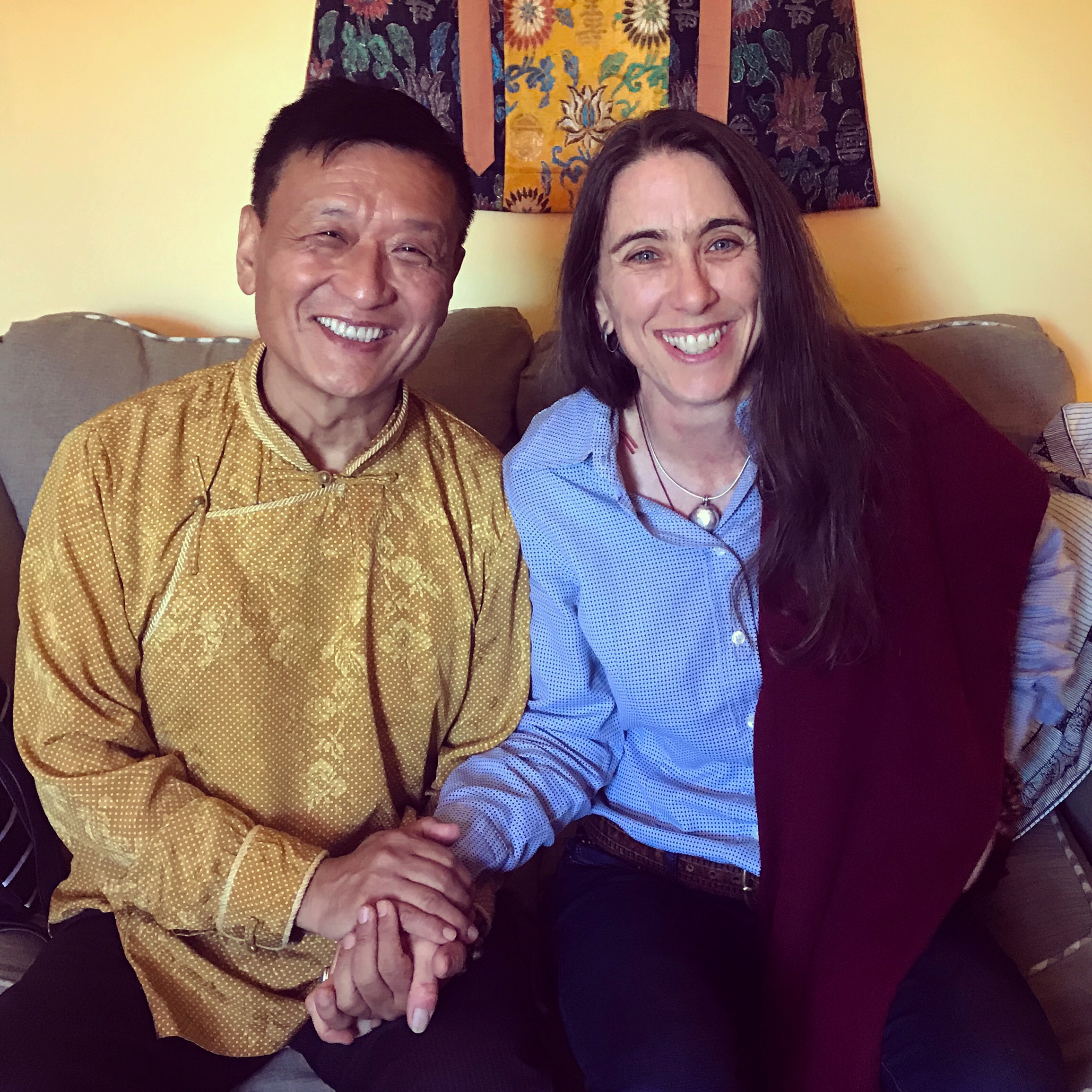
Raven Cypress Wood with Geshe Tenzin Wangyal Rinpoche

Recently, I have heard from many people who are curious about what translations and projects I am working on at the moment. So, I thought that it would be beneficial to post an update for everyone who is interested, especially for the many people who have offered donations of support. First, a few words about what has recently been completed. In November 2021, Sacred Smoke: The Ritual Practice of Fumigation and Offering in the Yungdrung Bön Religious Tradition was published by Sacred Sky Press. This book was close to publishing when Covid-19 arrived. So, it has been especially satisfying to see it become available. It is available both on Amazon and through LuLu. See the Publications page of this website for more information about this and other publications.

Sigyal Drak Ngak

Due to the pandemic, my translation of the healing practice of Sigyal Drak Ngak entitled The Heartdrop of Si Gyal that is All-pervasive and Clears Away Afflictive Emotions and Illness was published and made available for purchase for those with the transmission. This healing practice is especially effective for protecting against contagious illnesses and primarily uses mantric water. This has also been translated into French and is currently being translated into Portuguese. These translations are now being used by lamas and practitioners worldwide. If you have the transmission for this practice and you would like to order a copy of the translation, contact me and I can provide the order link.

I continue to translate prayers and practice texts for both Yungdrung Bön lamas and individuals. For example, His Eminence Menri Pönlop Yangtön Thrinley Nyima Rinpoche will be teaching in Poland soon and I was happily able to provide him with translations for each of his events related to practices of the Medicine Buddha, Mawé Sengé, and the longevity practice of Tséwang Rikdzin.

Mandala of The Precious Lamp

Currently, I am working on two books. First, I am translating select chapters from The Precious Lamp that Shakes the Depths of Cyclic Existence. This is a tantric text associated with the MA TRI mantra of the Yungdrung Bön religious tradition. Some years ago When H.E. Menri Ponlöp Yangton Thrinley Nyima Rinpoche was giving the empowerment for the MA TRI, he suggested to me that it would be of great benefit to translate the chapter from this text entitled, The 32 Benefits of the Recitation Practice of the Precious Lamp. It begins with the story of how Buddha Tönpa Shenrap himself gave the MA TRI teachings and spoke about the special qualities of the mantra.

“For ordinary men and women, when their awareness becomes free from its physical container, if they remember this mantra when the four elements of their body disintegrate, that alone will keep them from falling into the condition of a lower rebirth and they will attain a blissful place of liberation.” 

Extract from The 32 Benefits of the Recitation Practice of the Precious Lamp

This book will contain information regarding the historical source and lineage of the MA TRI mantra, translations for the yidam retreat, the daily practice, the MA TRI longevity practice, and the MA TRI practices for the intermediate state after death, as well as illustrations of each of the syllables and deities. These practices are profound and direct. My goal is to have this book ready for copy editing by the Autumn of 2022.

The Long Gye is a large text covering many of the ritual practices for the deceased.

The second book that I am working on is about the process of dying and death as it relates to the philosophy and ritual practices of the Yungdrung Bön religious tradition. I am writing this for both Yungdrung Bön practitioners and also for ordinary people who want to support a loved one who is a Bön practitioner. It is being written as a support for those who want to prepare for death during life through spiritual practice, for those experiencing the dying process, and for their loved ones. This book began as a pamphlet after a dear sangha sister had passed away. Years later, that pamphlet has grown into many chapters, translations, and many, many hours of research. One of the texts that I am translating for this book is the yogi Lishu Taring’s A Small Lamp that Clarifies the Signs of Death. This text gives detailed information about the signs of death and how to extend the lifespan if possible in order to enable the practitioner to prepare for the final moment of dying.

“I respectfully bow and offer prostrations to the place of great bliss, Kuntu Zang!   

I, Lishu Taring, have written The Lamp that Clarifies the Signs of Death. Regarding that, there are two kinds of death. Untimely death and death from exhaustion of the elements. The examinations in order to know the time of death are of three kinds: (1) the examination regarding the external aggregates, (2) the examination regarding the internal winds, and (3) the examination regarding the secret awareness.”

Extract from A Small Lamp that Clarifies the Signs of Death

I have heard from many people, both religious practitioners and non-religious individuals, who are in need of guidance regarding the process of dying, and how to support both themselves and others. In this book, I plan to offer information regarding the physical, mental, and spiritual process of dying and death together with the associated translations of the prayers and ritual practices that can be performed by the dying person and their loved ones.

It is my hope that both of these books will be of far-reaching benefit. In order to be sure that the translations are as clear and accurate as possible, much time is spent in research, cross-referencing, and talking with scholar monks who are familiar with the material. After the initial translation, time is spent in editing and annotation in order to make the material both true to the original texts while also making it as clear as possible for an English-speaking audience. Then, there is the formatting and copy editing of the written material. So, this work takes a large commitment of time. Because this work is not funded by grants or trusts, I am able to continue devoting time to this work, including the continuation of the website, because of the continued kind generosity of donors. Therefore, from the depths of my heart, I would like to thank all of you for your continued support and interest in Nine Ways. I am committed to continuing this work for as long as possible. we are all so fortunate to have encountered these authenticate teachings of wisdom during this lifetime. may we all have abundant health, joy, and prosperity! And ultimately, may we all attain the fruit of our practices!

Raven Cypress Wood

Don’t want to miss a post? Scroll to the bottom and click “Follow this blog.”

Want to join the mandala of Nine Ways supporters? Follow this link https://ravencypresswood.com/donate/ It’s easy through Paypal and Zelle.

Protection from the Queen of Existence

Monks at Menri Monastery dressed as the Six Manifestations of Sipé Gyalmo.

In the Yungdrung Bön tradition, the Queen of Existence Sipé Gyalmo is one of the primary protectors of the religious doctrine and its followers. She is an enlightened being who manifests in countless ways. In her Dzogku form, she manifests with a dark blue body, in a fierce stance with three faces, one hundred heads of various animals, thousands of arms holding weapons and other wrathful objects, hundreds of legs, and surrounded by unimaginable blazing flames.

Her body emanations are the six goddesses who watch over existence throughout the day and night. These manifestations are (1) the white goddess who watches over existence during dawn, (2) the golden goddess that watches during sunrise, (3) the red goddess that watches during midday, (4) the maroon goddess that watches during sunset, (5) the black goddess that watches during evening, and (6) the dark blue goddess that watches over existence during midnight.

“Especially, manifesting from the essence of space, the state of the unmoving nature of mind of Küntu Zangmo,

for the purpose of protecting the enlightened teachings of the Yungdrung Bön is the lord of the boundary between past and future, the Queen of Existence Sipé Gyalmo.

You are Dédro Sangwé Yum, the secret Mother who guides beings to bliss.

Your Body emanations are the wrathful goddesses of the six times.

Your Speech emanations are the four queens who rule over the four seasons.

Your Mind emanations are the female demons who are the nyen queens of existence.”

Excerpt from The Complete Accomplishment of Golden Libations for the Assembly of Bön Guardians and Protectors within Sacred Smoke: The Ritual Practice of Fumigation and Offering in the Yungdrung Bön Religious Tradition by Raven Cypress Wood

Her tülku manifestations appear with a dark blue body with three faces, six arms and riding either a black mule or a red mule. She can manifest in whatever way is necessary to give her protection and support.

Beginning on May 11, 2022 and continuing for one week, Menri Monastery in India will perform the extensive ritual of One Hundred Thousand Offerings to the Queen of Existence, Sipé Gyalmo. (See previous post for details: https://ravencypresswood.com/2022/04/23/100000-offerings-for-the-queen-of-existence/ ) During this ritual, Sipé Gyalmo is requested to bestow her blessings of protection and to support the development of the spiritual practice of Bön disciples. There is still time to donate towards this profound and meaningful activity.

To make a donation towards the ritual for Sipé Gyalmo, follow this link: http://kwling.org/bon/bum-tsok-offering/ This is the North American center for His Eminence Menri Lopon Yangton Trinley Nyima Rinpoche. The full amount of every donation will be sent to Menri Monastery and designated for the ritual. This donation can be dedicated for those that are ill, in danger, have recently passed away, or for yourself. If you are unable to donate monetarily, by rejoicing in the donations of others and the performance of the ritual, you also receive merit. One can also participate by engaging in Sipé Gyalmo practice, mantra recitation, engaging in virtue and avoiding acts of non-virtue during the week-long ritual.

Sipé Gyalmo riding a red mule as depicted within a Yungdrung Bön text

“EMAHO!

Mother of the vast expanse of the Bönku, which is primordially pure and free from elaboration,

in order to establish the Bön teachings in the Land of Snow, 

merely by calling out to you Single Mother Sipé Gyalmo, wherever you are, 

please come!”

Excerpt from The Alphabetical Praise of the Supreme Mother Sipé Gyalmo within Sacred Smoke: The Ritual Practice of Fumigation and Offering in the Yungdrung Bön Religious Tradition by Raven Cypress Wood

Raven Cypress Wood ©All Rights Reserved. No content, in part or in whole, is allowed to be used without direct permission from the author.

Don’t want to miss a post? Scroll to the bottom and click “Follow this blog.”

Want to join the mandala of Nine Ways supporters? Follow this link https://ravencypresswood.com/donate/ It’s easy through Paypal and Zelle.

What is Lungta?

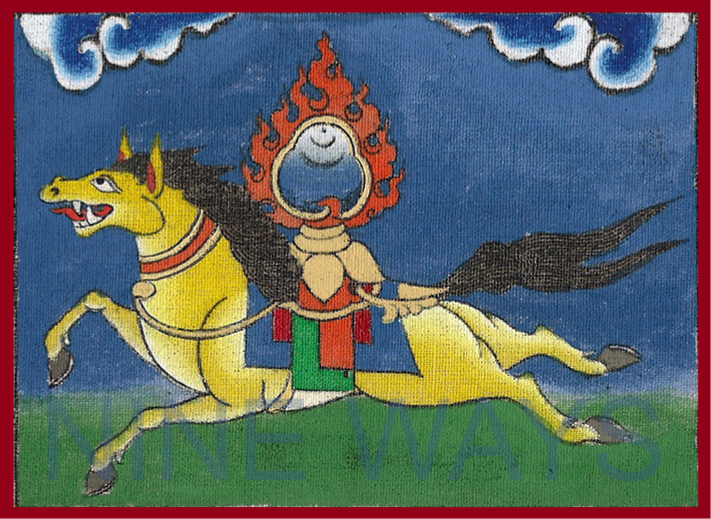
Image of a windhorse as painted on a prayer flag thangka. Photo credit: Raven Cypress Wood

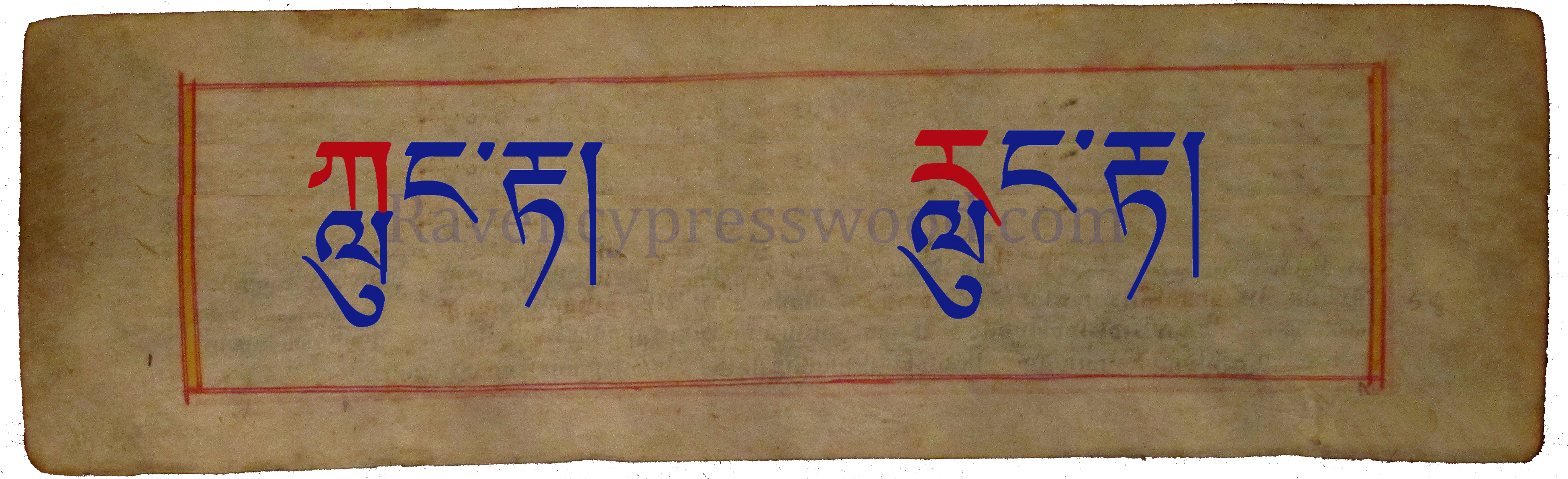
“Lungta” is a compound of two words: “lung” and “ta.” To have a deeper understanding of lungta, it is necessary to look at its two variant spellings. Both words are pronounced exactly the same, but the different spellings have different meanings. The written form “lungta” is a standard phonetic rendering of the Tibetan. To illustrate the different Tibetan spellings for those unfamiliar with the Tibetan syllabary, the standard Wylie transliteration method of Romanizing the Tibetan language can be used. The spelling difference applies to the first syllable of the first word. Transliterated from the Tibetan, the original spelling is klung rta and begins with the syllable “ka.” The modern, changed spelling is rlung rta and begins with the syllable “ra.” Although these syllables are silent and do not change the pronunciation, they do influence the meaning of the word.

The modern spelling is rlung rta. By itself, the word “rlung” means “wind.” This refers to wind from its most subtle form of energy to the most gross manifestation as an external element. “Ta,” the main syllable of the second word transliterates as “rta,” and means “horse.” This spelling is the same for both words. “Horse” in this context refers to the supreme horse which is endowed with extraordinary qualities somewhat similar to the mythic horse Pegasus. Because the horse was the mode of traveling with the greatest speed in ancient times, it symbolizes the swift reversal of bad fortune to good fortune, illness to health, poverty to prosperity, ignorance to wisdom, and so on. Therefore, the compound “rlung rta” literally translates to “windhorse.” The symbol of this, also known as a windhorse, can be seen in the center of many prayer flags carrying a flaming, wish-fulfilling jewel. In modern Tibetan astrological texts, all references to lungta are spelled with “ra” as the first syllable.

Left: klung rta with the syllable “ka” in red. Right: rlung rta with the syllable “ra” in red.

In many Bön texts, especially the ancient texts, lungta is spelled with the syllable “ka” as “klung” which can be translated as “fortune,” and sometimes as “river.” Some Tibetan dictionaries list one of the meanings of “klung” as “the element of space.” For the Bönpo, every Tibetan syllable is associated with a specific elemental characteristic, and the syllable “ka” arises from the element of space. The syllable “ra” arises from the element of fire. More specifically, the syllable “ka” is related to the vast, pervasive quality of space. This understanding points to the function of the force of lungta [klung rta]. It is a pervasive, protective force. As one of the five natal energies, it acts to support the other four natal energies of health, personal power or wangtang, vitality, and soul to have a quality of pervasiveness and to support them from diminishing. The compound “klung rta” refers to an individual’s force of good fortune and field of protection. If an individual’s lungta is strong, it enlivens the other four natal energies and naturally protects from negativity. Lungta has the ability to pervade everywhere like the sun. And like the sun, it can be experienced as being diminished or blocked due to external circumstances.

In this way, an individual’s lungta can be experienced as being weaker or stronger, increasing or diminishing. For example, each year is astrologically associated with one of the five elements. Inevitably, some years will be in a conflicting relationship with an individual’s natal lungta element. The year 2022 is ruled by the element of water. For individuals whose lungta is ruled by the element of fire, the element of water is in an enemy relationship with the element of fire that governs their lungta. When this occurs, lungta can be experienced as becoming weaker or blocked and result in chronic bad luck, obstacles to success, disharmony in relationships, and so on. Within the Yungdrung Bön, there are many methods to remove what is blocking the flow of lungta and thereby restore and strengthen it. One of the easiest and most common methods is the raising of prayer flags. Particularly, raising prayer flags of the same color as the element associated with an individual’s lungta. The element/color associations of the five elements are: earth=yellow, water=blue, fire=red, wind/wood=green, and space/metal=white. Additional practices that are effective methods to increase lungta include practices that strengthen the element associated with the lungta, rituals such as the fumigation and offering of smoke, performing acts of virtue and devotion such as circumambulating chortens or making satsa, reciting mantra and/or prayers, and practicing with the internal winds are all effective methods to increase lungta. The specific method used depends upon the knowledge, circumstance, and capacity of the individual. When the force of the lungta is strong there is a feeling of ease and flow to life. There are auspicious circumstances, success, good fortune, harmony, and a general feeling of well-being and support. Any task that is undertaken is successful and supportive circumstances naturally occur.

For more information about raising prayer flags, see previous article: https://ravencypresswood.com/2020/02/15/the-immeasurable-benefit-of-raising-prayer-flags/ For more information about the ritual of fumigation and offering of smoke, see: https://ravencypresswood.com/2021/11/19/new-book-release-sacred-smoke-the-ritual-practice-of-fumigation-and-offering-in-the-yungdrung-bon-religious-tradition/

“May my life force and vitality increase! May the strength of my body increase! May my personal power increase! May my lungta be well developed! May my soul and prosperity increase! May all lungta, soul, and prosperity that have decreased become well developed! May external, internal, and secret obstacles be cleared! May these wishes bring the accomplishment of all goals and intentions!”  

-Prayers on a Yungdrung Bön lungta prayer flag

Tibetan translation by Raven Cypress Wood ©All Rights Reserved. No content, in part or in whole, is allowed to be used without direct permission from the author.

Did you enjoy this content? This article is made possible by generous donors who want content like this to continue to be available. Don’t want to miss a post? Scroll to the bottom and click “Follow this blog.”

Join the mandala of Nine Ways supporters by donating through one of the services listed below.

Creating A Foundation for Spiritual Development: The Eight Freedoms that are Difficult to Obtain

Statue of Shardza Tashi Gyaltsen Rinpoche in Amdo, Tibet

In order to have a stable foundation upon which to further develop spiritual practice, it is necessary to begin with the sincere practice of the preliminary practices. Among the external preliminary practices is the single-pointed reflection upon the Eight Freedoms and the Ten Fortunes that are difficult to obtain. In his An Ocean of Instructions for the Preliminary Practices of the A Tri, Shardza Tashi Gyaltsen Rinpoche explains the eight freedoms in his section on the external preliminary practices. Without these conditions of freedom, it is not possible to practice the Bön teachings. By deeply reflecting upon the truth of each of these freedoms, the practitioner realizes the importance of not wasting the opportunity to practice.

The Eight Freedoms that are Difficult to Obtain:

  1. Freedom from Being Born a Hell-being

The cause of being born as a hell being is the negative karma of hatred and anger. The result is having to undergo the suffering and misery of heat and cold. The torment of heat and cold for the hell-beings is continuously unbearable and there is no freedom to act on the intention to practice Bön. 

2. Freedom from Being Born a Hungry Ghost

The cause of being born as a hungry ghost is the negative karma of desire and greed. The result is having to undergo the suffering and misery of hunger and thirst. The torment of hunger and thirst for the hungry ghosts is never-ending and there is no freedom to ever act on the intention to practice Bön.

3. Freedom from Being Born as an Animal or Beast of Burden

The cause of being born as an animal or a beast of burden is the negative karma of mental dullness. The result is having to undergo the suffering and misery of being stupid, mute, and being exploited for work.

From Shardza Rinpoche,

“When born as an animal, there is no opportunity to practice even a little bit of virtue. Even among the highest of the animals in the human world, such as horses and mules etc., even if you explain to them from a hundred different texts, apart from a little benefit from hearing, there isn’t the opportunity to understand even a single word. If they could recite the MA TRI a single time, they could have the opportunity to become enlightened. Because of having to experience the suffering and misery of stupidity and muteness, and never having an opportunity for any recitation, there is no freedom to ever act on the intention to practice Bön.”

From The Sutra of True Sincerity,

“Because there is no opportunity for study or listening during the time of having the body of a hell-being, hungry ghost, or animal along with their suffering and misery, there is no understanding. Because there is no understanding, there is no accomplishment. If there is no accomplishment, how can they attain enlightenment?” 

Woodblocks of Shardza Rinpoche’s compositions

4. Freedom from Being Born as a Long-lived God

Again from Shardza Rinpoche,

“Being a so-called “long-lived god” is one part of the result of the gods that are in a state of sustained concentration. However, there is no concept of good or bad. From the time that they are born, except for the moment of their death, conceptual thought has stopped. They remain for many great eons until this karma has been exhausted and they are reborn in the lower realms.  Because there isn’t any teaching, listening, or meditation practice regarding Bön, there is no opportunity to progress towards enlightenment.

5. Freedom from Being Born as a Savage or in a Remote Place

“When one is born as a savage, such as those who believe that killing is a good activity, they will never experience even the mere sound of the word “Bön.” When killing, they experience intense negative emotions. Afterward, they see the act of killing human beings and taking life as good. They inherit this negative activity from their parents and all of this becomes a non-virtuous way of life. Because of that, there is no freedom to practice Bön. When one is born in a remote or outlying area where the teachings of Tönpa Shenrap have not spread, there is no opportunity to practice Bön.” 

6. Freedom from Being Born without the Five Senses or with Profound Mental Impairment

“If someone is born mute, even though they encounter the Buddha’s teachings, they are unable to perform mantra recitations. A blind person cannot see the images and objects of enlightenment that support faith and devotion. The deaf cannot hear the sound of Bön speech. Those with profound mental impairments can’t understand what to cultivate and what to abandon. Therefore, there is no freedom to practice Bön.”

7. Freedom from Having Wrong Views

When someone has mistaken concepts that are incompatible with Bön, such as having the view that actions have no result or believing that the teachings of enlightenment are not valid etc., this contaminates the mind-stream. Having contaminated the mind-stream, they are unable to generate devotion towards the completely pure teachings of Buddha Tönpa Shenrap. Therefore there is no freedom to practice Bön.

8. Freedom from Being Born During a Time When a Buddha has not Appeared

For those who will be born during a dark era devoid of the presence of a buddha, there will be no freedom to practice Bön. 

Reflecting again and again upon these freedoms brings the recognition of being in possession of a precious opportunity. By deeply appreciating the positive circumstances that support the opportunity to practice Bön, a lasting foundation for spiritual development and motivation is established.

Tibetan translation by Raven Cypress Wood ©All Rights Reserved. No content, in part or in whole, is allowed to be used without direct permission from the author.

Don’t want to miss a post? Scroll to the bottom and click “Follow this blog.”

Want to join the mandala of Nine Ways supporters? Follow this link https://ravencypresswood.com/donate/