Category Archives: Translation

Ripening the Mind-stream with the Practice of Realizing Impermanence

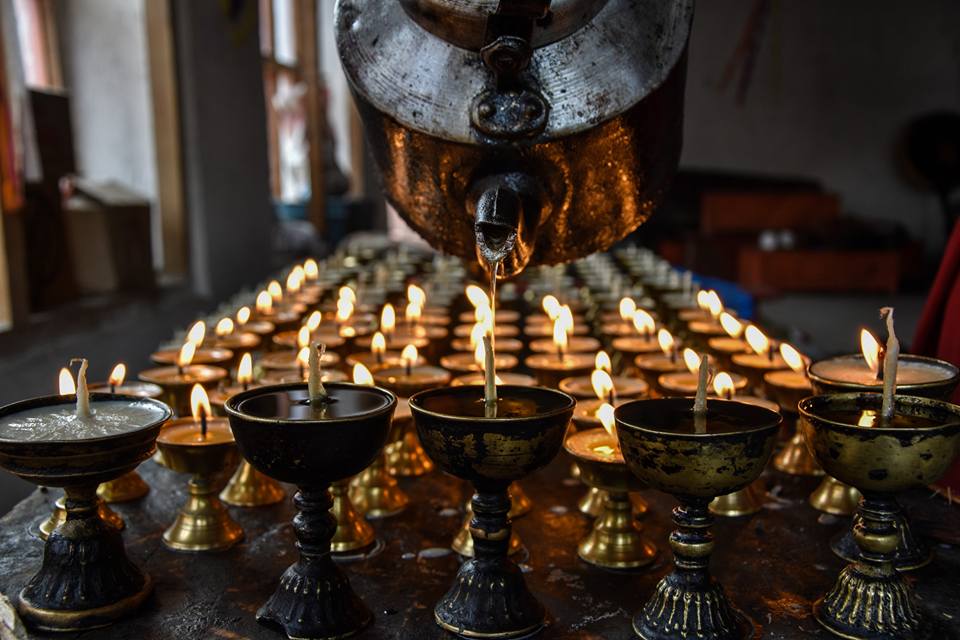
A traditional offering of butter lamps for the deceased. Photo credit: Unknown

In the Yungdrung Bön religious tradition, the practice of realizing impermanence is used as a method to ripen the mind-stream of an individual in order to prepare a solid foundation for further spiritual development. By reflecting upon the truth of the impermanent nature of all worldly phenomena, the wild mind that craves entertainment and distraction, and constantly seeks things to acquire or posses, is tamed. When the truth of impermanence is deeply realized rather than merely understood intellectually, the mind has a more open and relaxed relationship with worldly phenomena. Positive experiences such as love and joy are more appreciated since they are understood to be fleeting. Patience with discomfort and suffering is easier knowing that it too will not last. For the spiritual practitioner, the realization of the truth of impermanence turns the mind away from meaningless distraction and towards the spiritual path.

Traditionally, in order to deeply realize impermanence, the practitioner would reflect upon worldly phenomena. For example, thinking about how each season has come and gone since childhood, or the constant changing of the weather. Often the practitioner would go to the cremation ground or cemetery and reflect upon the fact that no matter how powerful, rich, famous, or adored a human being has ever been, no one has been able to live forever. In modern times, the truth of impermanence can be seen throughout the world.

As a support for the practice of realizing impermanence, the English translation of The Chanted Verse of Impermanence from the Aural Transmission of Zhang Zhung is being made publicly available for personal use. While undergoing the practice of realizing impermanence as a foundational practice, this prayer is chanted before and/or after a fervent period of reflection. Once impermanence has been realized and the mind has been tamed, this prayer can be chanted daily as a reminder and motivation to remain focused upon meaningful activities of body, speech and mind. The translation can be downloaded from this link: https://drive.google.com/file/d/146WL9uyT8u842TVHKnmXJH60CHr5dHJz/view?usp=sharing

“Even though all phenomena change, I alone expect to be permanent.

How sad!

Bless me that the realization of impermanence will arise in my mind-stream!

When thinking of death, I am instantly without distraction, but then I become lazy and procrastinate.

How sad!

Bless me that the realization of impermanence will arise in my mind-stream!”

—From The Chanted Verse of Impermanence

All translations and content by Raven Cypress Wood ©All Rights Reserved. No content, in part or in whole, is allowed to be used without direct permission from the author.

Don’t want to miss a post? Scroll to the bottom and click “Follow this blog.”
Practicing Generosity and Non-attachment

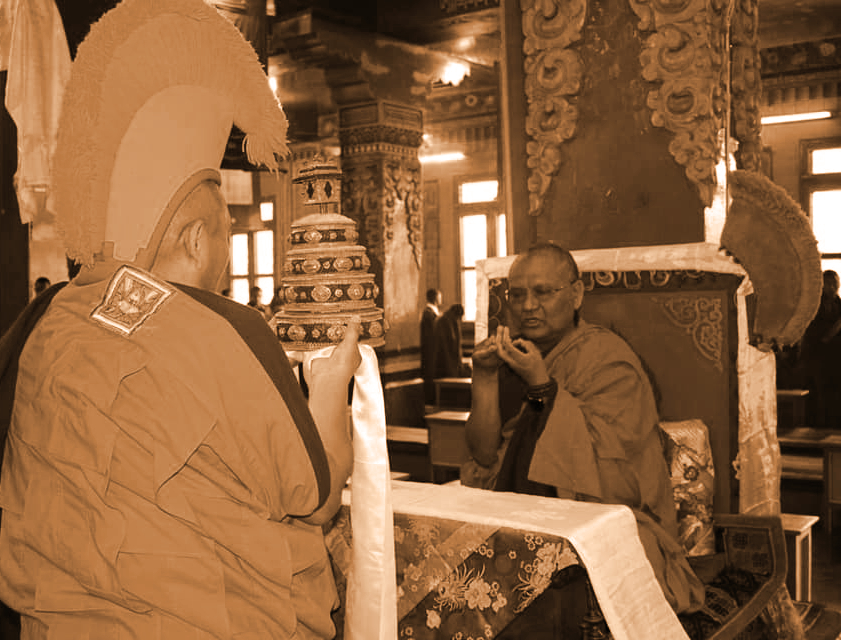
His Eminence Menri Ponlop Yangtön Thrinley Nyima Rinpoche being offered a mandala representing all inner and outer offerings. Photo credit: Unknown

“Mandala Offering

Emaho!

Within a golden mandala of a boundless buddha realm are arranged heaps of beautiful and brightly shining precious jewels.

These vast clouds of offerings, both real and imagined, that include the completely fulfilling and marvelous wealth and riches of both gods and humans,

I and all other sentient beings present this offering to the three precious jewels in order to perfect the two accumulations of merit and wisdom.

Please accept this with your compassionate blessings!”

— From The Accomplishment of Purifying Defilements with DU TRI SU, A Lamp that Clears Away the Darkness and Shakes the Depths of Cyclic Existence

All translations and content by Raven Cypress Wood ©All Rights Reserved.

No content, in part or in whole, is allowed to be used without direct permission from the author.

Don’t want to miss a post? Scroll to the bottom and click “Follow this blog.”
Dispelling the Darkness


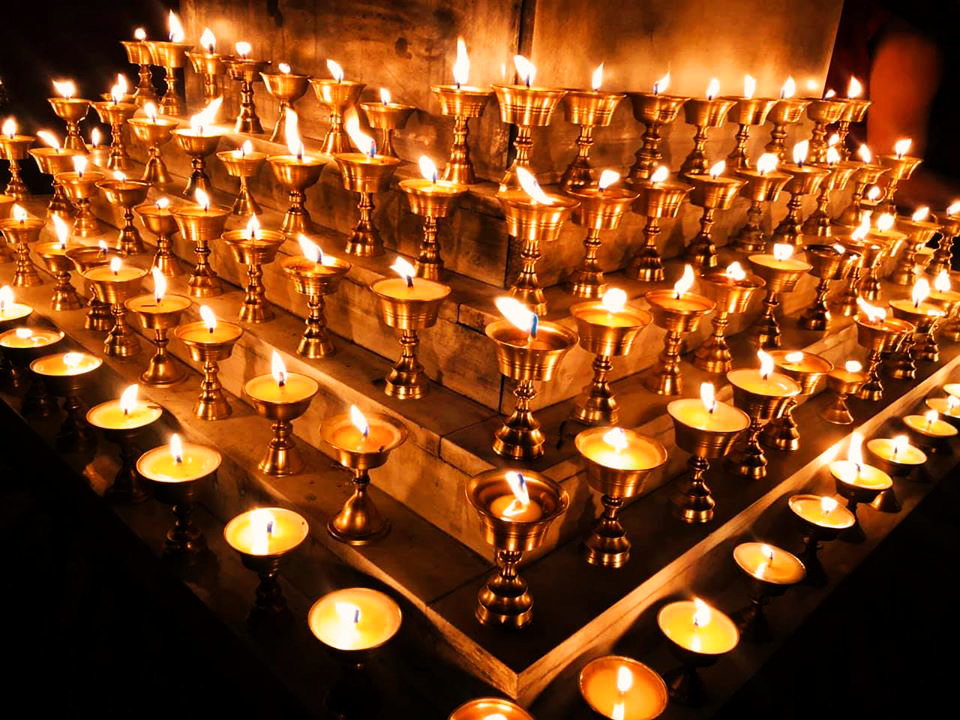
Butter lamp offering at Menri Monastery. Photo credit: Unknown

“How wonderful!

Within these small, circular containers is placed a wick of twisted gauze.

They are filled with clarified melted butter which is a divine, concentrated essence.

By lighting these bright offering lamps, the fire of the lamps clears away darkness and obscurations, and radiates throughout the vast, clear space of the sky.

Performing these activities mainly for our kind mothers and fathers who are the sentient beings within the three realms of cyclic existence,

and with compassion for those who have passed away into the realm between this life and the next,

may all of them be liberated from cyclic existence!”

— Extract from Raising a Victory Banner of Butter Lamps

Tibetan translation by Raven Cypress Wood ©All Rights Reserved. No content, in part or in whole, is allowed to be used without direct permission from the author.

Don’t want to miss a post? Scroll to the bottom and click “Follow this blog.”

A Wheel of Sound

Dra Khor at the entrance to the temple of Triten Norbutsé Monastery near Kathmandu, Nepal. Photo credit: Raven Cypress Wood

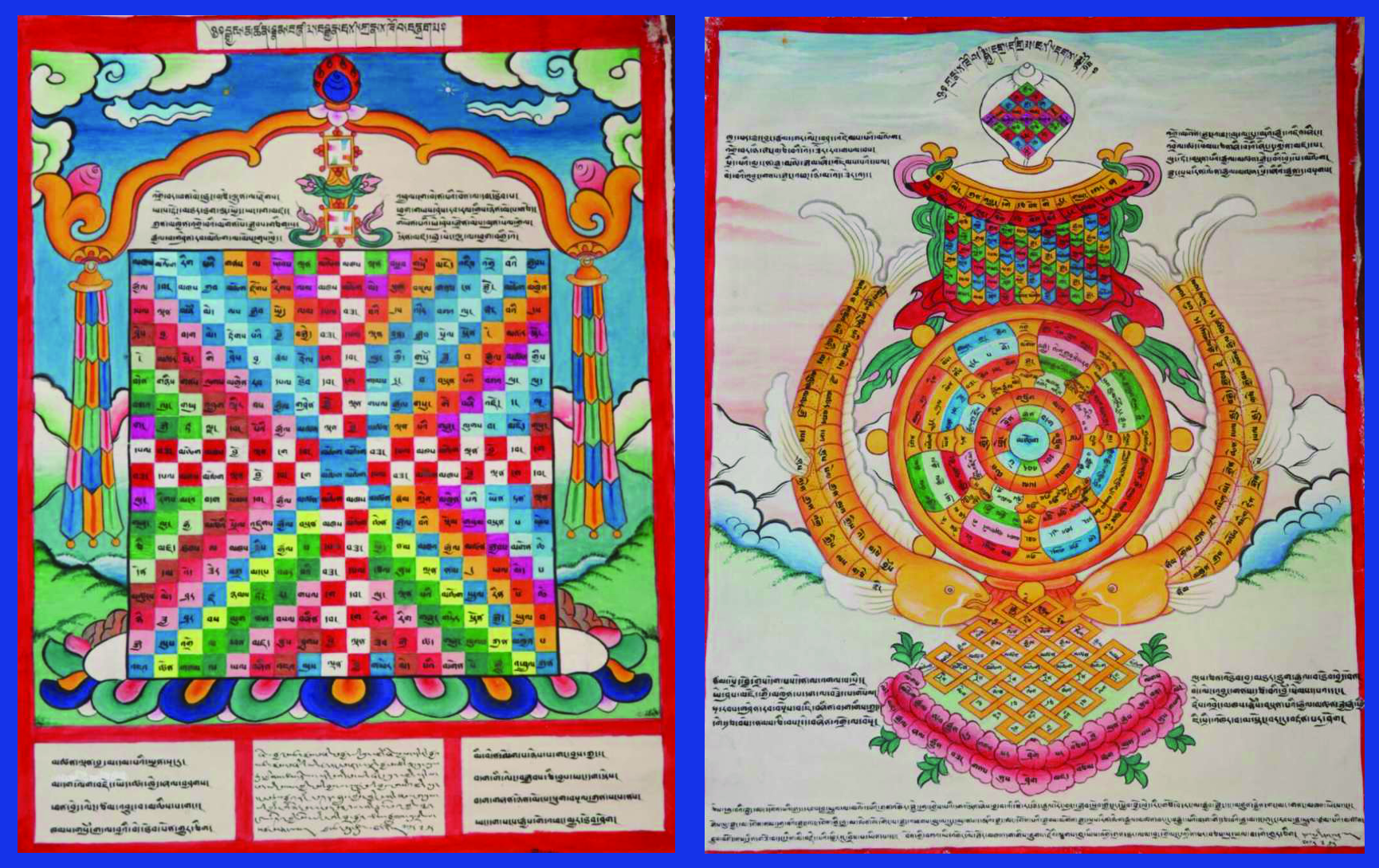
Within the Yungdrung Bön religious tradition there is a style of poetry that is considered an advanced art and is often used to praise spiritual masters or states of realization. The poetic verse is written in a kind of graph in which each syllable is written within its own geometric space often in contrasting colors that form patterns or images. These syllables then intersect with other lines of poetry or verse. The arrangement of syllables must be made in such a way that they must make sense with each intersecting syllable.

There are easier and more difficult versions of this poetic style. The easier style can be read left to right and top to bottom. The more difficult styles can be read left to right, top to bottom, diagonally, and from bottom to top. This style of poetry is called Künzang Khorlo་or the short form Kün Khor, Wheel of All Goodness. However, it is also often referred to simply as dra khor, a wheel of sound.

Examples of dra khor styles created by graduates of the Gyalrong Dialectic School. Originally published at: https://www.himalayabon.com/news/2018-04-16/1250.html

The top image of a dra khor in this article hangs in the entrance way of Triten Norbutsé Monastery located near Kathmandu, Nepal. This dra khor praises the founder of Menri Monastery and the realized master who is considered the second buddha, His Holiness Nyammé Sherap Gyaltsen Rinpoché. The well-known “De Chen Gyalpo” prayer in his honor is featured within the yellow, diagonal squares.

“De chen gyal po kün zang gyal wa du,

mi jé zung den sherap ma wé seng,

dzam ling bön gyi tsuk gyen nyam mé pa,

shé rap gyal tsen zhap la sol wa deb.


King of great bliss, embodiment of Küntu Zangpo and Gyalwa Düpa,

You are like the wisdom deity Mawé Sengé,

Never forgetting what you have perceived,

You are the unequaled crown ornament of the Bönpo world.

At the feet of Sherap Gyaltsen, I pray!”

The first line begins with the syllable “de” inside the yellow square located in the top left corner and reads diagonally downward to the center. Moving the Bön way, counter-clockwise, the second line begins with the syllable “mi” inside the yellow square in the bottom left corner and reads diagonally upward to the center. The third line begins with the syllable “dzam” inside the yellow square in the bottom right corner and reads diagonally upward to the center. The fourth and final line begins with the syllable “shé” inside the yellow square in the top right corner and reads diagonally downward to the center.

When the top line is read straight across, the first syllable “de” in the top left corner now becomes part of the word “dewar” “blissfully” and the line praises the realization of Nyammé Sherap Gyaltsen Rinpoché.

“You are the very essence of the three bodies of those who have blissfully gone; with unobscured, exalted knowledge, you embody the entirety of Bön.”

Examples of dra khor styles created by graduates of the Gyalrong Dialectic School. Originally published at: https://www.himalayabon.com/news/2018-04-16/1250.html

To begin a dra khor, the number of boxes needed is determined by the number of syllables in the poem. Once a design is determined and the boxes are drawn, a single syllable is drawn inside each box. Each dra khor can contain either a single poem or multiple poems or verse relating to a single subject or theme. These dra khor are often placed in the entrances of temples as they are considered to be objects of auspiciousness and blessing.

Examples of dra khor from the collected works of Mawang Kunga Rangdrol Rinpoche.

Beginning with the first establishment of a Yungdrung Bön dialectic school in exile in 1978 at Tashi Menri Ling, His Eminence Yongdzin Tenzin Namdak Rinpoché reformed the curriculum to include subjects originally taught in the renowned dialectic school of Yeru Wensaka and to also include subjects that were previously taught individually rather than as an organized part of the studies. In this way, he aimed to preserve traditional knowledge that was in danger of being lost. One of the subjects added to the mandatory curriculum was poetry. The current dialectic school teaches poetry according to three aspects: 1) style and meaning, 2) rhyming and meter and 3) symbolic meaning.

The complete Dra Khor inside the temple of Triten Norbutsé Monastery near Kathmandu, Nepal. Photo credit: Raven Cypress Wood

All translations and content by Raven Cypress Wood ©All Rights Reserved. No content, in part or in whole, is allowed to be used without direct permission from the author.

Don’t want to miss a post? Scroll to the bottom and click “Follow this blog.”
Protecting and Blessing the Mind with The Great Mantra

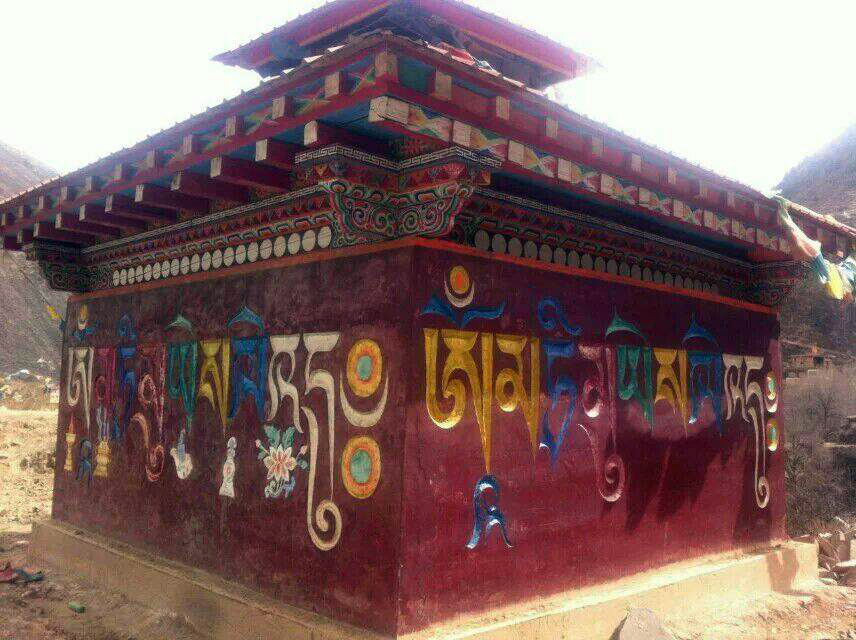
The MA TRI mantra at Gonggyal Monastery in Nya Rong, Tibet. Photo credit: Unknown

OM MA TRI MU YÉ SA LÉ DU

Within the Yungdrung Bön religious tradition the eight-syllable mantra OM MA TRI MU YÉ SA LÉ DU is known as the great mantra and is commonly referred to as the MA TRI mantra. It is the Essence Mantra of the Dzok ku, the enlightened state that embodies all perfected positive qualities and wisdoms. The sound and power of this essence mantra gives rise to the enlightened qualities and blessings of Buddha Tönpa Shenrap Miwoché and Buddha Sherap Jamma as well as the six buddhas who offer guidance to liberation for the the six kinds of sentient beings within cyclic existence: hell beings, hungry ghosts, animals, humans, demi-gods, and gods.  Each year around the time of the Tibetan New year in Dolpo, Nepal, this mantra is recited continuously without any interruption for 15 days. It is one of the three essence mantras of the Yungdrung Bön tradition that is recited a minimum of 100,000 times as a preliminary practice in order to prepare the student’s mind for further spiritual practice. The benefits of reciting this mantra are vast and beyond the imagination.

OM MA TRI MU YÉ SA LÉ DU

Alas! Fortunate Ones Listen!

The long flowing river of birth is the first.

The thunderous waterway of aging is the second.

The raging whirlpool of illness is the third.

Death that has no escape is the fourth.

These four are the demon rivers from which there is no escape.

Noble ones who wish to cross over those rivers, proclaim the melody of the MA TRI MU YÉ!


OM MA TRI MU YÉ SA LÉ DU

Alas! Fortunate Ones Listen!

The excellent means of accomplishment is the first.

Discovering the stairway to higher states is the second.

The blissful stairway of gods and humans is the third.

Traveling upon the stairway of joyful effort is the fourth.

These four are the four stairways to travel for the path of liberation.

Noble Ones who wish to ascend those stairways, proclaim the melody of the MA TRI MU YÉ!”

— Excerpt from Inspirational Verses Regarding the MA TRI written by the 13th century Tulku Loden Nyingpo.

The MA TRI mantra above a doorway. Photo credit: unknown

“This mantra is the heart elixir of the princpal teachings. It is a sacred connection for sentient beings during a dark time.  It is a key to the collection of sacred teachings  It is a lamp that clears away the darkness of ignorance.  So that sentient beings during the 500 years-long time of darkness will not have to exert themselves in meditation and accomplishment, this mantra recitation is the practice advice.

This recitation practice of the MA TRI is a precious lamp. Whoever goes before an esteemed lama or sacred support such as a shrine, chorten, or sacred statue, if they recite the mantra while performing prostrations and circumambulation and making prayers of aspiration, whatever they wish for will be quickly accomplished.”

— Extract from 32 Benefits of the Recitation Practice of the Precious Lamp

Tibetan translation by Raven Cypress Wood ©All Rights Reserved. No content, in part or in whole, is allowed to be used without direct permission from the author.

Don’t want to miss a post? Scroll to the bottom and click “Follow this blog.”