Category Archives: Tonpa Shenrap

Annual Retreat of the Peaceful & Wrathful Walsé Ngampa

The Yidam Walsé Ngampa and the Great Mother Ngammo Yumchen Tröpe Taktenma

Each year on the 23rd-29th lunar days of the 2nd lunar month, Menri Monastery performs a week-long retreat of the yidam Walsé Ngampa. In 2023, these dates correspond to April 13th-19th on the Western calendar. The retreat includes recitation of the complete yidam text along with accumulation of the mantra, one hundred feast offerings to the yidam and his retinue, as well as a ritual of protection to turn away malevolent forces as well as the causes for illness, accidents, conflicts, and other types of harm and danger.

The yidam Walsé Ngampa is one of the Five Supreme Embodiments, or literally the Five Supreme Citadels of the Father Tantra that are manifestations of the enlightened body, speech, mind, quality, and activity of Buddha Tönpa Shenrap Miwoché. Walsé Ngampa is the embodiment of Enlightened Body. He is dark blue with nine heads and eighteen arms with which he holds various weapons for subduing obstacles. He is the manifested form of the wisdom of emptiness. His consort has the nature of Buddha Satrik Érsang and is known as Ngammo Yumchen Tröpé Taktenma with a body color that is dark green with blue hair and eyebrows. In her right hand, she holds an amulet containing the earth and sky. In her left hand, she holds a vase of nectar. And she wears a necklace of the planets and stars.

The main ritual text for this deity is entitled, Stages of Practice for Walsé which was composed by the great sage Drenpa Namkha and rediscovered as a terma by Matön Drol Dzin in 1091 from a rock in Dangra Khyung-dzong. Reciting this text and performing the associated rituals has a profound benefit of blessing and protection. Menri Monastery will be performing this sacred activity or the benefit and welfare of all beings in support of their happiness and development of wisdom.

Raven Cypress Wood ©All Rights Reserved. No content, in part or in whole, is allowed to be used without direct permission from the author.

Don’t want to miss a post? Scroll to the bottom and click “Follow this blog.”

Want to join the mandala of Nine Ways supporters? Follow this link https://ravencypresswood.com/donate/ It’s easy through Paypal and Zelle.

Protecting the Mind with Mantra

The benefits of reciting mantra [Tibetan: nyén pa] are vast and without measure. Although there are thousands of mantra within the Yungdrung Bön tradition, there is one mantra known as The Great Mantra. It is commonly referred to as the MA TRI mantra. This mantra has eight syllables: OM MA TRI MU YÉ SA LÉ DU. In general, the power of a mantra is in the sound and vibration of each syllable. They are like a vibrational seed of energy that gives birth to a specific energy and power. For this mantra, the first two syllables are the seed syllables of a male and female buddha. The remaining six syllables are the sound of the six buddhas that guide sentient beings out of suffering and misery caused by the five poisons of anger, attachment, jealousy, pride, and ignorance.

From Thirty-three Benefits of the MA TRI Mantra:

“This is the heart mantra of all the buddhas. It is of benefit for sentient beings at the end of the eon when their lifespan has become shorter and there is less morality.”

And,

“The recitation of this mantra is enough. It is the fundamental essence of the entire collection of sacred teachings. It is the ultimate of all recitations. It is the innermost essence of all meditations. It is a sacred connection for sentient beings during a dark time.”

— Words from the mouth of Buddha Tönpa Shenrap Miwoché

The great mantra has many profound benefits and meanings. However, it is not necessary to be familiar with the thousands of pages of teachings and commentary devoted to the MA TRI mantra. In order to receive benefit from the mantra, it is enough to recite it with openness and trust. A mantra can be recited anytime, anywhere, out loud or silently if necessary. Especially when the mind is disturbed by inner or outer circumstances, focusing on the recitation of mantra has the immediate effect of protecting the mind from negativity and increasing a positive and beneficial state of mind.

“OM MA TRI MU YÉ SA LÉ DU

Alas! Fortunate Ones Listen!

Right here and now, because of our ignorance and delusion we have not attained mastery of the experience of awareness, and we wander throughout cyclic existence. We take on the magical illusion of solid flesh and undergo many kinds of suffering and misery.

There is no final escape. How sad!

Noble Ones who wish to travel the path of liberation in order to escape from that suffering and misery and arrive at a place of bliss, proclaim the melody of the MA TRI MU YÉ!”

And,

“OM MA TRI MU YÉ SA LÉ DU

Alas! Fortunate Ones Listen!

The many troops of mental dullness are the first.

The mighty coat of armor of pride is the second.

The trained army of envy is the third.

The sharp weapons of anger and hatred are the fourth.

These are the four frightening enemies that come from behind.

Noble Ones who wish to be delivered from those enemies, proclaim the melody of the MA TRI MU YÉ!”

— From Inspirational Verses Regarding the MA TRI written by the tertön Tülku Loden Nyingpo

All translations and content by Raven Cypress Wood ©All Rights Reserved. No content, in part or in whole, is allowed to be used without direct permission from the author.

Don’t want to miss a post? Scroll to the bottom and click “Follow this blog.”

Want to join the mandala of Nine Ways supporters? Follow this link https://ravencypresswood.com/donate/

Protecting and Blessing the Mind with The Great Mantra

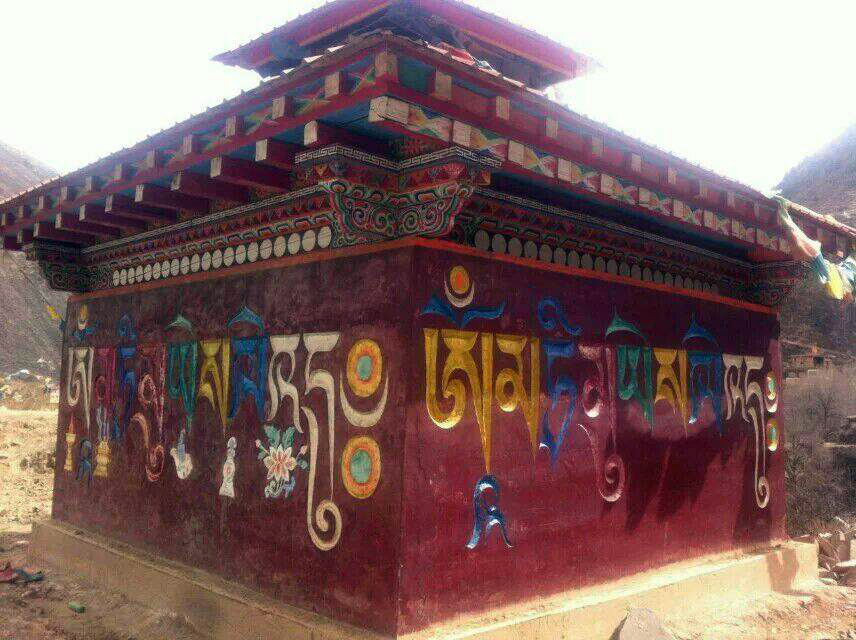
The MA TRI mantra at Gonggyal Monastery in Nya Rong, Tibet. Photo credit: Unknown

OM MA TRI MU YÉ SA LÉ DU

Within the Yungdrung Bön religious tradition the eight-syllable mantra OM MA TRI MU YÉ SA LÉ DU is known as the great mantra and is commonly referred to as the MA TRI mantra. It is the Essence Mantra of the Dzok ku, the enlightened state that embodies all perfected positive qualities and wisdoms. The sound and power of this essence mantra gives rise to the enlightened qualities and blessings of Buddha Tönpa Shenrap Miwoché and Buddha Sherap Jamma as well as the six buddhas who offer guidance to liberation for the the six kinds of sentient beings within cyclic existence: hell beings, hungry ghosts, animals, humans, demi-gods, and gods.  Each year around the time of the Tibetan New year in Dolpo, Nepal, this mantra is recited continuously without any interruption for 15 days. It is one of the three essence mantras of the Yungdrung Bön tradition that is recited a minimum of 100,000 times as a preliminary practice in order to prepare the student’s mind for further spiritual practice. The benefits of reciting this mantra are vast and beyond the imagination.

OM MA TRI MU YÉ SA LÉ DU

Alas! Fortunate Ones Listen!

The long flowing river of birth is the first.

The thunderous waterway of aging is the second.

The raging whirlpool of illness is the third.

Death that has no escape is the fourth.

These four are the demon rivers from which there is no escape.

Noble ones who wish to cross over those rivers, proclaim the melody of the MA TRI MU YÉ!


OM MA TRI MU YÉ SA LÉ DU

Alas! Fortunate Ones Listen!

The excellent means of accomplishment is the first.

Discovering the stairway to higher states is the second.

The blissful stairway of gods and humans is the third.

Traveling upon the stairway of joyful effort is the fourth.

These four are the four stairways to travel for the path of liberation.

Noble Ones who wish to ascend those stairways, proclaim the melody of the MA TRI MU YÉ!”

— Excerpt from Inspirational Verses Regarding the MA TRI written by the 13th century Tulku Loden Nyingpo.

The MA TRI mantra above a doorway. Photo credit: unknown

“This mantra is the heart elixir of the princpal teachings. It is a sacred connection for sentient beings during a dark time.  It is a key to the collection of sacred teachings  It is a lamp that clears away the darkness of ignorance.  So that sentient beings during the 500 years-long time of darkness will not have to exert themselves in meditation and accomplishment, this mantra recitation is the practice advice.

This recitation practice of the MA TRI is a precious lamp. Whoever goes before an esteemed lama or sacred support such as a shrine, chorten, or sacred statue, if they recite the mantra while performing prostrations and circumambulation and making prayers of aspiration, whatever they wish for will be quickly accomplished.”

— Extract from 32 Benefits of the Recitation Practice of the Precious Lamp

Tibetan translation by Raven Cypress Wood ©All Rights Reserved. No content, in part or in whole, is allowed to be used without direct permission from the author.

Don’t want to miss a post? Scroll to the bottom and click “Follow this blog.”

Birth Anniversary of Buddha Tönpa Shenrap’s First Born: Tobu Bumsang

Depiction of the birth of Prince Tobu Bumsang.

Although Buddha Tönpa Shenrap Miwoche was already a fully enlightened being and therefore has no worldly lineage, in order to continue the royal Shen lineage into which he was born and in order to benefit sentient beings, he had ten children.  The first born was his son, Prince Tobu Bumsang, who was born on the fifteenth lunar day of the second month. In 2020, this coincides with April 8th on the Western calendar.

Buddha Tönpa Shenrap Miwoché entrusted the teachings of the Tantra of the MA TRI mantra to Tobu Bumsang after he made a formal request for the teachings.

“To the Lord who is the compassionate protector of sentient beings, Sovereign of the teachings who is the principal deity of gods and humans, to the One who is ornamented with the clear, unobscured light of knowledge and is all-knowing, I bow and offer prostrations. 

What is the teaching? Who is included in the lineage?  How many benefits are there of this recitation practice?  Please bestow the oral transmission as well as the quintessential instructions.” 

Tobu Bumsang made this request for the benefit of sentient beings in cyclic existence.  Shenrap and Tobu Bumsang spoke in accordance with the hearing lineage. Then, from the completely pure mouth of Shenrap these words were spoken.

“O listen! 

Fortunate Son of a noble lineage, this Precious Lamp is the heart mantra of all of those who have gone beyond bliss. 

As for the lineage, those who have purified lower rebirths and shaken cyclic existence from the very depths are included within the lineage. 

As for this practice, it is mainly to rely upon trusting in the enlightened ones who have trained in the three kinds of emptiness. 

As for the benefit, so that sentient beings at the end of the eon, when their lifespan has become shorter and there is less morality, will not need to accomplish visualization and meditation, I will speak about the benefits of this recitation practice.

This recitation practice is the extracted heart essence of all of Those who have gone beyond bliss and is the fundamental essence of the entire collection of sacred teachings. 

It is the quintessential essence of all Bön.  It is the ultimate of all recitations. It is the heart elixir of the princpal teachings. It is a sacred connection for sentient beings during a dark time.”    

— Extracted from Benefits of the Recitation Practice of the Precious Lamp, the MA TRI Mantra

Tibetan translation by Raven Cypress Wood ©All Rights Reserved. No content, in part or in whole, is allowed to be used without direct permission from the author.

Don’t want to miss a post? Scroll to the bottom and click “Follow this blog.”

The Lotus Hat of the Yungdrung Bön

Religious festival at Menri Monastery 2015. Photo credit: Unknown

Within the Yungdrung Bön religious tradition, the lotus hat is worn by those who have received the full ordination of a renunciant. The shape of the hat resembles a full, blue lotus. In general, it represents the purity of perfecting the rules of completely pure discipline. It is surrounded by either four, six or eight lotus petals that represent purification throughout the four directions. The thread which holds the lotus petals to the hat represents the activity of subduing throughout the intermediate directions. The twenty-five pleats represent the enlightened state of the five buddha families. At the crown of the head, there is an opening to attach the crown ornament which extends from the hat towards the sky.

Tönpa Tritsuk Gyalwa.

The founder of the Yungdrung Bön religious tradition, Buddha Tönpa Shenrap Miwoche showed the path of renunciation by becoming a monk at the age of 31. This was his ninth deed. (For more information about the Buddha’s ninth deed, see previous article: https://ravencypresswood.com/2017/06/24/buddha-tonpa-shenraps-ninth-deed/ ) At his ordination, the six kinds of garments for a Yungdrung Bön renunciant fell from the sky. One of these garments was the lotus hat.

HE Yongdzin Tenzin Namdak Rinpoche wearing a lotus hat with the strips of cloth hidden underneath. Photo credit: Unknown

The long, thin strips of cloth that hang from the base of the hat near the ears are not mentioned within the texts. Therefore, the esteemed Yungdrung Bön spiritual master and scholar His Eminence Yongdzin Tenzin Namdak Rinpoche has stated that although it has become traditional to add them to the hat, they are not needed. Because of this, he sometimes takes these strips of cloth and places them inside the hat before putting it on.

All translations and content by Raven Cypress Wood ©All Rights Reserved. No content, in part or in whole, is allowed to be used without direct permission from the author.

Don’t want to miss a post? Scroll to the bottom and click “Follow this blog.”