Category Archives: Tibetan Culture & History

The First Spread of the Yungdrung Bön Teachings within the Realm of Tibet

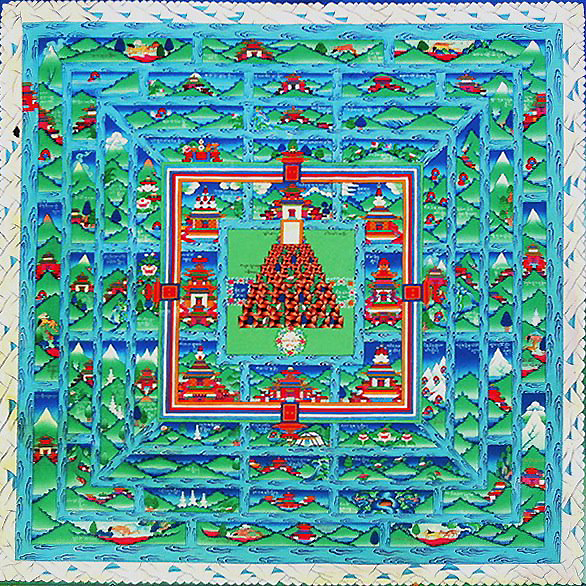
Depiction of the ancient land of Olmo Lungring

The founder of the Yungdrung Bon religious tradition, Lord Tönpa Shenrap Miwoche, was born into human form as a prince in the ancient land of Olmo Lungring within the ancient country of Tazik in the Wood Mouse year of 16,017 BC*.  Having taught the Yungdrung Bön to numerous disciples within Tazik, the teachings were eventually translated into three hundred sixty languages.  It is said that one hundred ninety-four of these languages pertained to realms beyond the borders of  Olmo Lungring.  Although Lord Tönpa Shenrap Miwoche made one journey into Tibet and taught the offering of torma as a substitute for harming living beings, the Yungdrung Bön teachings were not widespread at that time.

And so, having been translated and entrusted to various knowledge holders, the teachings were spread first into Zhang Zhung before spreading to India and China, and on into countries such as Kashmir, Nepal, Togar, Gilgit, Phrom, Zahor and Sumpa.  From Zhang Zhung, India and China, the teachings spread into the realm of Tibet. Because of this, many of the Yungdrung Bön texts today retain some of the original Zhang Zhung words, as well as words of other languages, which predate their translation into the Tibetan language.

The 1st universal ruler of Zhang Zhung, King Tri Wer Laje, possessor of the Golden Horned Crown and close disciple of Lord Tonpa Shenrap

During the reign of the first seven kings of Tibet, the teachings of Lord Tönpa Shenrap Miwoche flourished and each of these Tibetan kings had one or more Royal Bön Shen, or personal Yungdrung Bön priests, who acted as a kind of spiritual bodyguard to the king by protecting his lifespan, power and wealth as well as giving spiritual guidance.

Yumbu Lhakhang in the Yarlung Valley. Palace of the 1st Tibetan king, Nyatri Tsenpo, and used for centuries by his successors.

The first person appointed to rule as king over the entirety of Tibet, Nyatri Tsenpo, is said to have been of a supernatural lineage and was anointed king in the Wood Mouse year of 1136 BC.  During his reign, the Twelve Kinds of Knowledge of the Causal Vehicles of the Yungdrung Bön doctrine were widely spread and practiced.  His son, Mutri Tsenpo, invited one hundred eight Zhang Zhung scholars to Tibet and established forty-five centers for Yungdrung Bön practice and study.  During the reign of the next five Tibetan kings, the Yungdrung Bön had royal support and flourished.

1st Tibetan king: NyatriTsenpo

2nd Tibetan king: Mutri Tsenpo

3rd Tibetan king: Tingtri Tsenpo

4th Tibetan king: Sotri Tsenpo

5th Tibetan king: Daktri Tsenpo

6th Tibetan king: Jangtri Tsenpo

7th Tibetan king: Tride Yakpo

King Tride Yakpo had a son by the name of Drigum Tsenpo who was enthroned at the age of thirteen.  The Royal Bön Shen continued to be very powerful and influential in the royal court due to their deep connections with the kings of the Zhang Zhung empire.  King Drigum Tsenpo’s ministers began telling him that the words of the Bön Shen were more powerful than that of the king and that they posed a great and immediate threat.  Although he had practiced Bön in his youth, King Drigum Tsenpo called the Bön Shen together and told them that there was not enough room for both his authority and theirs in Tibet.  Therefore, he ordered them into exile.  With the exception of specific causal vehicle practices which were used to protect the king’s power and wealth, Drigum Tsenpo began the suppression and persecution of all of Lord Tönpa Shenrap’s teachings.  This was 683 AD, the first persecution of Yungdrung Bön which resulted in the hiding of texts as terma, or hidden treasure.

The Bön Shen loaded their texts upon domestic animals and traveled to the borderland of Zhang Zhung where they held a conference.  It was decided that in order to preserve the teachings, they would divide the texts among them.  Some of them traveled to the borderlands or other countries in order to spread the teachings.  Others hid the precious scriptures of the Yungdrung Bön and performed prayers of aspiration that the teachings would reemerge in a more favorable time and that the teachings of Lord Tönpa Shenrap would again spread for the benefit of sentient beings.

*All dates from Gal Che’i bsTan rTsis Phyogs bsDus, A Summary of Essential Chronology, published by Triten Norbutse Monastery.

Raven Cypress Wood© All Rights Reserved

Doorway to Zhang Zhung

The Six-peaked Doorway into Zhang Zhung. On the right, is the meditation cave of Drenpa Namkha. On the left, is the meditation cave of his son, Tsewang Rikdzin. Photo credit: Unknown.

Offering of Beauty

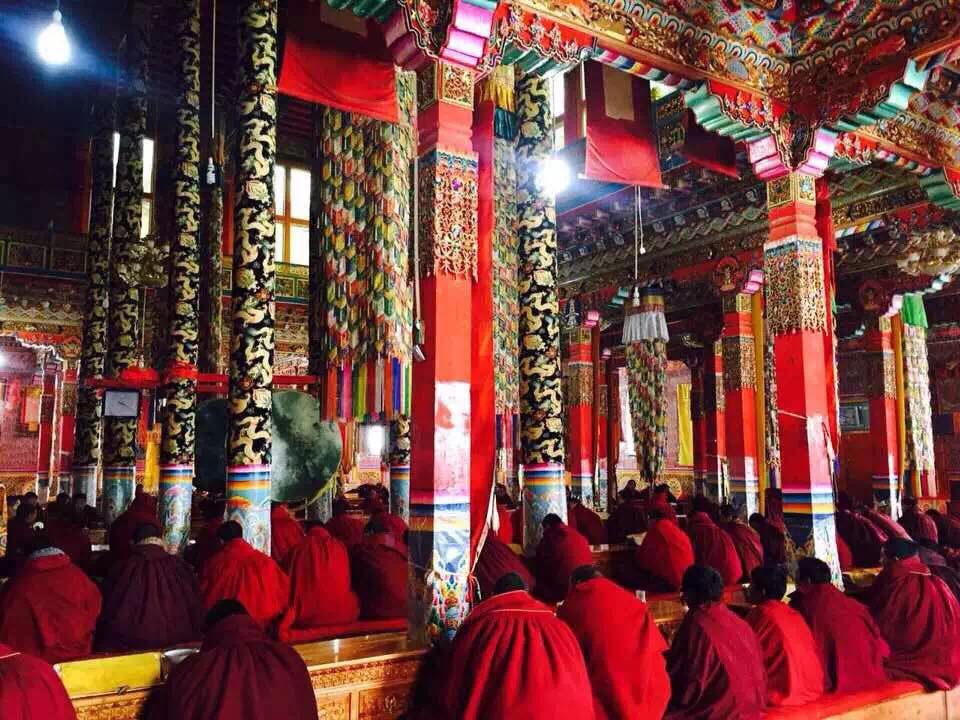
Kyungkar Yungdrung Tengye Ling Monastery in Tibet. Photo credit: Unknown

Modern Day Female Treasure Revealer

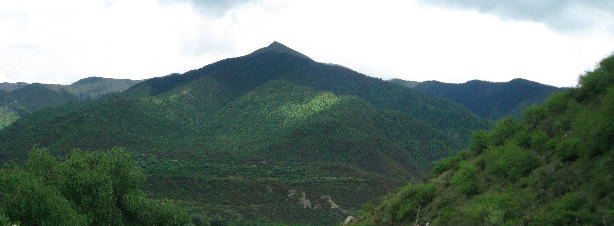
Kongpo Bonri, the Bon Mountain where Khandro Dechen Wangmo stayed in retreat and had many spiritual experiences.

In 1918 at the age of fifty one, Khandro (Sanskrit: dakini) Dechen Wangmo revealed a terma, or hidden religious treasure, that contained the hagiographies of sixteen female realized practitioners.  This was only one of many treasures that she revealed during her lifetime.  Born in Nyarong Tibet in 1868, Dechen Wangmo began having clear revelatory dreams by the young age of seven.  These dreams continued throughout her lifetime and often contained the location as well as the key to revealing many terma.  A non-sectarian practitioner, she was a disciple of both Bön and Buddhist lamas including the greatly esteemed and realized Shardza Tashi Gyaltsen.  Her main practice was Dzogchen accompanied by long life practices.  She compiled a chöd text and composed spiritual songs, including a song of revelation while she was practicing at the sacred site of Kongpo Bönri.  (See previous article:  https://ravencypresswood.com/2015/08/29/pilgrimage-kongpo-bonri/ )

Consort and spiritual companion to the tertön Sang Ngak Lingpa, it was Dechen Wangmo’s dreams that alerted him to the location of many terma as well as giving the key for opening them. While traveling to the kingdom of Hor, the couple stopped by a lake whereby Khandro Dechen Wangmo retrieved a terma of a statue of Ludrup Yeshe Nyingpo as well as a sacred text from the water spirits guarding the lake. Having arrived in Hor, the king requested that she herself give teachings in addition to those given by Tertön Lingpa.

She had her own disciples, some of whom compiled a hagiography of her which details her many pilgrimages, terma revelations, dreams, and sacred visions. Her importance and realization was recognized by many lamas who wrote long life invocations for her. She and Tertön Lingpa traveled extensively but their activities were mainly focused in the Amdo area of Eastern Tibet.

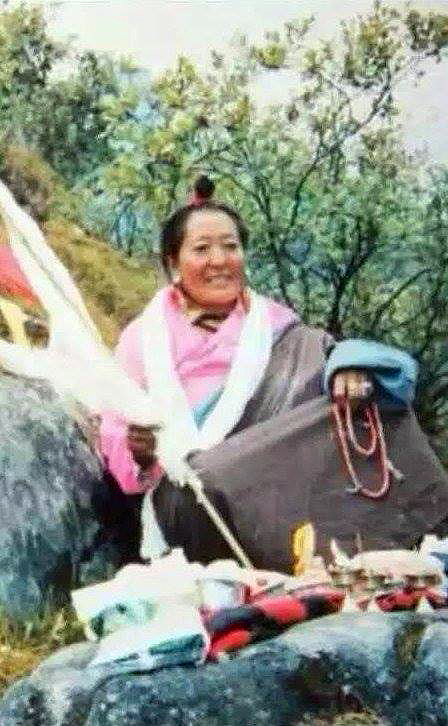
Khandro Khachö Wangmo. Photo credit: Kimball Cuddihy

Khandro Khachö Wangmo (1940-1987 CE ) was considered an incarnation of Khandro Dechen Wangmo. She was the daughter of Kündrol Drakpa, who was also known as Kündrol Humchen Drodül Lingpa, and was a lineage lama and tertön of the New Bön tradition. She was a realized practitioner and tertön who in 1986 CE discovered a small statue of Amitayus, a nine-pointed dorje, and blessed khandro dust from the sacred mountain Kongpo Bönri in south-eastern Tibet. Her discovery was witnessed by the public and documented in an essay by Span Hanna entitled Vast as the Sky, the Terma Tradition in Modern Tibet which is included in the book Tantra and Popular Religion in Tibet by Geoffrey Samuel and Hamish Gregor, edited by Elisabeth Stutchbury.

Raven Cypress Wood© All Rights Reserved
The Six Excellent Substances

The Six Excellent Substances are added to the dry tsampa when making torma. Photo credit: Raven Cypress Wood

A common group of ingredients needed for making torma,  and used in many Tibetan medicines is called Zang Druk, the Six Excellent Substances.  These six substances are: 1) Chu gang, 2) Gur gum, 3) Li shi, 4) Dza ti, 5) Suk mel, and 6) Ka ko la.  These substances are ground into powder and mixed together.

There are three types of Chu gang: 1) Tree Chu gang, 2) Rock Chu gang, and 3) Water Chu gang.   Tree chu gang comes from an Indian tree similar to bamboo.  It forms a milky white juice at the joints of the tree.  Rock chu gang is hard like a stone, and water chu gang comes from rivulets found on mountains such as Mount Tisé.

The plant which produces saffron is Crocus sativus.

The common name for Gur gum is saffron.  In general, there is low, medium and high quality grades of saffron. The common name for Li shi is cloves.  The common name for Dza ti is nutmeg.  The common name for Suk mel is cardamom.  This is also known as green cardamom.  The common name for Ka ko la is black cardamom.

Raven Cypress Wood© All Rights Reserved