
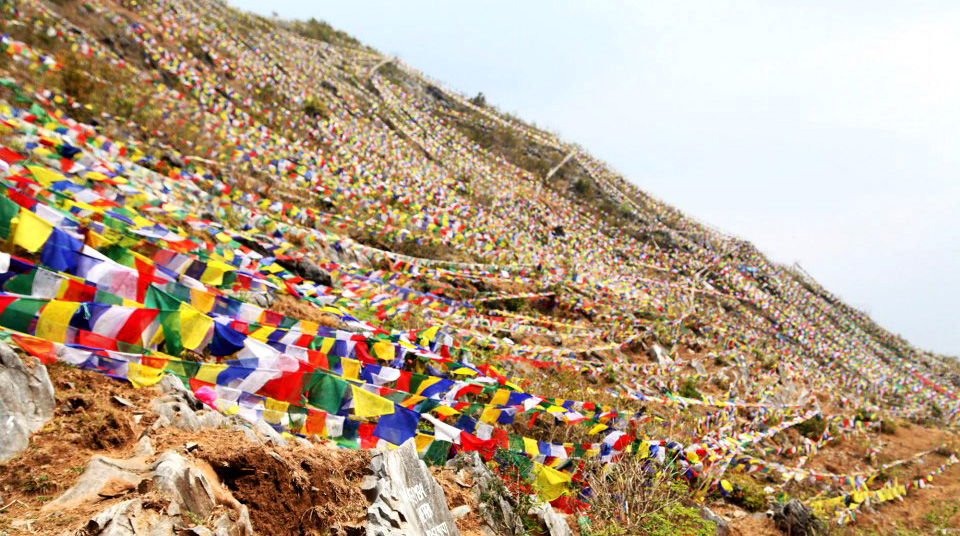
In the foreground, a Yungdrung Bon style mandala offering set at the Khyungkar Yungdrung Tengyeling Monastery in Tibet
In the foreground, a Yungdrung Bon style mandala offering set at the Khyungkar Yungdrung Tengyeling Monastery in Tibet
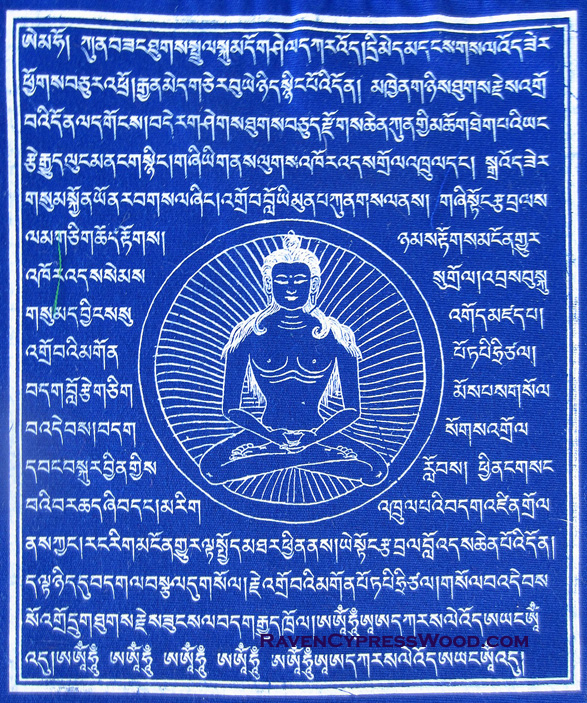
This Yungdrung Bön prayer flag has a center image of Tapihritsa. He was an historical person of the 8th century who attained full realization and is seen as being merged with the primordially enlightened Küntu Zangpo. Tapihritsa is an important figure in the lineage of the Zhang Zhung Aural Tradition of Dzogchen. The direct lineage of this tradition was never interrupted in any way and continues to this very day.
This prayer flag contains the “Invocation of Tapihritsa” as well as the Bön ‘SA LÉ Ö” heart mantra which is said to contain the complete introduction to the natural state of the mind.
“Lord Tapihritsa, protector of migrating beings, I offer this prayer to you! May the beings of the six realms of cyclic existence be held within your compassion, and may my mind be liberated!”
-From The Invocation of Tapihritsa. Translated by Raven Cypress Wood.
All content on Nine Ways ©Raven Cypress Wood
 In Tibetan astrology, there is a twelve year cycle. Each of these years is characterized by a different animal and associated with one of the five elements. Therefore, a full cycle of the twelve animals being associated with each of the five elements takes sixty years. The twelve animals according to the Yungdrung Bön texts are the Rat, Elephant, Tiger, Rabbit, Dragon, Horse, Snake, Sheep, Garuda, Monkey, Dog and Pig. Each animal is associated with a specific element for its life-force as well as a specific direction which is determined by the life-force element. Not only are these twelve animals associated with a particular year, they are also associated with particular months, days and hours.
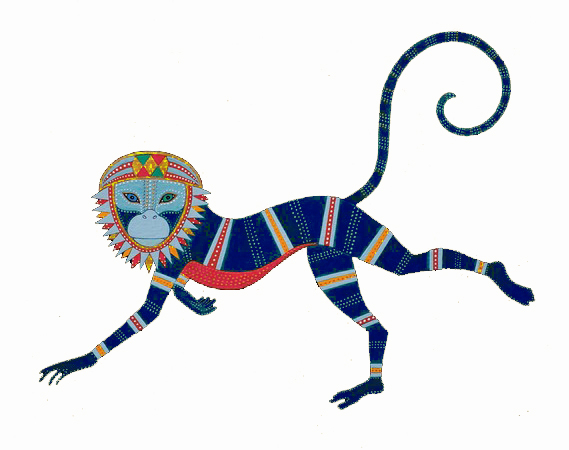
2016 will be the year of the Monkey. Therefore, people born during this year will be a Monkey and will have an emphasis of the specific qualities associated with Monkey. (This year corresponds with the Tibetan lunar calendar and begins February 08, 2016.) The element which governs the life-force of the Monkey is Metal (space) and its direction is West. So, if a Monkey person wanted to strengthen their life-force, they would focus upon strengthening the element of Metal internally and externally. The positive direction West. Therefore, facing this direction while meditating, doing healing rituals or just relaxing and taking deep breaths is beneficial.
In general, the Monkey is friendly, adaptable, playful and thinks outside of the box. The Monkey does not like to be trapped in any way and can use its ingenuity and keen sense of strategy to keep itself free. Although the Monkey has a good sense of humor and a sharp mind, too often it is tempted to use these qualities to elevate itself while lowering others. The Monkey is skilled at finding ways to benefit from an opportunity. Even when faced with difficulty, the Monkey most often lands on its feet. The Monkey has an insatiable desire for knowledge and study, but can grow bored once it has reached a level of mastery.
The Monkey‘s soul day is Friday and its life-force day is Thursday. These are the best days for beginning new projects and activities that are meant to increase or develop something. The obstacle day is Tuesday. This day is best for cleansing and letting things go. It is not a favorable day for beginning new things.
Monkey years include: 1944, 1956, 1968, 1980, 1992, 2004, 2016
If you were born during a previous year of the Monkey, this year as well as other Monkey years are considered a time of vulnerability to obstacles. This same astrological principal applies for all of the other eleven animal signs during their associated year. Therefore, it is recommended to engage in practices that support vitality, good fortune and spiritual merit such as hanging prayer flags, having a soul and life-force retrieval ritual performed, restoring any deterioration or violation of one’s spiritual commitments or any damaged relationship with one’s spiritual brothers and sisters, and/or performing prayers and rituals to remove obstacles. In general, making an effort to engage more with virtuous activities of body, speech and mind and committing to engage less with non-virtuous activities is supportive. According to the words of Buddha Tönpa Shenrap Miwoché, the practice of developing sincere unbiased and unlimited compassion is the greatest of all protections.
A common prayer within the Yungdrung Bön tradition that is used to remove obstacles is the Bar Che Lam Sel, The Spontaneous Wish-fulfillment of Removing Obstacles from the Path. The English, Spanish and Portuguese translations of this prayer are offered free for personal use on the Nine Ways Publications page. Click on the Publications tab above and scroll down to the download links for the prayer.
Raven Cypress Wood© All Rights Reserved
Don’t want to miss a post? Scroll to the bottom and click “Follow this blog.”
According to Tibetan astrology, we each have Five Natal Forces within us that are characterized by one of the five elements of earth, water, fire, wood or metal. (Metal is the astrological equivalent of space and wood is equivalent to wind.) These Five Natal Forces are the Vital Life-force, the force of the Body, Personal Power, Lungta and Soul.
The Vital Life-force is the force within an individual that is responsible for maintaining the connection between body and mind. As long as this connection exists, there is vital life-force. This force can be stable or unstable. The force of the Body is the force of our bodily health. The force of Personal Power, or wangtang, is the natal force of personal power or charisma, and is associated with prosperity. When this force is strong, it can lead to accomplishment of one’s goals with few or no obstacles, protection of the vital life-force, and general protection from any kind of danger or loss. Lungta is the force within an individual that is associated with good luck. Lungta literally means ‘wind-horse’. This symbolizes something that can move very fast and with great power. The Lungta has the ability to strengthen and uplift all of the other natal forces. The Soul is the mother of the vital life-force. When the Soul is strong, it gives the individual the ‘glow’ of health. This force can be variable depending upon whether it is strengthening or declining. According to texts, “Virtue is the mother of the soul.” Therefore, acts of virtue strengthen the force of the soul. This force cyclically moves through the entire body each month. See previous article, “Movement of the Soul Through the Body”.
Because each of these natal forces are associated with a specific element, they not only characterize these forces in general but are also affected by the elemental qualities of each calendar year. In this way, it is possible to anticipate the potential for one or more of these forces to encounter circumstances of support or decline. This is due to the fact that the five elements interact with one another according to their unique qualities. For example, water is the enemy of fire, but wood is the mother of fire. There are four possible relationships between elements: mother, child, friend or enemy. A person born in 1973 would be a Water Ox and the force of their lungta would be ruled by the element of water. For 2015, the force of lungta is ruled by the element of fire. Fire is in the friend relationship to water. This is considered a very good position and, in general, this person could expect their force of lungta to be strong during 2015. Calculations such as this are possible for each of the Five Natal Forces. If someone wanted to strengthen one or more of the natal forces, the texts prescribe methods of doing so including numerous rituals and practices. In general, virtuous activity, sincere spiritual practice and a mind of loving kindness protect these forces and keep them strong and well-developed.
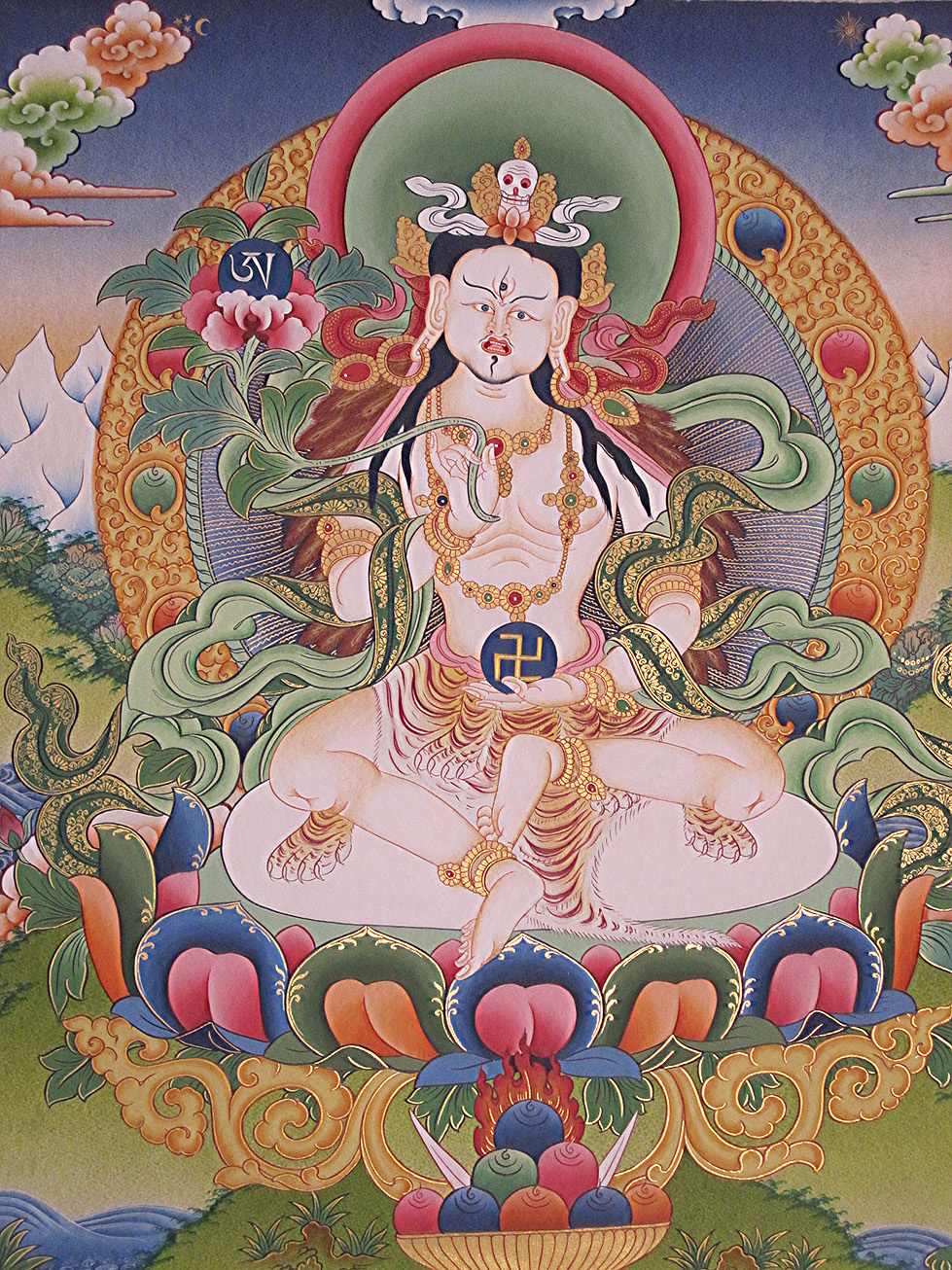
The deity of longevity, Tsewang Rikdzin
“EMAHO! Praise to the unborn, self-arisen tulku! Praise to the supreme gathering of all of the buddhas of the three times! Praise to the eternal, unchanging deity of longevity! Praise to the manifestation of Tséwang Rikdzin!” -from the Tséwang Jarima
According to the teachings of the Yungdrung Bön, a human life is rare and precious. Because of this, there are spiritual practices with the purpose of healing any damage to the lifespan and for removing any obstacles that could interfere with the complete fulfillment of the lifespan of an individual. One of the most common practices to attain these results is The Practice of the King of Longevity, Tséwang Rikdzin’s Supreme Collection that was received upon Jarima. Commonly referred to as the Tséwang Jarima. Within this text are rituals for healing as well as instructions for practicing with the King of Longevity, Tséwang Rikdzin. This deity holds a Tibetan letter AH which symbolizes his realization of emptiness and the highest of all teachings regarding absolute reality. He also holds the symbol of a yungdrung which represents changelessness and ceaselessness. In this context, these qualities are associated with his power over the lifespan.
Tséwang Rikdzin was an historical person. He was the son of Zhang Zhung Drenpa Namkha and his twin brother was Pema Tongdrol. Although an emanation with great knowledge and realization at his birth, Tséwang Rikdzin received many teachings and heart instructions from his father. In addition to composing many ritual texts in order to alleviate the suffering of sentient beings, he is also an important lineage master of the highest teachings, called Dzogchen, The Great Perfection.
The Tséwang Jarima text contains a long life mantra that is recited by Yungdrung Bön practitioners throughout the world. During the week-long longevity retreat, this mantra is recited 100,000 or more times in order to obtain the power and energy of the mantra and the yidam, Tséwang Rikdzin.
SO DRUM AH KAR MU LA TING NAM Ö DU MU YÉ TSÉ NI DZA
SO is the changeless space of all phenomena
DRUM is the unequaled palace of the deity
AH KAR is the nature of birth-less wisdom
MU LA is the seed syllable of the rikdzin, specifically Tséwang Rikdzin
TING NAM is the self-arising water of nectar
Ö DU is the bringing together of all of the attainments of longevity
MU YÉ is the mantric vibration of luck and prosperity
TSÉ NI is the essence of a human being
DZA is the iron hooks of light
 Nine Ways