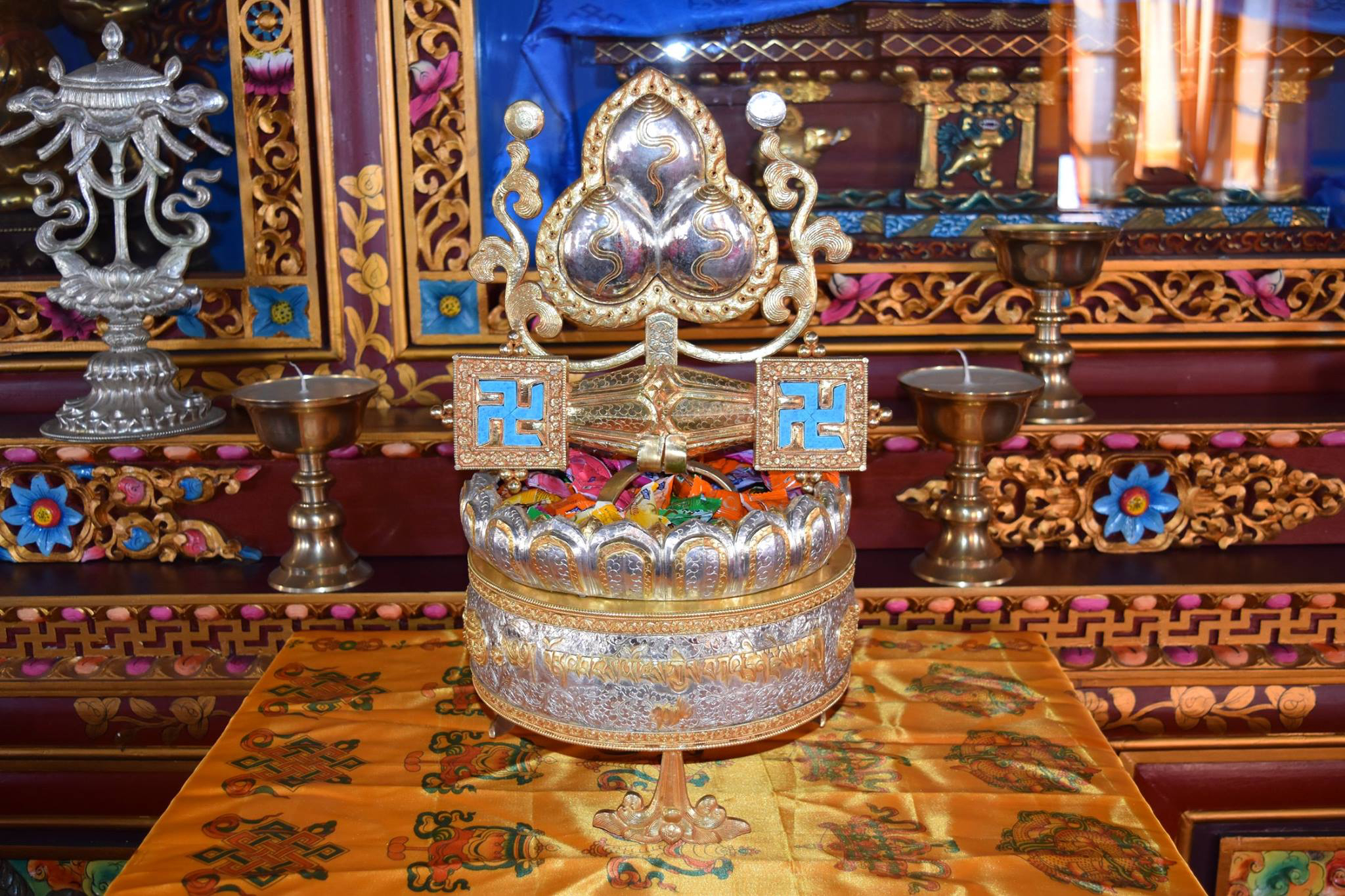
Special mandala offering with chakshing and flaming jewels presented to HH 33rd Menri Trizen Rinpoche and HE Yongdzin Tenzin Namdak Rinpoche in 2016 by the Worldwide Yungdrung Bon community.
Special mandala offering with chakshing and flaming jewels presented to HH 33rd Menri Trizen Rinpoche and HE Yongdzin Tenzin Namdak Rinpoche in 2016 by the Worldwide Yungdrung Bon community.
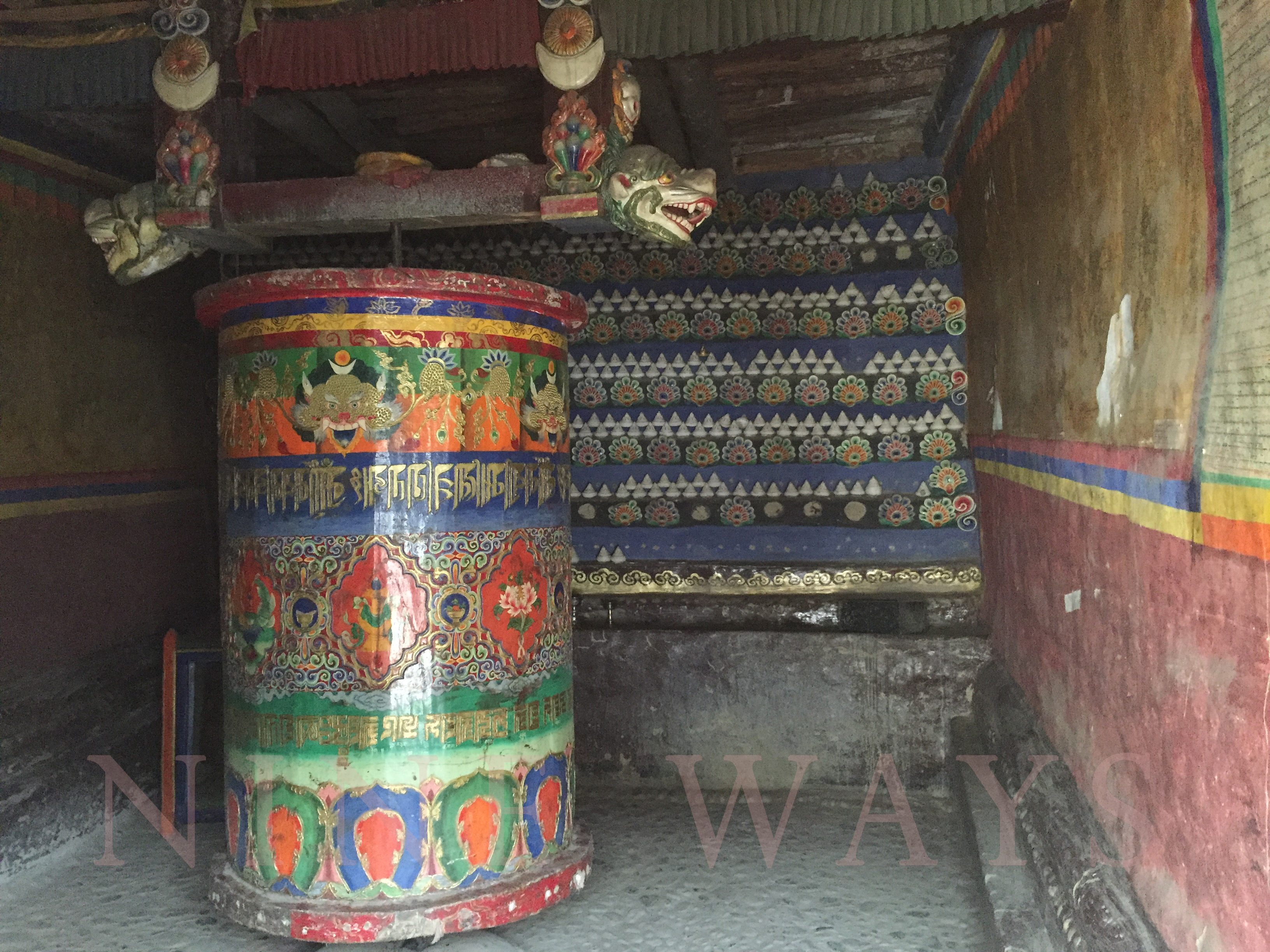
Prayer Wheel and tsa tsa house in Tsarka Dolpo, Nepal. Photo credit: Geshe Tenzin Yangton

Buddha Tonpa Shenrap manifests as the Completely Victorious One, Nampar Gyalwa
The reincarnation of a great king was born a prince by the name of Gya Kongtse Trulgyi Gyalpo. At a young age, this prince had great faith in the teachings of Buddha Tönpa Shenrap and performed many acts of devotion. At the age of twenty-five, he decided to build an exquisite temple in the ocean surrounding Olmo Lungring in order to accumulate merit for his next life. Because human beings were unable to work in this condition, he subdued one hundred demons who each vowed to complete the construction of the foundation within fifteen days as long as the prince kept their involvement a secret. And so, after fifteen days, the solid stone foundation of the temple rose above the surface of the ocean.
Before leaving, Prince Kongtse Trulgyal had told his mother that he would be away at the ocean for a month and that she must keep it a secret. However, as the days passed, the prince’s wife began to worry about him and tried to get information from his mother. Unable to withstand the constant questioning any longer, his mother finally told the prince’s wife the truth. Stunned and angry that she had been kept in the dark, she took the children and went in search of her husband, Prince Kongtse Trulgyal. Arriving at the ocean and crossing a small bridge to the newly constructed temple foundation, the family saw a large group of workers who all looked like the prince. Having been discovered, the demons, all of whom had taken on the likeness of the prince, immediately fled and construction of the temple came to a halt. In despair, Prince Kongtse Trulgyal enlisted the help of a bodhisattva who recruited the assistance of a group of water spirits in order to complete the temple’s construction.
Upon completion, the temple was truly majestic. However, the demons who had built the foundation for the temple became jealous and began attacking the temple intent upon destroying it. Prince Kongtse Trulgyal cried out for help from Buddha Tönpa Shenrap. Knowing of all of these events through his perfect omniscience, the enlightened Lord Tönpa Shenrap instantly manifested in the sky in his wrathful form as the Completely Victorious One Nampar Gyalwa, and together with five thousand five hundred bodhisattvas, he completely subdued the group of jealous demons. Descending from the sky to the temple, he then spoke according to the Yungdrung Bön teachings and installed representations of his enlightened Body, Speech and Mind in the temple in the tangible aspects of statues, scriptures and chortens.
Raven Cypress Wood ©2016 All Rights Reserved.

Ceremony at Kyungkar Yungdrung Tenggye Ling Monastery in Tibet. Photo credit: Unknown

Yumbu Lhakhang, Palace of the Yarlung Kings in the Yarlung Valley of Tibet
At the time when the first ruler of Tibet was established, the empire of Zhang Zhung was vast, the practice of Yungdrung Bön was flourishing and the Buddhism of India founded by Shakyamuni had not yet entered the territory of Tibet. The principality of Tibet consisted of minor kingdoms but was not yet unified under the rule of a single monarch. In order to consolidate power, the leaders of central and eastern Tibet decided to appoint a sole ruler of the entire realm.
During this time, it is said that Nyatri Tsenpo, the first king of Tibet, appeared and was chosen to rule over the Tibetans. His ancestry is of other-worldy origins and has been variously detailed as descending from either the gods or the powerful theurang spirits. In either case, it is believed that his power and magnificence were greater than that of a normal human being. It was believed that he had a supernatural connection to heaven known as a mu cord, which resulted in his being able to ascend the cord and return to heaven upon his death. Therefore, he did not leave a corpse behind. This was true of all of the first seven Tibetan kings.
The Thirty-Four Tibetan Kings of the Yarlung Dynasty*
1-7 The Seven Tri of the Sky, During their reign, the teachings of Yungdrung Bön flourished. Connected with the celestial sphere by a mu cord, these kings are said to have ascended to heaven by this cord at the time when their sons were old enough to rule, thereby not leaving a corpse behind.
12-17 The Six Good Ones Upon the Earth, During their reign, lamas of the Zhang Zhung empire acted as the Royal Bön Shen
18-25 The Eight Dé of the Water, During their reign, the teachings of Dzogchen were spread
26-30 The Five Tsen of the Middle
31-34 The Four Bönpo Kings of Prosperity, During their reign, the Yungdrung Bön teachings and practices flourished under the guidance of many knowledgeable lamas.
*Due to political reasons, historical lists of the Tibetan Kings differ among Buddhist and Bön accounts as well as differing among texts within the same tradition. I have relied upon the Yungdrung Bön text: Dar rGyas gSal Ba’i sGron Ma written by Pa Ton Tengyal Zangpo in 1345.
Raven Cypress Wood© All Rights Reserved
 Nine Ways