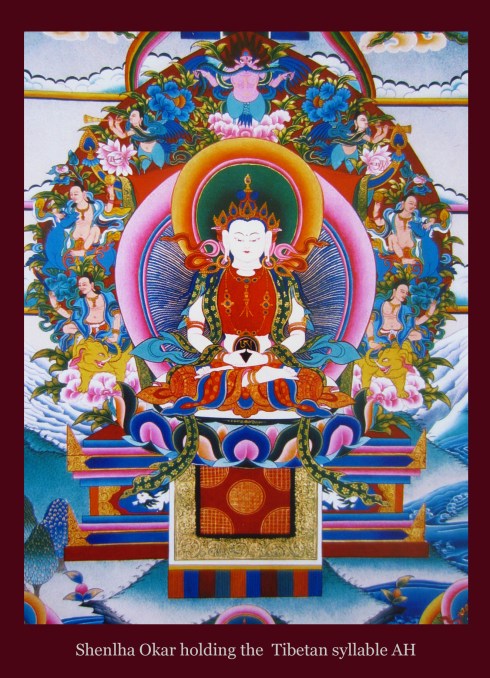
Central Figure of the Tibetan Thangkha Painting Related to The Fifth Way
Within the Nine Ways of Bön, the Fifth Way is called The Way of the Virtuous Lay Practitioners and specifies the proper conduct and commitments of a lay person taking vows. This Fifth Way is the first of the Nine Ways classified as ‘Ways of the Result’ or ‘Bön of the Fruit.’ In the Tibetan language, a lay practitioner is called ‘gen nyen’ [Tib. dge bsnyen] which literally translates as ‘one who serves virtue’ or ‘one who draws near to virtue.’ When asked the meaning of these concepts, the enlightened all-knowing teacher, Buddha Tönpa Shenrap Miwo answered,
“Virtuous means without negative actions. This is one who is committed to serve virtue through their body, speech and mind. Service means serving without holding contradictory views and properly remaining steadfast in service to virtue.”
In general, the lay practitioner commits to practicing the ten virtuous actions and renounces the ten non-virtuous actions of body, speech and mind. Buddha Tönpa Shenrap defines this kind of renunciation as 1) not performing the actions, 2) not requesting or encouraging others to perform them and 3) not feeling pleased that others have performed the negative actions. Similarly, one commits to 1) acting according to the ten virtuous actions, 2) encouraging others to participate in these activities and 3) feeling joy that others have performed virtuous actions. This is the inner practice.
The Three Virtuous Actions of the Body:
- Rather than killing, protecting the life of other beings.
- Rather than stealing, practicing generosity.
- Rather than engaging in sexual misconduct or causing others to break their vows, keeping one’s own vows and respecting the vows of others.
The Four Virtuous Actions of Speech:
- Rather than lying, speaking the truth.
- Rather than creating discord, speaking in a way that brings people together.
- Rather than using hurtful speech, speaking gently and kindly.
- Rather than gossiping or mindlessly talking, speaking in a useful way or reciting prayers.
The Three Virtuous Actions of the Mind:
- Rather than coveting the possessions and accomplishments of others, being generous and open.
- Rather than wishing harm to others or feeling resentful, cultivating the desire to help others.
- Rather than holding wrong views, practicing the teachings of Yungdrung Bön and establishing a true and authentic view.
When asked to teach the outward form of the lay practitioner, The All-knowing Teacher, Tönpa Shenrap first instructed the gathered assembly to construct the first Elegant Yungdrung Chorten [Sanskrit: stupa] according to his detailed instructions. Once completed, he consecrated the chorten and then began teaching the outer forms and behavior of a gen nyen or lay practitioner.

The Elegant Yungdrung Chorten which represents the stages of enlightenment
The practitioner must go before a pure lama who guides disciples and take the appropriate vows. According to a commentary written by the 23rd abbot of Menri Monastery, His Holiness Nyima Tenzin Rinpoché:
“As for the vows of a gen nyen: There are five kinds of lifetime vows. To abandon killing, to abandon taking what is not given, to abandon impure, wrong kinds of sexual conduct, and to abandon false speech are four. Abandoning one of the four kinds of food is the fifth. Some people have taught abandoning alcohol as a branch vow.
This is the gen nyen of completely renouncing according to the five kinds of established laws. Because of that, the gen nyen of pure behavior has renounced the basic kinds of impure activity.”
As for killing, one must abandon killing in anger especially another human being. One must abandon stealing, especially when it is driven by desire. One must avoid sexual contact that is damaging or abusive, one must avoid harmful speech especially if it creates a division within the spiritual community, and one must avoid lying especially about one’s spiritual experiences and attainments. As for the fifth which is a branch vow, one renounces either one of the four kinds of food. In this context, the four kinds of food are 1) meat, 2) garlic, 3) solid food after the mid-day meal, and 4) intoxicants such as drugs and alcohol. Regarding drugs and alcohol, the deeper meaning is the renunciation of intoxication which is an obstacle to mindfulness and incites negative behavior.
According to Buddha Tönpa Shenrap in The Nine Ways of Bön,
“As for the lifelong inner rules, one must abandon killing due to the influence of anger, abandon taking what is not given due to the influence of desire or attachment, abandon acting secretly to get what one wants without consideration of cause and effect due to the influence of ignorance, abandon performing unclean work due to the influence of pride, and abandon rough and abusive speech, meaningless talk, and telling lies. One must apply one’s self to their opposites.”
The Buddha goes on to describe the outer practices.
“As for the five intermediate principles, one should perform pure water-cleansing rites, perform prostrations and circumambulations with devotion and aspiration, create and place tsa tsa, and offer torma. Presenting offerings is a branch of gathering the [two] accumulations.”
All translations and content by Raven Cypress Wood ©All Rights Reserved. No content, in part or in whole, is allowed to be used without direct permission from the author.
Don’t want to miss a post? Scroll to the bottom and click “Follow this blog.”




 Nine Ways