Blog Archives

The First Way: Divination, Astrology, Ritual and Medicine

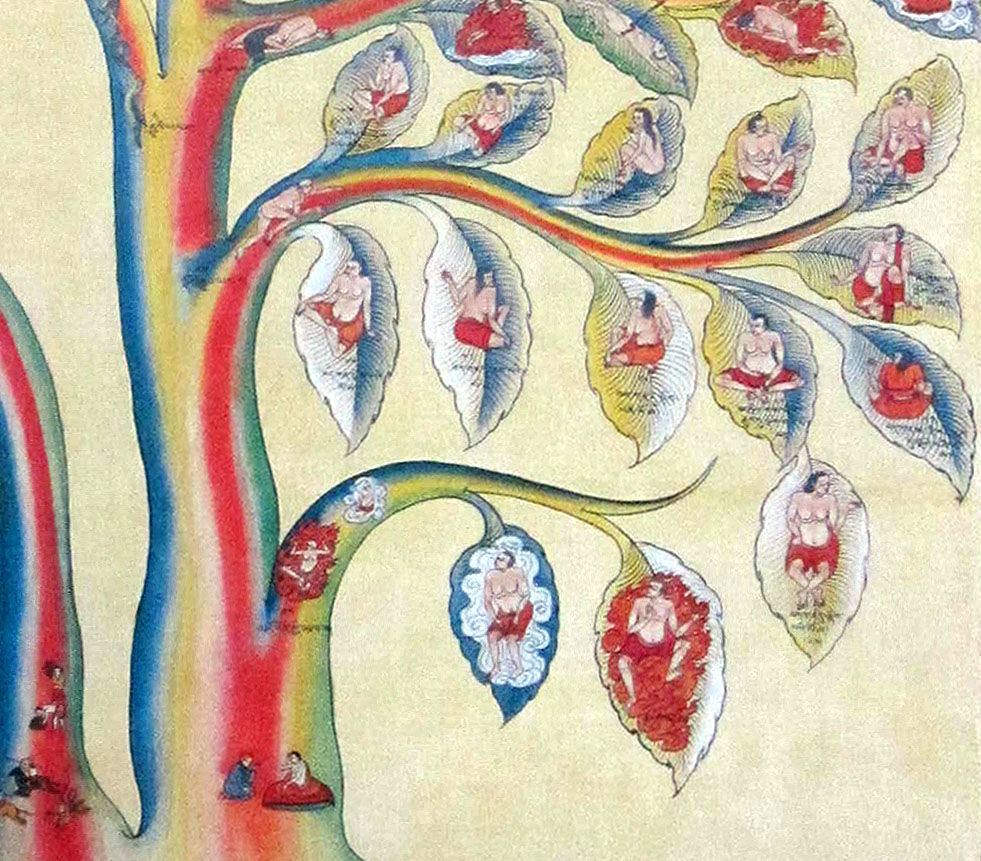
Detail from the tree of health and illness which shows the root, branches and leaves of both health and illness. Photo credit: Raven Cypress Wood

The First of the Nine Ways of Bön is The Way of the Shen of Prediction and contains methods of divination, astrology, healing rituals and medical diagnosis which deal directly with the concerns of this present, worldly life. As in all of the Nine Ways, the basis for all practice is compassion.  Although the ultimate goal is enlightenment and complete release from the suffering and misery of cyclic existence, the perspective of The Way of the Shen of Prediction is upon the individual’s immediate circumstances during this very lifetime.  Within the Yungdrung Bön tradition, the knowledge related to the divination, astrology, healing, and medical diagnosis is vast.  In the words of the Buddha Lord Tönpa Shenrap Miwo:

“In general, there are 360 different kinds of divination.  There are 360 kinds of astrological calculation.  There are 360 kinds of ritual and 21,000 methods of diagnosis in order to avert the danger of death.” 

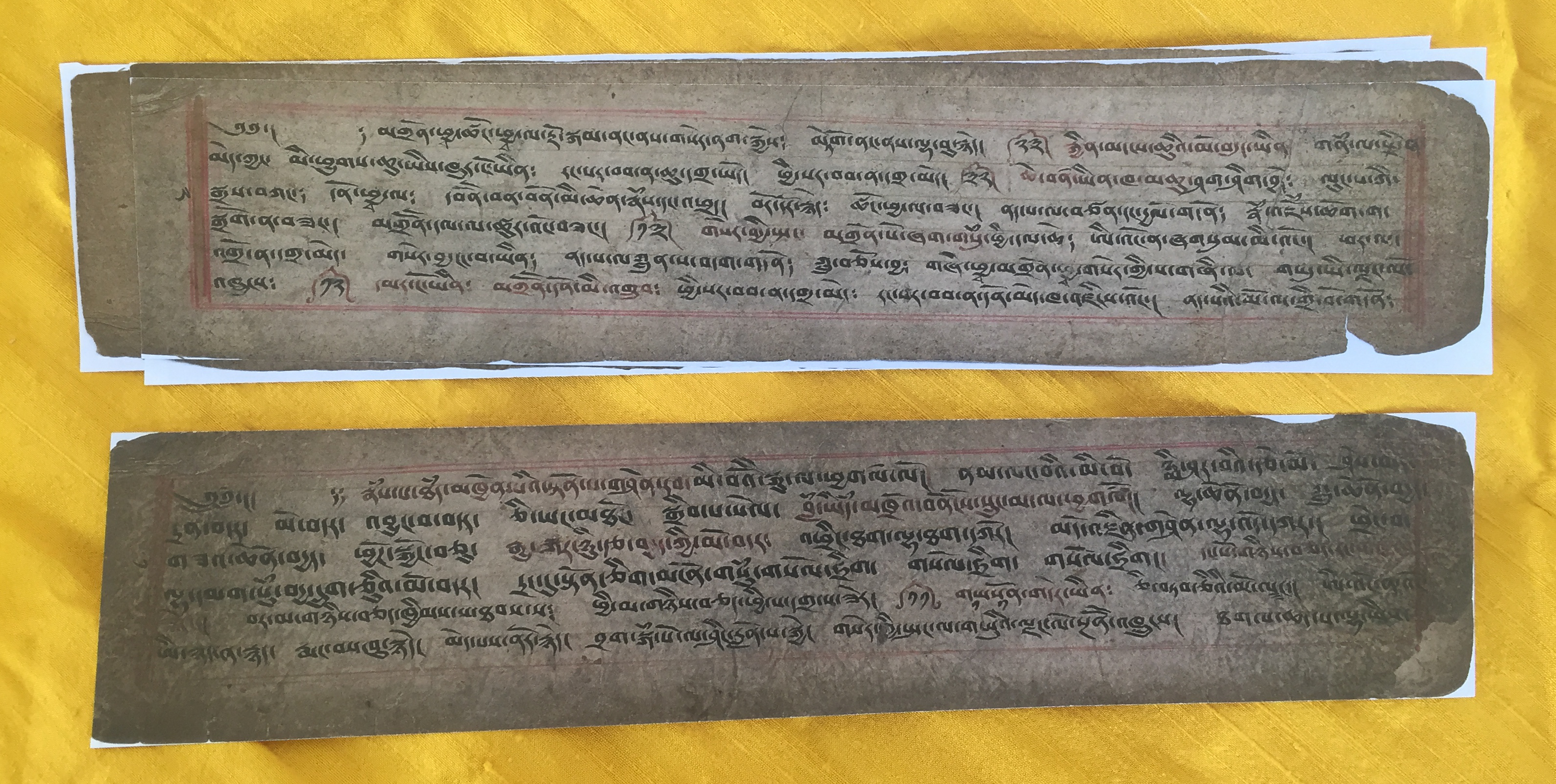
Divination or mo, This is a method through which one can obtain guidance for worldly questions such as, “Will my new project be successful?” or “Will my travel be safe?” If the answer is negative, the text will either recommend a different course of action or suggest an antidote such as prayers or ritual that could change the projected course of events for the positive. It is common to ask a lama for a divination for any number of reasons such as success of new projects, buying or selling a home, traveling, health, or marriage.
Copy of an old text detailing a method of divination taught directly by Lord Tönpa Shenrap. Photo credit: Raven Cypress Wood

There are four categories of divination within Yungdrung Bön tradition: 1) using a mala or die, 2) using the drala, or powerful protective spirits who are considered messengers of the gods, 3) dreams, and 4) reading signs and symbols. For each of these methods, it is necessary to receive instructions, transmission and empowerment. Then, a prescribed individual retreat is undertaken in order to receive the blessings and power of the respective deity associated with the divination.
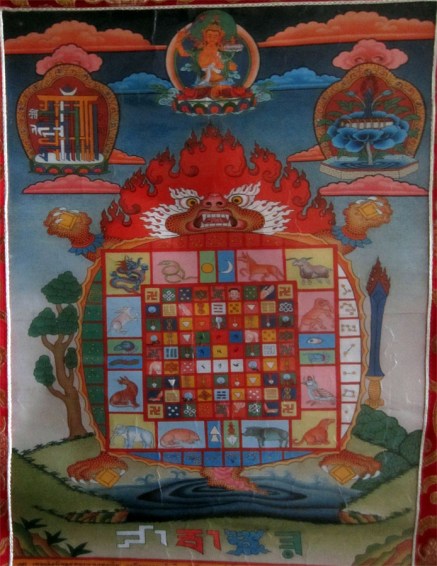
astrology thangkha

Astrological deities and symbols of the Yungdrung Bön. Photo credit: Raven Cypress Wood

Astrology or tsi, is a method to determine the harmony or disharmony with the external forces of the universe as well as a calculation of the flow of time.  For example, the Tibetan New Year begins somewhere between the beginning of February and the end of March. The exact date is determined astrologically. Each year is characterized by one of the five elements and by one of twelve animals which are alternatively male or female.  The qualities of this element and animal combination are identified with every individual born within that year. Subsequently, it is possible to use astrology in order to calculate the probable effect of any given year upon an individual in relation to health, success, wealth etc. For example, someone born in the year of the Male Wood Rat (1984) would have their force of good luck ruled by the wood element.  The year 2013 of the Western calendar was a Female Water Snake year and the year’s  force of good luck is ruled by the water element.  Because the wood element and the water element have a naturally positive relationship, the Male Wood Rat person is likely to have a very positive year related to their force of good luck.  It takes sixty years in order to complete the cycle of twelve animals and five elements.

Astrological calculations are important in order to ascertain the most favorable date and time for important events such as religious festivals, marriages, travel, significant business dealings, healing rituals, funerals, etc.  In this way, the events that take place can be in harmony with the natural energies of the universe and therefore amplify the positive outcome.

A Yungdrung Bön monk prepares for a longevity and life ransom ritual. Photo credit: Geshe Chapur Lhundrup Rinpoche.

Ritual or to, ritual methods used to prevent or stop harm coming from unseen, external forces.  According to the texts, what we perceive as empty space is actually crowded with beings that are invisible to us.  Because humanity damages and pollutes the external environment without consideration for these other beings, we cause harm and offense to these unseen spirits who then seek repayment or revenge.  This can lead to sudden unexplained loss or illness that is resistant to medical cure.

Once divination or astrology has established that the source of the disturbance is one or more of these external unseen forces, a specific ritual is advised in order to restore health and harmony.  Traditionally, a lama is asked to come to the home in order to perform the necessary ritual.  The family hosts the lama and the assistants for the duration of the ritual.  Some rituals are concluded in a single day.  Others may can take many days to complete.

Medical Diagnosis  or men, is a method of diagnosing the cause of a physical illness and prescribing a medicine to bring about a cure. The root of health is awareness and virtuous behavior, and the root of illness is ignorance and non-virtuous behavior.  This idea is expounded at great length in the Yungdrung Bön medical texts.   Health is the balance of the qualities of wind, bile and phlegm within the body.  Illness is the weakness, damage or excess of any or all of these qualities.  The hot or cold nature of the imbalance is also taken into consideration.

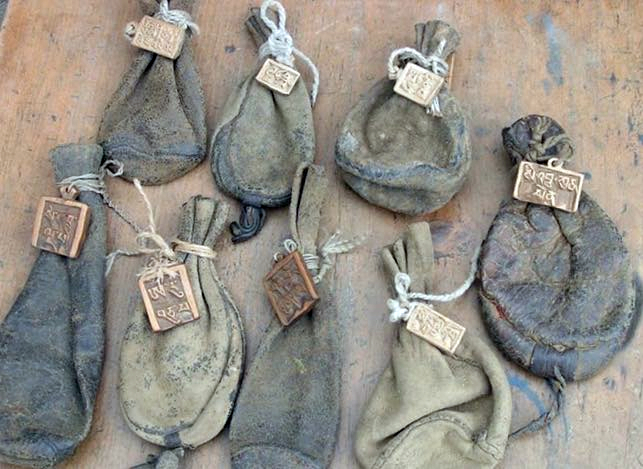
Old-style Tibetan medicine bags. Photo credit: Dr. Nyima Gurung.

When diagnosing the root cause of an illness, the doctor will use the three techniques for diagnosis: 1) seeing, 2) touching, and 3) questioning. These include observing the general demeanor of the patient, listening to the sound of their voice, studying the appearance and shape of their tongue, examining the qualities of their urine, and feeling the multiple pulses of both wrists.  The doctor will also question the patient about their behavior, diet and the onset of symptoms.

When prescribing medicine, the Tibetan doctor gives herbal medicines that are to be taken at specific times of day.  Medicine is most effective when taken at the time that the disease is most active or at the designated time of the affected organ.  Additionally, the doctor will give advice for diet and behavior, sometimes prescribing that a patient be more generous and less greedy, or to spend more time with spiritual practice and less time with mindless distraction.  Prevention of disease includes the discrimination of beneficial and harmful activities as well as an appropriate diet with a proper balance of rest and activity.

Raven Cypress Wood ©All Rights Reserved. No content, in part or in whole, is allowed to be used without direct permission from the author.

Don’t want to miss a post? Scroll to the bottom and click “Follow this blog.”


Sacred Place

A seat for one of the monks at Triten Norbutse Yungdrung Bön Monastery in Kathmandu, Nepal.

monk seat

The 84,000 Doors of Bön at Your Fingertips

mala

“The mala represents the destined connection with the Enlightened Beings.  The mala string represents the 84,000 doors of Bön.  The head bead represents the principal teacher.  The counting beads represent the Six Subduing Shen, the six enlightened Shen who tame the six realms of cyclic existence.”  ~from The Advice of Lishu Taring

The mala is called treng wa in Tibetan.  It consists of one hundred eight counting beads and one larger main bead, often referred to as the ‘head bead’ or the ‘lama bead’.  Malas can have spacer beads which are not counted during recitation of a mantra but are used for decorative purposes or to lengthen the mala and enable it to fit onto an individual’s wrist.  Various kinds of counters are often added to the mala so that the practitioner can keep track of the mantra recitations. Malas can be made from various materials.  Traditionally, many of these materials were symbolic.  For example, tantric practitioners would often use malas made of bone to represent impermanence.

Before a mala is used, the practitioner will have it consecrated by a lama.  This blesses it and also removes any contamination that the materials might carry with them that could be an obstacle to obtaining the benefit of the recitations performed using the mala.  Although there are one hundred eight beads, one complete round of recitations is counted as one hundred.  In this way, if any beads have accidentally been skipped during the recitation, they are accounted for with the ‘additional’ eight beads.  Many practices require a commitment to recite a minimum of one hundred thousand repetitions of a mantra.  Therefore, these ‘extra’ beads ensure that the commitment has been fulfilled.  In general, during recitation, the practitioner is not allowed to eat, drink, talk, sneeze, spit or cough. These activities expel or diminish the power that is being generated.  Once the session of mantra recitation is complete, the mala is rubbed gently between the hands and blown upon by the practitioner.  In this way, the mala becomes further empowered and blessed by the mantras that have been recited.

The mala is a sacred object and should not be worn as though it is a kind of jewelry. It should be kept clean and not be handled by others.  By wearing the mala on the wrist or carrying it in a pocket on the body, it acts as a form of protection.  The mala is also sometimes used for divination or healing purposes.  Lamas will sometimes give away their mala intact, or one bead at a time.  Because of the power of the lama’s practice and recitation, this gift is a great blessing.

What are the Nine Ways of Bon?

Dolpo-Samling

(Samling Monastery in Dolpo, Nepal)

There are three hagiographies of Buddha Tönpa Shénrap Miwoché’s life.  They are commonly known as the Do Düs, the short version which has only one volume.  The Zer Mik is the medium length version with 2 volumes.  The Zi Ji is the long version and has 12 volumes containing a total of 61 chapters.  All of these texts are classified within the Kangyur.  It is within the longer version, the Zi Ji, that the teachings of Yundgrung Bön are explained by the Buddha within the context of nine different ways, or vehicles.  The 1st, 2nd, 3rd and 4th Ways are classified as The Causal Ways, or the Bön of Causes.  The 5th, 6th, 7th, and 8th Ways are classified as the Ways of the Result, or the Bön of the Fruit.   The 9th Way contains the teachings of the Great Perfection, or Dzogchen.  From the 1st to the 9th Way, the view, or perspective, of the methods and teachings becomes increasingly higher.  However, even though one is a practitioner of a higher ‘Way’, this does not exclude the practice of one or more of the lower ‘Ways’ should the need arise.   Although the methods differ, all of the Nine Ways have compassion as their base.

In centuries past, during times of persecution, the Bönpo would hide their texts rather than have them destroyed.  Later, after the political environment had changed and they were no longer in danger, the texts would be searched for and brought out from their hiding places.  In this way, there came to be three different classifications of the Nine Ways of Bön according to the region in which the texts were found after being hidden.  These three are referred to as The Southern Treasures, The Northern Treasures, and The Central Treasures.

In 1961, the Rockefeller Foundation gave funds to various universities who had established Tibetan studies programs in order to allow them to invite Tibetan scholars for a 3 year period.  Yongdzin Tenzin Namdak Rinpoche, Geshe Lungtok Tenpa’i Nyima Rinpoche, the future abbot of Menri Monastery, and Geshe Samten Karmey were invited to England by David Snellgrove.  During this time, Yongdzin Rinpoche suggested the translation of excerpts of the Nine Ways based upon the Southern Treasures.  Yongdzin Rinpoche personally selected the passages that David Snellgrove translated.  In 1967, these excerpts were published as The Nine Ways of Bön.  At that time, very little was known about the Yungdrung Bön tradition among Western scholars.  There was a great deal of theorizing and conjecture.  So, although Snellgrove’s translation of the text is quite accurate, his own personal conclusions as to the origins and influences of the Yungdrung Bön should be taken within the context of the time in which he was writing.  However, to-date, his translation remains the only extended translation of the Nine Ways that is available.

(en español: https://losnuevecaminos.wordpress.com/about/)

The Nine Ways of Bön according to the Southern Treasures:

1. The Way of the Shen of Prediction: This Way includes divination, astrology, various rituals, and medical diagnosis.

2. The Way of the Shen of the Phenomenal World: This Way includes rituals dealing with communication with external forces such as rituals of protection, invocation, ransom of the soul and life-force, and  of repelling negative or harmful energies.

3. The Way of the Shen of Manifestation: This Way includes venerating a deity or master and then applying mantra and mudras in order to accomplish a goal such as requesting assistance from natural energies.

4. The Way of the Shen of Existence: This Way is primarily focused upon rituals for the dead and methods to promote longevity for the living.

5. The Way of the Virtuous Lay Practitioners: This Way specifies the proper conduct of lay person taking vows.

6.  The Way of the Fully Ordained: This Way specifies the proper conduct for those who are fully ordained practitioners.

7. The Way of the White AH: This Way is primarily focused upon tantric practice using visualization.

8. The Way of the Primordial Shen: This Way is primarily focused upon higher tantric practice.

9. The Unsurpassed Way: This Way is primarily focused upon the practice of Dzogchen, or The Great Perfection.  This Way does not rely upon antidotes of any kind, ritual or practice with a meditational deity.  It is concerned with the realization of the true nature of one’s own mind.

Blue like the Clear, Open Sky

blue text

In the Bön Buddhist tradition, the color blue has great, meaningful significance.  Specifically, the blue of the clear, open, vast expanse of the sky.  Among the five schools of Tibetan Buddhism, only Bönpo monks have blue on their robes.  In ancient times, Bön practitioners wore blue robes.  Bön texts are wrapped in blue cloth, the stiff top and bottom covers which protect the paper are blue, and all page edges are painted with blue ink.  Here, a sacred scripture is written on blue paper.