Blog Archives

Buddha Tonpa Shenrap’s Fourth Deed: The Deed of Guiding

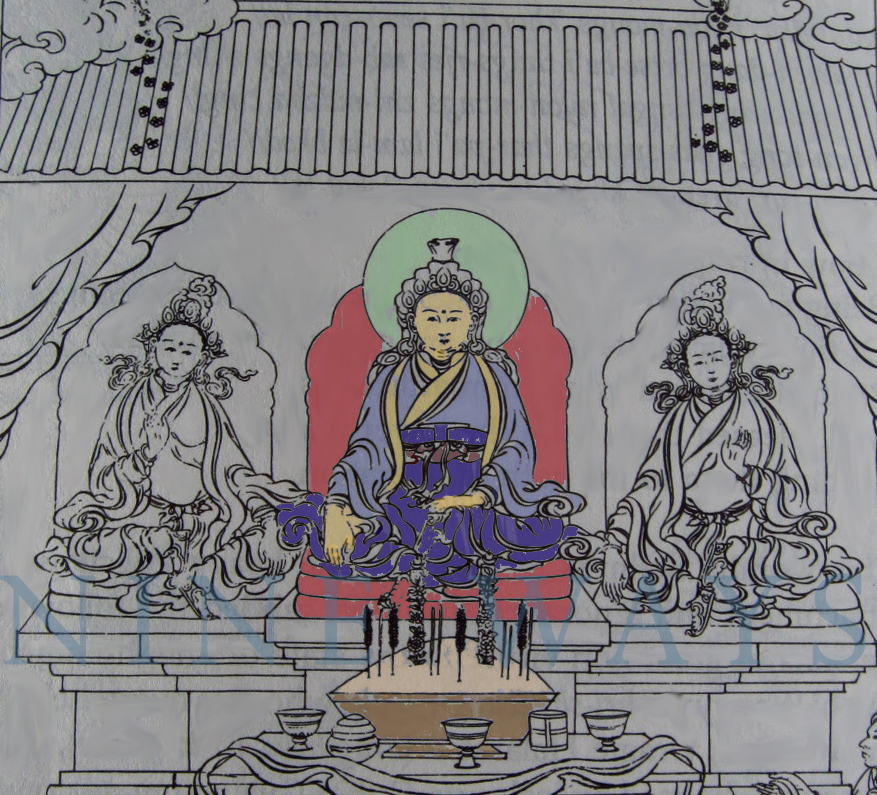
fourth-deed-guiding-w-watermarkAs the Buddha Tönpa Shenrap Miwoché was teaching his disciples, a messenger came to him with a request for help from the deity Sangpo Bumtri.  In the land of Öma Jamkya there was an evil minded prince, named Tobu Dödé, that was slaughtering many living beings including humans. The deity Sangpo Bumtri respectfully requested the Buddha’s help to tame the mind of this evil minded prince.

As Buddha Tönpa Shenrap accompanied by some of his disciples arrived to help, Tobu Dödé incited his army to rise up and kill all of them. Remaining in his golden chariot, the Buddha emanated rays of light into the four main directions which manifested as flaming, wrathful deities. Each of these deities was dark blue having nine heads, four legs, and eighteen arms each holding a different weapon. Upon seeing these deities, many fainted and Tobu Dödé feared for his life. Falling upon his knees before Buddha Tönpa Shenrap, he begged for mercy and vowed to stop killing and to practice virtue. However, even though the evil minded prince had made a vow and had received teachings from the Buddha, his mind remained filled with hatred and anger.

Sometime later, Tobu Dödé fell seriously ill and began to have visions of hell. He cried out for the Buddha to help him and then died. Due to his previous actions, he was reborn into the realm of hell and was tortured. His cries of pain were heard by the Buddha and, due to His great compassion, He descended into hell. Calling out with the mantra “A KAR A ME DU TRI SU NAKPO ZHI ZHI MAL MAL!” both the Lord of death and Tobu Dödé recognized him. The Buddha told him that although the realm of hell was only a manifestation of his own mind, it had now taken form due to his previous karma. The Buddha instructed him regarding the nature of karma and the essence of meditation. When Tobu Dödé’s understanding had changed and his mind developed, even though he continued to be in the realm of hell, the heat and cold no longer harmed him.

Meanwhile, the family and companions of Tobu Dödé, fearing for the consequences of their own negative karma after their death, approached the Buddha and asked for his help. In order to teach beings, He invoked the deities and made offerings on behalf of Tobu Dödé. After seven days, he was freed from the realm of hell. However, because his negative karma continued to ripen, he was successively born into each of the realms of cyclic existence. At the same time, Buddha Tönpa Shenrap Miwoche continued to supplicate the deities and make offerings. Being released from the hell realm, Tobu Dödé was reborn into the realm of the hungry ghosts. After seven days, he was released and was reborn into the realm of animals. After seven days, he was released and reborn into the realm of human beings among barbarians. After seven days, he was released and reborn into the realm of the demi-gods. After seven days, he was released and reborn into the realm of the gods. Although the realm of the gods is filled with leisure and happiness, it remains within cyclic existence and is impermanent. However, due to the continued offerings and supplications of the Buddha, Tobu Dödé was reborn as a human being in the purest land of Olmo Lungring.  In this way, Buddha Tönpa Shenrap Miwoche showed a method for releasing the suffering of negative karma.


Yungdrung Bon in Mustang

A Yungdrung Bon temple in Jomson, Mustang

The Next Generation

Young nuns at Rayna Menling Nunnery in Dolanji, India

Young nuns at Rayna Menling Nunnery in Dolanji, India

The Fourth Way: Rituals for the Dead

candles at ceremony smaller with credit

It is traditional to make many offerings of light for those who have died

The Fourth Way within the Nine Ways of Bön is called The Way of the Shen of Existence  and is primarily focused upon rituals for the dead.  From the perspective of Yungdrung Bön, the moment that the consciousness leaves the container of the physical body is a time of great potential.  If someone has received the proper instructions and practiced, it is possible for them to achieve liberation from cyclic existence at that time.  If not, there are methods to lead the deceased’s consciousness to liberation or at the very least, to guide them to the circumstances of a positive rebirth.

In general, once an ordinary person dies, they experience a kind of unconsciousness like falling into a deep sleep.  “Awakening” from this state, it is possible for them to not realize that they have in fact died and therefore to continue to be attached to their family and life situation.  Generally lasting three days, but possibly longer, this is the time when the lama tells the individual that they have died and instructs them to not be afraid and to release their attachment to family and friends.  The fourth day after death begins a 49 day period of transition referred to as the “bardo” and literally translates as “in-between”.  During these seven weeks, the individual both becomes less attached to the previous life and is drawn by the force of karma to the next life.  While this is happening, each week the deceased is having experiences of each of the six possible destinies of rebirth.  These six destinies of rebirth from lowest to highest are: the hell realm, the hungry ghost realm, the animal realm, the human realm, the demi-god realm, and the god realm.  For example, during the first week, the person would have experiences related to the hell ream.  During the second week, they would have experiences related to the hungry ghost realm, and so on.  Therefore,  prayers and rituals are done each week that emphasize antidotes and guidance for the particular obstacles and experiences that the deceased might be having.  Additionally, offerings of light, prayers of aspiration and recitation of mantra for the benefit of the deceased are performed each day.  On the 49th day, special rituals and prayers are performed in order to strongly influence the path of rebirth.

Buddha Drajin Donpung, Buddha of the human realm

Drajin Donpung, Buddha of the human realm

This is a general description.  Whether someone spends a greater or lesser time in the bardo, or doesn’t experience it at all, is dependent upon many factors including their virtue or non-virtue and the strength of their awareness and spiritual development.

The lama performing the rituals must have both proper knowledge of the rituals as well as have developed great compassion for other beings.  According to the words of the Enlightened Lord Tönpa Shenrap Miwo,

“The best of shen who is expert in meditation and who has aroused feelings of immeasurable compassion towards feeble living beings, and who possesses the four immeasurable qualities and who puts the good of others before himself..”

Preceding the preparations for the rituals, the lama will ascertain the details of the death such as the time and circumstances involved.  Then, a divination and astrological calculations are performed in order to determine the proper day and place to perform the ritual and burial as well as any additional rituals that could be of benefit for the family.  In this way, the natural process of death and rebirth is supported by the spiritual guidance and the ritual expertise of the lama.  From the Bardo Thodal, “Liberation Upon Hearing”:

“Lama, from your compassion, bless me.  Bless me to stop the deluded visions of the bardo.  Bless me that I may prevent the possibility of rebirth in the lower destinies of rebirth.  Bless me that I may achieve the five wisdoms.”

Illuminating the Sacred

Nangzhig-Monastery-at-night

The Yungdrung Bön Monastery of Nangzhig during one of the New Year celebrations