Blog Archives

Pilgrimage: Yanggon Monastery

Yang gon Monastery edited

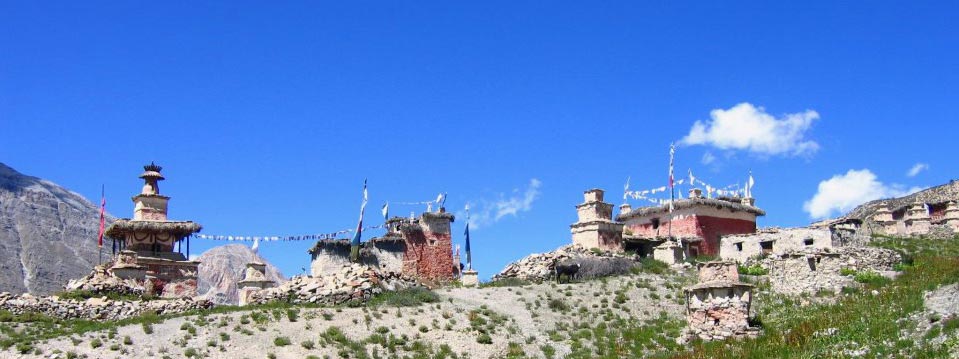
Location: The full name of this monastery is Yanggon Tongdrol Phuntsok Ling, Temple of the Yangtön Lineage, Land of Complete Fulfillment that Liberates upon Seeing.   However, it is commonly referred to simply as Yanggon Monastery.  At 14,160 ft above sea level, it is located in the highest village within the remote area of Dolpo, Nepal.  This is the village of Charka (Tsarka in Tibetan.  Charka is the common Nepali pronunciation.)  It is located at the junction of two rivers appropriately named The Big River and The Small River.  The monastery complex consists of the first temple which is now in ruins, the second temple which was originally built in the mid-nineteenth century and later moved in the early 90’s and consolidated with the third temple which was built in 1988 by the current head lama, Yangtön Lama Tashi Gyaltsen.

Charka village highest village in NepalThe village of Charka

History: The history of the Yangtön lineage is closely interwoven with the history of the Yungdrung Bön tradition itself.  It is said that two of Buddha Tönpa Shenrap’s disciples were Yangtön lamas.  And during the reign of the first Tibetan king, Nyatri Tsenpo in the second century B.C., the official priest for the king and the kingdom was a Yangtön lama.  The original seat of the family was at Taktsé Jari in Upper Tsang, Western Tibet.  The great lama, Yangtön Sherab Gyaltsen was the first to travel away and eventually settled in Mustang, Nepal where he established a hermitage.    Another lama, known as Lama Ngakpa, settled in Mustang for a time but then made his way to Dolpo.  Because all of his children died at a young age, he brought a boy to Dolpo from the original family seat of Taktsé.  This prompted the rest of the family to follow and settle in Dolpo.  It was this boy, Yangtön Gyaltsen Rinchen, who founded the nearby monastery of Samling.  He was also a teacher to the esteemed Dru Gyalwa Yungdrung who wrote a practice manual for the Oral Transmission of the Zhang Zhung Dzogchen teachings.

Lama Tashi editedYangtön Lama Tashi Gyaltsen

Currently: The head lama of the monastery is Yangtön Lama Tashi Gyaltsen.  He was the first of the Yangtön lamas to receive his Geshe, Doctorate of Religion and Philosophy, from Menri Monastery in Dolanji, India.  His younger brother soon followed and is now the head teacher of the monastery, His Eminence Menri Lopön Thrinley Nyima Rinpoche.  Their nephew, Yangtön Geshe Tenzin, has also received his Geshe degree and, like his uncles, he travels throughout the world teaching as well as spending time in the village of Charka organizing building projects and offering rituals and teachings to the villagers.  In addition to his activities of building and preserving the family temples, monks’ living quarters and building projects, Yangtön Lama Tashi is also responsible for the teaching and spiritual guidance of a small group of young monks.
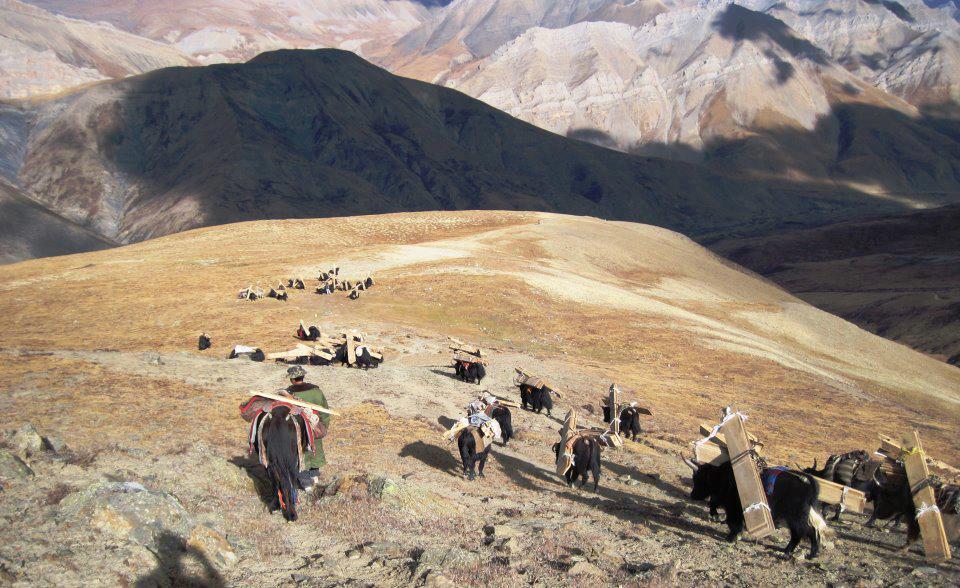
Yaks carrying wood in DolpoYaks carrying lumber

Because of the remoteness of the village, all supplies for building must be carried in on foot.  This is a slow and arduous process.  Building supplies must be brought by animal from Jomsom, Mustang via a narrow, single-track path.  This can take up to seven days.  Large beams for construction must be carried by humans from Tibet.  The cost of getting the supplies to the remote village can average 4-5 times the actual cost of the supplies themselves.  Rocks for a building’s foundation can only be gathered in Winter because they are located on the opposite side of the river and it is necessary to wait until the river freezes enough to be walked across.  In recent years, in spite of the difficulty, the Yangtön lamas have been able to build and begin to establish a much needed medical clinic in the village that will serve the 500-600 villagers.   The clinic is located on monastery grounds and is supervised by the monastery.  Before the establishment of the clinic, the nearest medical support was over a hundred miles away.  Common medicines were rare and infection from minor cuts and injuries easily became life threatening.  Infant mortality was over 50%.  Construction of the free healthcare clinic began in 2009.  Three people are being trained as doctors who will staff the clinic.  One is learning Western medicine, one is learning traditional Tibetan medicine and a third is specializing in being a midwife.  In addition to medical intervention, the staff will also educate the local population about hygiene and first aid.

Charka clinic 2010Medical Clinic in the village of Charka

For more information about Yanggon Monastery, http://www.yanggon.org/

For more information about the free healthcare clinic and its current needs, http://kwling.org/projects/clinic/

The First Temple in Exile: Dorpatan Monastery

Dhorpatan Bon Monastery

The official name of this monastery is Tashi Gégye Thaten Ling.  However, it is commonly referred to as the Dorpatan Monastery.  This was the first Yungdrung Bön temple in exile. It is located in Nepal, south of Dolpo, in the village of Dorpatan.  In addition to the monastery, there is also a medical clinic which serves the local population.  The settlement is now roughly divided into an area inhabited by the Bönpo and an area inhabited by the Buddhists, mostly Kagyu.  However, the religious practices and festivals are predominantly Yungdrung Bön.

map of dhorpata

In the early 1960’s after the Chinese invasion, a refugee camp for the Bönpo was established in Dorpatan by The Red Cross.  At that time, the spiritual head of the Bönpo and 32nd Abbot of Menri Monastery, Kündun Sherap Lodro, was staying in Kathmandu after having fled Tibet.  He traveled to Dorpatan and initiated the construction of a temple.  Kündun Sherap Lodro later went to India and management of the temple was taken over by Tsultrim Nyima.  He was the father of the current abbot of Triten Norbutse monastery in Kathmandu, Khenpo Tempa Yungdrung Rinpoche.  Tsultrim Nyima was strongly devoted to his work with the temple but was unfortunately killed at a relatively young age.  At that time, management of Dorpatan Monastery was taken over by Sonam Gyaltsen.  After his death, Geshe Tenzin Dargye was appointed as the abbot and continues in this position until today.

Khenpo Tamdin smaller(Khenpo Tenzin Dargye, also called Khenpo Tamdin, is the current abbot of Dorpatan Monastery.)

Khenpo Ratsa Geshe Tenzin Dargye was born in 1966 in Jomsom Mustang, Nepal.  His father, Yungdrung Gyal, is the 36th in the Phong la Ratsa lineage of East Amdo.  His mother, Konchok Dolmo, is of the Amchi lineage, a Tibetan doctor.   Khenpo Tenzin Dargye was tutored at home by his father until the age of nine and then sent to study in India.  At the age of sixteen, he decided to become a monk.  In 1996, he received his Doctorate of Religion and Philosophy, or Geshe Degree,  from the Dialectic School of Menri Monastery. After this, he worked as the organizer of the Bön Children’s Welfare Center and the medical dispensary for seven years. In 1996, he was asked by the 33rd Menri Trizen to transfer and to become the abbot of Dorpatan Monastery.  Over the years, Khenpo Tenzin Dargye has worked to improve the monastery.  Together with Dr. Tsultrim Sangye, they established a medical clinic in order to provide much needed medical services to the local and surrounding area.  Khenpo regularly travels and teaches throughout Asia, the United States, Mexico and Europe.

In the region surrounding Dorpatan Monastery, the main agriculture consists mostly of potatoes although there has been an effort to establish apple trees.  During the summer, there is also a great deal of animal husbandry.  During the Winter, many people migrate south and trade potatoes for salt, rice and wheat.

The 84,000 Doors of Bön at Your Fingertips

mala

“The mala represents the destined connection with the Enlightened Beings.  The mala string represents the 84,000 doors of Bön.  The head bead represents the principal teacher.  The counting beads represent the Six Subduing Shen, the six enlightened Shen who tame the six realms of cyclic existence.”  ~from The Advice of Lishu Taring

The mala is called treng wa in Tibetan.  It consists of one hundred eight counting beads and one larger main bead, often referred to as the ‘head bead’ or the ‘lama bead’.  Malas can have spacer beads which are not counted during recitation of a mantra but are used for decorative purposes or to lengthen the mala and enable it to fit onto an individual’s wrist.  Various kinds of counters are often added to the mala so that the practitioner can keep track of the mantra recitations. Malas can be made from various materials.  Traditionally, many of these materials were symbolic.  For example, tantric practitioners would often use malas made of bone to represent impermanence.

Before a mala is used, the practitioner will have it consecrated by a lama.  This blesses it and also removes any contamination that the materials might carry with them that could be an obstacle to obtaining the benefit of the recitations performed using the mala.  Although there are one hundred eight beads, one complete round of recitations is counted as one hundred.  In this way, if any beads have accidentally been skipped during the recitation, they are accounted for with the ‘additional’ eight beads.  Many practices require a commitment to recite a minimum of one hundred thousand repetitions of a mantra.  Therefore, these ‘extra’ beads ensure that the commitment has been fulfilled.  In general, during recitation, the practitioner is not allowed to eat, drink, talk, sneeze, spit or cough. These activities expel or diminish the power that is being generated.  Once the session of mantra recitation is complete, the mala is rubbed gently between the hands and blown upon by the practitioner.  In this way, the mala becomes further empowered and blessed by the mantras that have been recited.

The mala is a sacred object and should not be worn as though it is a kind of jewelry. It should be kept clean and not be handled by others.  By wearing the mala on the wrist or carrying it in a pocket on the body, it acts as a form of protection.  The mala is also sometimes used for divination or healing purposes.  Lamas will sometimes give away their mala intact, or one bead at a time.  Because of the power of the lama’s practice and recitation, this gift is a great blessing.

What are the Nine Ways of Bon?

Dolpo-Samling

(Samling Monastery in Dolpo, Nepal)

There are three hagiographies of Buddha Tönpa Shénrap Miwoché’s life.  They are commonly known as the Do Düs, the short version which has only one volume.  The Zer Mik is the medium length version with 2 volumes.  The Zi Ji is the long version and has 12 volumes containing a total of 61 chapters.  All of these texts are classified within the Kangyur.  It is within the longer version, the Zi Ji, that the teachings of Yundgrung Bön are explained by the Buddha within the context of nine different ways, or vehicles.  The 1st, 2nd, 3rd and 4th Ways are classified as The Causal Ways, or the Bön of Causes.  The 5th, 6th, 7th, and 8th Ways are classified as the Ways of the Result, or the Bön of the Fruit.   The 9th Way contains the teachings of the Great Perfection, or Dzogchen.  From the 1st to the 9th Way, the view, or perspective, of the methods and teachings becomes increasingly higher.  However, even though one is a practitioner of a higher ‘Way’, this does not exclude the practice of one or more of the lower ‘Ways’ should the need arise.   Although the methods differ, all of the Nine Ways have compassion as their base.

In centuries past, during times of persecution, the Bönpo would hide their texts rather than have them destroyed.  Later, after the political environment had changed and they were no longer in danger, the texts would be searched for and brought out from their hiding places.  In this way, there came to be three different classifications of the Nine Ways of Bön according to the region in which the texts were found after being hidden.  These three are referred to as The Southern Treasures, The Northern Treasures, and The Central Treasures.

In 1961, the Rockefeller Foundation gave funds to various universities who had established Tibetan studies programs in order to allow them to invite Tibetan scholars for a 3 year period.  Yongdzin Tenzin Namdak Rinpoche, Geshe Lungtok Tenpa’i Nyima Rinpoche, the future abbot of Menri Monastery, and Geshe Samten Karmey were invited to England by David Snellgrove.  During this time, Yongdzin Rinpoche suggested the translation of excerpts of the Nine Ways based upon the Southern Treasures.  Yongdzin Rinpoche personally selected the passages that David Snellgrove translated.  In 1967, these excerpts were published as The Nine Ways of Bön.  At that time, very little was known about the Yungdrung Bön tradition among Western scholars.  There was a great deal of theorizing and conjecture.  So, although Snellgrove’s translation of the text is quite accurate, his own personal conclusions as to the origins and influences of the Yungdrung Bön should be taken within the context of the time in which he was writing.  However, to-date, his translation remains the only extended translation of the Nine Ways that is available.

(en español: https://losnuevecaminos.wordpress.com/about/)

The Nine Ways of Bön according to the Southern Treasures:

1. The Way of the Shen of Prediction: This Way includes divination, astrology, various rituals, and medical diagnosis.

2. The Way of the Shen of the Phenomenal World: This Way includes rituals dealing with communication with external forces such as rituals of protection, invocation, ransom of the soul and life-force, and  of repelling negative or harmful energies.

3. The Way of the Shen of Manifestation: This Way includes venerating a deity or master and then applying mantra and mudras in order to accomplish a goal such as requesting assistance from natural energies.

4. The Way of the Shen of Existence: This Way is primarily focused upon rituals for the dead and methods to promote longevity for the living.

5. The Way of the Virtuous Lay Practitioners: This Way specifies the proper conduct of lay person taking vows.

6.  The Way of the Fully Ordained: This Way specifies the proper conduct for those who are fully ordained practitioners.

7. The Way of the White AH: This Way is primarily focused upon tantric practice using visualization.

8. The Way of the Primordial Shen: This Way is primarily focused upon higher tantric practice.

9. The Unsurpassed Way: This Way is primarily focused upon the practice of Dzogchen, or The Great Perfection.  This Way does not rely upon antidotes of any kind, ritual or practice with a meditational deity.  It is concerned with the realization of the true nature of one’s own mind.

Blue like the Clear, Open Sky

blue text

In the Bön Buddhist tradition, the color blue has great, meaningful significance.  Specifically, the blue of the clear, open, vast expanse of the sky.  Among the five schools of Tibetan Buddhism, only Bönpo monks have blue on their robes.  In ancient times, Bön practitioners wore blue robes.  Bön texts are wrapped in blue cloth, the stiff top and bottom covers which protect the paper are blue, and all page edges are painted with blue ink.  Here, a sacred scripture is written on blue paper.