Blog Archives

Pilgrimage to the Center of the World: Gang Tise

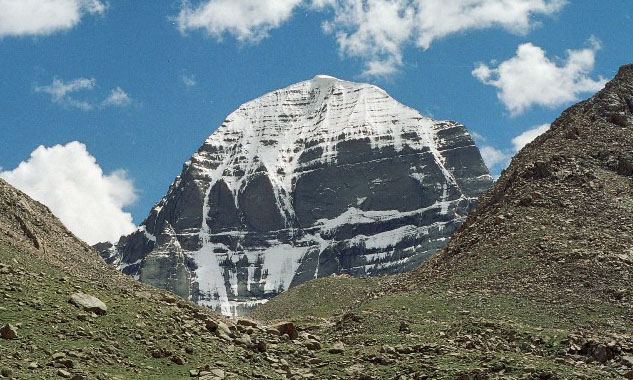
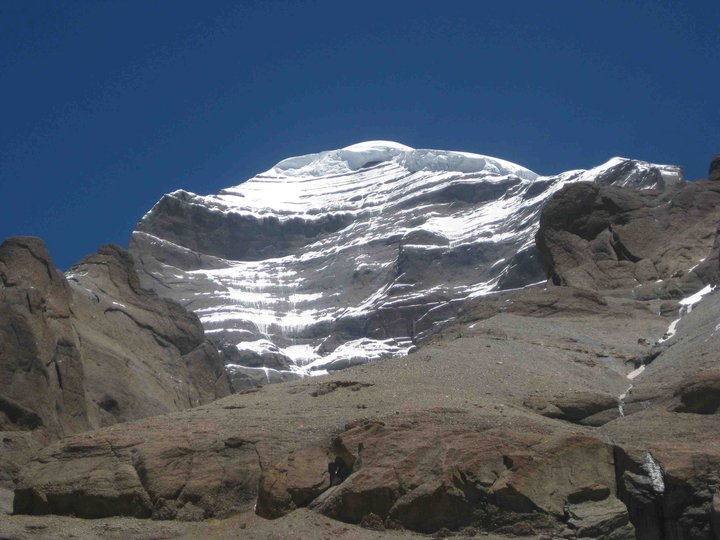
mt tise landscape view(Southern Face of Mount Tisé, also known as Mount Kailash)

It is the seat of Shiva according to Hindus.  Many Jains believe it to be the holy site where the founder of the Jain religion, Lord Rishabhdev, attained liberation.  It is the place where Milarepa lived and practiced according to Buddhists who call the mountain Gang Rinpoche, Precious Snow Mountain.  And according to the Bönpos, it is Mount Tisé, sacred dwelling place of deities, the place where Buddha Tönpa Shenrap Miwoché taught and meditated, and where many sages after him, such as the great lama Drenpa Namkha, Choza Bönmo and Lishu Taring, practiced the teachings of the Yungdrung Bön.  For all of them, to make a pilgrimage to this place and to circumambulate the mountain has great spiritual significance.  “Whoever visits Gang Tisé will achieve liberation after three lifetimes.” And, “If you cleanse with the purification waters of the four directions (of the mountain), you will be reborn in a pure realm.”

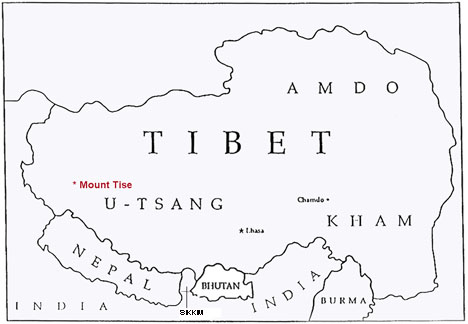
In Sanskrit and on most English language maps, it is called Mount Kailash.  It is located in far Western Tibet in the Ngari region which is a remote and arid landscape only spotted with vegetation.  With no source of wood, campfires are fueled with goat and horse dung.  Reaching the area through a pass of over 16,000 feet in altitude, the air is thin and the light intensely reflects upon every object in the landscape.  Until recent history, there were no roads in to this region.  The mountain has a 22,028 foot peak that is topped with snow year round.  Each of the four sides of the mountain are distinctively different. It has never been climbed.   For the devout, that would be an unthinkable desecration.  In 1980, Reinhold Messner was given permission to climb it by the Chinese.  However, he declined.  In 2001, a Spanish team led by Jesus Martinez Novas was given permission to climb the mountain.  However, due to international disapproval, the Chinese reversed their decision and banned all attempts to ever climb the mountain.

Mt Tise map

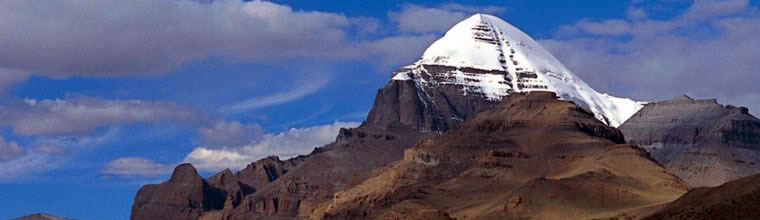
Mount Tisé was at the center of the ancient kingdom of Zhang Zhung.  Tisé is a Zhang Zhung word referencing the mountain as the source of many waters.  It was the soul mountain of both the Zhang Zhung king and the kingdom and was considered the center of the world.  The Zhang Zhung deity, Walchen Gekho and his 360 emanations,  reside at its summit.   It is described in many historical Yungdrung Bön texts in great detail.  “In the center of the phenomenal world is Mount Tisé, the Nine-storied Yungdrung Mountain.  From it, four rivers flow towards the four directions.”  These four great rivers which originate in the area surrounding the mountain are the Karnali, also known as the Ganges which flows Southward, the Sutlej also known as the Punjabi which flows Westward, the Brahmaputra which generally flows Eastward, and the Indus which generally flows to the Northwest from the area.  The texts say that Mount Tisé will survive the fires that will destroy the world at the end of the current eon.  The texts describe it further:  “It looks like a crystal chorten.  It’s four sides are like four equal squares in the four directions.”  And, “It has the four kinds of qualities: peaceful, expansive, powerful and wrathful.  It is an immeasurable shrine with great blessings”

Tise North side edited(Northern face of Mount Tisé)

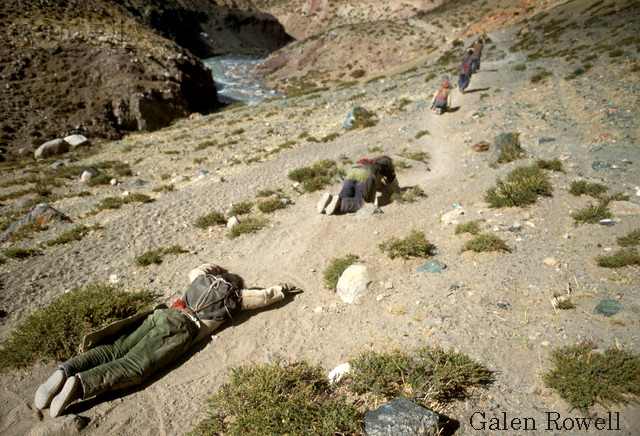
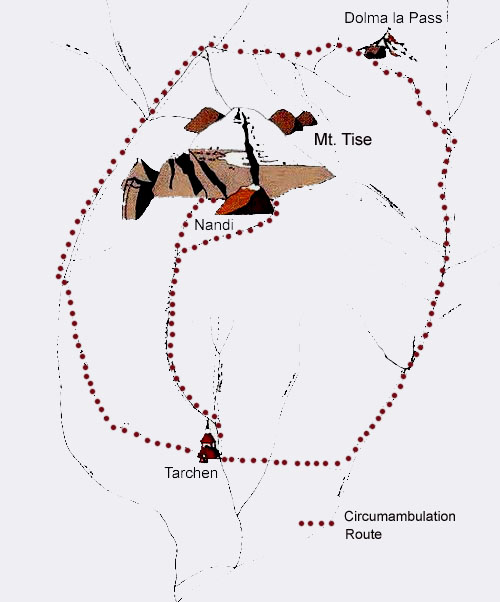
Pilgrimage season is generally May-September.  The circumambulation, or korwa, begins at Tarchen, a small settlement on the South-side of the mountain.  Until the Chinese invasion, it was a major center for the region’s trade.  Now, although the summer continues to be the busy trade season, it is much diminished from the past.  By the time a pilgrim reaches this starting point, it is possible that they have spent years getting here, often prostrating the entire journey.  Once here, if a pilgrim is unable to undergo the hardship of the korwa, here at Tarchen someone can be found to be sponsored to go in their place.  In that case, the merit generated by the virtuous activity is shared between the sponsor and the one actually doing the korwa. For the Bönpo and the Jain, the korwa is counter-clockwise.  For Buddhists and Hindus, it is clockwise.  The path is marked by many sacred places of veneration where great sages meditated or where the power and blessings of deities reside.  There are also four places designated for prostrations along the way.  These are areas large enough for the pilgrims to stop and spend time prostrating and paying homage to the sacred mountain.  However, there are those practitioners who choose to perform full prostrations the entire length of the thirty-two mile circuit around the mountain.  Doing this, a single circuit takes about two weeks.  These pilgrims must carry their provisions with them and wear thick, leather aprons and mittens to protect their body from the stoney ground.  For those who walk around the mountain, most choose to finish within three days.  Others choose to begin hours before dawn so that they can complete the journey in a single 13-15 hour day.  The pilgrim’s path rises in the thin air to an altitude of 18,500 feet at the Dolma la Pass, the highest point of the route.


Pilgrims Prostrating Themselves(Pilgrims prostrating around the mountain.)

In general, pilgrims perform three circumabulations of the mountain.  If the pilgrim is completing the circuit in a single day, they will take a day of rest in between the three korwa of the mountain.  Some make a commitment to complete 1o8 circuits.  This takes two pilgrimage seasons.  From the starting point at Tarchen, there is also an inner korwa.   Several miles North of Tarchen past a couple of monasteries, there is a smaller mountain, called Nandi, whose korwa brings the pilgrim close to the very face of Mount Tisé.  This inner korwa is forbidden until one has completed at least thirteen circumambulations of the outer korwa.
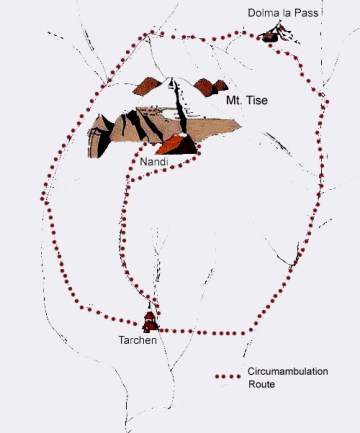
Mt Tise outer and inner korwa edited

Just seeing the mountain is a blessing.  And undergoing the arduous task of its korwa is said to purify one’s negativity.  It is vitally important in the history of Yungdrung Bön.  According to the text, “Mount Tisé, the crystal chorten, soul mountain of Yungdrung Bön, is like nine stacked yungdrungs.  Externally, it is like a chorten made of crystal snow.  Internally, it is like the palace of the three tutelary deities.  Secretly, it is the vast and profound gathering place for the mother and sister khandro.”  “Having washed away karmic traces by purifying oneself with the healing waters, you will be reborn in a joyous realm of the gods.  Having reversed obstacles and adverse circumstances by performing the korwa through prostrating, you will be able to live out the full extent of your lifespan.”  Thus it is said.

Mt Tise East face by Rikdzin lama(Eastern Face of Mt. Tisè.  Photo by Rikzin Lama)

To read more about Mount Tisé see Sacred Landscape and Pilgrimage in Tibet by Geshe Gelek Jinpa and Charles Ramble.  The Light of Kailash by Chogyal Namkhai Norbu Rinpoche.  Or The Sacred Mountain of Tibet by Russell Johnson and Kerry Moran. And in Tibetan, Gangs Tise’i sKor by HE Menri Yongdzin Tenzin Namdak Rinpoche.


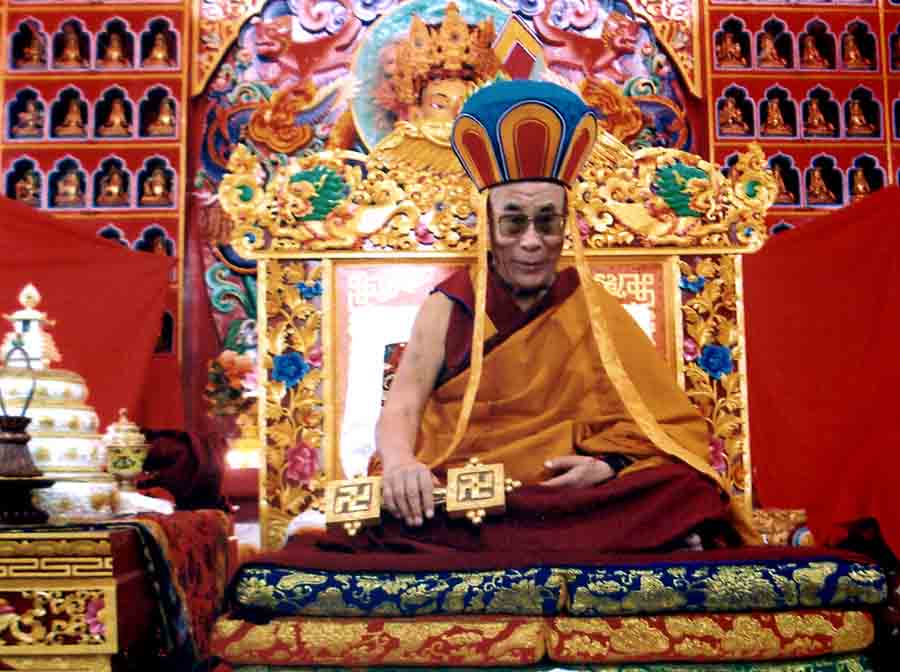
His Holiness the Dalai Lama at Menri Monastery

Dalai Lama on throne at Menri

His Holiness the Dalai Lama on the throne at Menri Monastery, the spiritual seat of the Yungdrung Bön.  Here, he wears a Bön lama’s hat and holds the chakshing which is a symbol of the Buddha Tönpa Shenrap Miwoché.

The Five Elements: Earth

kham-earth-w-watermark The element of Earth is called sa in Tibetan.  It is symbolized by the shape of a square and its color is yellow, or golden.  The unique vibration of this element is the sound ‘KHAM’.  It is associated with the direction East.  From the Yungdrung Bön point of view, East is one of the cardinal directions but it is also associated with ‘the front’.  For instance, when looking at the image of a deity, East is always considered the front of the deity.  Earth provides solidity and stability.

Environmentally, our dependence upon the element of Earth is obvious since this is the name of the very planet that we live upon.  Additionally, it is the soil in which we grow our food and the foundation upon which we build our homes.  In the Yungdrung Bön tradition, one’s relationship with the environmental element of Earth is not only with the form.  It includes the spirits of the element itself as well as seeing the land as a living being.  Before beginning construction of a building, it is important to examine the characteristics of the land.  Traditionally, it is seen as a turtle.  If you build upon the turtle’s ‘head’, then the spirit of the land will ‘die’ and the soil will become barren and empty.  It is best to build in the ‘stomach’ of the turtle because here, there is more empty space and no ‘major organs’ will be disturbed.  Once the proper location has been determined, it is important to communicate with the spirits of the land that are already in residence at that location and to assure them that you mean no harm and that you apologize for any disturbance that the building causes them.  To simply begin digging holes, cutting down trees and erecting buildings would be similar to someone barging into your house and rearranging furniture and knocking down walls without even acknowledging your existence.  Therefore, these things are considered important for maintaining harmony.

Within our bodies, the element of Earth rules our flesh.  More specifically, it is associated with the spleen.  The element Earth, along with the other elements, also exist within us in a more subtle form as a kind of wind that ideally moves upwards in our bodies and brings nourishment to our five senses and to our brain.  The balance or imbalance of this subtle Earth wind affects our internal experience.  When the element of Earth is balanced within us, we feel stable, secure, confident and able to handle whatever comes our way.  We are steady and consistent in our relations, our commitments, and our routines.  We feel that we have enough support for our life.  And we have sustained concentration and diligence in our meditation practice.  If Earth is in excess, then we feel lazy, weighed down, and heavy.  Our bodies and minds literally plod along.  Our thinking is dull and lacks creativity or inspiration.  To the extreme, we become depressed and only want to sleep.  If Earth has become weakened, we are literally ungrounded.  It is difficult to maintain focus on anything long enough to finish it or follow through.  We are filled with doubt and find it difficult to make decisions.  We feel insecure and dissatisfied.

In order to bring the element of Earth back into balance, there are methods such as Tibetan medicine, ritual and meditation practices.  There are specific yogic exercises within the Yungdrung Bön tradition which use the focus of the mind together with the breath and movement of the physical body to balance and strengthen the subtle elements within us.  To learn more about these yogic exercises see Healing with Form, Energy and Light by Tenzin Wangyal Rinpoche.  Additionally, there are other methods available to us.  For example, if the Earth element is weakened, spend time feeling the pull of gravity upon your physical body.  Sit and meditate upon the image of a mountain.  Eat heavier foods and avoid caffeine and being overly busy.  Sit still.  If the element of Earth is in excess, then get up and move the body.  Go for a walk or do other kinds of exercise.  Eat lighter more easily digested foods.  Avoid the temptation to sleep too much.  Spend time with people who are active and creative.  Pay more attention to the wind and the movement of things around you.  When the element of Earth is balanced within us, we can remain grounded and focused in any situation without getting stuck or losing the ability to change and be flexible.

The First Way: Divination, Astrology, Ritual and Medicine

Detail from the tree of health and illness which shows the root, branches and leaves of both health and illness. Photo credit: Raven Cypress Wood

The First of the Nine Ways of Bön is The Way of the Shen of Prediction and contains methods of divination, astrology, healing rituals and medical diagnosis which deal directly with the concerns of this present, worldly life. As in all of the Nine Ways, the basis for all practice is compassion.  Although the ultimate goal is enlightenment and complete release from the suffering and misery of cyclic existence, the perspective of The Way of the Shen of Prediction is upon the individual’s immediate circumstances during this very lifetime.  Within the Yungdrung Bön tradition, the knowledge related to the divination, astrology, healing, and medical diagnosis is vast.  In the words of the Buddha Lord Tönpa Shenrap Miwo:

“In general, there are 360 different kinds of divination.  There are 360 kinds of astrological calculation.  There are 360 kinds of ritual and 21,000 methods of diagnosis in order to avert the danger of death.” 

Divination or mo, This is a method through which one can obtain guidance for worldly questions such as, “Will my new project be successful?” or “Will my travel be safe?” If the answer is negative, the text will either recommend a different course of action or suggest an antidote such as prayers or ritual that could change the projected course of events for the positive. It is common to ask a lama for a divination for any number of reasons such as success of new projects, buying or selling a home, traveling, health, or marriage.

Copy of an old text detailing a method of divination taught directly by Lord Tönpa Shenrap. Photo credit: Raven Cypress Wood

There are four categories of divination within Yungdrung Bön tradition: 1) using a mala or die, 2) using the drala, or powerful protective spirits who are considered messengers of the gods, 3) dreams, and 4) reading signs and symbols. For each of these methods, it is necessary to receive instructions, transmission and empowerment. Then, a prescribed individual retreat is undertaken in order to receive the blessings and power of the respective deity associated with the divination.

astrology thangkha

Astrological deities and symbols of the Yungdrung Bön. Photo credit: Raven Cypress Wood

Astrology or tsi, is a method to determine the harmony or disharmony with the external forces of the universe as well as a calculation of the flow of time.  For example, the Tibetan New Year begins somewhere between the beginning of February and the end of March. The exact date is determined astrologically. Each year is characterized by one of the five elements and by one of twelve animals which are alternatively male or female.  The qualities of this element and animal combination are identified with every individual born within that year. Subsequently, it is possible to use astrology in order to calculate the probable effect of any given year upon an individual in relation to health, success, wealth etc. For example, someone born in the year of the Male Wood Rat (1984) would have their force of good luck ruled by the wood element.  The year 2013 of the Western calendar was a Female Water Snake year and the year’s  force of good luck is ruled by the water element.  Because the wood element and the water element have a naturally positive relationship, the Male Wood Rat person is likely to have a very positive year related to their force of good luck.  It takes sixty years in order to complete the cycle of twelve animals and five elements.

Astrological calculations are important in order to ascertain the most favorable date and time for important events such as religious festivals, marriages, travel, significant business dealings, healing rituals, funerals, etc.  In this way, the events that take place can be in harmony with the natural energies of the universe and therefore amplify the positive outcome.

A Yungdrung Bön monk prepares for a longevity and life ransom ritual. Photo credit: Geshe Chapur Lhundrup Rinpoche.

Ritual or to, ritual methods used to prevent or stop harm coming from unseen, external forces.  According to the texts, what we perceive as empty space is actually crowded with beings that are invisible to us.  Because humanity damages and pollutes the external environment without consideration for these other beings, we cause harm and offense to these unseen spirits who then seek repayment or revenge.  This can lead to sudden unexplained loss or illness that is resistant to medical cure.

Once divination or astrology has established that the source of the disturbance is one or more of these external unseen forces, a specific ritual is advised in order to restore health and harmony.  Traditionally, a lama is asked to come to the home in order to perform the necessary ritual.  The family hosts the lama and the assistants for the duration of the ritual.  Some rituals are concluded in a single day.  Others may can take many days to complete.

Medical Diagnosis  or men, is a method of diagnosing the cause of a physical illness and prescribing a medicine to bring about a cure. The root of health is awareness and virtuous behavior, and the root of illness is ignorance and non-virtuous behavior.  This idea is expounded at great length in the Yungdrung Bön medical texts.   Health is the balance of the qualities of wind, bile and phlegm within the body.  Illness is the weakness, damage or excess of any or all of these qualities.  The hot or cold nature of the imbalance is also taken into consideration.

Old-style Tibetan medicine bags. Photo credit: Dr. Nyima Gurung.

When diagnosing the root cause of an illness, the doctor will use the three techniques for diagnosis: 1) seeing, 2) touching, and 3) questioning. These include observing the general demeanor of the patient, listening to the sound of their voice, studying the appearance and shape of their tongue, examining the qualities of their urine, and feeling the multiple pulses of both wrists.  The doctor will also question the patient about their behavior, diet and the onset of symptoms.

When prescribing medicine, the Tibetan doctor gives herbal medicines that are to be taken at specific times of day.  Medicine is most effective when taken at the time that the disease is most active or at the designated time of the affected organ.  Additionally, the doctor will give advice for diet and behavior, sometimes prescribing that a patient be more generous and less greedy, or to spend more time with spiritual practice and less time with mindless distraction.  Prevention of disease includes the discrimination of beneficial and harmful activities as well as an appropriate diet with a proper balance of rest and activity.

Raven Cypress Wood ©All Rights Reserved. No content, in part or in whole, is allowed to be used without direct permission from the author.

Don’t want to miss a post? Scroll to the bottom and click “Follow this blog.”


The 84,000 Doors of Bön at Your Fingertips

mala

“The mala represents the destined connection with the Enlightened Beings.  The mala string represents the 84,000 doors of Bön.  The head bead represents the principal teacher.  The counting beads represent the Six Subduing Shen, the six enlightened Shen who tame the six realms of cyclic existence.”  ~from The Advice of Lishu Taring

The mala is called treng wa in Tibetan.  It consists of one hundred eight counting beads and one larger main bead, often referred to as the ‘head bead’ or the ‘lama bead’.  Malas can have spacer beads which are not counted during recitation of a mantra but are used for decorative purposes or to lengthen the mala and enable it to fit onto an individual’s wrist.  Various kinds of counters are often added to the mala so that the practitioner can keep track of the mantra recitations. Malas can be made from various materials.  Traditionally, many of these materials were symbolic.  For example, tantric practitioners would often use malas made of bone to represent impermanence.

Before a mala is used, the practitioner will have it consecrated by a lama.  This blesses it and also removes any contamination that the materials might carry with them that could be an obstacle to obtaining the benefit of the recitations performed using the mala.  Although there are one hundred eight beads, one complete round of recitations is counted as one hundred.  In this way, if any beads have accidentally been skipped during the recitation, they are accounted for with the ‘additional’ eight beads.  Many practices require a commitment to recite a minimum of one hundred thousand repetitions of a mantra.  Therefore, these ‘extra’ beads ensure that the commitment has been fulfilled.  In general, during recitation, the practitioner is not allowed to eat, drink, talk, sneeze, spit or cough. These activities expel or diminish the power that is being generated.  Once the session of mantra recitation is complete, the mala is rubbed gently between the hands and blown upon by the practitioner.  In this way, the mala becomes further empowered and blessed by the mantras that have been recited.

The mala is a sacred object and should not be worn as though it is a kind of jewelry. It should be kept clean and not be handled by others.  By wearing the mala on the wrist or carrying it in a pocket on the body, it acts as a form of protection.  The mala is also sometimes used for divination or healing purposes.  Lamas will sometimes give away their mala intact, or one bead at a time.  Because of the power of the lama’s practice and recitation, this gift is a great blessing.