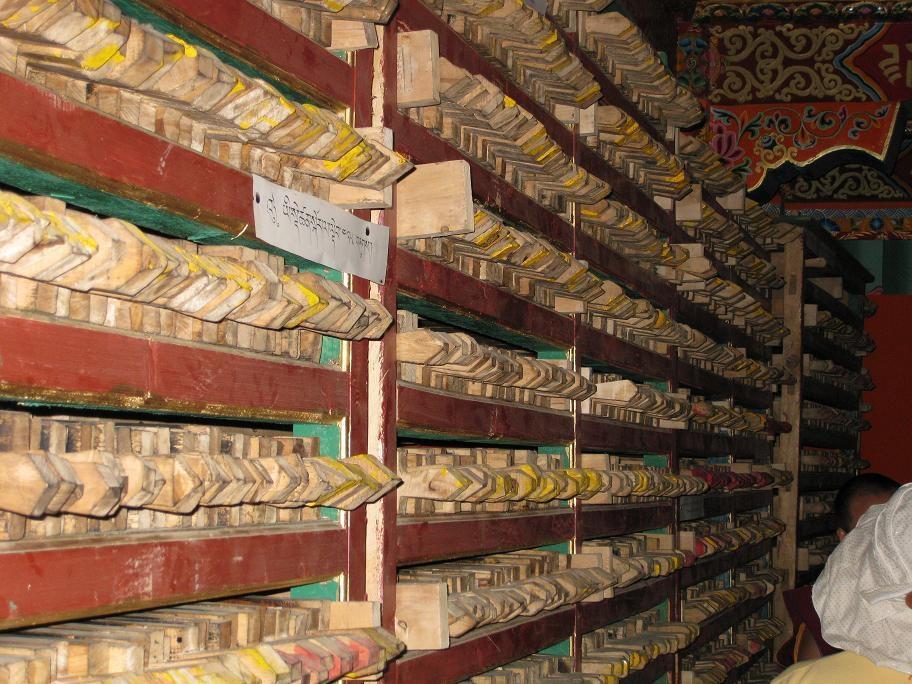
Woodblocks used for printing the sacred texts
Woodblocks used for printing the sacred texts
 In the Tibetan language, the word for ‘devotion’ is ‘mo gu‘.
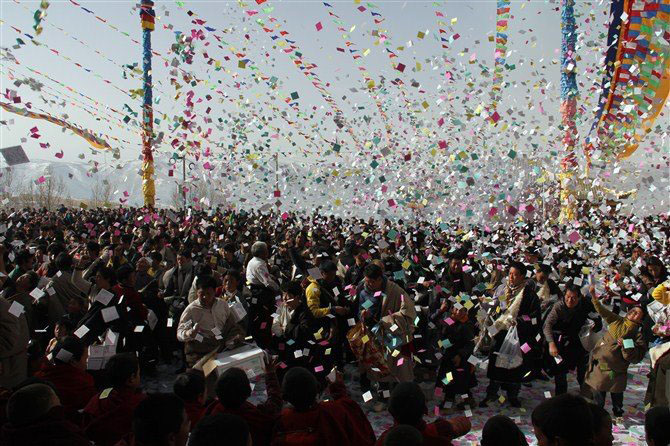
The Full Moon is a time when energies are naturally rising. This is an auspicious time to perform virtue such as spiritual practice, making sacred offerings, visiting sacred places, giving to charity, or protecting the lives of other beings. It is also an ideal time to engage in activities that will strengthen and increase one’s positive qualities and good luck such as raising prayer flags, bringing sacred or precious things into the home, or performing smoke offerings. Here, a group in Tibet uses wind-horse papers which are printed with mantra and prayers for good luck and good health. By tossing them into the sky, it is believed that the energy of the mantras and prayers are activated and will lift one’s energy of luck, vitality, personal power and prosperity.
The Third of the Nine Ways of Bön is called The Way of The Shen of Magical Power and includes practices for venerating a yidam, a meditational deity, or a spiritual master. Then, the practitioner uses mantra together with mudras, symbolic hand gestures, in order to accomplish a goal such as requesting assistance from powerful worldly spirits to remove obstacles or subdue malevolent forces. In general, these practices involve the three stages of:1) praise and service, 2) practice and attainment, and the 3) application of appropriate ritual activities. A yidam is an enlightened being who has manifested in a specific form that embodies specific enlightened qualities that a practitioner can perfect within themselves by meditating upon that yidam deity. For example, the yidam Red Garuda is often practiced to gain influence and power over natural forces in order to avert natural disasters. These practices require an advanced ability to focus and visualize, deep devotion and faith in the yidam as well as the need to undergo a prolonged, solitary retreat of single-pointed practice in order to acquire the power of the yidam. For this kind of practice, the enlightened Lord Tönpa Shenrap has advised that the practitioner should go to a wrathful place such as a mountain that is known to have wrathful energy or to a cemetery. Wrathful retreat places are described as being desolate, infertile areas with jagged rocks or mountains with rough energy.
 (Meditation caves in Mustang, Nepal)
It is also necessary for the practitioner to take and strictly keep all of the vows related to such a tantric practice. Then, having properly prepared the necessary ritual items, the practitioner sets both an external boundary and an internal boundary. The external boundary keeps away any disturbance from the external world which might interrupt the retreat. The internal boundary keeps the practitioner’s mind focused and protected from distracting thoughts. For the Praise and Service part of the practice, the practitioner performs the practice while continuously imagining the enthroned deity in the space just in front and above their head. Generating immense trust and devotion to the deity and a steadfast intention to benefit other beings is of utmost importance. From the words of Lord Tönpa Shenrap Miwo:
“One should exert one’s self in the three kinds of longing devotion to them. One should seek them out like a child who is unable to bear even a moment of separation from the mother. One should seek them out like a needed guide along a dangerous path which is filled with dangers and peril. One should seek them out like the desire to be with an intimate friend who thinks only of you and no one else.”
For the Practice and Attainment part of the practice, it is important to know how to properly prepare the ritual offerings, the appropriate mandala, and the shrine. One also needs to know which sacred instruments will be needed, how to play them and the specific melody for the practice, as well as how to perform the appropriate mudras. These mudras, or sacred hand gestures, are an important method of communication with the unseen. Everything must be clean and of the best quality that is available according to the practitioner’s circumstances. All of the ritual activities must be properly performed. Otherwise, it is possible to create obstacles because of errors. Therefore, by carrying out these ritual activities properly and with undistracted focus, the practitioner unites his body, speech and mind with that of the deity and becomes inseparable from the deity’s qualities and wisdom. In this way, blessings and both ordinary and extraordinary spiritual abilities are received from the deity.

(There are many types of mudras, or symbolic hand gestures.)
For the Application of Ritual Activity part of the practice, having attained the blessings and power of the deity, the practitioner now has the ability to subdue forces which are harming others or interfering with the practice of virtue or other religious activity. Therefore, acting from a foundation of compassion and with the intent to be of benefit, the practitioner overcomes these malevolent forces. From the words of Lord Tönpa Shenrap Miwo:
“If people who enter and practice this Third Way do not have compassion as the base, they are like a seed thrown on infertile ground. If the seed is thrown in a dry place, how can it grow? Thus, one must have faith which will benefit one’s self as well as having compassion which will benefit others.”
These teachings are contained within the external, internal and secret tantras. Their primary goal is to have an immediate result and to bring happiness and help to beings during this very lifetime.
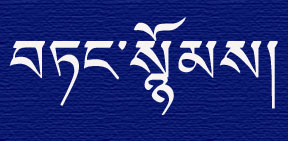 One of the Four Immeasurable Qualities is ‘Equanimity‘. In the Tibetan language, it is ‘Tang Nyom‘. Tang Nyom is the practice and aspiration to perceive all beings in the same way rather than with the bias of the labels ‘friend’ or ‘enemy’. Seeing them otherwise is due to a lack of understanding of the true nature of reality. Therefore, it is important to train the mind to perceive all beings with a benevolent attitude and cultivate the authentic quality of Equanimity, or Tang Nyom, towards all beings.
 Nine Ways