Blog Archives

Happy New Year! Highlights of 2025 for Nine Ways and A Peek Into 2026

Happy New Year! I would like to take this opportunity to share a little bit about the work of Nine Ways in 2025 and what is on its way in 2026. First, I would like to thank all of you who donated towards the work of Nine Ways in the past year. It is these donations that make Nine Ways possible and support my ability to translate Yungdrung Bön texts and publish articles and books to support the worldwide sangha. I appreciate each and every donation and offer my heartfelt gratitude. In this time when it seems as though everything is becoming monetized, I remain committed to keeping Nine Ways free and accessible without a paywall in 2026. However, this is only possible through your support. Supporters giving once a year or monthly donations are the reason Nine Ways is still available. Thank you!

2025

In 2025, Nine Ways published 30 articles with over 55,000 views throughout 139 different countries. Many articles were subsequently translated into other languages and, with permission, published on other websites to extend the reach of Nine Ways even further.

The Nine Ways website expanded to include the Nine Ways Shop ( https://ravencypresswood.com/nine-ways-shop/ ) that offers practice support and ritual items for Yungdrung Bön practitioners in the continental U.S. Purchase of the current items supports the memorial chorten for Yangtön Lama Tashi Gyaltsen Rinpoche that will be built in his home village of Tsarka in Dolpo, Nepal. To date, Nine Ways has raised over $1,500 for the chorten. These funds have been sent to his nephew, Geshe Tenzin Yangtön, who is overseeing the planning of the chorten. With these additional funds, he is now happily planning a larger and nicer chorten than he originally thought was possible.

In September, A Blazing Mala of Wish-fulfilling Jewels: A Compilation of Daily Prayers from the Yungdrung Bön Religious Tradition was published. For more about this book, see the announcement article here: https://ravencypresswood.com/2025/09/28/now-available-a-blazing-mala-of-wish-fulfilling-jewels-a-compilation-of-daily-prayers-from-the-yungdrung-bon-religious-tradition/

Throughout the year, due to the visibility of Nine Ways, I am contacted by Yungdrung Bön practitioners around the world requesting help in arranging personal rituals or prayers, seeking clarification regarding Tibetan language or translation advice, and/or help in connecting with a community sangha or nearest Yungdrung Bön lama. Please continue to reach out. I am happy to help when I can or connect you with someone else who can help.

2026

In 2026, Nine Ways will continue to offer articles related to the Yungdrung Bön tradition free of charge. If there is a particular subject that you would like to know more about and think it might also be of interest to the wider community, feel free to email me at RCW108@Gmail.com and suggest topics for articles.

In 2026, I will be expanding my online and in-person mentorship of Yungdrung Bön practitioners seeking guidance or advice regarding their practice or in preparation for an intensive personal retreat. These can be one-time consultations or regular meetings based upon what is most needed at the time. I am also available on a more limited basis for those wanting to have in-person support or guidance for their practice or personal retreat for one or more days. Email me at RCW108@Gmail.com for more information or to set up an appointment.

In response to many requests over the past couple of years, online classes are coming! I am in the process of planning a series of one-day as well as multi-day classes and support groups. Stayed tuned for more updates.

Nine Ways will publish my book of prayers and practice guidance that are for the benefit of those recently deceased. This book is entitled Planting a Garden of Virtue for the Deceased. This book will contain prayers and rituals that are performed throughout the first three days after death and the subsequent 49 days of the intermediate state before rebirth. Among the prayers that have been translated to include in this book is The Sutra of Destroying the Doors to Negative Rebirths. This text is one commonly recited in the Yungdrung Bön Tibetan community especially if a death was the result of a sudden accident or any kind of violence. In February 2025, a dear friend of mine was shot and killed in a random act of violence. This is the prayer suggested to me by His Eminence Menri Pönlop Yangtön Trinley Nyima Rinpoche. Having recited this prayer for 49 days, I was inspired to translate and publish it for the benefit of others. This is an excerpt from The Prayers of Aspiration within The Sutra of Destroying the Doors to Negative Rebirths:

“Having stopped the continuation of the heat and cold of the hell beings, may hatred and anger transform into an expanse of loving kindness! Having stopped the continuation of the hunger and thirst of the hungry ghosts, may desire and attachment transform into an expanse of generosity! Having stopped the continuation of the stupidity and muteness of the animals, may dull-mindedness transform into an expanse of wisdom! Having stopped the continuation of the savagery of humans, may jealousy transform into an expanse of openness! Having stopped the continuation of the fighting and disputes of the demi-gods, may pride transform into an expanse of peacefulness! Having stopped the continuation of the loss and downfall of the gods, may laziness transform into an expanse of diligence! Having stopped the continuation of the delusions of the beings in the intermediate state, may they transform into buddhas of happiness!”

Title page of The Sutra of Destroying the Doors to Negative Rebirths

The Tibetan New Year, or Losar, will be on February 18th and will be The Year of the Fire Horse. Because Buddha Tönpa Shenrap manifested in his human form during a Horse year, this will be a special year for all Bönpos. The article describing the significance of the Fire Horse year and its meaning according to Tibetan astrology will be published on Nine Ways in the coming weeks.

I hope that everyone and their loved ones are all doing well and that 2026 brings you abundant happiness, indestructible health, prosperity, merit, and positive circumstances!
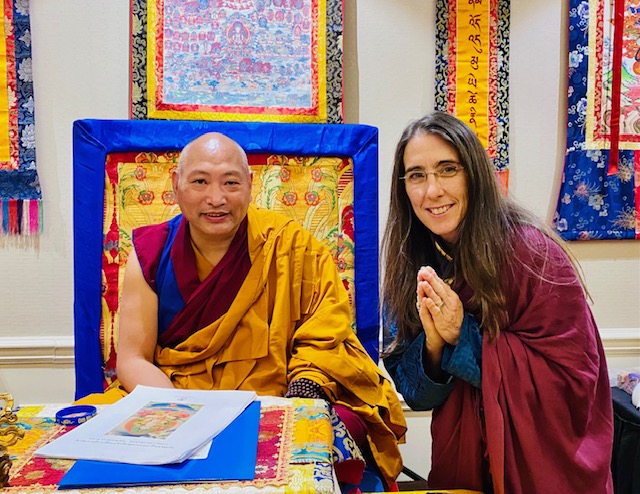
Raven Cypress Wood with His Holiness the 34th Menri Trizin Rinpoche

Raven Cypress Wood ©All Rights Reserved. No content, in part or in whole, is allowed to be used without direct permission from the author.

Did you enjoy this content? This article is made possible by generous donors who want content like this to continue to be available. Don’t want to miss a post? Scroll to the bottom and click “Follow this blog.”

Join the mandala of Nine Ways supporters by donating through one of the services listed below.

The Fifth Way: In the Service of Virtue

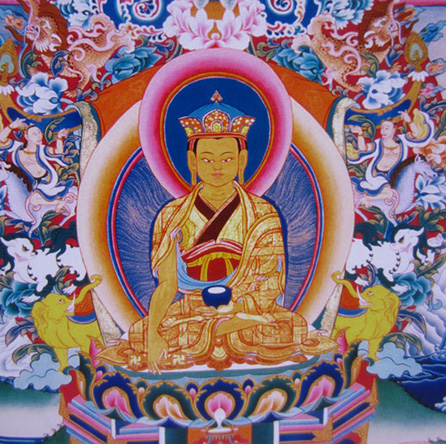
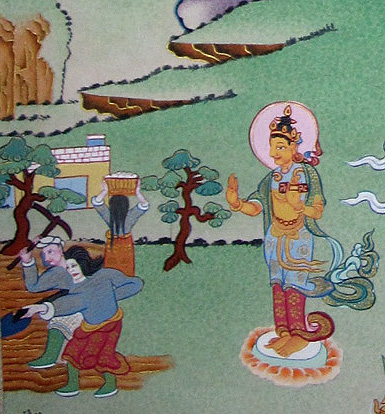
Central Figure of the Tibetan Thangkha Painting Related to The Fifth Way

Within the Nine Ways of Bön, the Fifth Way is called The Way of the Virtuous Lay Practitioners and specifies the proper conduct and commitments of a lay person taking vows. This Fifth Way is the first of the Nine Ways classified as ‘Ways of the Result’ or ‘Bön of the Fruit.’ In the Tibetan language, a lay practitioner is called ‘gen nyen’ [Tib. dge bsnyen] which literally translates as ‘one who serves virtue’ or ‘one who draws near to virtue.’ When asked the meaning of these concepts, the enlightened all-knowing teacher, Buddha Tönpa Shenrap Miwo answered,

“Virtuous means without negative actions. This is one who is committed to serve virtue through their body, speech and mind. Service means serving without holding contradictory views and properly remaining steadfast in service to virtue.”

In general, the lay practitioner commits to practicing the ten virtuous actions and renounces the ten non-virtuous actions of body, speech and mind.  Buddha Tönpa Shenrap defines this kind of renunciation as 1) not performing the actions, 2) not requesting or encouraging others to perform them and 3) not feeling pleased that others have performed the negative actions. Similarly, one commits to 1) acting according to the ten virtuous actions, 2) encouraging others to participate in these activities and 3) feeling joy that others have performed virtuous actions. This is the inner practice.

The Three Virtuous Actions of the Body:

  1. Rather than killing, protecting the life of other beings.
  2. Rather than stealing, practicing generosity.
  3. Rather than engaging in sexual misconduct or causing others to break their vows, keeping one’s own vows and respecting the vows of others.

The Four Virtuous Actions of Speech:

  1. Rather than lying, speaking the truth.
  2. Rather than creating discord, speaking in a way that brings people together.
  3. Rather than using hurtful speech, speaking gently and kindly.
  4. Rather than gossiping or mindlessly talking, speaking in a useful way or reciting prayers.

The Three Virtuous Actions of the Mind:

  1. Rather than coveting the possessions and accomplishments of others, being generous and open.
  2. Rather than wishing harm to others or feeling resentful, cultivating the desire to help others.
  3. Rather than holding wrong views, practicing the teachings of Yungdrung Bön and establishing a true and authentic view.

When asked to teach the outward form of the lay practitioner, The All-knowing Teacher, Tönpa Shenrap first instructed the gathered assembly to construct the first Elegant Yungdrung Chorten [Sanskrit: stupa] according to his detailed instructions. Once completed, he consecrated the chorten and then began teaching the outer forms and behavior of a gen nyen or lay practitioner.

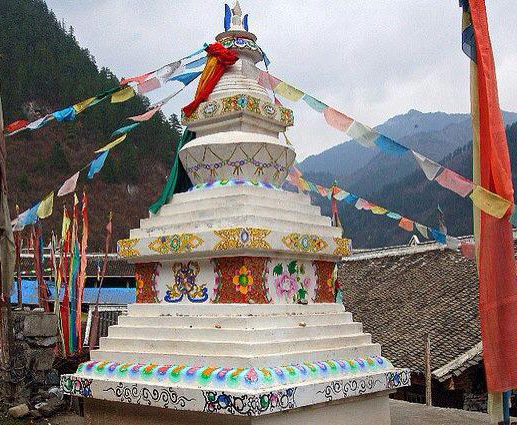
Elegant Yungdrung Bon Chorten edit

The Elegant Yungdrung Chorten which represents the stages of enlightenment

The practitioner must go before a pure lama who guides disciples and take the appropriate vows. According to a commentary written by the 23rd abbot of Menri Monastery, His Holiness Nyima Tenzin Rinpoché:

“As for the vows of a gen nyen: There are five kinds of lifetime vows.  To abandon killing, to abandon taking what is not given, to abandon impure, wrong kinds of sexual conduct, and to abandon false speech are four.  Abandoning one of the four kinds of food is the fifth.  Some people have taught abandoning alcohol as a branch vow.

This is the gen nyen of completely renouncing according to the five kinds of established laws.  Because of that, the gen nyen of pure behavior has renounced the basic kinds of impure activity.”

As for killing, one must abandon killing in anger especially another human being. One must abandon stealing, especially when it is driven by desire. One must avoid sexual contact that is damaging or abusive, one must avoid harmful speech especially if it creates a division within the spiritual community, and one must avoid lying especially about one’s spiritual experiences and attainments. As for the fifth which is a branch vow, one renounces either one of the four kinds of food. In this context, the four kinds of food are 1) meat, 2) garlic, 3) solid food after the mid-day meal, and 4) intoxicants such as drugs and alcohol. Regarding drugs and alcohol, the deeper meaning is the renunciation of intoxication which is an obstacle to mindfulness and incites negative behavior.

According to Buddha Tönpa Shenrap in The Nine Ways of Bön,

“As for the lifelong inner rules, one must abandon killing due to the influence of anger, abandon taking what is not given due to the influence of desire or attachment, abandon acting secretly to get what one wants without consideration of cause and effect due to the influence of ignorance, abandon performing unclean work due to the influence of pride, and abandon rough and abusive speech, meaningless talk, and telling lies. One must apply one’s self to their opposites.”

The Buddha goes on to describe the outer practices.

“As for the five intermediate principles, one should perform pure water-cleansing rites, perform prostrations and circumambulations with devotion and aspiration, create and place tsa tsa, and offer torma. Presenting offerings is a branch of gathering the [two] accumulations.”

All translations and content by Raven Cypress Wood ©All Rights Reserved. No content, in part or in whole, is allowed to be used without direct permission from the author.

Don’t want to miss a post? Scroll to the bottom and click “Follow this blog.”

The Seventh Way: The Way of the White AH

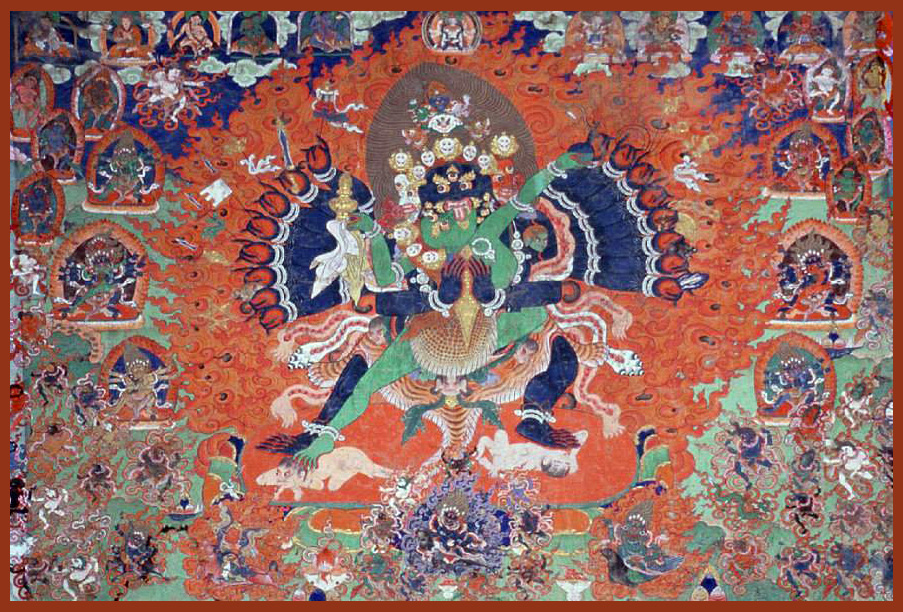
The enlightened wrathful deity, Walse Ngampa

Among the Nine Ways of Bön, The Seventh Way is The Way of the White AH.  This Seventh Way is the first of the Nine Ways of Bön whose view is transformation rather than renunciation or avoidance.  Rather than avoiding the five poisons, they taken upon the path and transformed into the five positive qualities.  Hatred and anger are transformed into love, confusion and mental dullness are transformed into wisdom, pride is transformed into peacefulness, desire and attachment are transformed into generosity, and envy and jealousy are transformed into openness.  To support this practice, the vessel of the external environment is transformed into a divine palace and the beings within are transformed into gods and goddesses.

The Seventh Way has many requirements of ritual items, ritual activity, deity visualization, mandala construction and rules of conduct.  In general there are three primary categories of: support, accomplishment, and activity.  Within the category of support, there are three outer, three inner, and three ritual preparations.  Within the category of accomplishment, there are eighteen branches: six regarding the base, six regarding the path, and six regarding the result.  Within the category of activity, there are nine divisions that can be directly correlated to each of the Nine Ways.

The Sixth Way: The Way of the Fully Ordained

Yungdrung Bon nuns in Tibet. Photo credit: Mary Ellen McCourt

Within the Nine Ways of Bön, the Sixth Way is the Way of the Fully Ordained.  Or, literally translated, the Way of the Straight and Righteous.  This involves accepting the renunciation vows of a monk or nun and living accordingly.  A novice receives 25 vows that form the basis of taking the further vows of the fully ordained.  For monks, there are 250 vows for full ordination.  For nuns, there are 360 vows.  According to the words of the enlightened Lord Tönpa Shenrap:

“In front of the abbot, the teacher and the witness, accept the vows with joy, faith and devotion.  Abandon the karmic tendencies of the three poisons.”

During Lord Tönpa Shenrap’s time in the human realm, he demonstrated the path of monastic discipline by becoming a monk.  At that time, he was known as Tritsuk Gyalwa.

Lord Tonpa Shenrap demonstrating the path of monastic discipline. In this form, he is known as Tritsuk Gyalwa.

“Don’t hate enemies or turn and go the other way.  Don’t be attached to friends and relatives.  Don’t cherish wordliness.  Body and mind should be single-pointed and at ease.  In your outer conduct, don’t act in an agitated manner.  In your inner ethics, don’t wander in to laziness.”

Raven Cypress Wood© All Rights Reserved

(This blog is offered for free to the worldwide students of Yungdrung Bön.  It is made possible by readers like you.  If you would like to join in making a gift of support for this blog or the translation work of Raven Cypress Wood, please go to https://www.paypal.com/home, click ‘Send’ and use Raven’s account rcw108@gmail.com.  Any amount is of great support!)

The Fourth Way: Rituals for the Dead

candles at ceremony smaller with credit

It is traditional to make many offerings of light for those who have died

The Fourth Way within the Nine Ways of Bön is called The Way of the Shen of Existence  and is primarily focused upon rituals for the dead.  From the perspective of Yungdrung Bön, the moment that the consciousness leaves the container of the physical body is a time of great potential.  If someone has received the proper instructions and practiced, it is possible for them to achieve liberation from cyclic existence at that time.  If not, there are methods to lead the deceased’s consciousness to liberation or at the very least, to guide them to the circumstances of a positive rebirth.

In general, once an ordinary person dies, they experience a kind of unconsciousness like falling into a deep sleep.  “Awakening” from this state, it is possible for them to not realize that they have in fact died and therefore to continue to be attached to their family and life situation.  Generally lasting three days, but possibly longer, this is the time when the lama tells the individual that they have died and instructs them to not be afraid and to release their attachment to family and friends.  The fourth day after death begins a 49 day period of transition referred to as the “bardo” and literally translates as “in-between”.  During these seven weeks, the individual both becomes less attached to the previous life and is drawn by the force of karma to the next life.  While this is happening, each week the deceased is having experiences of each of the six possible destinies of rebirth.  These six destinies of rebirth from lowest to highest are: the hell realm, the hungry ghost realm, the animal realm, the human realm, the demi-god realm, and the god realm.  For example, during the first week, the person would have experiences related to the hell ream.  During the second week, they would have experiences related to the hungry ghost realm, and so on.  Therefore,  prayers and rituals are done each week that emphasize antidotes and guidance for the particular obstacles and experiences that the deceased might be having.  Additionally, offerings of light, prayers of aspiration and recitation of mantra for the benefit of the deceased are performed each day.  On the 49th day, special rituals and prayers are performed in order to strongly influence the path of rebirth.

Buddha Drajin Donpung, Buddha of the human realm

Drajin Donpung, Buddha of the human realm

This is a general description.  Whether someone spends a greater or lesser time in the bardo, or doesn’t experience it at all, is dependent upon many factors including their virtue or non-virtue and the strength of their awareness and spiritual development.

The lama performing the rituals must have both proper knowledge of the rituals as well as have developed great compassion for other beings.  According to the words of the Enlightened Lord Tönpa Shenrap Miwo,

“The best of shen who is expert in meditation and who has aroused feelings of immeasurable compassion towards feeble living beings, and who possesses the four immeasurable qualities and who puts the good of others before himself..”

Preceding the preparations for the rituals, the lama will ascertain the details of the death such as the time and circumstances involved.  Then, a divination and astrological calculations are performed in order to determine the proper day and place to perform the ritual and burial as well as any additional rituals that could be of benefit for the family.  In this way, the natural process of death and rebirth is supported by the spiritual guidance and the ritual expertise of the lama.  From the Bardo Thodal, “Liberation Upon Hearing”:

“Lama, from your compassion, bless me.  Bless me to stop the deluded visions of the bardo.  Bless me that I may prevent the possibility of rebirth in the lower destinies of rebirth.  Bless me that I may achieve the five wisdoms.”