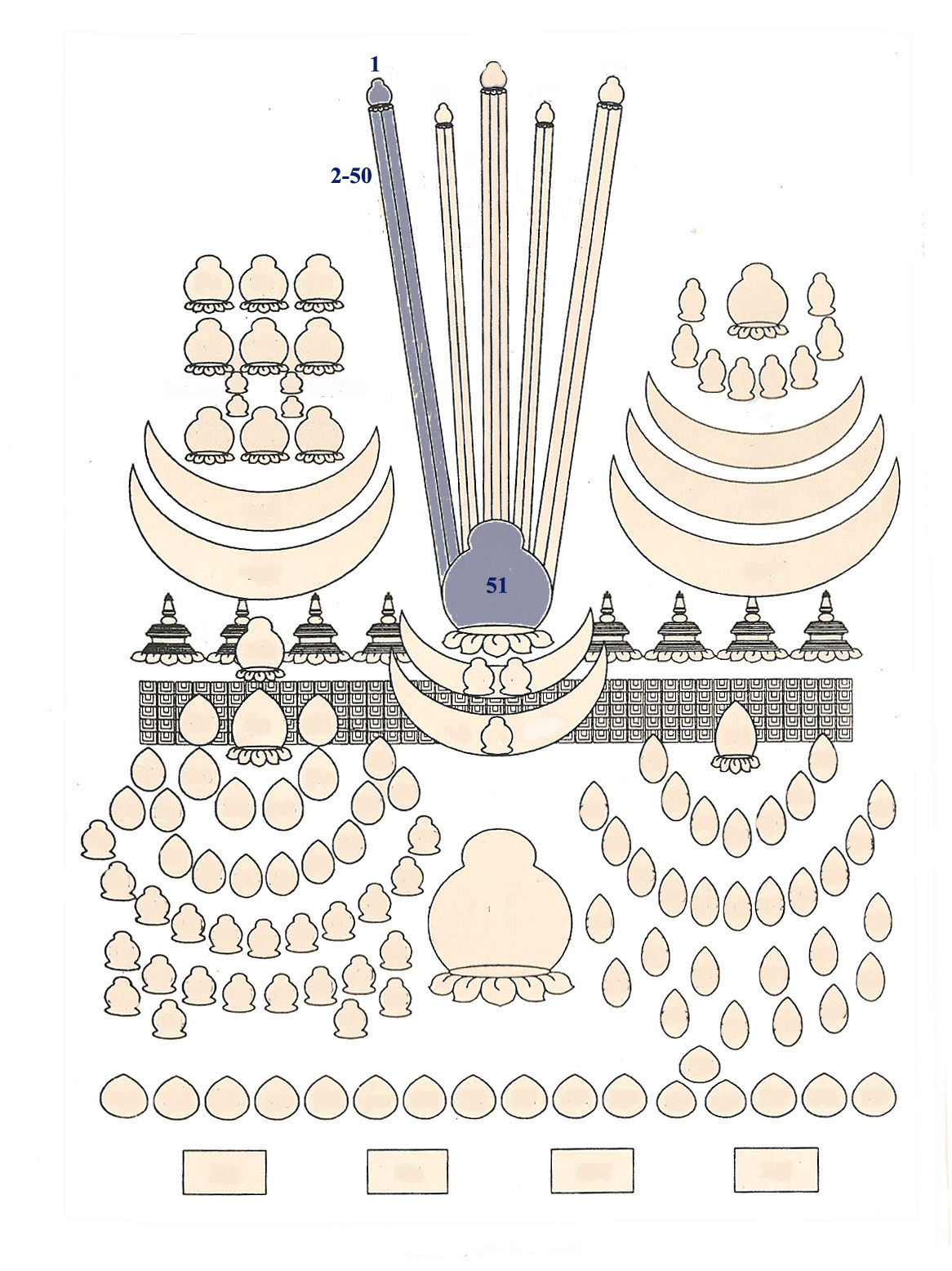
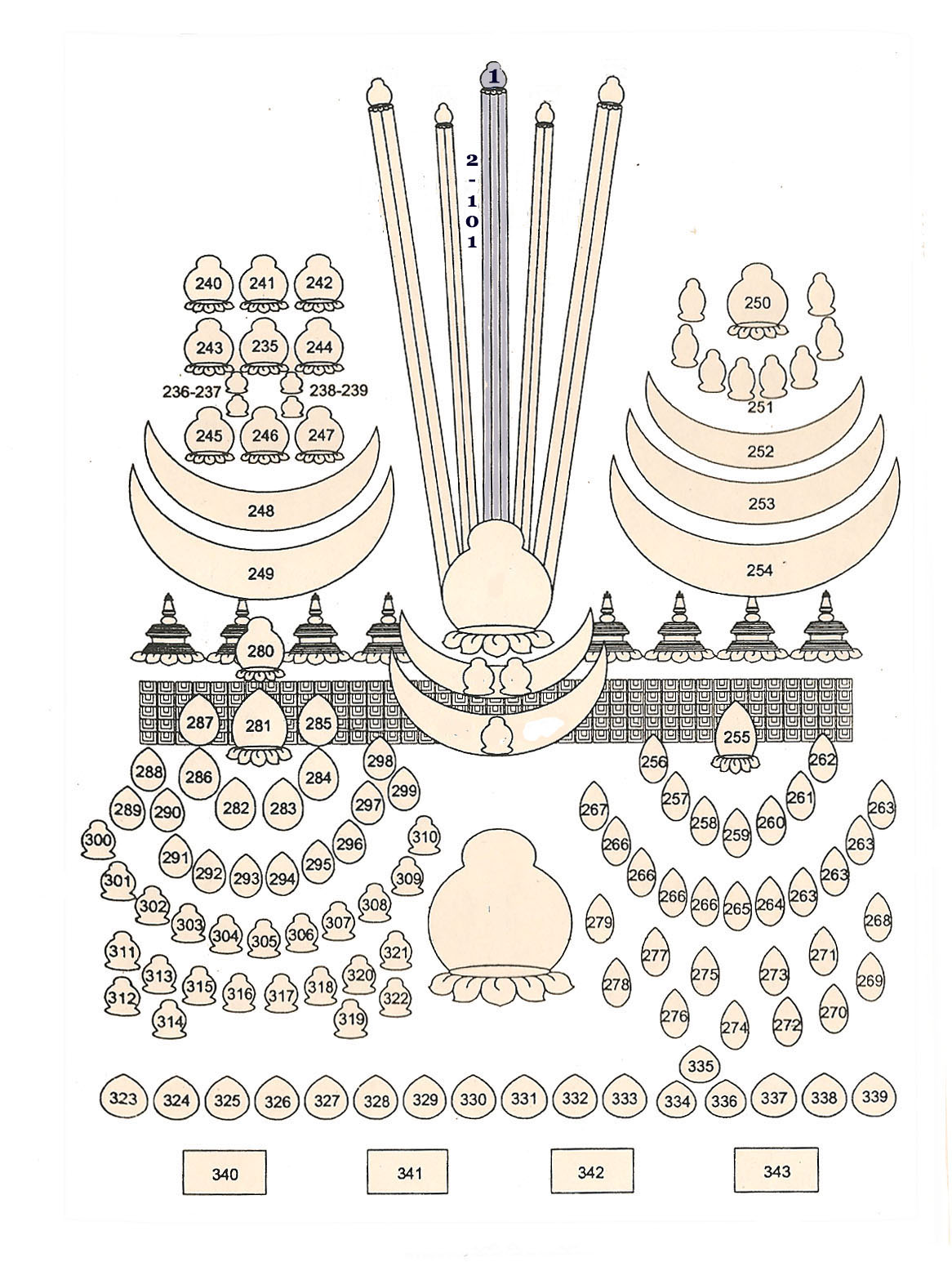
In the Yungdrung Bön tradition, the place where the deities and objects of veneration are gathered is called the “Tsok Zhing”, the “Field of Accumulation”. It is also sometimes translated as the “Field of Merit” or the “Merit Field” because what is being accumulated by paying homage and making offerings to this place is merit, or virtue. This is the Merit Field according to the Menri Tradition from a drawing done by the great master and scholar HE Yongdzin Tenzin Namdak Rinpoche.
This is the lineage of monastic discipline. These lineage masters have all taken monk’s vows and therefore wear the appropriate clothing to distinguish them from laypeople.
1. Tritsuk Gyalwa. 16,017 BC – 7,817 BC. This is the name that the enlightened Lord Tönpa Shenrap Miwoche received upon taking ordination as a monk at the age of 31. Although he was already a completely enlightened being, he showed the example of taking the path of renunciation.
Lord Tonpa Shenrap showing the path of renunciation as the monk Tritsuk Gyalwa
2. Tsukshen Gyalwa
3. Drangsong Gyalwa. He was one of Tönpa Shenrap’s eight sons. His birth name was Tobu Bumsang.
4. Tsukse Mawo
5. Tridé Gungdrak
6. Mucho Demdruk
7. Mutsa Trahé. He was from the ancient land of Tazik. He was one of The Six Translators who wrote down the words of Lord Tönpa Shenrap into their respective languages and brought them to their respective countries.
8. Tridé Öpo
9. Lhang Lhang Tsukphü
10. Dangwa Yi Ring
11. Thukar Yeshé
12. Gung Rum Yeshe
13. Ölha Selbar
14. Dzütrul Yeshé
15. Yeshé Tsultrim
16. Yungdrung Tsultrim
17. Tsukphü Tsultrim
18. Gachu Gyalwa
19. Yagong Gyalwa
20. Détsun Rabsel
21. Jotsün Yeshé
22. Muzi Salzang. He was a manifestation of Mucho Demdruk. During a time of suppression, he retreated to a cave and went into a meditation of cessation, stopping all thoughts and sensations. Hundreds of years later, Tribar Tsultrim came upon him in the cave.
23. Tribar Tsultrim. He was the manifestation of Tsukshen Gyalwa. He was born a prince but due to external circumstances, he was banished to Mongolia and became a slave of a local ruler. One day, while looking after the ruler’s horses, he wandered into a cave that looked dark at the entrance but light on the inside. Once inside the cave, he saw a figure that resembled a monk but whose hair had grown down to the ground and become entangled. The karmic connection immediately ripened and he joyfully began prostrating and requesting that the monk awake from his meditation. Day after day, he returned to the cave. First, one of the monk’s eyebrows moved, then a portion of his face. On the third day, he yelled at the slave, “Are you a human or non-human obstacle?” The slave replied that he desired to become his disciple. The monk agreed and gave him full ordination. The monk in the cave was Muzi Selzang.
24. Gyalwa Tsukphü. He was the manifestation of Tobu Bumsang, son of Lord Tönpa Shenrap.
25. Tsukphü Tsultrim. He was the manifestation of Tsukse Mawo.
26. Lachen Mutur. He was born in 952 AD. He was also known by his monastic name, Sherap Tsultrim. He had many disciples, both Yungdrung Bön and Buddhist. He gave his disciples the four signs of monastic ordination which were, Upper and lower garments, a lotus hat and a meditation mat that were all blue. He said that if the articles could not be entirely blue, then they should have parallel seams of blue thread. He was a manifestation of Mutsa Trahé.
27. Nyö Tsün Rinchen Gyaltsen. He was the manifestation of Tridé Öpo.
28. Nyö Künga Tsultrim. He was the manifestation of Lhang Lhang Tsukpü.
29. Gar Rinchen Tsukpü. He was the manifestation of Dangwa Yi Ring
30. Trapü Tsultrim. He was the manifestation of Tuk Kar Yeshé.
31. Nyöla Drukpa Tsultrim Yeshé. He was the manifestation of Gang Rum Tsukpü.
32. Sheltsün Yungdrung.He was the manifestation of Ölha Salwar.
33. Gur Tsün Yungdrung Gyaltsen. He was the manifestation of Yeshé Tsultrim.
34. Khenlop Namnyi
35. Me’u Gongdzö Ritropa. 1038-1096. He was the manifestation of Sertok Chejam and founder of the AH Tri Lineage of Dzogchen teachings. (See previous post, The Saint.)
After these lamas, the lineage splits into four different lines according to the families of Dru, Zhu, Pa and Shen. The following is the lineage of the 1st Abbot of Menri Monastery, Nyammé Sherap Gyaltsen.
36. Métön Sherab Ödzer
37. Shentön Namkha Gyaltsen.He was the manifestation of the great lama, Drenpa Namkha.
38. Yorpo Métön Drakpa Pal. He was a manifestation of the great lama, Drenpa Namkha.
39. Dütsi Gyaltsen. He was the manifestation of Lhatri of Zhang Zhung.
40. Darma Gyaltsen.He was the manifestation of Hripa Gyermé.
41. Tsultrim Lama
42. Drogön Martön Gyallé
43. Bartang Zhangtön Sonam
44. Sumtön Lhabum
45. Shentön Drogön Lodro Gyaltsen
46. Shentön Yeshé Lodro.In 1173, he built the temple of Darding Sergo Tramo Tsukla Khang in Darding.
47. Men Gongwa Dülwa Lodro
48. Men Gongwa Sherap Lodro
49. Gya Rongwa Yungdrung Yeshé
50. Drutön Tsultrim Yeshé. He was the Abbot who gave vows to Nyammé Sherap Gyaltsen.
51. Nyammé Sherap Gyaltsen. 1356-1415. He is known as the Second Buddha and was the founder and 1st abbot of Tashi Menri Monastery in Tibet. (See previous post, Celebration of the Second Buddha.)
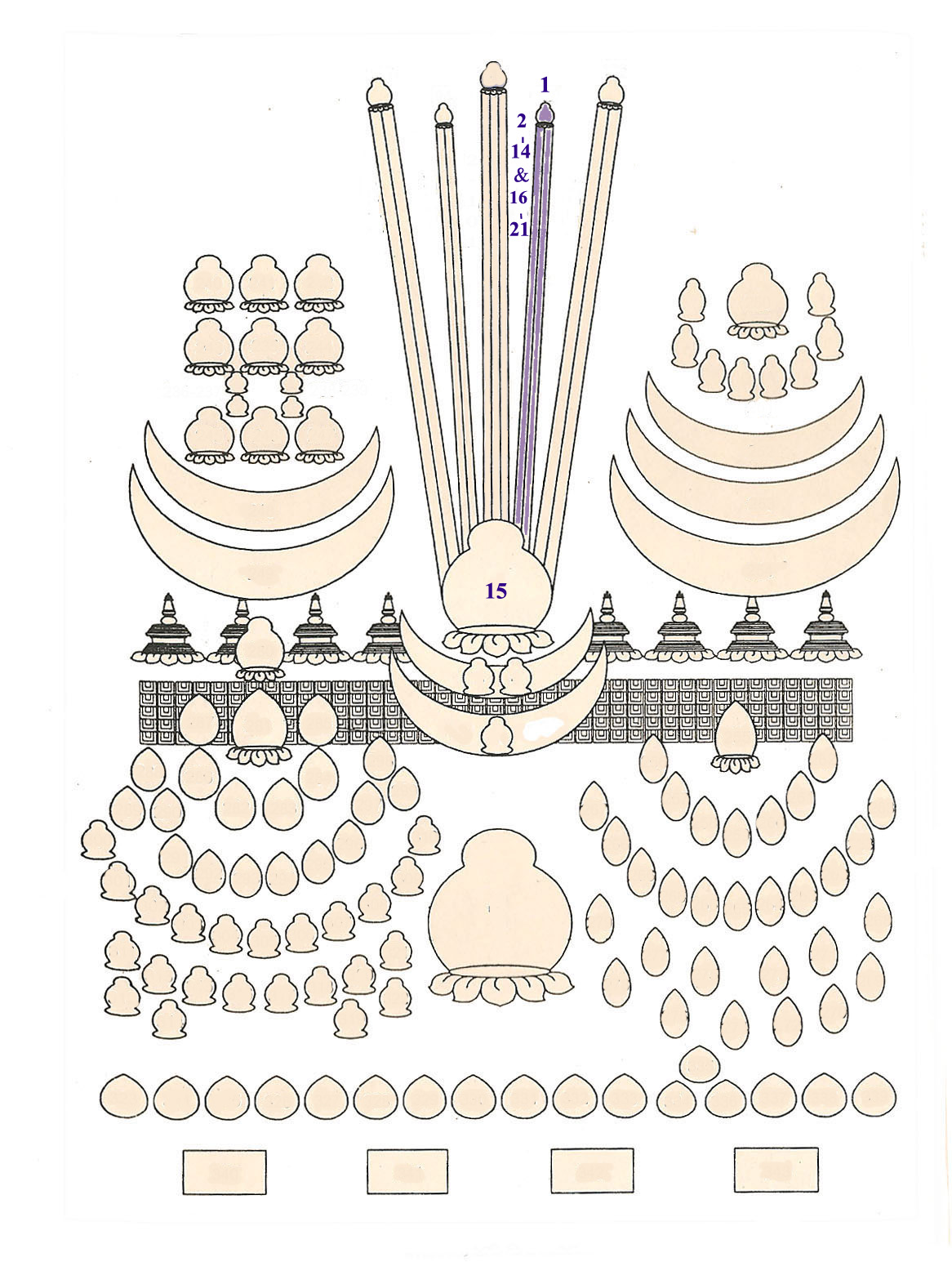
In the Yungdrung Bön tradition, the place where the deities and objects of veneration are gathered is called the “Tsok Zhing”, the “Field of Accumulation”. It is also sometimes translated as the “Field of Merit” or the “Merit Field” because what is being accumulated by paying homage and making offerings to this place is merit, or virtue. This is the Merit Field according to the Menri Tradition from a drawing done by the great master and scholar HE Yongdzin Tenzin Namdak Rinpoche.
The Lineage of the Profound Guidance through AH, also known as the AH Tri, is one of three lineages of Dzogchen teachings in the Yungdrung Bön tradition. (See previous posts regarding The Aural Transmission of Zhang Zhung and the Renowned Three Cycles of Dzogchen.) This lineage of Dzogchen teachings was closely associated with the Dru family. From Menri Abbot Nyammé Sherap Gyaltsen until Menri Abbot Kunzang Gyaltsen, the lineage was passed down through the abbots of Menri Monastery.
1. Founder of the lineage, Me’u Gongdzö Ritropa. He is often referred to simply as Dampa, “The Sage” or “The Saint”. (See previous post, The Saint.) He exhibited many signs of accomplishment such as flying through the sky and leaving his hand and foot prints in stone. Although his primary focus was upon his meditation, he also wrote a number of texts. In addition to material he collected from other sources, he added his own gong ter, or mind treasure, to this collection. He organized the practice of the A Tri into 80 meditation sessions.
Founder of the AH Tri Lineage of Dzogchen teachings, The Saint, The Supreme Gongdzo Ritropa Rinpoche
2. Gomchen Barwa. He was an unconventional person and became a great yogi. He was known for odd and somewhat dramatic displays. One day, Gongdzo Ritropa took Gomchen to a grassy area that was quite wet. The lama knew that Gomchen was known to have been quite athletic in his youth. So he told him to make a great leap. In doing so, Gomchen slipped and violently fell down. In that very instant, he achieved spiritual realization without interruption. Rather than taking ordination, he remained a laymen his entire life. He had many disciples and attained the rainbow body of light.
3. Kyunggom Joyung.
4. Dampa Tsulshé.
5. Drogön Yorpo Mepal. He composed a commentary for the Guidance through AH teachings.
6. Dutsi Gyaltsen.
7. A Zha Lodro Gyaltsen, 1198-1263. He condensed the number of meditation sessions to 30.
8. Dru Dulwa Gyaltsen.
9. Druchen Gyalwa Yungdrung, 1242-1290 A.D. He was born into the Dru family in the area of Yeru Wensaka in Central Tibet. He received his monk vows from his older brother, Dru Dulwa Rinpoche. He was once the abbot of Yeru Wensaka Monastery which was founded by his family. He further condensed the number of meditation sessions of the Guidance through AH to 15 and composed the fundamental practice text “AH Tri Practice in 15 Sessions”.
10. Dru Namkha Odzer.He was the younger brother of Dru Gyalwa Yungdrung.
11. Dru Sonam Gyaltsen, 1268-1321. He was the nephew of Dru Gyalwa Yungdrung.
12. Dru Sonam Lodro, 1277-1341.
13. Dru Namgyal Kara
14. Rinchen Lodro.His mother was from the Dru family.
15. Nyammé Sherap Gyaltsen, 1356-1415. He is known as the Second Buddha and founded Tashi Menri Monastery in Tibet. (See previous post, Celebration of the Second Buddha.)
16. Rinchen Gyaltsen. He became abbot of Menri Monastery in 1415.
17. Namkha Yeshe. He became abbot of Menri Monastery in 1446.
18. Kunzang Gyaltsen. He became abbot of Menri Monastery in 1464.
Tsok zhing according to MenriThe Yungdrung Bon Merit Field of the Menri Tradition
In the Yungdrung Bön tradition, the place where the deities and objects of veneration are gathered is called the “Tsok Zhing”, the “Field of Accumulation”. It is also sometimes translated as the “Field of Merit” or the “Merit Field” because what is being accumulated by paying homage and making offerings to this place is merit, or virtue. This is the Merit Field according to the Menri Tradition from a drawing done by the great master and scholar HE Yongdzin Tenzin Namdak Rinpoche.
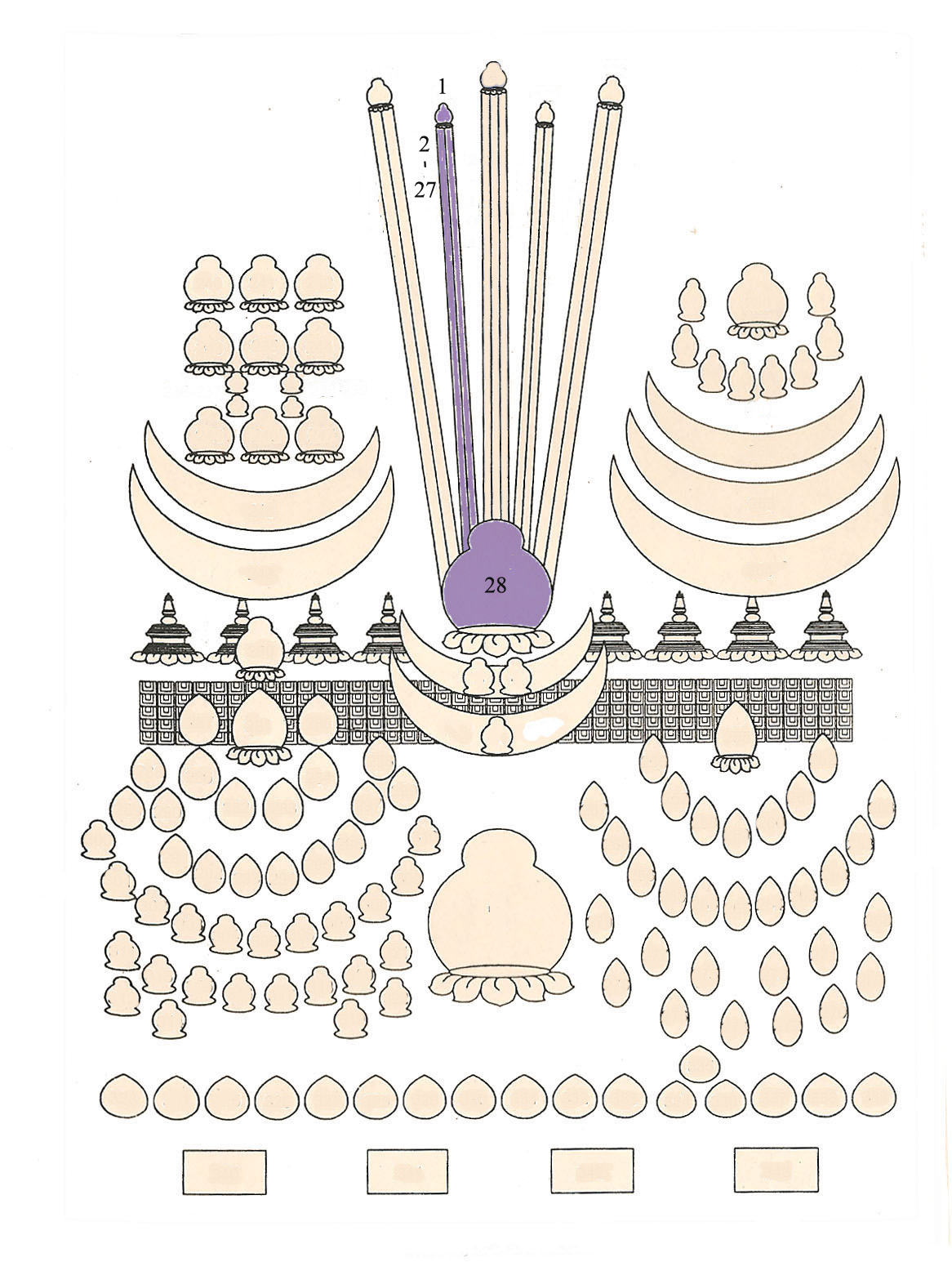
Diagram highlighting the placement of the Dzogchen Lineage within the Merit Field thangkha.
#1-28 depicts the Lineage of the Three-fold Cycle of Dzogchen Proclamations. In Tibetan, the Dzogchen Drakpa Korsum Gyü.
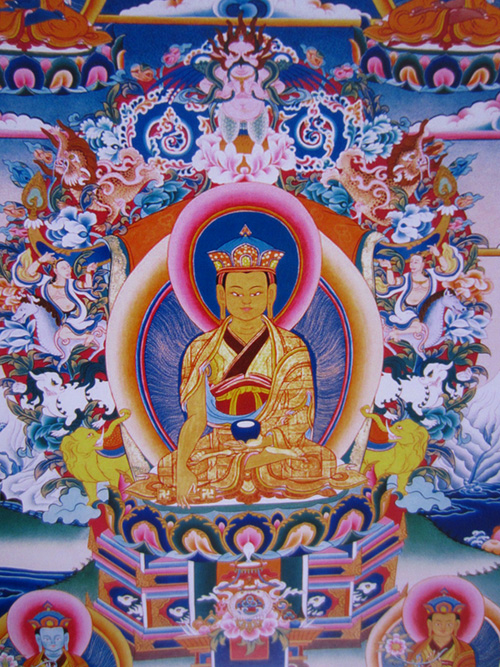
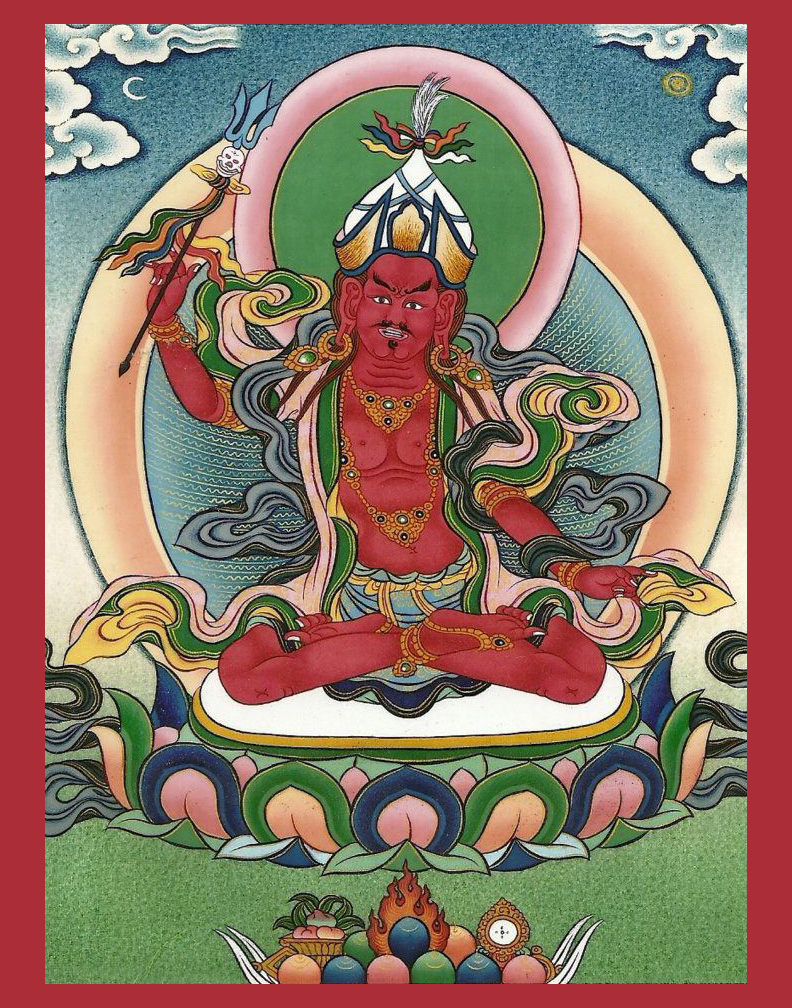
1. The source of the lineage, the White Light Deity, Shenlha Ökar. He appears in the form of dzok ku, the enlightened Body of the Perfected Qualities and wears the corresponding ornaments. His compassion is all-pervasive.
2. The Five Victorious Families who have gone beyond bliss, aka The Five Buddha Families.
3. Chimé Tsukphü. He was the previous existence of the enlightened Lord Tönpa Shenrab Miwoche immediately before descending from heaven to earth.
4. Lhashen Yongsu Dakpa. He was the shen of the gods who received the teachings from Chimé Tsukphü.
5. Milu Samlek. He was the shen of the humans who received the teachings from Chime Tsukphü. He was born a prince in the ancient land of Tazik as his father, the king, was about to die. He was known for his intelligence even as a young man.
#6-10 The Transmission of the Changeless Sages
6. Lushen Yeshé Nyingpo. He is the shen of the lu, aka nagas, who received the teachings from Chime Tsukphü.
7. Ödzer Pakmé. He was a master from Tazik.
8. Münpo Künsal
9. Trulshen Nangden
10. Sangwa Düpa. He was a chief disciple of Chimé Tsukphü. He was born a prince of Tazik.
Translator and great yogi, Lama Tonggyung Tuchen
#11-14 The Transmission of the Scholarly Translators
11. Tonggyung Tüchen
12. Sé Bön Shari Uchen
13. Chétsa Kharbu
14. Nyachen Lishu Taring. A king and queen found a beautiful young girl in a forest. They named her Takza Liwer. Some time later, through the performance of ritual, she transformed herself into a man. However, she was still female when she wrote the root text for The Three-fold Cycle of Dzogchen Proclamations in the 8th century. As a male, he became heir to the kingdom and was called Nyachen Lishu Taring.
15. Dé Bön Gyimtsa Machung
16. Drupchen Chogye
17. Choza Bönmo
18. Zhotön Ngödrup Drakpa. He was an emanation of Lishu Taring and a tertön, or treasure revealer, who rediscovered hidden texts behind a statue of Vairochana in Lhodrak that were hidden by Lishu Taring during a time of persecution for the Yungdrung Bön.
19. Gyaton Jodé
20. Zhikpo Nangseng
21. Kyotön Ngakpal
22. Yotön Lhunpal
23. Sengé Drukdra
24. Bönzhik Lodé
25. Tokden Yungrin
26. Khetsün Sherdrüp
27. Yonten Sengé
28. The Second Victor and founder of Tashi Menri Monastery,Nyammé Sherap Gyalsten1356-1415.
Tsok zhing according to MenriThe Yungdrung Bon Merit Field of the Menri Tradition
In the Yungdrung Bön tradition, the place where the deities and objects of veneration are gathered is called the “Tsok Zhing”, the “Field of Accumulation”. It is also sometimes translated as the “Field of Merit” or the “Merit Field” because what is being accumulated by paying homage and making offerings to this place is merit, or virtue. This is the Merit Field according to the Menri Tradition from a drawing done by the great master and scholar HE Yongdzin Tenzin Namdak Rinpoche.
#1-101 depicts the Aural Lineage of Zhang Zhung, the Zhang Zhung Nyen Gyü. This lineage of Dzogchen teachings is continuous and unbroken.
#1-9 are the Nine Divine Beings of the Mind to Mind Transmission. These Beings transmitted the teachings by way of intrinsic awareness, rikpa.
1. The source of the lineage, the teacher Küntu Zangpo. This is the Bönku. He is naked and without ornamentation.
2. Shenlha Ökar, the pure, white light deity of compassion. This is the Dzok ku. His compassion is all-pervasive and he is the embodiment of exalted, positive qualities.
3. Gyalwa Shenrap, the divine being that descended to the human realm in order to guide sentient beings. This is the Tulku and he became known as the Lord Tönpa Shenrap Miwoché.
4. Tsemé Öden, the divine being that emanated into a god realm in order to guide bodhisattvas.
5. Trulshen Nangden, the divine being that emanated into a god realm from the mind of Küntu Zangpo.
6. Barnang Khujuk, the divine being that emanated into a god realm from the speech of Küntu Zangpo
7. Zangza Ringtsun, a divine emanation of the Great Mother Sherap Chamma and the divine mother of Chimé Tsukpü. Trulshen nangden descended upon her right shoulder in the form of a turquoise cuckoo and caused a subtle, internal heat. One year later, she gave birth to Chimé Tsukpü. Her body color is golden and she holds a golden vase in her right hand and a golden mala in her left hand.
8. Chimé Tsukpü, He is turquoise in color. Nine days after his birth, his mother Zangza Ringtsun found him suspended in space and radiating light. He taught both tantra and Dzogchen.
The beginning of the Aural Transmission Lineage
9. Sangwa Düpa, He received the transmission through rikpa and was the first to use speech as well as awareness to transmit the teachings. He was born a prince of Tazik and began the transmission among human beings. Because he was the first to use speech to transmit the teachings, he is also known as The Teacher of the Aural Transmission Lineage.
#10-33 The 24 Masters of the Aural Transmission Lineage of Zhang Zhung
These 24 Masters were all from the ancient kingdom of Zhang Zhung and used speech to transmit the teachings. Each of them attained the full realization of Dzogchen and displayed that realization by attaining the rainbow body of light. These 24 masters are divided into 4 groups.
#10-14 The Five Beyond-All Masters
#15-20 The Six Masters who show the Six Meanings of Dzogchen
#21-29 The Nine Masters of Experience Within
#30-33 The Four Masters of Ürgyen
The Five Beyond-All Masters
Lhabön Yongsu Dakpa, He received the transmission from Sangwa Düpa and spread the teachings in the god realm.
Lübön Banam, He received the transmission from Sangwa Düpa and spread the teachings in the lü (Sanskrit. naga) realm.
Mibön Tridé Zambu, He received the transmission from Sangwa Düpa and spread the teachings in the human realm.
Banam Kyolpo
Trisho Gyalwa, He was the son of Banam Kyolpo.
The Six Masters who show the Six Meanings of Dzogchen
Rasang Bönpo Samdrup
Darma Sherap
Darma Bodé
Zhang Zhung Bönpo Tripén
Muyé Lhagyung
Mashen Lézang
The Nine Masters of Experience Within
Gyershen Taklha
Rasang Bönpo Yungdrung Se
Séchen Yungdrung Pén
Gébar Döndrup
Gyerpung Gépén
Dése Gégyal
Zhang Zhung Namgyal
Muyé Lhagyung Karpo
Shen Horti Chenpo
The Four Ürgyen Masters
Shen Dönkün Druppa
Rasang Bönpo Péngyal
Gurip Sega
Dawa Gyaltsen
Tapihritsa, He was born into a nomadic family in the country of Zhang Zhung. He practiced at a place near Mt. Tise known as Sengé Tap. He practiced for nine years without interrupting it with ordinary, human speech. He achieved the rainbow body of light. After this, Tapihritsa manifested as a young boy and began working as a shepherd for a wealthy man in the area where Nangzher Lopo was practicing. Upon meeting, Nangzher Lopo asked the boy a series of questions and became annoyed at his answers. Challenging him to debate in front of the Zhang Zhung king, the boy laughed and began speaking about the true nature of mind. Realizing that this was an emanation and not an ordinary boy, Nangzher Lopo fainted. Regaining consciousness, he saw that the boy had transformed and was showing a clear and luminous body surrounded by a rainbow and suspended in space.
Gyerpung Nangzher Lopo, He extensively practiced the cycles of Zhang Zhung Meri and Gekho. In doing so, he acquired great magical power. He was the priest for the Zhang Zhung king and was well-known throughout the kingdom. Because of his devotion, he met and received teachings from Tapihritsa 3 times. He lived for 573 years.
Lineage Masters of the Aural Transmission of Zhang Zhang prior to the 8th Century
The Six Yogis from Zhang Zhung
Gyalzik Sechung, He first received these teachings when he was 72 years old. He lived for 317 years and attained the rainbow body of light.
Mu Shen Tsogé, At the age of 3, Nangzher Lopo identified him as a qualified student and he received the teachings at the age of 19. He lived for 173 years and attained the rainbow body of light.
Mu Gyershen Tsotang, He lived for 113 years and attained the rainbow body of light.
Mu Shotram Chenpo, He lived for 117 years and attained the rainbow body.
Mu Gyalwa Lodro, He was attendant to Mu Shotram Chenpo for nine years before he received teachings. He lived for 270 years and attained the rainbow body of light.
Pongyal Tsenpo, also known as Ponchen Tsenpo, He purified all the defilements of his physical body and therefore it was not necessary for him to eat food for nourishment. He lived for 1,600 years and his body showed no signs of aging. He then transformed himself into a turquoise cuckoo and flew off towards the southwest in order to subdue demons.
Here, the lineage splits into Upper & Lower systems of transmission according to the geographical location in which it was transmitted.
The Upper System of Transmission
The Six Realized Sages
To these disciples was transmitted the Four Cycles of the Precepts Transmission (the Ka Gyü Kor Zhi), but not the Experiential Transmission (the Nyam Gyü).
Gugé Loden, He received the teachings from Pöngyal Tsenpo in an area near Mount Tisé. As a youth, he worked as a goatherd and had often dreamt of a blue cuckoo speaking to him. One day, he watched as a cuckoo descended from the sky near him. Going closer, instead of a bird, he found a yogi in a blue robe. This was Pöngyal Tsenpo.
Pureng Kunga, He practiced in the area of Mount Tisé. By following his lama’s guidance on Dzogchen, he attained realization in one month.
Naljor Sechok, He had the power to prolong his life span and displayed many miracles.
Kyungji Mutur, He was a wandering yogi without any particular place of practice.
Dewa Ringmo
Tokmé Zhikpo, He lived most of his life in a cave. He gave the full transmission to Yangtön Sherap Gyaltsen. This same lama also received the full transmission of the Lower system of transmission. In this way, he reunited the two transmissions.
The Lower System of Transmission
Lhundrup Mutur
Shengyal Lhatse, He lived for 113 years.
Lhagom Karpo, He lived for 97 years.
Ngodrup Gyaltsen, He was the son of Lhagom Karpo. He asked his father for teachings but his father refused and told him that he had performed a divination that indicated that his son was not a good candidate. Ngodrup then abandoned his wife and child and went to study with a Buddhist. Soon after this, his father reconsidered his decision and agreed to teach him. He lived for 73 years.
Orgom Kündul, Few Bönpo followers sought teachings from him but many Buddhist practitioners sought him out. He lived for 80 years.
The Upper and Lower Systems of Transmission reunite in the person of Yangtön Sherap Gyaltsen
Yangtön Sherap Gyaltsen, He was born into the prestigious Yangtön lineage of Dolpo, Nepal. He lived and taught during the 11th century. He received the full transmissions of both the Upper and the Lower Systems of Transmission and therefore united the transmissions. Out of compassion, he wrote down some of the teachings as well as commentaries. According to prophecy, his life span was to be 75 years but due to writing down the secret teachings, he died at the age of 63.
Here, the lineage splits again into the Southern and the Northern Lineage. Below is the list of the lamas of the southern Lineage of Transmission.
The Five Masters of the Mantra and the Mind:
These five masters held the transmission of both the precepts as well as the practice of the yidam and protector Zhang Zhung Meri
Dampa Bumjé, He spread the Bön teachings in the areas of Dolpo, Mustang and Western Tibet. His father was Yangtön Sherap Gyaltsen. After his death, Dampa received teachings from his mother. Because of his extraordinary meditative experiences, he added his own teachings to those of his father in the Experiential Transmission.
Lu Drakpa Tashi Gyaltsen, He was also a son to Yangtön Sherap Gyaltsen. Unlike his brother, he was a wandering yogi. He lived for 85 years.
Tokden Wonpo Yeshe Gyaltsen, His mother was Yangtön Sherap Gyaltsen’s daughter. His father was a bandit and he joined him in his exploits. One day, he father was killed during a fight and he was badly wounded. Once he recovered, he began to seek revenge. After some time had passed, he became tired with fighting and went to his uncle, Dampa Bumjé, to learn to read so that he could read the scriptures. However, his progress was slow and he went to his other uncle, Lu Drakpa, and asked for teachings that didn’t require the ability to read. Having received the teachings of the Zhang Zhung Nyen Gyü, he practiced and attained realization.
Yangtön Gyaltsen Rinchen, From the age of 8 until 21, he practiced tantra. At the age of 21, he received the Dzogchen teachings. He founded the monastery of Samling in Dolpo, Nepal.
Chikchö Depa Sherap, He is also known as Tokden Depa Sherap. He practiced in the area of Mount Tisé among other places.
Druchen Gyalwa Yungdrung, 1242-1290. He was one of four brothers and received monk’s vows from his older brother. He was once the abbot of Yeru Wensaka Monastery which was founded by his family. He organized the practices of the Zhang Zhung Nyen Gyü into a widely used practice manual commonly known as the Chak Tri. He wrote many prayers, ritual guides and commentaries.
Ripa Sherap Lodro, He was from Dolpo and traveled a great deal throughout Tibet.
Yeshé Rinchen
Rangdrol Lama Gyaltsen, He frequently debated Buddhist monks including Tsongkhapa.
A Tok Sherap Gyaltsen, He was the personal attendant to Dru Gyalwa Yungdrung. He showed many signs of realization and lived for 120 years.
Kartsa Sonam Lodro
The Transmissions for both the Southern and the Northern Lineages reunite in the person of Patön Tengyal Zangpo
Patön Tengyal Zangpo, He showed many signs of realization and is said to have circumambulated Mount Tisé in the form of a vulture.
Tokden Shepal
Namkha Özer
Yungdrung Yeshé
Rinchen Lodro
Nyamme Sherap Gyaltsen, 1356-1415 He founded Tashi Menri Monastery in Tibet. For further information, see the previous blog post “Field of Accumulation: Abbots of Menri”.
Rinchen Gyaltsen
Namkha Yeshé
Kunzang Gyaltsen
Tsultrim Gyaltsen
Sonam Yeshé
Sonam Yungdrung
Shetsu Drungmu
Sherap Özer
Yungdrung Gyaltsen
Sherap Lodro
Sherap Özer
Tsukpü Özer
Yungdrung Tsultrim
Rinchen Özer
Rinchen Lhundrup
Sherap Tenzin
Sherap Wangyal
Yungdrung Wangyal
Püntsok Namgyal
Sherap Gonggyal
Nyima Tenzin
Choklé Namgyal
Sherap Yungdrung
Sanggye Tenzin
Tenzin Tsultrim
Gyalwa Lodro
Tenpa Lodro
Nyima Wanggyal
Sherap Lodro
Sanggye Tenzin Lopon Tenzin Namdak
Lungtok Tenpé Nyima, the 33rd holder of the golden throne of Menri Monastery
Lungtok Dawa Dargyal, the 34th holder of the golden throne of Menri Monastery
Lord of Refuge, His Eminence Menri Yongdzin Lopön Tenzin Namdak Rinpoché
Did you enjoy this content? This article is made possible by generous donors who want content like this to continue to be available.




 Nine Ways