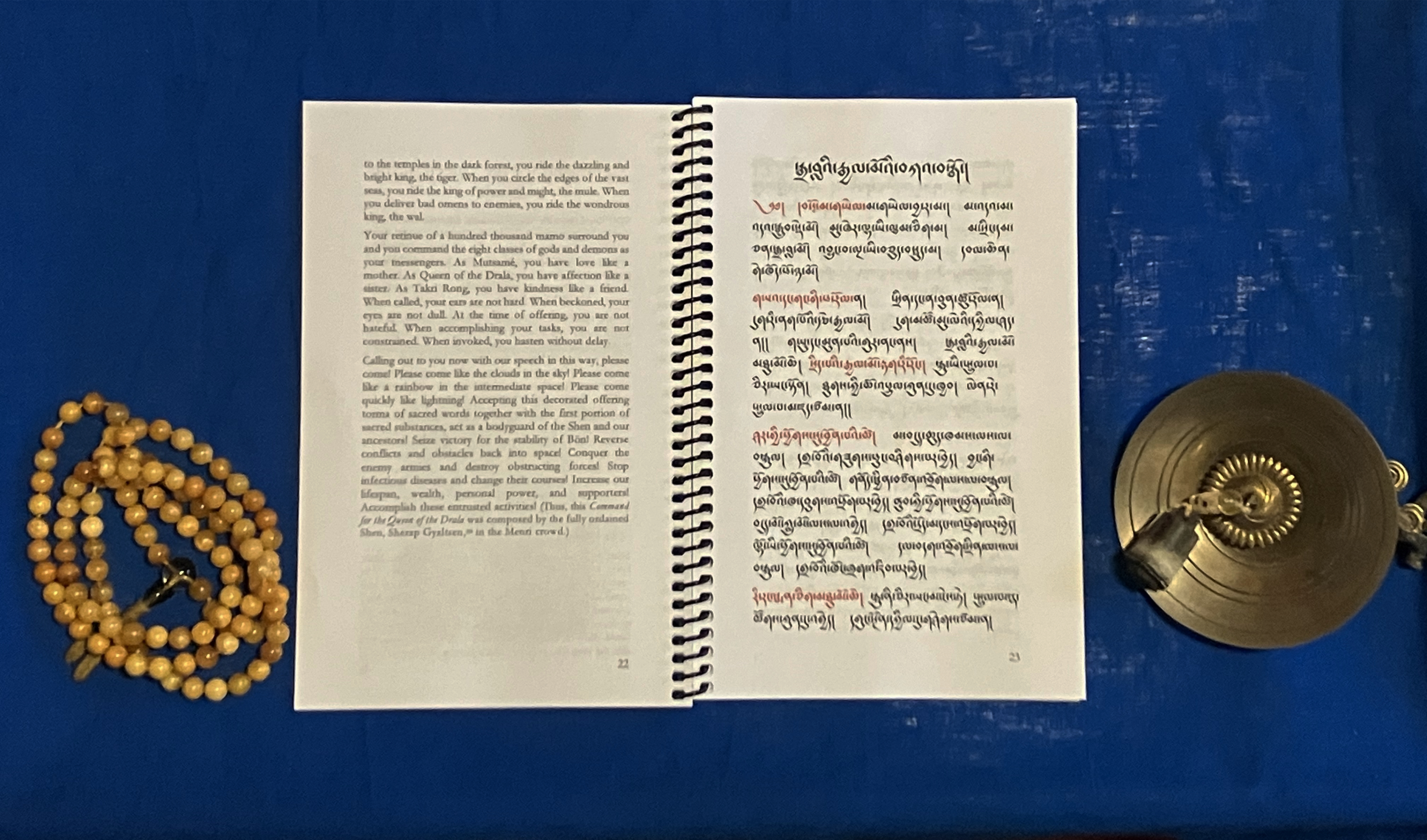
After multiple requests by the Yungdrung Bön faithful to have English translations related to invoking the drala available in order to prevent, harmonize, and/or avert disruptions or harm caused by astrological influences, Nine Ways is happy to announce publication of Summoning the Drala: Protection and Support from Primordial Guardians. There is both a spiral bound color book and an eBook available. Only the print book contains the Tibetan language prayers and corresponding phonetics for recitation. There is an introduction that gives a brief explanation of the drala and how to make offerings. Prayers include the preliminary practices of requesing consideration, generating the mind of enlightenment, going for refuge, water cleansing, and fumigation with incense. Then follows the newly translated Essential Invocation of the Drala which is a prayer given by Buddha Tönpa Shenrap, and Command for the Queen of the Drala which was composed by the one known by Bönpos as The Second Buddha, the unrivaled Nyammé Sherap Gyaltsen, founder of Menri Monastery and the one who united the three lineage transmissions of sutra, tantra, and dzogchen. The practice booklet concludes with the hundred syllable mantra, a dedication of merit, and symbolic images of armor and weapons that can be used for making offerings to the drala. Both the print booklet and the eBook are available here: https://www.lulu.com/search?sortBy=RELEVANCE&page=1&q=drala&adult_audience_rating=00
Table of Contents
Introduction
The Tügkar, Drala, Changseng, and Nyen
Making Offerings
Summoning the Drala
Requesting Consideration
Going for Refuge
Generating the Mind of Enlightenment
Cleansing with Water
Fumigating with Incense
Essential Invocation of the Drala
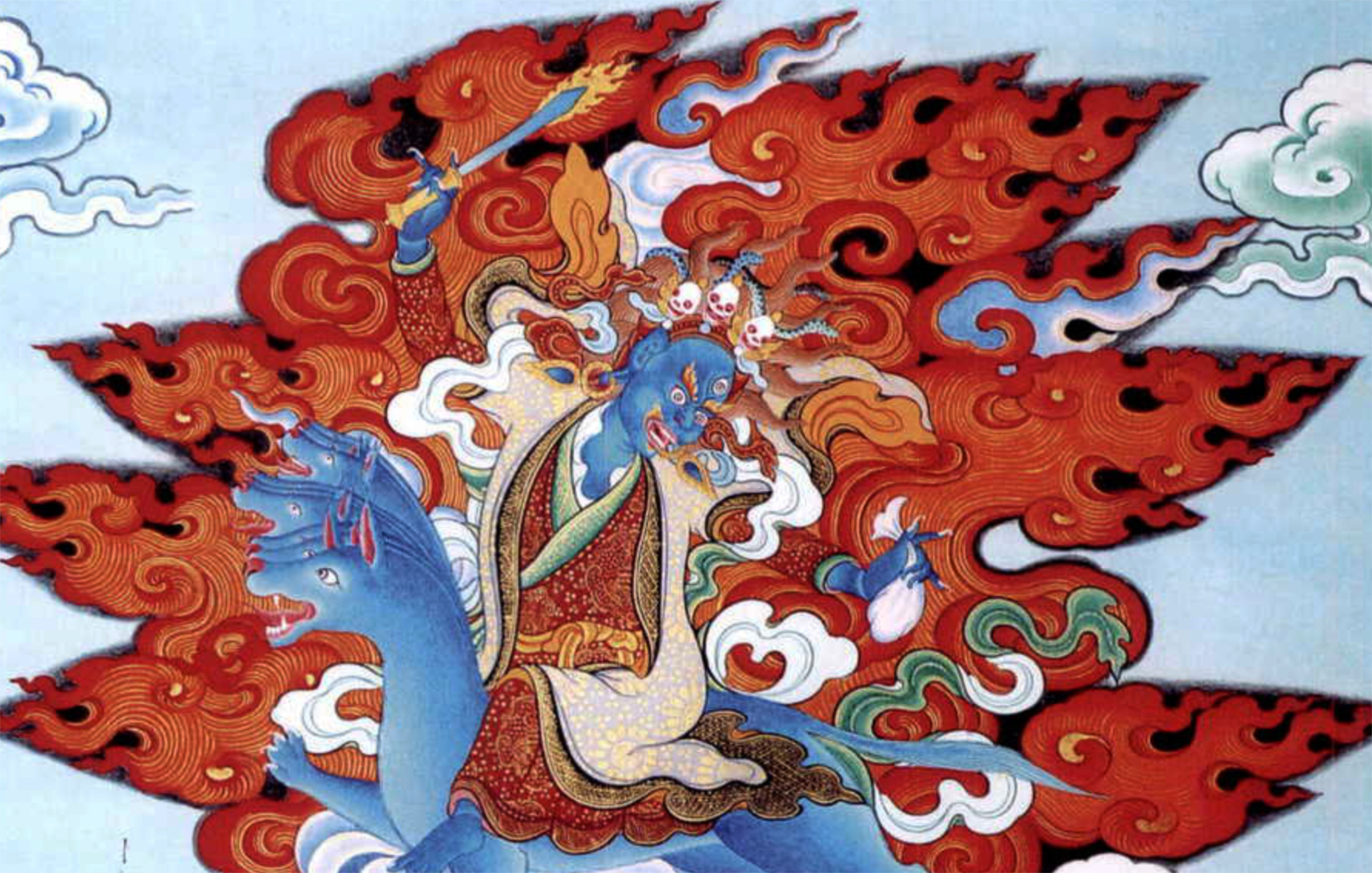
Command for the Drala Queen
The One Hundred Syllable Mantra
Dedication
Appendix
Endnotes
This booklet is meant to be an immediate support for those in need rather than an in-depth study of the subject material. These specific prayers were chosen because they are frequently recommended as expedient ways to invoke support and neutralize harm by calling upon the drala who are a primordial class of worldly protecters. Especially, from the view of astrology, each year brings both supportive and challenging aspects to each individual. For those whose yearly Tibetan astrological calculation indicates a probability for obstacles, one of the recommended methods for support is to call upon the drala. (To know more about who can benefit from invoking the drala during the current year of the Fire Horse, see previous article: https://ravencypresswood.com/2026/02/14/2026-the-year-of-the-male-fire-horse/)
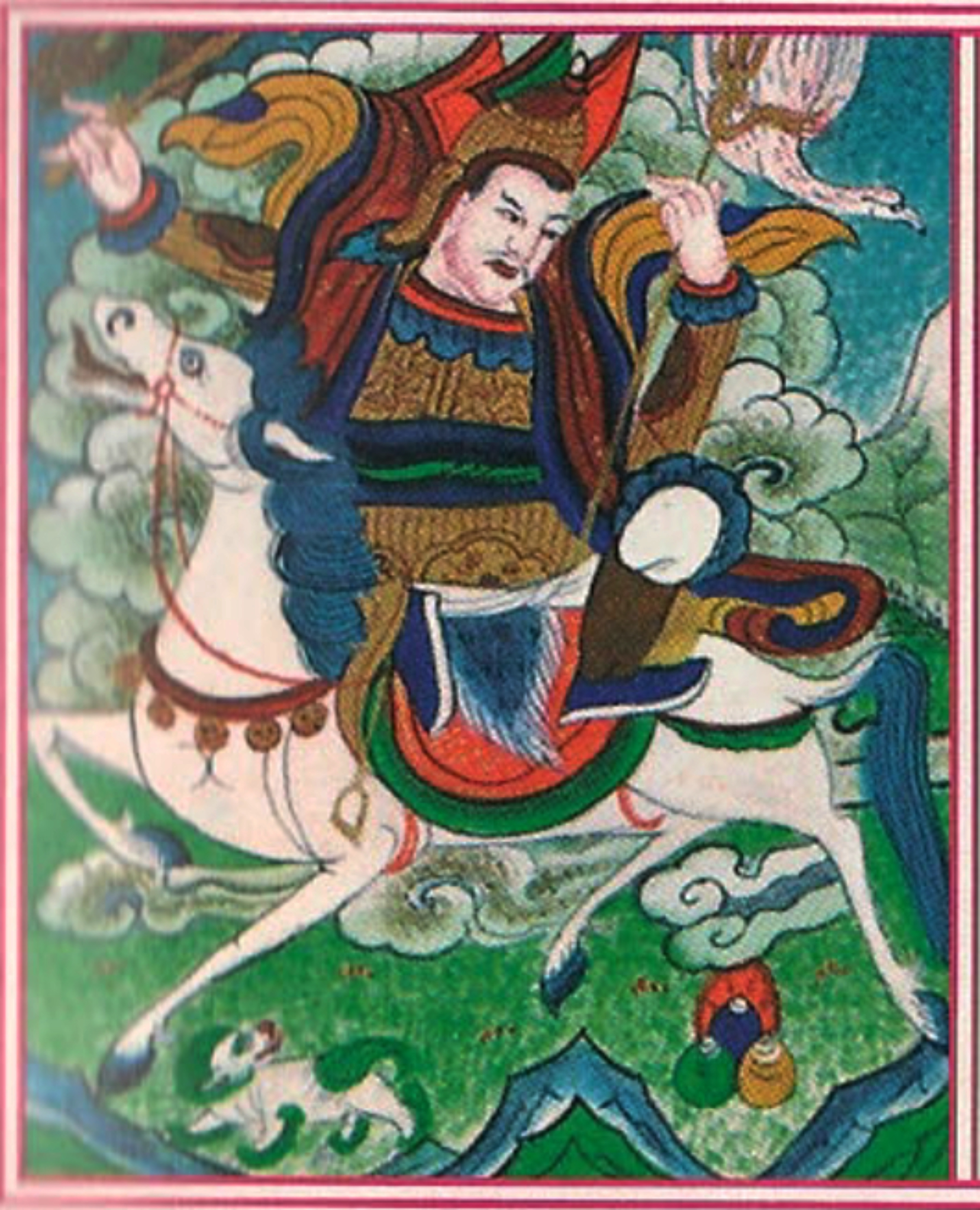
“From our great ancestor of the past, Mu Chuk Khorlo, until the present victors of Bön and beyond, we have relied upon you as our close allies and made offerings to the drala of the ancestral lineages from generation to generation. Now, at our time of need, when we call upon the army of gods because of enemies, we beseech you to come quickly without delay!”
Did you enjoy this content? This article is made possible by generous donors who want content like this to continue to be available. Don’t want to miss a post? Scroll to the bottom and click “Follow this blog.”
Join the mandala of Nine Ways supporters by donating through one of the services listed below.
Mawé Sengé, Lion of Speech, with a sword of knowledge and a scripture.
After the Tibetan New Year celebrations, students at Menri Monastery enter into an intensive retreat to cultivate the qualities of the wisdom deity Mawé Sengé, Lion of Speech. This retreat begins on the 24th lunar day of the 1st month and concludes on the 30th lunar day. In 2026, these dates are March 12th – March 18th on the Western calendar. The purpose of this retreat is to receive the blessings and empowerment of the wisdom deity Mawé Sengé in order to develop and sharpen the students’ intellect to support their upcoming studies in the new school year. The practice of Mawé Sengé is performed many times each day and the mantra of the deity is recited as much as possible throughout the retreat with a minimum accumulation of one hundred thousand mantra recitations.
Mawé Sengé is the manifestation of the Dzok ku, the enlightened state that spontaneously expresses perfected qualities. If practiced regularly, he clears away the darkness of confusion, develops the intellect, and gives a quick and steadfast memory without forgetfulness. If his practice is properly applied and accomplished, there are seven specific signs that arise that indicate his blessings and power have been accomplished. These are called The Seven Signs of Attaining Wisdom that Blazes Like Fire. They are:
The sign of having removed the darkness of lack of knowledge from the intellect. Specifically, this refers to removing a weak or unclear intellectual understanding.
The sign of having the eye of wisdom. This is the attainment of clairvoyance, expansive knowledge, and wisdom.
The sign of being like a lion of glorious poetry. This refers to the ability to write expert discourses, specifically scholastic poems and compositions.
The sign of the sun of superior knowledge rising. This refers to the capability of having clear knowledge, without any confusion, regarding the qualities of any knowable subject.
The sign of attaining the recollection of intelligence that is never forgotten. This refers to a steadfast capability of remembering what has been learned without forgetfulness.
The sign of being like a thunderbolt when debating. This refers to the capability to brilliantly overcome all others, without defeat or fear, when debating any subject whatsoever.
The sign of the intellectual memory being fast like lightening. This refers to an extraordinary ability of having a clear and quick memory.
“I go for refuge to the wisdom deity for the intellect.I generate the supreme mind of enlightenment for the benefit of vigorous training in the highest wisdom.Having compassionately purified all karmic obscurations without exception, please bestow the attainments of an increased intellect, useful knowledge, and a divine voice!”
— From The Short Practice of Mawé Sengé. Tibetan translation: Raven Cypress Wood
Mawé Sengé holding a sword and a butter lamp
In the Yungdrung Bön tradition, there are two principal forms of the wisdom deity Mawé Sengé. Both of these forms share most characteristics. However, one form holds a sword and a scripture as the hand objects. The other form holds a sword and a butter lamp. This second principal form of Mawé Sengé is according to the prayer, An Offering of Praise for the Supreme Wisdom Deity Sherab Mawé Sengé, A Garland of Utpala Flowers composed by the highly revered Nyammé Sherab Gyaltsen Rinpoche.
“With a sword of wisdom held in your right hand, you cut the root of deluded thoughts and self-grasping.
With a butter lamp of clarity held in your left hand, you dispel the dark intellect and ignorance of migrating beings.
In the space to your right and left, the sun and moon blaze with the splendor of the inseparability of method and knowledge.”
— Extract from An Offering of Praise for the Supreme Wisdom Deity Sherab Mawé Sengé, A Garland of Utpala Flowers
Did you enjoy this content? This article is made possible by generous donors who want content like this to continue to be available. Don’t want to miss a post? Scroll to the bottom and click “Follow this blog.”
Join the mandala of Nine Ways supporters by donating through one of the services listed below.
The anniversary of the passing away of Kyagön Dawa Gyaltsen Rinpoche is the 7th and 8th lunar days of the 11th month. In 2025, these dates coincide with December 26th & 27th on the Western calendar. He was born during the Fire Dragon year of 1796 and founded Ralak Yungdrung Ling Monastery on the bank of the Yarlung Tsangpo River in 1834. This monastery developed into one of the largest and most prestigious centers for learning within the Yungdrung Bön tradition. It was renowned for its extensive library and the fact that it had its own woodblocks to print texts. The monastery contained many golden statues including a gilt-copper image of Nampar Gyalwa that was two-stories high. It also contained reliquary stupas enshrining the remains of previous abbots. In 1965 during the cultural revolution, the monastery was burned to the ground. In 1982, two monks who had been in residence at the monastery prior to its destruction began the process of reconstruction.
Ralak Yungdrung Ling Monastery in Tibet. Photo credit: Unknown.
Supplication Prayer to the Lord of Refuge Dawa Gyaltsen
“You, a teacher born into the Amdo family lineage of Nangzhik, you spread the unrivaled Bön teachings of the White AH throughout your homeland.
You embody the essence of all buddhas by having having perfected the exalted qualities of the major and minor characteristics.
I pay homage to the Buddha who manifested in human form!”
— Translated from the Tibetan by Raven Cypress Wood
Reliquary containing the sacred relics of Kyabgön Dawa Gyaltsen. Photo credit: Unknown
At the age of sixty-seven during the water dog year of 1862 on the auspicious 8th lunar day of the middle winter month at mid-day, the warmth of his body and his consciousness concentrated at the center of his heart. His eyes looked straight ahead, unmoving. After the third sounding of the syllable “Pé!” related to the transference of consciousness practice, he left the shell of his physical body for the great bliss space of absolute reality.
Did you enjoy this content? This article is made possible by generous donors who want content like this to continue to be available. Don’t want to miss a post? Scroll to the bottom and click “Follow this blog.”
Join the mandala of Nine Ways supporters by donating through one of the services listed below.
In 2024, Gary Freeman was on pilgrimage in Nepal with a group of Geshe Sonam Gurung’s students and had seen some beautiful murals of various manifestations of Sipé Gyalmo. Inspired by these images, he contacted me and generously offered to sponsor translation of prayers related to these specific manifestations. In the past, Gary and his wife Adriana sponsored the English translation of the healing waters practice of Sigyal Drakngak. Because of their request and sponsorship, this practice was translated into multiple languages, published, used by disciples worldwide during the Covid-19 pandemic, and continues to be used by regular practice groups. So, even though I was in the midst of finalizing translations for a forthcoming book on the MA TRI tantra, I set that aside to happily translate a few prayers. After sending the finished translations to Gary, I thought that it would be wonderful if they were also available to with the worldwide Yungdrung Bön community. With that in mind, I decided to create a small booklet of prayers focusing on female protectors that could be used by the faithful while on pilgrimage.
After a couple of weeks, I decided that the booklet was finished and went back to working on the MA TRI translations. However, I was constantly considering other prayers that would be beneficial additions. I would then add an additional prayer and again decide that it was complete. After doing this a few times, I surrendered to totally focusing on the pilgrimage booklet. Weeks turned to many months and the booklet grew to a 200 page book. And so, A Blazing Mala of Wish-fulfilling Jewels was born. It is a compilation of prayers and practices of the Yungdrung Bön religious tradition with an emphasis on female buddhas, protectors, and yogis. Being composed by enlightened ones or realized masters, these prayers carry power beyond that of ordinary words. When performed with faith and devotion, their profundity is inconceivable. When performed in conjunction with instruction and oral transmission from an authentic Yungdrung Bön master, their power and effectiveness are exponentially multiplied. These prayers are used for awakening the heart and mind, offering devotion, accumulating merit and wisdom, removing obstacles, protecting and increasing the life force, making aspirations, and so on. The book is formatted similar to a traditional Tibetan prayer book in that one prayer seamlessly follows another in an unbroken way. Thus, it is like a mala with each prayer like an individual bead being connected by the strong thread of Bön wisdom within the verses. When used with faith and devotion, the prayers become like blazing, wish-fulfilling jewels.
Most of the compositions are from my personal collection of Tibetan language prayer books and were translated over the course of many years. Some were translated in response to a request from a single individual, others were translated from a request by a Yungdrung Bön lama to be used for a one-time teaching or event, and others are prayers that have become part of my own practice. A select few were translated specifically to be included in the book. I am delighted to now share them with the worldwide Yungdrung Bön community.
The English language translations in the first half of the book are followed by the Tibetan language text with corresponding phonetics. The end of the book contains a brief Glossary of Terms and Notes section but there are no explanations of the meaning of the prayers or instructions for their use. In that way, use of A Blazing Mala of Wish-fulfilling Jewels assumes that the reader has at least some basic familiarity with the material, the Yungdrung Bön religious tradition, and with the language and terms used within the prayers. The book follows the traditional structure of beginning with prayers of homage and supplication to the lamas, followed by supplications and invocations of the peaceful and wrathful deities, and concluding with prayers of aspiration and dedication. My wish is that this book will be a support for happiness and spiritual development for generations to come.
Yeshe Walmo sacred dance at Menri Monastery in India
“Mother Yeshé Walmo, together with your powerful, magical emanations, you guard both the teachings and those who keep their vows, and you cut the life force of those who break their vows. You liberate the discordant into space and guide along the path of liberation. I, an only child, constantly call out to my mother. Does the single mother’s ears not hear me? I, an only child, constantly yearn for my mother. Does the single mother’s heart not consider me? Sole Mother, I, the Shen practitioner who calls upon you, am accepting hardships, aspiring to enlightenment, relying on solitary places, carrying the lama at my crown, and practicing with my mind in the midst of diversions and distractions. Single Mother, lead me along the path! Sole Mother, fulfill my wishes! Sole Mother, dispel my obscurations!”
On the 24th day of the 7th lunar month in the Western year 2017, His Holiness the 33rd Menri Trizin Lungtok Tenpé Nyima Rinpoché displayed his realization by passing into nirvana from his physical body. In 2025, this date coincides with the Western calendar date September 15th. On this day, Yungdrung Bön religious centers worldwide will recognize this auspicious day with special prayers and rituals.
In accordance with the request of H.H. 34th Menri Trizin Rinpoche, a statue with the likeness of H.H. the 33rd Menri Trizin Lungtok Tenpé Nyima Rinpoche was commissioned and installed at Menri Monastery in India.
On the full moon day of the 5th lunar month in 1929, His Holiness was born in Amdo, Tibet into the Jongdong family lineage. He was given the name Lama Thar. By the age of 13, he had gained knowledge and experience for chanting, performing rituals, and playing instruments. At the age of 14, he performed the preliminary practices including the 900,000 accumulations three times. He received novice monk vows at the age of 17. Eight years later, he completed his geshe degree. In 1956, he received empowerment and teachings for the Four Cycles of the Aural Transmission of Zhang Zhung from His Holiness the 30th Menri Trizin Tenpa Lodrö Rinpoche. In 1968 at the age of 39, he was selected through an extensive ritual process to become the 33rd Menri Trizin and leader of the worldwide Yungdrung Bön community.
Three years after his enthronement, he began construction of the main temple of Pal Shenten Menri Ling in Dolanji, India. Two years later, he opened a dispensary and began distributing free medicine not only to the local Bönpo, but also to the local Indian community. In 1975, he founded the Central School for Tibetan in Dolanji. Three years later, he founded the dialectic college at Menri Monastery to enable monks to receive the prestigious geshe degree. At the age of 66 in 1994, His Holiness 33rd Menri Trizin returned to Tibet for the first time. Arriving at Tashi Menri, he sat on the golden throne of Nyammé Sherap Gyaltsen in the original Menri Monastery.
Memorial chorten for His Holiness the 33rd Menri Trizin at Pal Shenten Menri Ling
At the age of 89 in the early evening of the 24th day of the 7th lunar month in 2017, His Holiness entered into parinirvana and his physical body remained in a state of tukdam for many days. Three days before, he asked for all of the school children to come and see him and receive a gift of candy. The next day, he requested for all of the villagers to come and visit him. On the morning of his passing into nirvana, he gave an audience to all the ordained.
“It is important for you to feel grateful every day to the one who introduced you to the nature of mind. When you do a meditation you feel gratitude, blessings, and thankfulness, experiences of inspiration and devotion. It is not like your gratitude is benefitting the master. Rather, it is important in order for you to develop your practice. If you cannot do a form of guru yoga every day, then just before you are going to sleep, as you are going to bed, feel the blessings, gratitude, and joy and dissolve the master from the crown of the head to the heart. Feel the master in your heart and go to sleep. You will have better dreams and more peaceful sleep. When you wake up in the morning, those energies can come out from the top of the head, that liveliness, and you can have a better day. You can begin the right way.”
Extract from Living Wisdom: Dzogchen Teachings from the 33rd Menri Trizin, His Holiness Lungtok Tenpai Nyima Rinpoche published by Sacred Sky Press
Supplication Prayer to H.H. the 33rd Menri Trizin Rinpoché
“Marvelous! The omniscient wisdom of the Buddhas and Bodhisattvas of the ten directions is condensed into a single essence in you, Highest One.
You carry out the enlightened activities of spreading the vast and profound teachings of Tönpa Shenrap.
To you, Lungtok Tenpé Nyima, I supplicate and pray.
é ma ho, rap jam chok chü gyal wa sé ché kyi,
khyen tsé yé shé ngo wo chik dü pa, zap gyé shen ten pel wé trin lé chen







 Nine Ways