Category Archives: Tibetan Culture & History

The 84,000 Doors of Bön at Your Fingertips

mala

“The mala represents the destined connection with the Enlightened Beings.  The mala string represents the 84,000 doors of Bön.  The head bead represents the principal teacher.  The counting beads represent the Six Subduing Shen, the six enlightened Shen who tame the six realms of cyclic existence.”  ~from The Advice of Lishu Taring

The mala is called treng wa in Tibetan.  It consists of one hundred eight counting beads and one larger main bead, often referred to as the ‘head bead’ or the ‘lama bead’.  Malas can have spacer beads which are not counted during recitation of a mantra but are used for decorative purposes or to lengthen the mala and enable it to fit onto an individual’s wrist.  Various kinds of counters are often added to the mala so that the practitioner can keep count of the mantra recitations. Malas can be made from various materials.  Traditionally, these materials were symbolic because of their energetic qualities.  For example, tantric practitioners would often use malas made of bone to represent impermanence.

Before a mala is used, the practitioner will have it consecrated by a lama.  This blesses it and also removes any contamination that the materials might carry with them that could be an obstacle to obtaining the benefit of the recitations.  Although there are one hundred eight beads, a single round of recitations is counted as one hundred.  In this way, if any beads have accidentally been skipped during the recitation, they are accounted for with the ‘extra’ eight beads.  Many practices require a commitment to recite a minimum of one hundred thousand repetitions of a mantra.  Therefore, these ‘extra’ beads ensure that the commitment has been fulfilled.  In general, during recitation, the practitioner is not allowed to eat, drink, talk, sneeze, spit or cough. These activities expel or diminish the specific power of the mantra that is being cultivated.  Once the session of mantra recitation is complete, the mala is rubbed gently between the hands and blown upon by the practitioner.  In this way, the mala becomes further empowered and blessed by the mantra.

The mala is a sacred object and should not be worn as jewelry. It should be kept clean and not be handled by others.  By wearing the mala on the wrist or carrying it in a pocket on the body, it acts as a form of protection.  The mala is also sometimes used for divination or healing purposes.  Lamas will sometimes give away their mala intact, or one bead at a time.  Because of the power of the lama’s practice and recitation, this gift is a great blessing.

Raven Cypress Wood© All Rights Reserved

Link to the Ancient Past

Heir to the Shen Lineage and direct descendant of Lord Tonpa Shenrap Miwoche, Shen Tsukpu Namdrol Rinpoche

The Second Spread of the Yungdrung Bön in Tibet

Yumbum Lhakhang in the Yarlung Valley, ancient palace of the early Tibetan kings

The eighth king of Tibet, Drigum Tsenpo,  fearing the power and influence of the Bön Shen priests, banished them along with the Yungdrung Bön teachings from the kingdom.  This was first persecution of Yungdrung Bön which resulted in the hiding of Yungdrung Bön texts as terma, or hidden treasure.  See previous post, https://ravencypresswood.com/2016/10/01/the-first-spread-of-the-yungdrung-bon-teachings-within-the-human-realm/.  After the king had banished the priests, there remained no one powerful enough for him to fight.  Therefore, he sent a message to the minor ruler of the Tibetan region of Lho Drak, Lo Ngam Ta Dzi, and commanded him to a challenge with his army.  Although Lo Ngam was not inclined to fight, the king insisted and Lo Ngam had no choice but to agree.  Soon thereafter, Lo Ngam had a dream in which he was given specific instructions on how to defeat King Drigum Tsenpo.  Having followed the advice given in his dream, Lo Ngam was victorious and the king was killed.  He put King Drigum Tsenpo’s corpse into a copper coffin and threw it into the Tsangpo River.  He then banished the king’s sons, made the queen a shepherdess, and ruled the land of Tibet for thirteen years.

The greatly accomplished yogi, Tong Gyung Tuchen

The queen had a son who, after discovering his royal lineage from a minister loyal to the queen, killed Lo Ngam Ta Dzi.   Receiving news of his death, Drigum Tsenpo’s son Pude Gung Gyal, returned to Tibet from exile.  Recognizing that the suppression of Bön had caused the death of his father and the downfall of both his family and the entire realm of Tibet, Pude Gung Gyal made the decision to reinstate Yungdrung Bön along with its priests, the Bön Shen.  He sent an urgent message to the accomplished Yungdrung Bön yogi, Tong Gyung Tüchen, who was practicing in isolation on an island in the Lake of Nam.  He pleaded with the yogi to help him revive Yungdrung Bön.  Tong Gyung Tuchen agreed and instructed Pude Gung Gyal to invite one hundred knowledge holders to Tibet in order to begin its revitalization.  These one hundred Bön Shen performed a rite of purification for the murdered king, Drigum Tsenpo, offered blessings to all of those present, and offered their support as Pude Gung Gyal ascended the throne and assumed the title of King of Tibet.  He became known as Tolek Tsenpo, King of the Highest Good.  Thus, the teachings and practice of Yungdrung Bön flourished and spread again in the land of Tibet.

All Rights Reserved ©Raven Cypress Wood 2016

*All dates from Gal Che’i bsTan rTsis Phyogs bsDus, A Summary of Essential Chronology, published by Triten Norbutse Monastery.


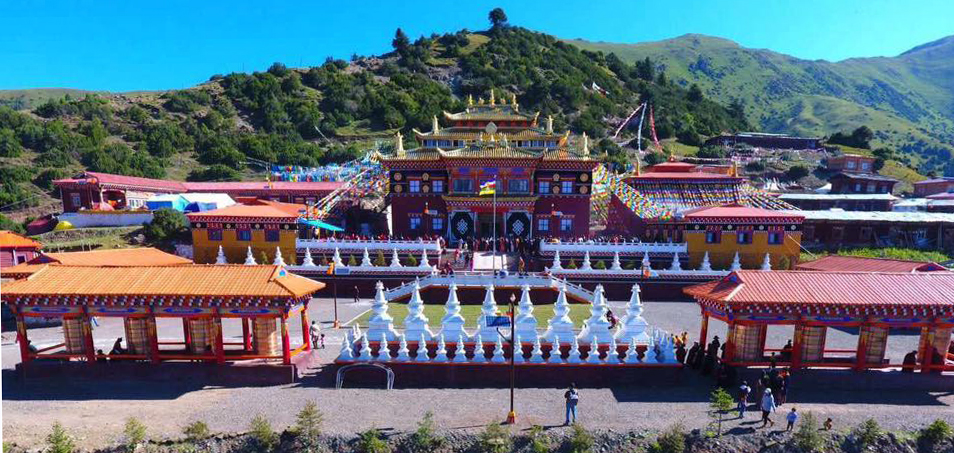
Pilgrimage: Tardé Miyo Samten Bön Ling Monastery

Tarde Miyo Samten Bon Ling Monastery in Kham, Tibet. Photo credit: Unknown

The Yungdrung Bön monastery of Tarde Miyo Samten Bön Ling is located in Derge County near the Yangtze River in the Kham region of Tibet.  The Land of Blissful Liberation and Unshakeable Bön Meditation was founded by Kunga Namgyal and, although the founding date is uncertain, the history of the monastery records seventeen subsequent generations to the present.  Although the monastery was destroyed during the cultural revolution that began in 1959, beginning in the 1980’s it was rebuilt by the senior monks.  The mountain directly behind the monastery is called Tsang Chen and is believed to be the home of the local deity.

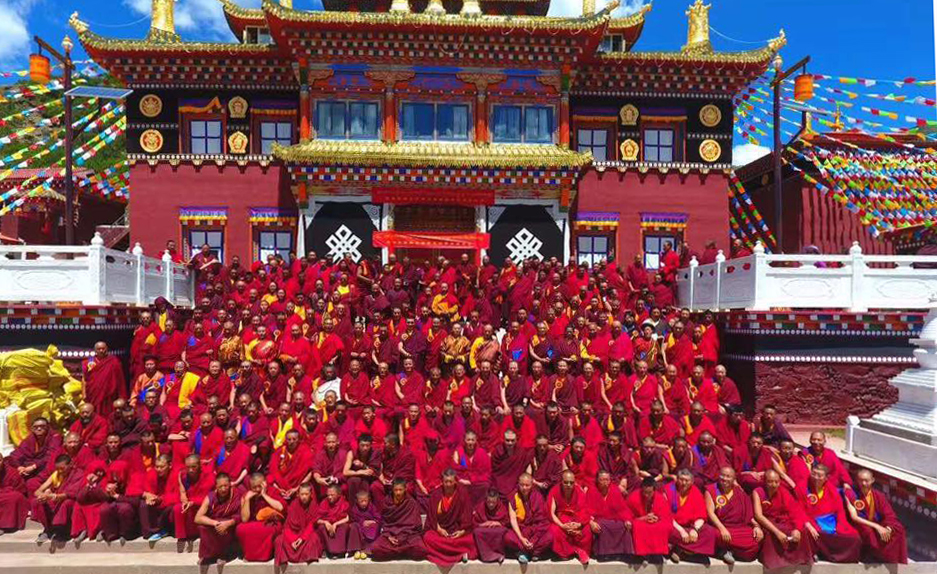
Those in attendance at the 5th Conference on Upholding and Preserving the Bon Teachings. Photo credit: Unknown

In 2016, the monastery hosted the 5th Conference on Upholding and Preserving the Teachings of the Yungdrung Bön.  A number of prominent Yungdrung Bön scholars gave presentations at the conference and there were also rituals and ceremonies to mark the special occasion.

Chortens before the Tarde Miyo Samten Ling Monastery in Kham, Tibet. Photo credit: Unknown


The First Spread of the Yungdrung Bön Teachings within the Realm of Tibet

Depiction of the ancient land of Olmo Lungring

The founder of the Yungdrung Bon religious tradition, Lord Tönpa Shenrap Miwoche, was born into human form as a prince in the ancient land of Olmo Lungring within the ancient country of Tazik in the Wood Mouse year of 16,017 BC*.  Having taught the Yungdrung Bön to numerous disciples within Tazik, the teachings were eventually translated into three hundred sixty languages.  It is said that one hundred ninety-four of these languages pertained to realms beyond the borders of  Olmo Lungring.  Although Lord Tönpa Shenrap Miwoche made one journey into Tibet and taught the offering of torma as a substitute for harming living beings, the Yungdrung Bön teachings were not widespread at that time.

And so, having been translated and entrusted to various knowledge holders, the teachings were spread first into Zhang Zhung before spreading to India and China, and on into countries such as Kashmir, Nepal, Togar, Gilgit, Phrom, Zahor and Sumpa.  From Zhang Zhung, India and China, the teachings spread into the realm of Tibet. Because of this, many of the Yungdrung Bön texts today retain some of the original Zhang Zhung words, as well as words of other languages, which predate their translation into the Tibetan language.

The 1st universal ruler of Zhang Zhung, King Tri Wer Laje, possessor of the Golden Horned Crown and close disciple of Lord Tonpa Shenrap

During the reign of the first seven kings of Tibet, the teachings of Lord Tönpa Shenrap Miwoche flourished and each of these Tibetan kings had one or more Royal Bön Shen, or personal Yungdrung Bön priests, who acted as a kind of spiritual bodyguard to the king by protecting his lifespan, power and wealth as well as giving spiritual guidance.

Yumbu Lhakhang in the Yarlung Valley. Palace of the 1st Tibetan king, Nyatri Tsenpo, and used for centuries by his successors.

The first person appointed to rule as king over the entirety of Tibet, Nyatri Tsenpo, is said to have been of a supernatural lineage and was anointed king in the Wood Mouse year of 1136 BC.  During his reign, the Twelve Kinds of Knowledge of the Causal Vehicles of the Yungdrung Bön doctrine were widely spread and practiced.  His son, Mutri Tsenpo, invited one hundred eight Zhang Zhung scholars to Tibet and established forty-five centers for Yungdrung Bön practice and study.  During the reign of the next five Tibetan kings, the Yungdrung Bön had royal support and flourished.

1st Tibetan king: NyatriTsenpo

2nd Tibetan king: Mutri Tsenpo

3rd Tibetan king: Tingtri Tsenpo

4th Tibetan king: Sotri Tsenpo

5th Tibetan king: Daktri Tsenpo

6th Tibetan king: Jangtri Tsenpo

7th Tibetan king: Tride Yakpo

King Tride Yakpo had a son by the name of Drigum Tsenpo who was enthroned at the age of thirteen.  The Royal Bön Shen continued to be very powerful and influential in the royal court due to their deep connections with the kings of the Zhang Zhung empire.  King Drigum Tsenpo’s ministers began telling him that the words of the Bön Shen were more powerful than that of the king and that they posed a great and immediate threat.  Although he had practiced Bön in his youth, King Drigum Tsenpo called the Bön Shen together and told them that there was not enough room for both his authority and theirs in Tibet.  Therefore, he ordered them into exile.  With the exception of specific causal vehicle practices which were used to protect the king’s power and wealth, Drigum Tsenpo began the suppression and persecution of all of Lord Tönpa Shenrap’s teachings.  This was 683 AD, the first persecution of Yungdrung Bön which resulted in the hiding of texts as terma, or hidden treasure.

The Bön Shen loaded their texts upon domestic animals and traveled to the borderland of Zhang Zhung where they held a conference.  It was decided that in order to preserve the teachings, they would divide the texts among them.  Some of them traveled to the borderlands or other countries in order to spread the teachings.  Others hid the precious scriptures of the Yungdrung Bön and performed prayers of aspiration that the teachings would reemerge in a more favorable time and that the teachings of Lord Tönpa Shenrap would again spread for the benefit of sentient beings.

*All dates from Gal Che’i bsTan rTsis Phyogs bsDus, A Summary of Essential Chronology, published by Triten Norbutse Monastery.

Raven Cypress Wood© All Rights Reserved