Category Archives: Five Elements

The Twelve Animals of Tibetan Astrology: 2020 Year of the Metal Rat

According to Tibetan astrology, there is a repeating twelve-year cycle.  Each year is characterized by a different animal and associated with one of the five elements.  Therefore, a full cycle of the twelve animals being associated with each of the five elements is sixty years.  The twelve animals according to the Yungdrung Bön texts are the Rat, Elephant, Tiger, Rabbit, Dragon, Horse, Snake, Sheep, Garuda, Monkey, Dog and Pig.  Each animal is associated with a specific element for its life-force as well as a specific direction which is determined by the life-force element.  Not only are these twelve animals associated with specific years, they are also associated with specific months, days and hours that attributed the characteristics of that particular animal.

Monday February 24, 2020 is the Tibetan New Year and begins the year of the Metal Rat.  Therefore, people born during this year would be a Metal Rat and would have an emphasis of the specific qualities associated with the Rat.  (It is important to remember that this year corresponds with the Tibetan lunar calendar which begins somewhere between February and mid-March each year.) In both the Tibetan and Chinese languages, the words for ‘rat’ and ‘mouse’ are the same. Similarly, the words for ‘iron’ and ‘metal’ are the same. So, it could also be referred to as the year of the iron mouse. However, because of the inference of meaning in the English language for these terms compared with the specific characteristic qualities they are meant to convey, it will be referred to as the year of the metal rat in this article.

People born during a Rat year will have an emphasis of the specific qualities associated with the symbol of the Rat.  According to Tibetan astrology, the element which governs the life-force of the Rat is Water and its positive direction is North.  So, if a Rat person wanted to strengthen their life-force, they would focus upon strengthening the element of Water internally and externally.  Because the positive direction is North, facing this direction while meditating, engaging in healing practices or just relaxing and taking deep breaths is beneficial.

In general, the Rat symbolizes prosperity because of their propensity to accumulate wealth and enjoy success. They can be generous with their wealth but they can also become overly attached to their luxury which can manifest as selfishness. The Rat is adaptable and flexible and can use most circumstances to their advantage. Because of this, they are successful with many of their objectives.

The Rat is colorful, charismatic and enjoys being around others. They can be generous and engaging, although these interactions can be motivated by a need to reinforce the ego and pride. Once they trust someone, they are sentimental and generous within the relationship and can be a trusted intimate. They appear smart and relaxed. However, when a Rat feels frustrated or betrayed it is important for them to rely upon their calm due to the possible reflex of aggression and revenge.

The Rat‘s soul day is Wednesday and its life-force day is Tuesday.  These are the best days for beginning new projects and activities that are meant to increase or develop something.  The obstacle day is Saturday.  This day is best for purification and letting things go.  It is not a favorable day for beginning new activities or risky activities.

Rat years include: 1948, 1960, 1972, 1984, 1996, 2008, and 2020

If you were born during a previous year of the Rat, this year as well as other Rat years are considered a time of vulnerability to obstacles. This same astrological principal applies for all of the other eleven animal signs during their associated year. Therefore, it is recommended to engage in practices that support vitality, good fortune and spiritual merit such as hanging prayer flags, having a soul and life-force retrieval ritual performed, restoring any deterioration or violation of one’s spiritual commitments or any damaged relationship with one’s spiritual brothers and sisters, and/or performing prayers and rituals to remove obstacles. In general, making an effort to engage more with virtuous activities of body, speech and mind and committing to engage less with non-virtuous activities is supportive. According to the words of Buddha Tönpa Shenrap Miwoché, the practice of developing sincere unbiased and unlimited compassion is the greatest of all protections.

A common prayer within the Yungdrung Bön tradition that is used to remove obstacles is the Bar Che Lam Sel, The Spontaneous Wish-fulfillment of Removing Obstacles from the Path. The English, Spanish and Portuguese translations of this prayer are offered free for personal use on the Nine Ways Publications page. Click on the Publications tab above and scroll down to the download links for the prayer.

All translations and content by Raven Cypress Wood ©All Rights Reserved.

No content, in part or in whole, is allowed to be used without direct permission from the author.

Don’t want to miss a post? Scroll to the bottom and click “Follow this blog.”

The Twelve Animals of Tibetan Astrology: The Pig

In Tibetan astrology, there is a twelve-year cycle.  Each of these years is characterized by a different animal and associated with one of the five elements.  Therefore, a full cycle of the twelve animals being associated with each of the five elements is sixty years.  The twelve animals according to the Yungdrung Bön texts are the Rat, Elephant, Tiger, Rabbit, Dragon, Horse, Snake, Sheep, Garuda, Monkey, Dog and Pig.  Each animal is associated with a specific element for its life-force as well as a specific direction which is determined by the life-force element.  Not only are these twelve animals associated with specific years, they are also associated with specific months, days and hours.

Feb 05, 2019 begins the Tibetan New Year, or Losar, and the year of the Earth Pig.  People born during a Pig year will have an emphasis of the specific qualities associated with the symbol of the Pig.  (These years correspond with the Tibetan lunar calendar and begin sometime between late January and early April.)   According to Tibetan astrology, the element which governs the life-force of the Pig is Water and its positive direction is North.  So, if a Pig person wanted to strengthen their life-force, they would focus upon strengthening the element of Water internally and externally.  Because the positive direction is North, facing this direction while meditating, engaging in healing practices or just relaxing and taking deep breaths is beneficial.

In general as an astrological symbol, the Pig person is honest and uncomplicated. A Pig person is straight-forward, but not in an aggressive way. They are often seen as “good, down-to-earth” people by others. This is because the Pig person does not harbor hidden agendas. They can be trusted and relied upon. In general, they have many friends to whom they are generous and jovial, and are always willing to be helpful. However, the Pig person can have difficulty setting boundaries and saying ‘no.’ And because they tend to be naive, it is possible for them to be taken advantage of by others. Although the Pig person is generous, they also enjoy having money for themselves and living in leisure and comfort. For this reason, the pursuit of pleasure and entertainment can become imbalanced and lead to excess.

The Pig’s soul day is Wednesday and its life-force day is Tuesday.  These are the best days for beginning new projects and activities that are meant to increase or develop something.  The obstacle day is Saturday.  This day is best for purification and letting things go.  It is not a favorable day for beginning new activities or risky activities.

Pig years include: 1935, 1947, 1959, 1971, 1983, 1995, 2007, and 2019

If you were born during a previous year of the Pig, this year as well as other Pig years are considered a time of vulnerability to obstacles. This same astrological principal applies for all of the other eleven animal signs during their associated year. Therefore, it is recommended to engage in practices that support vitality, good fortune and spiritual merit such as hanging prayer flags, having a soul and life-force retrieval ritual performed, restoring any deterioration or violation of one’s spiritual commitments or any damaged relationship with one’s spiritual brothers and sisters, and/or performing prayers and rituals to remove obstacles. In general, making an effort to engage more with virtuous activities of body, speech and mind and committing to engage less with non-virtuous activities is supportive. According to the words of Buddha Tönpa Shenrap Miwoché, the practice of developing sincere unbiased and unlimited compassion is the greatest of all protections.

A common prayer within the Yungdrung Bön tradition that is used to remove obstacles is the Bar Che Lam Sel, The Spontaneous Wish-fulfillment of Removing Obstacles from the Path. The English, Spanish and Portuguese translations of this prayer are offered free for personal use on the Nine Ways Publications page. Click on the Publications tab above and scroll down to the download links for the prayer.

Raven Cypress Wood© All Rights Reserved

Don’t want to miss a post? Scroll to the bottom and click “Follow this blog.”

The Twelve Animals of Tibetan Astrology: The Dog

In Tibetan astrology, there is a twelve-year cycle.  Each of these years is characterized by a different animal and associated with one of the five elements.  Therefore, a full cycle of the twelve animals being associated with each of the five elements is sixty years.  The twelve animals according to the Yungdrung Bön texts are the Rat, Elephant, Tiger, Rabbit, Dragon, Horse, Snake, Sheep, Garuda, Monkey, Dog and Pig.  Each animal is associated with a specific element for its life-force as well as a specific direction which is determined by the life-force element.  Not only are these twelve animals associated with a particular year, they are also associated with particular months, days and hours.

Feb 16, 2018 begins the Tibetan New Year, or Losar, and the year of the Earth Dog.  People born during a Dog year will have an emphasis of the specific qualities associated with the symbol of the Dog.  (These years correspond with the Tibetan lunar calendar and begin sometime between late January and early April.)   In astrology, the element which governs the life-force of the Dog is Earth and its positive direction is Northwest.  So, if a Dog person wanted to strengthen their life-force, they would focus upon strengthening the element of Earth internally and externally.  Because the positive direction is Northwest, facing this direction while meditating, engaging in healing practices or just relaxing and taking deep breaths is beneficial.

In general as an astrological symbol, the Dog person is loyal, straightforward, and honest. Because of their desire to offer their help and support, they are diligent and responsible with tasks. The Dog person takes great care in all that they do and is methodical and precise. Because of this, they do not like to be rushed in completing tasks or making decisions. Others can become frustrated at the Dog person’s seeming inertia when actually they are diligently analyzing the situation in order to be certain in making the correct decision. This tendency towards analysis and judgement can be in excess and lead the Dog person to overly analyze situations and consequently fall into despair or pessimism. For this reason, the Dog person can be seen as quite serious. However, they do not take their loved ones for granted and their relationships are long-lasting.

The Dog’s soul day is Monday and its life-force day is Wednesday.  These are the best days for beginning new projects and activities that are meant to increase or develop something.  The obstacle day is Thursday.  This day is best for purification and letting things go.  It is not a favorable day for beginning new activities.

Dog years include: 1934, 1946, 1958, 1970, 1982, 1994, 2006, and 2018

If you were born during a previous year of the Dog, this year as well as other Dog years are considered a time of vulnerability to obstacles. This same astrological principal applies for all of the other eleven animal signs during their associated year. Therefore, it is recommended to engage in practices that support vitality, good fortune and spiritual merit such as hanging prayer flags, having a soul and life-force retrieval ritual performed, restoring any deterioration or violation of one’s spiritual commitments or any damaged relationship with one’s spiritual brothers and sisters, and/or performing prayers and rituals to remove obstacles. In general, making an effort to engage more with virtuous activities of body, speech and mind and committing to engage less with non-virtuous activities is supportive. According to the words of Buddha Tönpa Shenrap Miwoché, the practice of developing sincere unbiased and unlimited compassion is the greatest of all protections.

A common prayer within the Yungdrung Bön tradition that is used to remove obstacles is the Bar Che Lam Sel, The Spontaneous Wish-fulfillment of Removing Obstacles from the Path. The English, Spanish and Portuguese translations of this prayer are offered free for personal use on the Nine Ways Publications page. Click on the Publications tab above and scroll down to the download links for the prayer.

Raven Cypress Wood© All Rights Reserved

Harmony and Disharmony of the Five Elements

“From totally void emptiness, a totally clear light appeared. That light…came into being as a luminous wheel, whirling spontaneously. From the self-produced energy of the wheel, weightless wind came into being. The moving energy of the wind grew stronger and stronger and…from the energy of the wind, heat came into existence. From the clash between the heat of fire and the cold of the wind, moisture and water came into being. Subtle and coarse particles gathered in the water, and when their energy developed, they came into being as the Golden Earth that Supports Everything.”
~from the Yungdrung Bön text: The Precious Citadel where Everything is Brought Together as translated by Donatella Rossi in The Light of Kailash By Namkhai Norbu Rinpoche

The Five Elements of Space, Air, Fire, Water and Earth are the basis for all the exists.  These elements are in constant relationship with one another, and it is this harmony, disharmony, balance or imbalance that determines the health or disease of organisms as well as the development or disintegration of dynamic systems.  Many cultures around the world acknowledge the importance of the Five Elements in both mundane and spiritual activities.  Within the Yungdrung Bön tradition, each element has its own distinctive qualities which are represented by a specific color, shape, sound, and direction.  Within our physical bodies, the Earth element is related to our flesh, the Water element is related to our blood, the Fire element is related to our internal  heat, the Wind (or Wood according to astrology) element is related to our breath and movement within the body, and the Space (or Metal according to astrology) element is related to our consciousness.

Among the Five Elements themselves, one way of describing their interactions is through the  five kinds of relationship: Mother, Friend, Self,  Child, and Enemy.  The relationship of ‘Mother’ is the one of greatest harmony.  The relationship of ‘Friend’ is very harmonious.  The relationship of ‘Son’ is considered to be neutral.  The relationship of ‘Enemy,’ as the name indicates, is considered to be the one of greatest conflict.  The relationship of ‘Self’ occurs when the same elements encounter one another.  This can either be good or bad depending upon the specific element involved.  Therefore, the possible relationship combinations for the Five Elements are defined as the following:

Mother: these relationships are considered the most harmonious

  • Earth is the mother of Metal
  • Metal is the mother of Water
  • Water is the mother of Wood
  • Wood is the mother of Fire, and
  • Fire is the mother of Earth

Friend: these relationships are considered to be very harmonious

  • Earth is a friend to Wood
  • Wood is a friend to Metal
  • Metal is a friend to Fire
  • Fire is a friend to Water, and
  • Water is a friend to Earth

Son: these relationships are considered to be neutral, and are in fact the ‘Mother’ relationships in reverse

  • Earth is the son of Fire
  • Fire is the son of Wood
  • Wood is the son of Water
  • Water is the son of Metal, and
  • Metal is the son of Earth

Enemy: these relationships are considered the least desirable and most destructive, and are in fact the ‘Friend’ relationship in reverse

  • Earth is an enemy to Water
  • Water is an enemy to Fire
  • Fire is an enemy to Metal
  • Metal is an enemy to Wood, and
  • Wood is an enemy to Earth

Self: When two of the same elements meet, the quality depends upon the elements involved

  • Earth to Earth and Water to Water are both considered to be a good combination, but not as positive as the Friend relationship
  • Fire to Fire and Metal to Metal are both considered to be a bad combination, but not as negative as the Enemy relationship

There are many ways to apply this knowledge in daily life.  For example, by understanding the relationship between the element of the lunar year and an individual’s astrological elements, it can be determined what kind of elemental forces will be active for that individual for any given year.  The year 2017 is ruled by the element of Fire, which is actually the energy of wangtang, or personal charisma for people born in that year.  For those born in Earth years, the Fire Element (lunar year) to Earth Element (individual birth year) is in a Mother relationship as regards the wangtang.  Therefore, these people might feel very strong personal power and charisma during this lunar year.  However, for those born in a Fire year, it is a Self relationship considered to be bad.  This indicates that it is possible for these people to experience a decrease of power and influence, and perhaps even encounter bad luck.  Knowing this, before any negativity develops, this individual could benefit from activities and/or practices that would increase their wangtang such as wealth practices, making offerings, or other virtuous spiritual activity.  This is but one example of how the Five Elements directly influence our daily lives.  With this knowledge, we can support our health and prosperity as well as support our spiritual practice and growth.

Prayers for Peace and Harmony

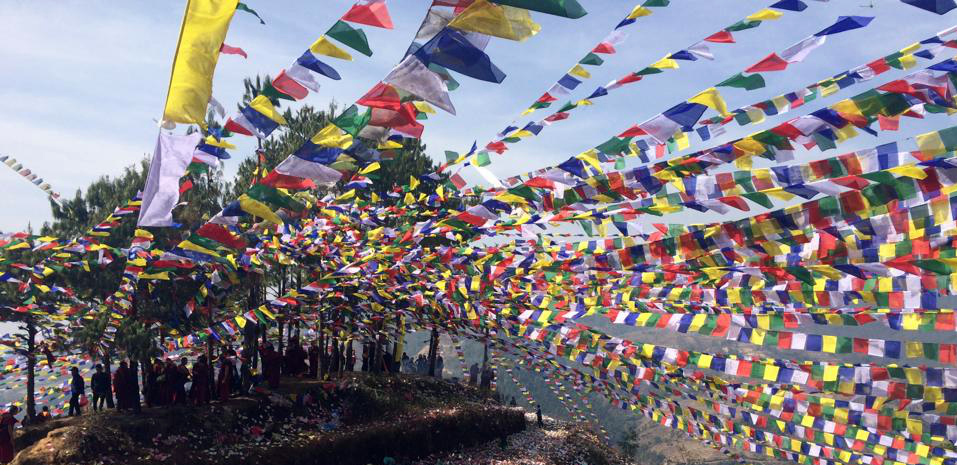
Prayer Flags at Tashi Menri Monastery in Dolanji, India. Photo credit: Unknown