
Yungdrung Bön monks gather for a ritual outside of the meditation hall at Triten Norbutse Monastery in Kathmandu, Nepal.
These white hats are worn by the monks during all tantric rituals.
Yungdrung Bön monks gather for a ritual outside of the meditation hall at Triten Norbutse Monastery in Kathmandu, Nepal.
These white hats are worn by the monks during all tantric rituals.

Ritual Sang, or fumigation offering. Photo by Chamma Ling Colorado
The second of the Nine Ways of Bön is called The Way of the Shen of the Phenomenal World and includes rituals for communicating with external forces such as rituals of protection, ransom of the soul and life-force, and expelling negative or harmful forces. It is called ‘Phenomenal’ because it deals with phenomena that are visible and real for us. As in all of the Nine Ways, the basis for everything is compassion.
The texts of the Yungdrung Bön tradition include many details about the categories of unseen spirits and the specific kinds of harm and illness that they can cause for humans. In order to reverse these kinds of interferences and obstacles, the corresponding ritual needs to be performed to appease or turn back the unseen, external force. In general, there are four categories of rituals in the Second Way: rituals for exorcism or turning back negativity, rituals for the spirits known as dré and si, rituals for ransoming the soul, and rituals of the masters.
Rituals of Exorcism: These rituals have the immediate effect of reversing the direction of whatever harmful energy or force that is directed towards us. In some instances, it is more accurately a cleansing rather than an exorcism because it directly involves the removal of the pollution or defilement created by negative actions or circumstances. Because humans engage in activities which are impure, they create a basis for negativity. This leads to a disturbance of both the positive external spirits as well as lower kinds of spirits who become angry and seek revenge in response to harmful, human activity. In general, there are twelve different kinds of exorcism. One of the most commonly practiced rituals within this Second Way is the Sang, also called Lha Sang. This ritual uses fumigation with smoke to cleanse the impurities caused by humanity. This ritual is commonly performed in the early morning on hilltops on auspicious days. From the Offering of Sang to Local Spirits and Guardians:
“Having satisfied you with these offerings, do not send contagious illnesses, shortages of food, fighting or arguments, frost or hail to our crops, lightning or loss of property, human illness or illness to our animals. Act as a friend and give us the strength and power of your support.”
Rituals for the Dré and Si: The dré and si are two different classes of negative spirits who delight in causing harm to others. It is said that these negative spirits came into being at the first moment of phenomenal existence and that they reside at the center of the Earth. Among other things, they have the power to cause sudden accidents, create wars between nations and spread epidemics. These rituals are primarily concerned with offering gifts of appeasement and ways of subduing them.
Rituals of Ransom: The enlightened Lord Tönpa Shenrap Miwoché defined ‘ransom’ as the exchange of two things. In these rituals, elaborate offerings are given to the offending spirits as a ransom for the soul, life-span or vital life-force of an individual. There are many kinds of ransom rituals, but in general they fall into one of three categories: 1) ransom for men, 2) ransom for women, and 3) ransom for children. The ritual preparation, offerings and performance are quite specific and elaborate and can take many days.

During the ransom ritual, the effigy of a deer holding a long-life arrow is most often used to represent the soul of the patient.
Rituals of the Masters: In general, these rituals are of four types: 1) making offerings to the powerful but worldly gods, 2) offering to the powerful spirits who live in the atmosphere, 3) offering to the guardians, and 4) pacifying the spirits of the land, trees, water and rocks. These rituals specify appropriate offerings for each type of spirit and the proper method for giving the offering. In this way, a harmonious relationship with the spirits is maintained and suffering and obstacles towards humans are averted or resolved.
Raven Cypress Wood ©2013
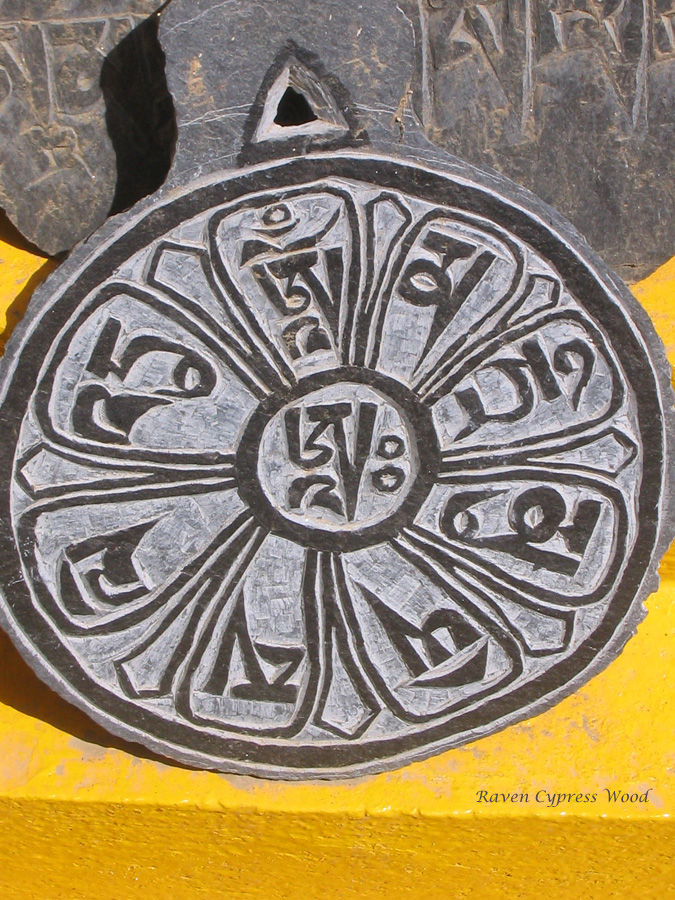
This stone found at the base of a chorten at the Yungdrung Bön Monastery of Triten Norbutse in Kathmandu, Nepal. This mantra is one of the three heart mantras of the Yungdrung Bön tradition. Its benefit is vast. OM MA TRI MU YÉ SA LÉ DU.
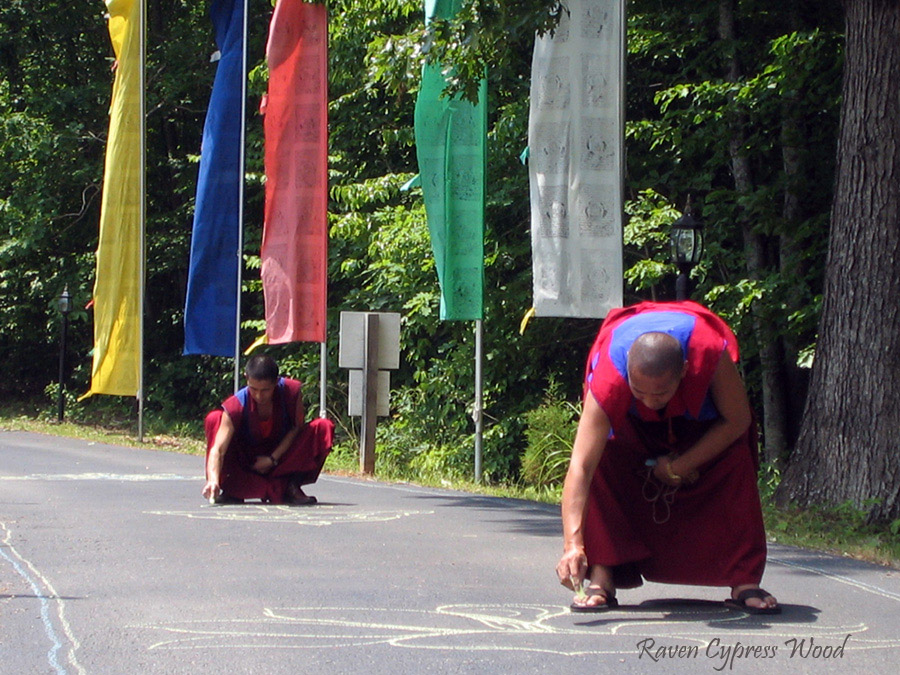
Bön Buddhist monks prepare for the arrival of the 33rd Menri Trizen, spiritual leader of the Bönpo, by drawing the eight auspicious symbols.

Beautifully illustrated, this text is for the generation and increase of wealth, good luck and supportive circumstances. This, and various other texts, can be found in the home of laypeople. On a chosen auspicious day each year, one or more monks are requested to come and read these texts out loud in the family home so that the family may receive the blessings of the prosperity practice as well as the virtuous activity of hosting the monks during the recitation.
 Nine Ways