
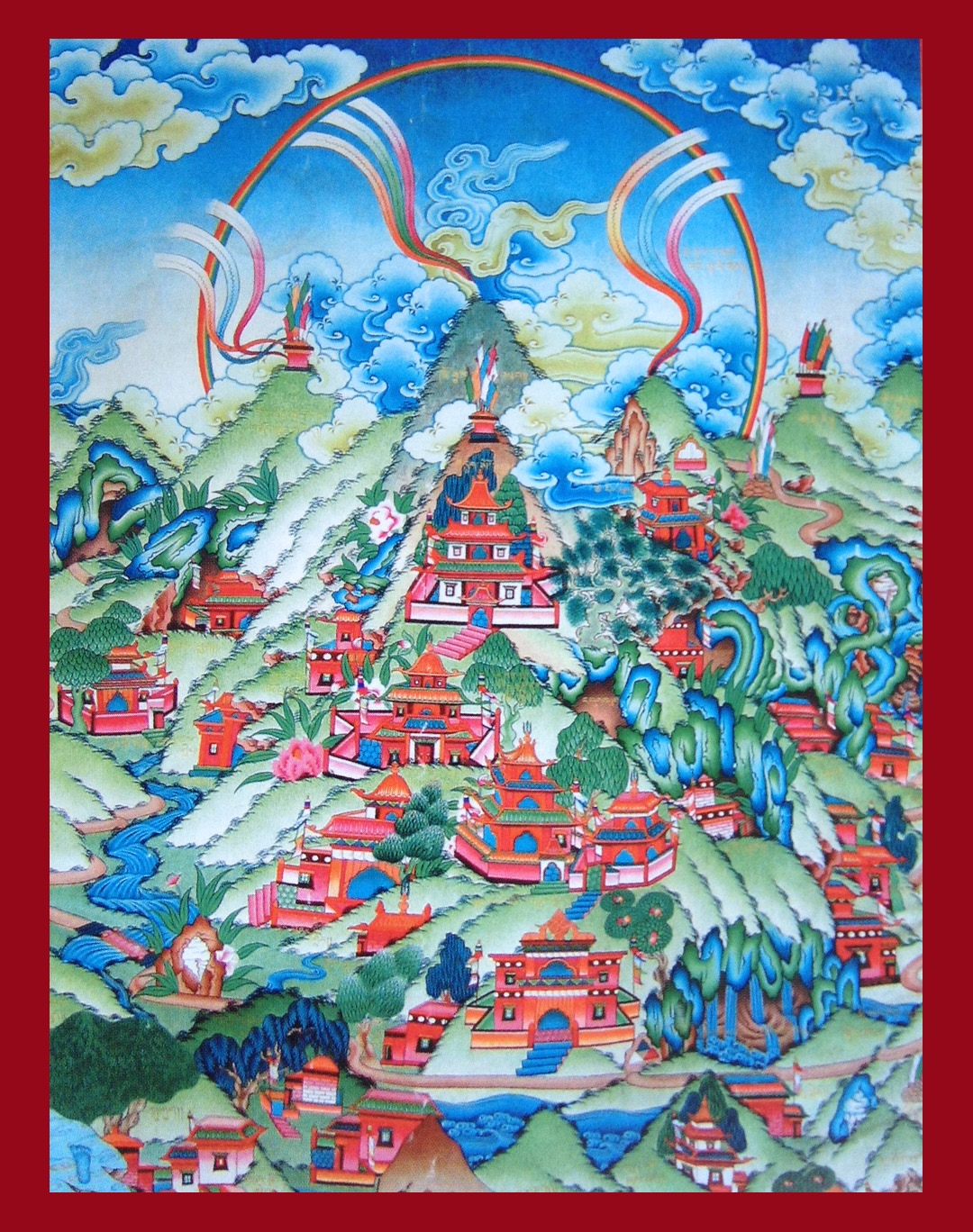
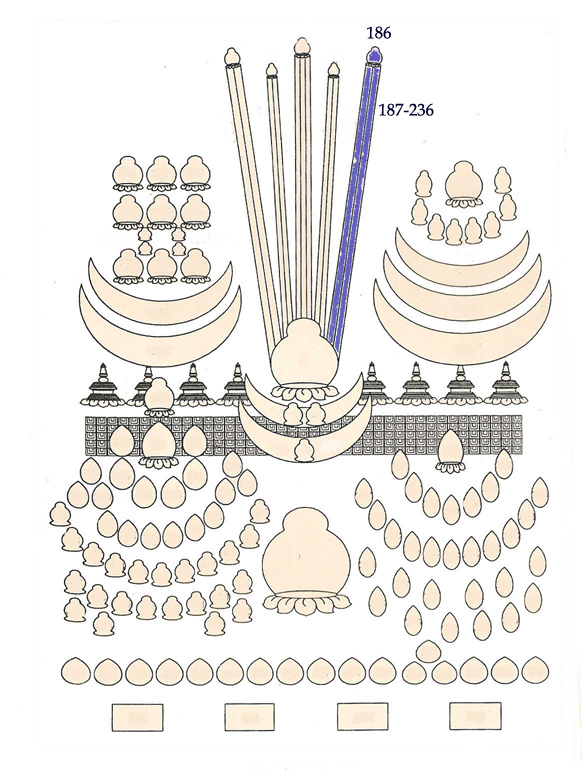
In the Yungdrung Bön tradition, the place where the deities and objects of veneration are gathered is called the “Tsok Zhing”, the “Field of Accumulation”. It is also sometimes translated as the “Field of Merit” or the “Merit Field” because what is being accumulated by paying homage and making offerings to this place is merit, or virtue. This is the Merit Field according to the Menri Tradition from a drawing done by the great master and scholar His Eminence Yongdzin Tenzin Namdak Rinpoche.
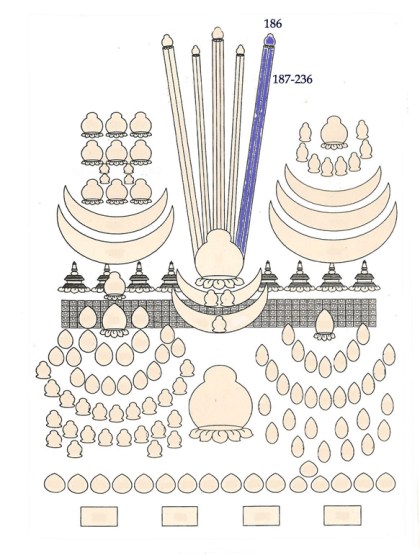
This is the lineage of tantra and these lineage masters wear the clothes of yogis, tertons or revealers of hidden sacred treasure, or monks accordingly. These profoundly pure masters of tantra have all accomplished the attainments of practice.
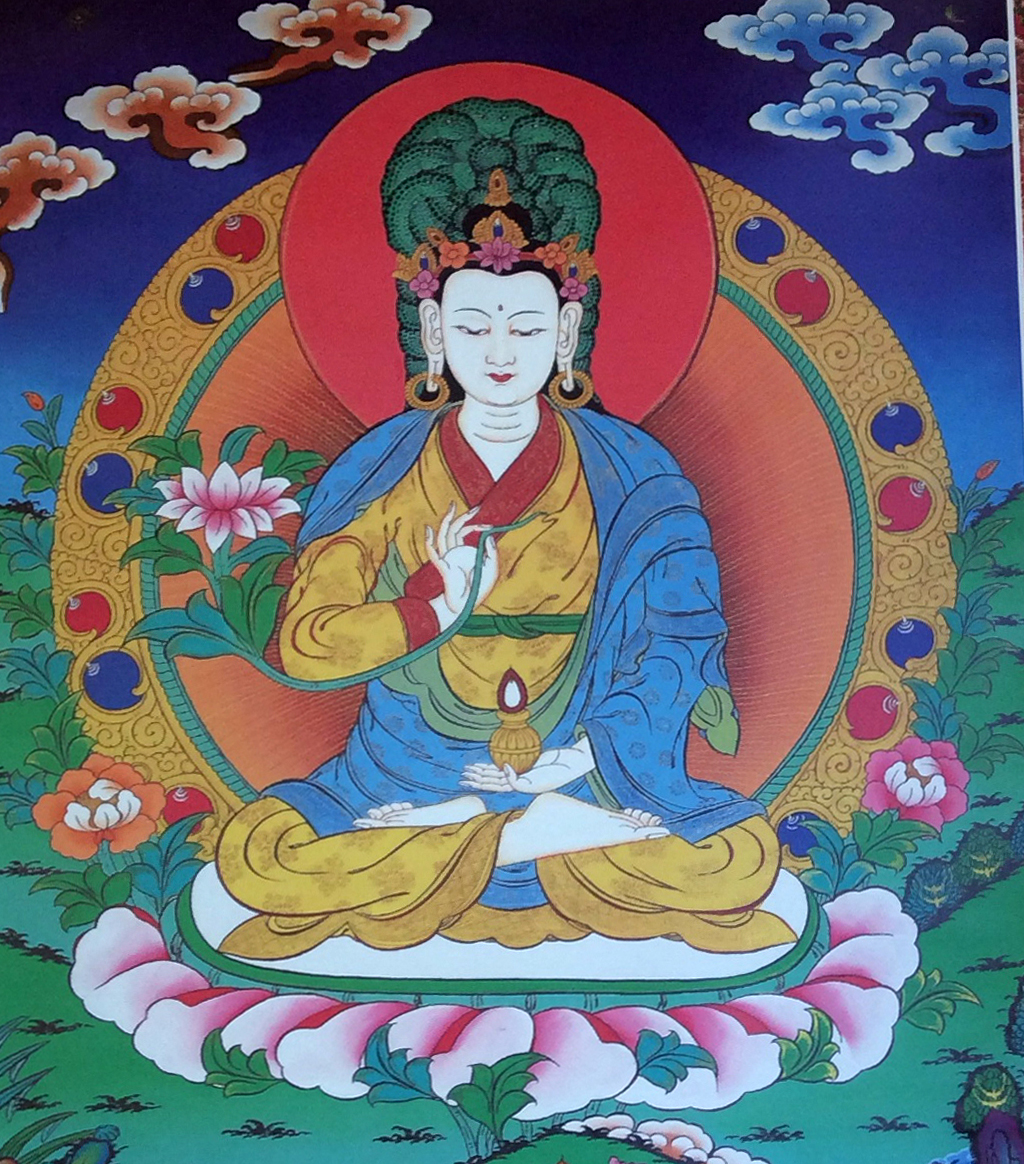
1. Trulshen Nangden was the incarnation of Lord Tönpa Shenrap before he manifested in Olmo Lungrik. Transforming himself into a blue cuckoo, he alighted upon the shoulder of the deity Zangza Ringtsun. This caused a subtle, internal heat. As a result, he was miraculously born to her as Chimé Tsukpü.
2. Zangza Ringtsun was an emanation of the enlightened wise, loving Mother, Sherap Chamma who received the teachings of the Secret Mother Tantra from the primordial Buddha.
3. Chimé Tsukpü was miraculously born to Zangza Ringtsun.
4. Sangwa Düpa is cited in some texts as the previous incarnation of Buddha Shakyamuni.
5. Takla Mebar was a prince of Tazik.
6. Lhashen Yongsu Dakpa spread the teachings among the gods.
7. Milu Samlek was known for his intelligence and wrote separate commentaries for each of the three cycles of the Mother Tantra: outer, inner, and secret. He spread the teachings in the human realm.
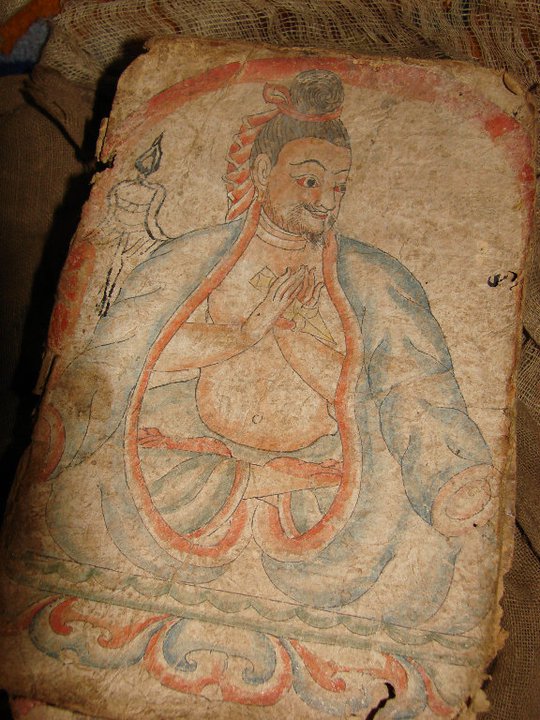
8. Ludrup Yeshe Nyingpo was born to parents who had been childless for a long time. After making offerings and praying to the lu, or naga, a child was born to them. He spead the teachings among the lu.
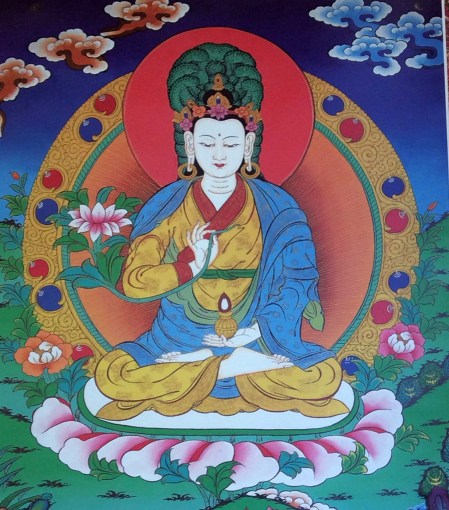
Lama Ludrup Yeshe Nyingpo
9. Nangwa Dokchen transmitted the teachings to the son of the first Tibetan king.
10. Mutri Tsenpo was the son of the first Tibetan king, Nyatri Tsenpo. He invited one hundred eight esteemed scholars of Zhang Zhung to Tibet. After him, these teachings were not taught for three generations due to political obstacles.
11. Hara Chipar received the teachings from the four magical khandro of the elements of earth, fire, water and air in order to keep the teachings from further decline.
12. Takwer Liwer was a female practitioner and achieved supernatural powers. She could tame wild animals and also transform herself into anything that she wished. The spirits of earth and water obeyed her commands. After living for three hundred sixty years, she achieved the fruit of realization, the rainbow body of light.
13. Anu Traktak practiced on Mount Tise (Kailash) and lived for two hundred fifty-five years.
14. Sené Ga’u was born in Zhang Zhung and had many teachers. It is said that he could cure leprosy simply by looking at the patient. He achieved the rainbow body of light.
15. Tami Teké lived for two hundred seventy-seven years and achieved supernatural powers.
16. Shebu Rakhuk lived for two hundred years and achieved supernatural powers.
17. Zingwa Tüchen was a Chinese practitioner and lived for two hundred sixty-one years.
18. Pébön Toktsé
19. Pébön Toktrul lived for one hundred thirty-five years.
The Four Great Scholars: 20-23 These four scholars translated many Yungdrung Bön texts from the Zhang Zhung language into Tibetan.
20. Tonggyung Tüchen
21. Shari Uchen was a previous manifestation of the modern day saint, Shardza Tashi Gyaltsen Rinpoche.
22. Gyimte Machung
23. Chetsa Kharbu
24. Hripa Gyermé
25. Mutsa Gyermé gave the text Zi Ji to the 14th century master, Loden Nyingpo in a vision.
26. Drenpa Namkha was born in 753 AD. In general, there are three Drenpa Namkha that are incarnations of the previous one. 1) Drenpa Namkha of Tazik 2)Drenpa Namkha of Zhang Zhung who was a prince and is commonly referred to as La Chen, the great lama. It was this Drenpa Namkha that married an Indian Brahman girl and had twin sons, Tsewang Rikdzin and Pema Tongdrol. 3) Drenpa Namkha of Tibet who saved many Yungdrung Bön texts from destruction during the persecution of Bön by the Tibetan kind Trisong Detsen. See previous post, “Practice of the Great Lama, Drenpa Namkha.”
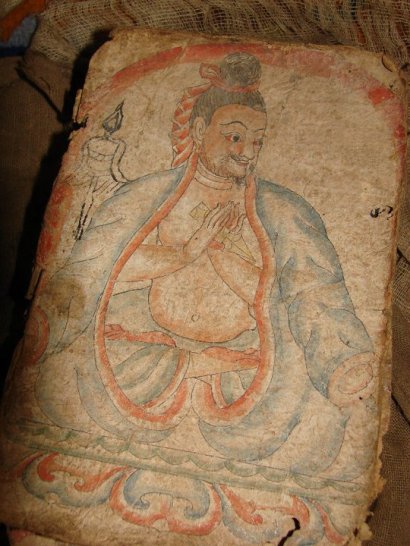
Lama Drenpa Namkha
27. Shenchen Luga 996-1035 was a manifestation of Tonggyung Tüchen and was a terton, or treasure discoverer, one who discovers texts and/or sacred objects that are hidden. He had many disciples who began religious centers in their respective home villages.
28. Germi Nyi Öd was born in Zhang Zhung and was a terton. He lived for three hundred years.
29. Matön Sidzin was a terton who discovered many texts including a ritual invocation of the protector Sipe Gyalmo.
30. Yiltön Khyungö Tsal was born in 1198 and was a great terton who discovered many texts including the main ritual text for the protector and yidam Gekho,
31. Druchen Namkha Yungdrung
32. Wangden Zhuye Lekpo was one of Shenchen Luga’s main disciples and served him as an attendant. He founded the famous Ri Zhing Monastery.
33. Patön Palchok Zangpo was one of the final disciples to meet Shenchen Luga.
34. Me’u Lhari Nyenpo composed a summary of the long version of the Yungdrung Bön Prajnaparamita that was discovered as terma by Shenchen Luga.
35. Drusha Khyungi Gyaltsen was the son of Druchen Namkha Yungdrung.
36. Drusha Jetsun
37. Drutön Nyigyal
38. Yorpo Mépal 1134-1168
39. Nyi Tsultrim Gyaltsen
40. Drogön Dutsi Gyaltsen
41. Drogön Lodro Gyaltsen 1198-1263 was also known as Azha Lodro Gyaltsen.
42. Dulwa Gyaltsen
43. Drutön Gyalwa Yungdrung
44. Namkha Özer
45. Sonam Gyaltsen
46. Sonam Lodro
47. Namkha Sonam
48. Tsewang Gyaltsen
49. Namkha Rinchen
50. Namgyal Kara
51. Khedrup Rinchen Lodro

 Nine Ways