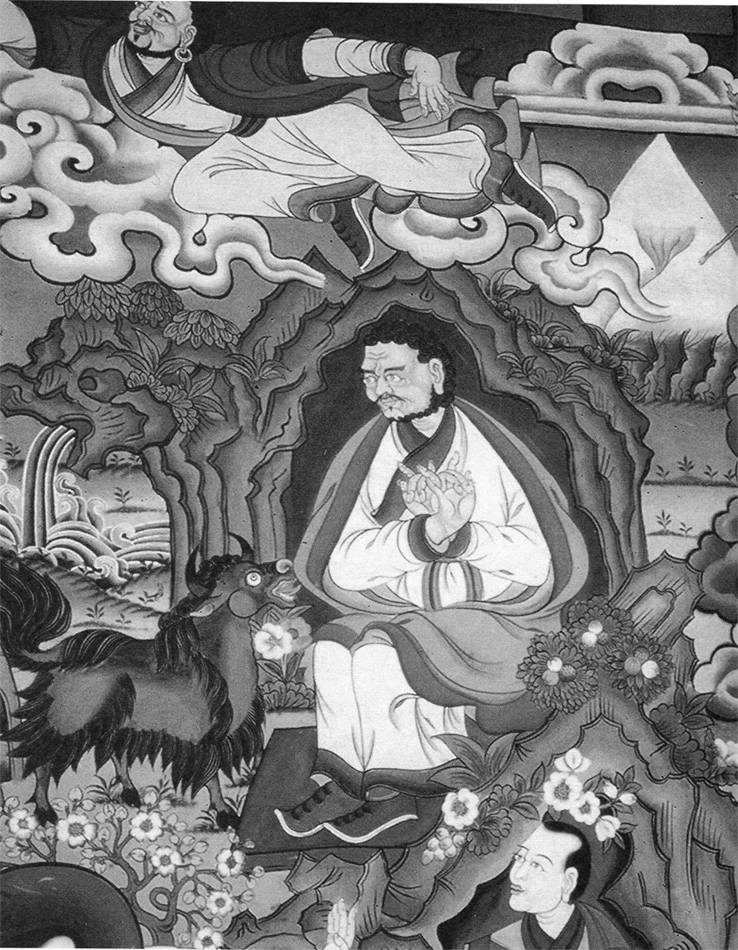
 (Mural in Bhutan depicting the Great Lama, Drenpa Namkha)
According to the lunar calendar of the Yungdrung Bön, the 10th day of each month is the day set aside for the practice of the three sages: Drenpa Namkha and his two twin sons, Tséwang Rikdzin and Pema Tongdrul. On this day, it is appropriate to pay homage and make offerings to these lamas as well as to recite the mantras associated with their respective practices.
The practices of Drenpa Namkha and Tséwang Rikdzin, are widespread in the Yungdrung Bön tradition. In general, there have been three separate manifestations of Drenpa Namkha. Each was a reincarnation of the previous manifestation. There was the Drenpa Namkha of Tazik, Drenpa Namkha of Zhang Zhung, and Drenpa Namkha of Tibet. Drenpa Namkha of the ancient kingdom of Zhang Zhung was a prince who lived during 914 BCE. He married an Indian Brahman girl and had twin sons, Tséwang Rikdzin and Pema Tongdrul, who were born in the year 888 BCE. This manifestation of Drenpa Namkha wrote many Dzogchen texts and is often referred to simply as La Chen, or The Great Lama.
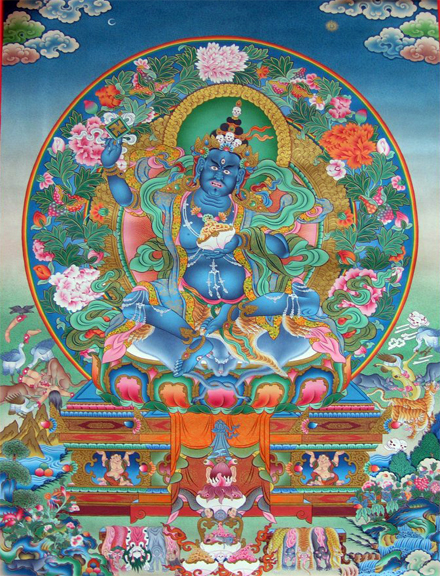 (As a meditational deity, Drenpa Namkha is most often depicted in a semi-wrathful form, blue in color and holding a yungdrung in his right hand.)
Drenpa Namkha of Tibet was born in the year 753 CE in Southern Tibet. He was an accomplished practitioner and renowned scholar. During this time, the kingdom of Tibet was ruled by King Trisong Detsen. This king had many Bön priest in his court, including Drenpa Namkha. When the king decided to convert the kingdom to the new Indian religion of Buddhism, he began to drive out the Bön priests and to destroy their texts. The Bön lamas were given the choice of exile from the kingdom, suicide, or conversion to the new religion. Many lamas chose to escape with texts and to try and preserve the teachings elsewhere. Drenpa Namkha chose to stay and protect the teachings and the texts from within Tibet. So, at the age of 31, he cut his own hair with a blade of gold and ordained himself a Buddhist with these words,
“A person who has attained realization would not make a distinction between his son and his enemy. I have no partiality for anything. Therefore, I shall be ordained.” (Translation by Samten Karmay from the Treasury of Good Sayings written by Shardza Tashi Gyaltsen.)
After his conversion, he had many texts hidden within chortens, statues and columns at the monastery of Samye. He continued to compose texts and to teach. Among his many students was the king, Trisong Detsen himself. Years later, the king allowed him to openly return to his practice of the Yungdrung Bön teachings.
“Look upon me with your unbiased compassion morning and night during the past, present and future. Turn back both seen and unseen enemies! My present and future Refuge and Protector, bless me to accomplish my intentions!”
~From the Prayer to Drenpa Namkha, translated by Raven Cypress Wood
Raven Cypress Wood ©All Rights Reserved. No content, in part or in whole, is allowed to be used without direct permission from the author.
Don’t want to miss a post? Scroll to the bottom and click “Follow this blog.”
Want to join the mandala of Nine Ways supporters? Follow this link https://ravencypresswood.com/donate/ It’s easy through Paypal, Zelle, and Venmo.



 Nine Ways
