The Yidam Walsé Ngampa and the Great Mother Ngammo Yumchen Tröpe Taktenma
Each year on the 23rd-29th lunar days of the 2nd lunar month, Menri Monastery performs a week-long retreat of the yidam Walsé Ngampa. In 2023, these dates correspond to April 13th-19th on the Western calendar. The retreat includes recitation of the complete yidam text along with accumulation of the mantra, one hundred feast offerings to the yidam and his retinue, as well as a ritual of protection to turn away malevolent forces as well as the causes for illness, accidents, conflicts, and other types of harm and danger.
The yidam Walsé Ngampa is one of the Five Supreme Embodiments, or literally the Five Supreme Citadels of the Father Tantra that are manifestations of the enlightened body, speech, mind, quality, and activity of Buddha Tönpa Shenrap Miwoché. Walsé Ngampa is the embodiment of Enlightened Body. He is dark blue with nine heads and eighteen arms with which he holds various weapons for subduing obstacles. He is the manifested form of the wisdom of emptiness. His consort has the nature of Buddha Satrik Érsang and is known as Ngammo Yumchen Tröpé Taktenma with a body color that is dark green with blue hair and eyebrows. In her right hand, she holds an amulet containing the earth and sky. In her left hand, she holds a vase of nectar. And she wears a necklace of the planets and stars.
The main ritual text for this deity is entitled, Stages of Practice for Walsé which was composed by the great sage Drenpa Namkha and rediscovered as a terma by Matön Drol Dzin in 1091 from a rock in Dangra Khyung-dzong. Reciting this text and performing the associated rituals has a profound benefit of blessing and protection. Menri Monastery will be performing this sacred activity or the benefit and welfare of all beings in support of their happiness and development of wisdom.
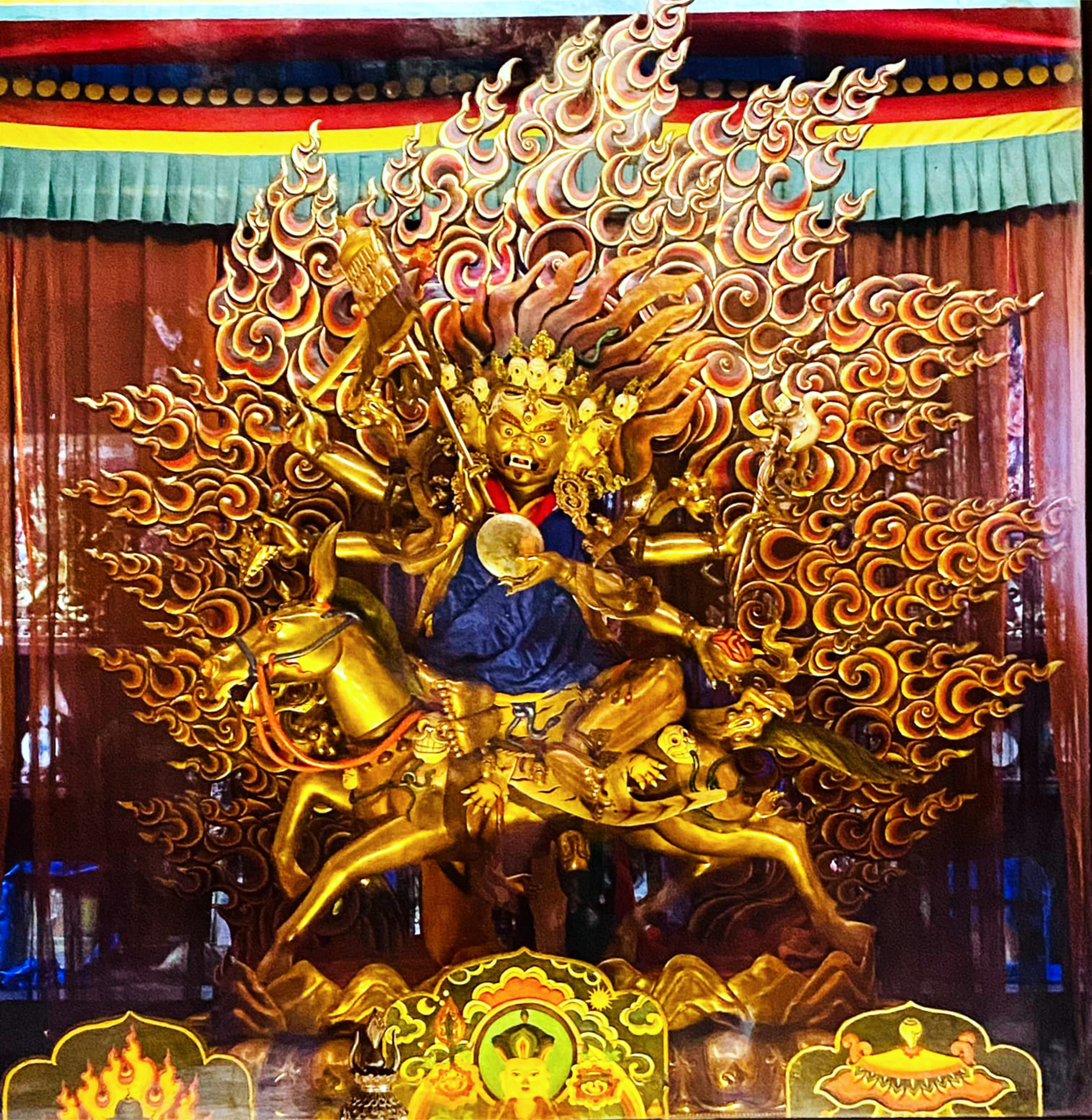
Sipé Gyalmo statue installed in the Menri Monastery protectors’ temple
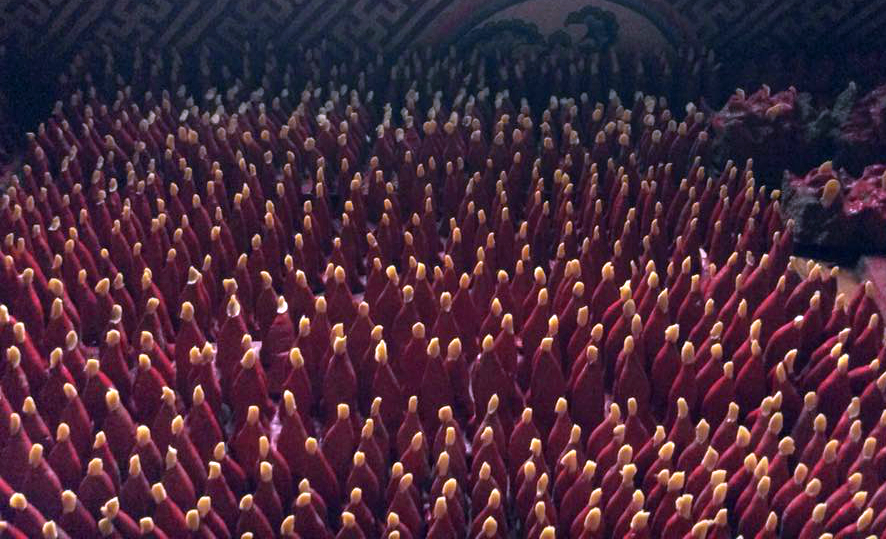
Beginning on April 24, 2023 and continuing for one week, Menri Monastery in India will perform their annual ritual of One Hundred Thousand Offerings to the Queen of Existence, Sipé GyalmoBum Tsok. This important ritual is performed for the purpose of requesting the enlightened protector Sipé Gyalmo to remove obstacles and bestow her blessings. This year, the emphasis will include requesting her blessings for longevity, excellent health, and success for His Holiness the 34th Menri Trizin, His Eminence Yongdzin Rinpoche, and His Eminence Menri Pönlop Rinpoche; as well as her help in the complete eradication of the global pandemic and for the peace and happiness of all beings.
Monks, nuns, and laypeople will all participate in the preparation and execution of the ritual. One hundred thousand small torma will be made and offered alongside one large torma, and other offerings of food, flowers, butter lamps, pure water, and sweet smelling incense. The merit of supporting and/or participating in this ritual removes obstacles, increases fortunate circumstances such as being protected from harm and being blessed with prosperity, good health, and harmonious circumstances.
Offering support and making a connection with a donation of even a single dollar brings great benefit. Donations can be made through multiple organizations. Kyungdzong Wodsel Ling is the North American center for His Eminence Menri Pönlop Yangtön Thrinley Nyima Rinpoche and they are collecting donations to be sent to Menri Monastery in support of the Sipé Gyalmo Bum Tsok. They ask that all donations be made by April 20th. More information about the Bum Tsok and a link for donating can be found here: http://kwling.org/bon/bum-tsok-offering/
The full amount of every donation will be sent to Menri Monastery and designated for the ritual. This donation can be dedicated for those that are ill, in danger, have recently passed away, or for yourself. If you are unable to donate monetarily, you can also participate by engaging in Sipé Gyalmo practice, mantra recitation, engaging in acts of virtue and avoiding acts of non-virtue during the time of the week-long ritual.
100,000 offering torma for the enlightened protector, Sipé Gyalmo. Photo credit: Unknown.
Sipé Gyalmo is an enlightened protector and also a yidam, or meditational deity. Her invocations and offerings are performed daily in Yungdrung Bön Monasteries.
“Within a burial ground ablaze with an eon-destroying fire, amidst swirling waves in an ocean of dark-colored blood, majestically sitting atop a black mule is the Queen of Existence, the single mother who brings migrating being to bliss.
Her body is the frightening color of dark-colored lapis lazuli. She has three faces and six arms. Her right face is white, her left face is red, and the face in the center is dark blue. Her blue-black hair billows upwards. The crown of her head is adorned with the perfect buddhas of the three times. Her nine overwhelming eyes blaze like an eon-destroying fire. Her six ears are perfectly curved like half-moons. The clicking sound of her tongues causes vow-breakers and evil forces to fall unconscious. The upper part of her body moves and is beautiful, and on the lower part of her body she wears a tiger skin as a skirt. She is ornamented with encircling, tamed snakes and a necklace of skulls.
The first hand on her right raises a dark-colored victory banner. The first hand on her left holds a mirror that illuminates the three realms of phenomenal existence. The middle hand on her right lifts a sharp, sword of wisdom. The middle hand on her left grasps an iron hook of method and compassion. The final hand on her right holds a sharp phurba of fierce liberation. The final hand on her left holds a human skull-cup filled with blood.
She uses a poisonous black snake as a halter for her magnificent black mule. The three upper and lower straps of her saddle are turquoise snakes. Her mount wears a crown of silk ribbons at its ears and is adorned with a necklace of gold, silver, and turquoise Bönpo flat bells.”
Sipé Gyalmo, Queen of Existence, who rides a black mule
“Having accomplished your practices in successive previous lifetimes, Mother Sipé Gyalmo,
you lovingly protect me like a mother protects her very own child.
Like the body and its shadow, you surround me with your love and affection.
Single-pointedly, I supplicate to you from my heart!
Never separated from your loving compassion,
protect me with your four kinds of peaceful, expansive, powerful, and wrathful activities!
Please act so that whatever goal or intention that I wish for will be accomplished without any hindrance!”
— Sipe Gyalmo’s EntrustedActivity composed by Shardza Rinpoche. Translated by Raven Cypress Wood
You can subscribe to the Khyungdzong Wodsel Ling newsletter by following this link: http://kwling.org/contact/

Forty-Three Trainings for an Enlightened Mind And Other Divine Writings by Raven Cypress Wood introduces us to Kündun Sonam Lodro, the 22nd Abbot of Menri Monastery, and his poetic compositions of spiritual guidance. Born in 1784, he was the first of the Menri abbots to forego a life of complete solitary practice for long pilgrimages throughout Tibet. Along the way, he spent time in intensive meditation as well as meeting with faithful followers of Yungdrung Bön and Buddhist monk scholars. In this way, he became renowned for both his incredible intellect and his realization.
In this book, four of Kündun Sonam Lodro’s compositions have been translated into English. Forty-Three Trainings for an Enlightened Mind is a five-part composition of forty-three stanzas that provides guidance for daily living and spiritual development for practitioners of lesser knowledge or capacity, those of ordinary capacity, and for the most advanced practitioners. This epic work inspires the reader to continually follow the path of virtue and truth above all else.
“In order to practice the path of liberation at all times during the day and night, you must have the kind of diligent effort that is like trying to extinguish your hair that has caught on fire.”
—Excerpt from Forty-Three Trainings for an Enlightened Mind
Sherap Gongyal’s Supplication and Experiential Song upon Perceiving the Suffering and Misery of Cyclic Existence is prose of such vivid imagery that it pierces the delusory nature of worldly things and inspires commitment to a meaningful human life and spiritual development.
“Craving for the deep mud of food and property is like covering the eyes with both hands while they are bound together by desire and attachment.
There is no freedom, and one will fall into the muddy depths and become trapped. And so, they remain within the deep mire of cyclic existence.
Lama, think of us! Hold us within your compassion! Lead us along the path of liberation and great bliss, I pray!”
—Excerpt from Sherap Gongyal’s Supplication and Experiential Song upon Perceiving the Suffering and Misery of Cyclic Existence
The Spontaneous Wish-fulfillment of Removing Obstacles from the Path is a commonly recited prayer within the Yungdrung Bön religious tradition. Rather than a composition, this prayer was given to Kündun Sonam Lodro during a vision of the enlightened Khandro Sherap Lo Pélmo and therefore is considered an oral transmission. This prayer is recited either as a daily practice or when needed to remove problems or obstacles. In the colophon of the prayer, it states: “By reciting this prayer a single time, obstacles of an entire year are pacified. By reciting it 100 times, obstacles of one lifetime are pacified.” And, “If you perform this aspiration prayer and request attainments, there will be food for those who need food, clothes for those who need clothes, and so on. Whatever supreme accomplishment that you ask for will happen without a doubt!”
A Flowing River of Supplications and Blessings is a heartfelt homage to the places of ultimate refuge. The beauty of the writing naturally guides the mind of the reader to a state of inspiration and openness.
“Within the king’s palace at the center of my body is the embodiment of all spiritual masters, the root lama, surrounded by a gathering of the guardians of the teachings.
To the one who pacifies all outer and inner obstacles, I devotedly prostrate, present offerings, and supplicate! Compassionately bless me and all other migrating beings!
Without exception, having pacified all illness, obstacles, and external interferences, lead us along the path of liberation and great bliss!”
—Excerpt from A Flowing River of Supplications and Blessings
The English language translation of these writings is followed by the Tibetan text. Additionally, the book contains a brief biographical introduction to Kündun Sonam Lodro, an extensive list of his compositions, a brief history of Menri Monastery together with a list of its thirty-four abbots along with their associated dates.
Additionally, it will soon be available at the Ligmincha International Store here: https://ligmincha.org/?s=raven&post_type=product and also through Namse Bangdzo Bookstore, Amazon, and Barnes and Noble.
The twelve animals of Tibetan astrology according to Yungdrung Bön are the Rat, Elephant, Tiger, Rabbit, Dragon, Horse, Snake, Sheep, Garuda, Monkey, Dog, and Pig. Each animal has a specific element associated with its lifeforce and a positive direction determined by that element. Each year, one of these twelve animals is associated with one of the five elements of either metal, wood, fire, water, or earth. In other contexts, metal is referred to as space, and wood is referred to as wind or air. It takes sixty years for all twelve animals to be associated with each of the five elements. When this happens, it is considered one complete cycle that repeats again and again.
February 21, 2023 begins the Tibetan Royal New Year and the Year of the Water Rabbit. The year of the Water Rabbit continues until February 9, 2024. Therefore, people born on or after February 21st will have the natal astrology of a Water Rabbit with its associated characteristics. In general, Rabbit years are considered to be times of calm and ease that bring beauty and harmony. They are periods with less suffering and conflict. Thus, people have more time for entertainment, pleasure, and enjoyment. Because of this, there is the temptation to become lazy and distracted especially if the previous year was especially difficult. Also, Rabbit years are often times of population growth.
In general, the Rabbit is kind and polite, and enjoys elegance and comfort. It protects its peaceful environment and will make an effort to avoid conflict and confusion which can give others the impression of being indifferent or aloof. If the Rabbit feels directly threatened, it will express its anger through subtlety and cleverness rather than outbursts.
The element which governs the lifeforce of the Rabbit is Wood and its positive direction is East. So, if a Rabbit person wanted to strengthen their lifeforce, they would focus upon strengthening the element of Wood internally and externally. This could be as simple as wearing the color green which is associated with the element Wood. The Rabbit’s positive direction is East. So, facing this direction while meditating, reciting prayers, or just relaxing and taking deep breaths is beneficial. The negative direction is West. This is the direction from which danger or obstacles are most likely to arise and it is the direction towards which to release and let go of negativity or for ritual offerings to pacify negative forces.
The Rabbit’s soul day is Thursday and the life-force day is Saturday. These are the best days for beginning new projects, activities to increase or develop something, or meeting new people. The obstacle day is Friday. This day is best for cleansing and letting things go. It is an unfavorable day for beginning new projects or taking risks.
Rabbit years include: 1915, 1927, 1939, 1951, 1963, 1975, 1987, 1999, and 2011
Thangkha depicting the Tibetan astrological symbols and their relationships. Private collection: Raven Cypress Wood
According to Tibetan astrology, there are five factors associated with each year that have a corresponding element. These five factors are lifeforce, health, personal power, lungta or the force of good luck, and soul. The elements associated with these five factors change each year. For the Water Rabbit year of 2023, these five factors and their associated elements are:
Lifeforce: Wood
Health: Metal
Personal Power: Water
Lungta: Fire
Soul: Water
Although the associated elements to the five factors change each year, the element associated with the lifeforce is determined by the animal sign. Therefore, it is possible to calculate the influence of the year of the Water Rabbit upon the lifeforce of each of the other natal animal signs without having knowledge of the respective birth year. This influence is calculated by the relationship of the five elements to one another. For example, the element of Wood is considered the Mother of the element of Fire. Thus, a Wood to Fire relationship is considered Excellent. However, a Fire to Wood relationship is considered Neutral. There are six possible types of combinations that result in a relationship that is either Excellent, Very Good, Good, Neutral, Bad, or Very Bad. The influence of the Water Rabbit year on the lifeforce of each of the astrological signs is as follows:
Rat: Neutral
Elephant: Very Bad
Tiger: Bad
Rabbit: Bad
Dragon: Very Bad
Snake: Excellent
Horse: Excellent
Sheep: Very Bad
Monkey: Very Good
Garuda: Very Good
Dog: Very Bad
Pig: Neutral
Because these are calculations regarding the lifeforce, if the prediction is negative it would be particularly beneficial for those individuals to protect the lifeforce of other beings, to perform or sponsor the performance of a Life Release ritual which frees those animals that would be otherwise killed, or to contribute to the care of homeless people and/or stray animals. Also, it would be very beneficial to perform longevity practices such as The Longevity Practice of Tsewang Rikdzin (https://www.lulu.com/shop/raven-cypress-wood/indestructible-the-longevity-practice-of-tsewang-rikdzin/hardcover/product-23499207.html?page=1&pageSize=4), and to recite many longevity mantras. These activities specifically protect and strengthen the lifeforce.
This calculation concerns only one factor among five and is only a partial view of the totality of the possible influence of the year. Tibetan astrology includes calculations based upon the influence of both the five elements as well as calculations based upon the influence of the constellations. In order to have a complete prediction of possible influences or events, it is necessary to look at a complete astrological calculation based upon an individual’s date and time of birth.
However, especially if a person was born during a previous year of the Rabbit, this year is considered a specific time of vulnerability to obstacles and illness. Therefore, it is recommended that those individuals take preventive measures to reverse or at least diminish the potential for any problems or obstacles to arise. It is important for them to avoid any risky behavior and take extra care with their health and safety. Making an effort to engage more with virtuous activities of body, speech, and mind and engaging less with non-virtuous activities as well as encouraging this behavior in others is a method to eliminate obstacles. Additionally, spiritual activities that support merit, good fortune, and health such as hanging prayer flags, donating to spiritual practitioners or any kind of charitable work, repairing damaged or broken spiritual commitments with one’s lama, spiritual community, or enlightened beings, connecting with the protectors and meditational deities, having a soul and life-force retrieval ritual performed, and regularly performing prayers and/or rituals to remove obstacles are skillful methods to reverse potential negativity. According to the words of Buddha Tönpa Shenrap Miwoché, the practice of developing sincere, unbiased and unlimited compassion is the greatest of all protections.
A common prayer within the Yungdrung Bön tradition that is used to remove obstacles is the Bar Che Lam Sel, The Spontaneous Wish-fulfillment of Removing Obstacles from the Path. The English, Spanish, and Portuguese translations of this prayer are offered free for personal use on the Nine Ways Website. Click on the Publications tab above and scroll down to find the download link for the prayer.
“By reciting this Spontaneous Wish-fulfillment of Removing Obstacles from the Path a single time, obstacles of an entire year are pacified. By reciting it one hundred times, obstacles of one lifetime are pacified.
Furthermore, by merely reciting it, it has the ability to protect from fear or injury from gods, demons, and humans, fear of not having food, wild animals, the five elements, etc. It pacifies illness and negative spirits, and reverses all negative predictions or divinations.”
— Excerpt from Spontaneous Wish-fulfillment of Removing Obstacles from the Path
Geshe Yongdong Losar. Photo: Courtesy of Sherab Chamma Ling
For those interested in a traditional Tibetan astrological horoscope to calculate the influence of 2023 on each of their natal factors of lifeforce, health, personal power, lungta, and soul, Geshe Yongdong Losar of Sherab Chamma Ling in British Columbia, Canada offers Tibetan astrological horoscopes through his website. Follow this link for more information about Geshe Yongdong and his astrological calculations: https://sherabchammaling.com/product/astrology-reading/
November 29th is the birth celebration of the 34th holder of the golden throne of Menri Monastery Lungtok Dawa Dargyal Rinpoché. He was born in Amdo, Tibet and given the birth name Norbu Sampel. He began school at the age of five and began to learn religious chanting at the age of eight. At seventeen, he took novice monk vows and received the name Tsultrim Nyima. The following year, he entered the Dialectic School of Gamel Monastery. In 1994 in Tibet, he met H.H. 33rd Menri Trizin Lungtok Tenpé Nyima Rinpoché and received his full monastic ordination from him, receiving the name Dawa Dargyal Wangpo. In 1996, he completed his Geshe degree and then traveled to Menri Monastery. He then entered the esteemed Dialectic school of Menri Monastery and received his Menri Geshe degree in 2012 in the presence of H.H. 33rd Menri Trizin.
In September 2017, H.H. 34th Menri Trizin displayed the truth of impermanence and passed beyond his physical vessel. At that time, the Geshe from Amdo, Dawa Dargyal, was the general secretary of Menri Monastery and undertook the responsibility of helping to organize the memorial service and cremation ceremony. On January 1st, through the multi-day ritual and prayer ceremony, he was chosen by the Yungdrung Bön protectors to ascend the throne as abbot of Menri Monastery. On February 20, 2018, he was enthroned as the 34th Menri Trizin, holder of the golden throne of the second buddha Nyamme Sherap Gyaltsen.




 Nine Ways