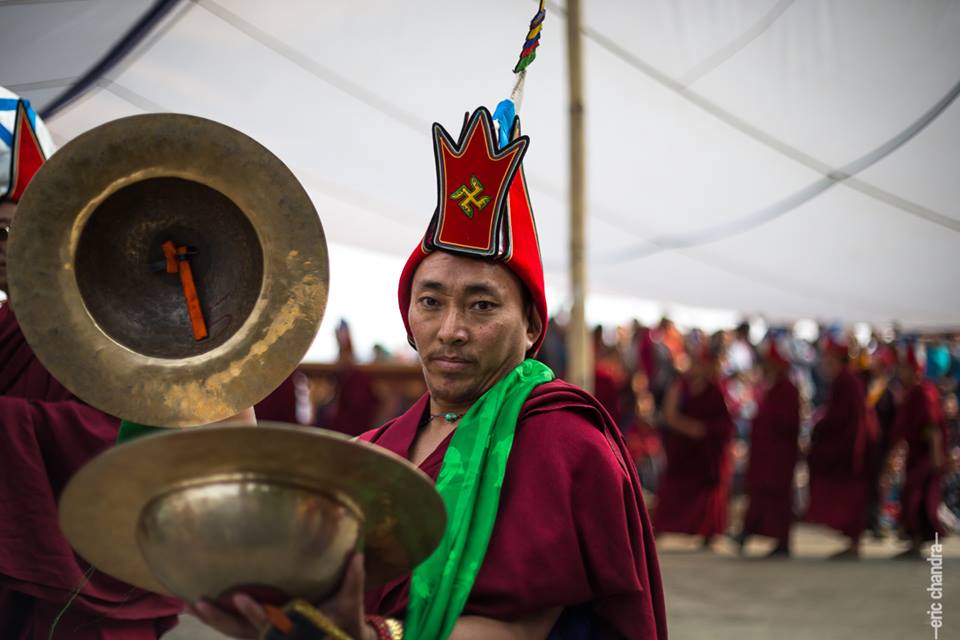
A Yungdrung Bon monk plays the cymbals during a religious ceremony. Photo credit: Unknown
A Yungdrung Bon monk plays the cymbals during a religious ceremony. Photo credit: Unknown

“From totally void emptiness, a totally clear light appeared. That light…came into being as a luminous wheel, whirling spontaneously. From the self-produced energy of the wheel, weightless wind came into being. The moving energy of the wind grew stronger and stronger and…from the energy of the wind, heat came into existence. From the clash between the heat of fire and the cold of the wind, moisture and water came into being. Subtle and coarse particles gathered in the water, and when their energy developed, they came into being as the Golden Earth that Supports Everything.”
~from the Yungdrung Bön text: The Precious Citadel where Everything is Brought Together as translated by Donatella Rossi in The Light of Kailash By Namkhai Norbu Rinpoche
The Five Elements of Space, Air, Fire, Water and Earth are the basis for all the exists. These elements are in constant relationship with one another, and it is this harmony, disharmony, balance or imbalance that determines the health or disease of organisms as well as the development or disintegration of dynamic systems. Many cultures around the world acknowledge the importance of the Five Elements in both mundane and spiritual activities. Within the Yungdrung Bön tradition, each element has its own distinctive qualities which are represented by a specific color, shape, sound, and direction. Within our physical bodies, the Earth element is related to our flesh, the Water element is related to our blood, the Fire element is related to our internal heat, the Wind (or Wood according to astrology) element is related to our breath and movement within the body, and the Space (or Metal according to astrology) element is related to our consciousness.
Among the Five Elements themselves, one way of describing their interactions is through the five kinds of relationship: Mother, Friend, Self, Child, and Enemy. The relationship of ‘Mother’ is the one of greatest harmony. The relationship of ‘Friend’ is very harmonious. The relationship of ‘Son’ is considered to be neutral. The relationship of ‘Enemy,’ as the name indicates, is considered to be the one of greatest conflict. The relationship of ‘Self’ occurs when the same elements encounter one another. This can either be good or bad depending upon the specific element involved. Therefore, the possible relationship combinations for the Five Elements are defined as the following:
Mother: these relationships are considered the most harmonious
Friend: these relationships are considered to be very harmonious
Son: these relationships are considered to be neutral, and are in fact the ‘Mother’ relationships in reverse
Enemy: these relationships are considered the least desirable and most destructive, and are in fact the ‘Friend’ relationship in reverse
Self: When two of the same elements meet, the quality depends upon the elements involved
There are many ways to apply this knowledge in daily life. For example, by understanding the relationship between the element of the lunar year and an individual’s astrological elements, it can be determined what kind of elemental forces will be active for that individual for any given year. The year 2017 is ruled by the element of Fire, which is actually the energy of wangtang, or personal charisma for people born in that year. For those born in Earth years, the Fire Element (lunar year) to Earth Element (individual birth year) is in a Mother relationship as regards the wangtang. Therefore, these people might feel very strong personal power and charisma during this lunar year. However, for those born in a Fire year, it is a Self relationship considered to be bad. This indicates that it is possible for these people to experience a decrease of power and influence, and perhaps even encounter bad luck. Knowing this, before any negativity develops, this individual could benefit from activities and/or practices that would increase their wangtang such as wealth practices, making offerings, or other virtuous spiritual activity. This is but one example of how the Five Elements directly influence our daily lives. With this knowledge, we can support our health and prosperity as well as support our spiritual practice and growth.

HE Menri Lopon Rinpoche offers a mandala to 33rd Menri Trizen Rinpoche at Menri Monastery in India. Photo credit: Unknown
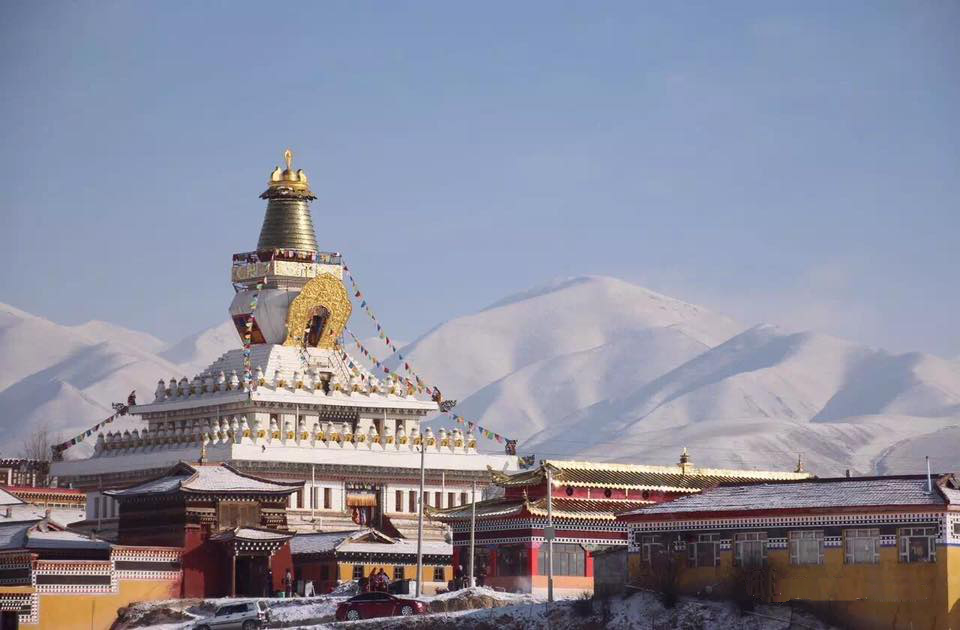
Nangzhik Yungdrung Bon Monastery in Tibet
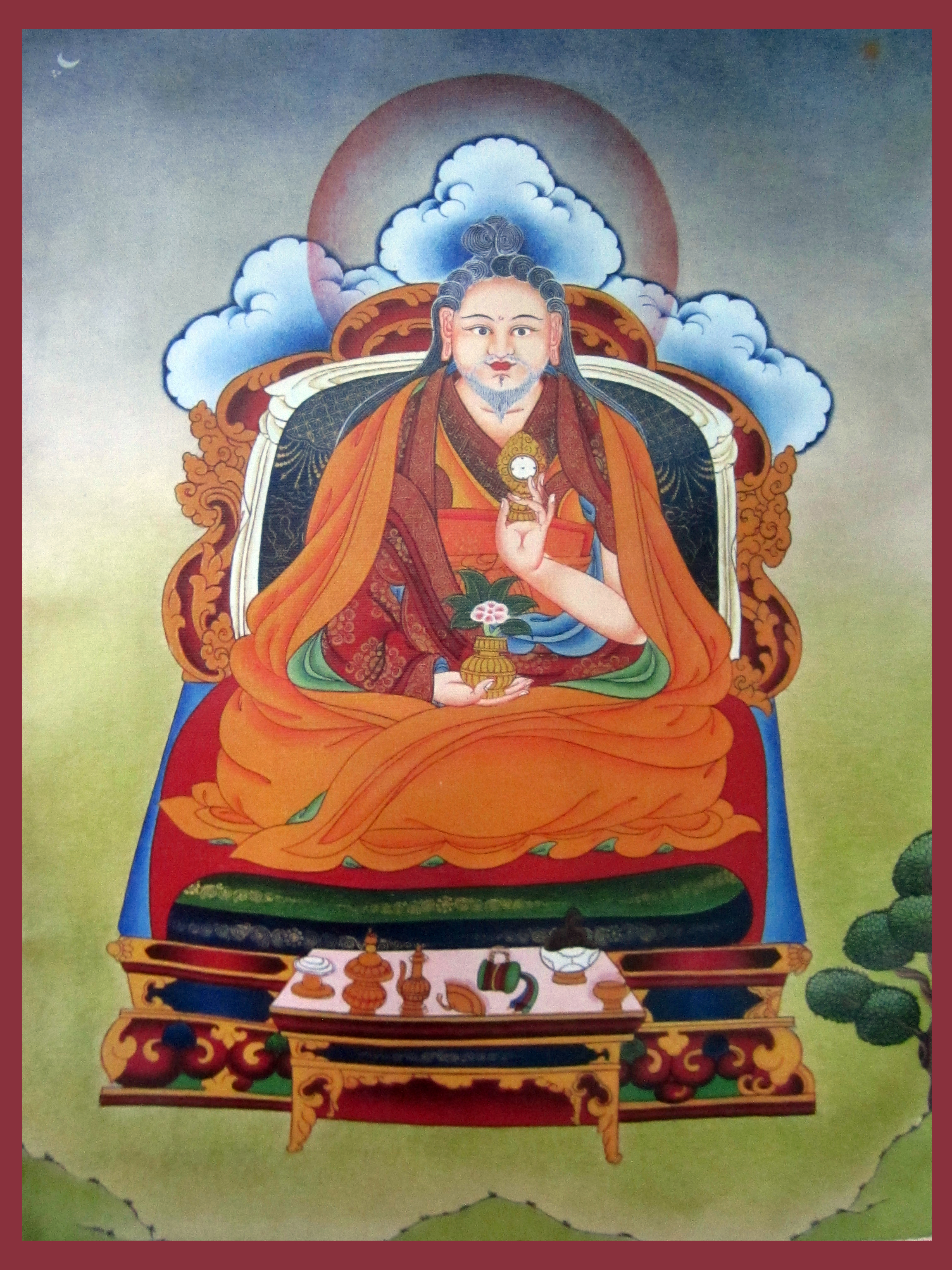
Ancient Family:
The history of the Yangtön lineage is closely interwoven with the history of the Yungdrung Bön tradition itself. It is said that two of Lord Tönpa Shenrap’s disciples were Yangtön lamas. And during the reign of the first Tibetan king, Nyatri Tsenpo in the second century B.C., the official priest for the king and the kingdom was a Yangtön lama.
The name “Yangtön” is an abbreviation of the ancient Zhang Zhung family name “Ya Ngal” and “Tönpa” together meaning “Teacher of the Ya Ngal clan.” The original seat of the Ya Ngal clan was at Taktse Jari in Upper Tsang, Tibet. This is where Yangtön Sherap Gyaltsen was born during the Fire Snake year of 1077 C.E. Because it was prophesied that he would be an emanation of the ancient lama Pangla Namshen, he was also called by this name. In his youth, he studied under many lamas including the first abbot of the famous Yeru Wensaka Yungdrung Bön Monastery, Druchen Yungdrung Lama. He devoted himself to study and there were no Buddhists who could defeat him in a debate. He eventually became known as “Yangtön Chenpo”, the Great Yangtön.
At the age of 27, he took two wives although he had no children with either of them. He intently practiced the Yungdrung Bön tantric teachings and attained great magical power. He preferred a life of practice and isolation to a worldly life and would often go alone to a mountain and enter into retreat. In addition to his magical power, he also had many visions and meditative experiences. Once while he was meditating, a woman appeared and asked,
“How much knowledge do you have?” He replied, “I am completely knowledgeable.” At that, the woman became unhappy, and crying, she left. He thought, “When I told her that I was knowledgeable, she became unhappy, if she appears tomorrow, I should tell her that I don’t know anything.” The next day, the woman appeared and asked the same question as before. This time, he replied, “I don’t know anything. Are there any good qualities that you could teach me?” Happy with this response, she answered, “If you want to learn some good qualities, in a cliff of lu and demons, never seeing the sun or moon, lives Ronggom Tokmé Zhikpo. Go there and you will have some great things to learn.” Having said this, she left. Just hearing this, Yangtön Chenpo’s heart was overcome with joy and he neglected to ask where he could find the lama. He waited for the woman to appear the next day but she did not return. After a week had passed, he decided that he could wait no longer and that he must go and find this lama.

Tibet to Mustang: Searching for the Lama
Yangtön Sherap Gyaltsen was the first of his family to leave the area of Taktsé Jari in Tibet. He first traveled throughout Amdo and Kham for three years looking for Ronggom Tokmé Zhikpo, but did not find him. After that, he went to Central Tibet and searched for the lama there for three years, but did not find him. Then, he went to Ngari and searched for three more years, but did not find Ronggom Tokmé Zhikpo. Utterly despondent, he decided to return home. When he reached Mustang, he came upon two men who were playing a game of dice. One of the gambling mantras went like this, “Never seeing the sun and moon, the yogi Ronggom Tokmé Zhikpo knows!” Upon merely hearing this, Yangtön Chenpo’s body began to shake. Thinking that it would now be possible to meet with the lama, he became delighted and began to laugh. But then he thoughts changed and he decided that maybe it wouldn’t be possible because even though he had already spent nine years looking, he hadn’t found the lama. He then began to weep. He asked the two men where the lama lived and they replied, “Below here, near Lowo Montang in a cliff of lu and demons, in the upper part of the valley. At this, he went to find the lama. Around this time, Ronggom Tokmé Zhikpo had a dream in which he was told that an emanation of Pangla Namshen would arrive and that he should give him teachings. The next day, Yangtön Chenpo finally met with his lama, Ronggom Tokmé Zhikpo, and began receiving profound instructions from him.
Teachings and Legacy
Tokmé Zhikpo gave Yangtön Chenpo the Upper Transmission of The Aural Lineage of Zhang Zhung. Previously, he had received both the Upper and Lower traditions of The Aural Transmission from Lama Orgom Kündrol, teachings and transmissions from The AH Tri dzogchen teachings from Me’utön Lhari Nyenpo, as well as many pointing out instructions. He had the good fortune to meet with and receive teachings from many lamas. At the Zangri Shar Monastery, he went before the great teacher of the Me’u lineage, Khepa Palchen, for a ritual cutting of his hair and receiving vows. He was known as a teacher who had received the signs of accomplishment for the full development of training in sutra, tantra and dzogchen. In modern times, it is the equivalent of the title of “Geshe”, “Lopön” or “Khenpo”.
Yangtön Sherap Gyaltsen settled in Gyal Zhug Dong Kar in Mustang, Nepal where he established a hermitage called Kyaru Gon. To some of his disciples he taught The Extensive Aural transmission of Zhang Zhung, to others he taught the medium-length text, and to still others he taught the condensed version of The Aural Transmission. These became three distinct transmissions known as “The Upper Transmission”, “The Lower Transmission”, and “The Intermediate Transmission.” He practiced wherever he went and exhibited numerous signs of his realization. With his third wife, he had a daughter and two sons. His sons were named Bumjé Ö and Tashi Gyaltsen. They became lineage holders of the Southern Lineage of Transmissions which also included the esteemed Druchen Gyalwa Yungdrung who composed the widely used Practice Manual for The Aural Transmission of Zhang Zhung commonly referred to as the Chaktri.
For many generations, both the transmission of The Experiential Teachings of The Aural Transmission of Zhang Zhung and The Practice of Zhang Zhung Meri had become seperated from the transmission of the precepts of The Aural Transmission of Zhang Zhung into two distince Upper and Lower lineage transmissions. Yangtön chenpo reunited these two transmission lineages, and out of kindness towards future students, he wrote down some of the Experiential Teachings of the Aural Transmission of Zhang Zhung along with their commentaries. According to prophecy, his life span was supposed to be 75 years long but because he had written down these secret teachings, it created an obstacle that caused him to die at the age of 63.
“Within a palace of great bliss where he resides,
is the all-knowing tulku with braids of hair.
You were prophesied as a mighty, victorious lord, a realized Shen.
At the feet of Yangtön Chenpo, I pray!”
From A Mala of Pearls, Invocation of the Yangtön Lineage, translated from the Tibetan by Raven Cypress Wood.
Raven Cypress Wood©2017
Special thanks to Menri Lopon Yangtön Trinley Nyima Rinpoche, head teacher at Menri Monastery, for sharing the ‘Yangtön Chenpo’ entry from his forthcoming Tibetan language Encyclopedia of Yungdrung Bön. For more on this invaluable work, please see previous post:https://ravencypresswood.com/2013/09/20/the-mighty-task-of-preserving-ancient-knowledge/
Raven Cypress Wood ©All Rights Reserved. No content, in part or in whole, is allowed to be used without direct permission from the author.
Did you enjoy this content? This article is made possible by generous donors who want content like this to continue to be available. Don’t want to miss a post? Scroll to the bottom and click “Follow this blog.”
Join the mandala of Nine Ways supporters by donating through one of the services listed below.

 Nine Ways