 Each of the letters of the Tibetan alphabet are associated with one of the five elements according to their inherent sound. The letters associated with the space element are AH, KA, KHA, GA NGA, and HA.
Blog Archives
Sounds of Space
Shardza Hermitage
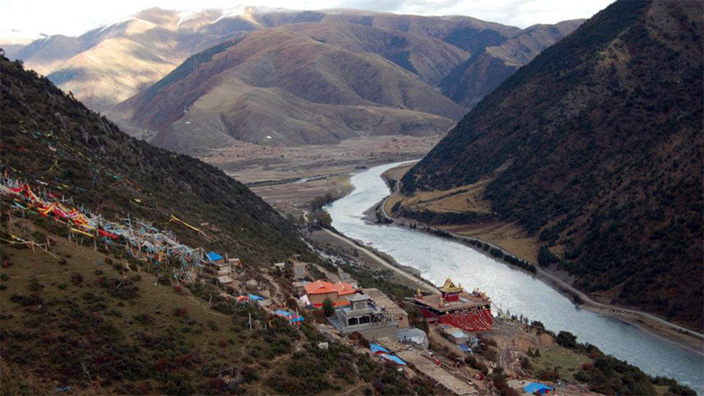
This mountain hermitage was founded by the great master Shardza Tashi Gyaltsen in 1890 at the age of 33. It is located in the Kham region of Tibet on the Northeast bank of the Dzachu river and is inaccessible by vehicle. The place where Shardza lived and meditated is located further up the mountain and referred to as the ‘upper hermitage’, or Dechen Ritro, the mountain hermitage of great bliss. Below, is the ‘lower hermitage’ consisting of the temple where he taught his disciples as well as a small printing house.
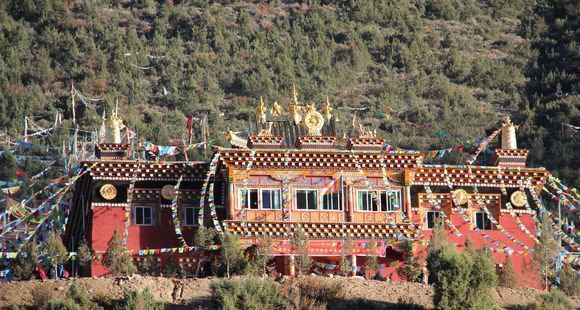
(The temple at Shardza Hermitage)
During Shardza’s lifetime, the hermitage only housed a few of his disciples. Now, however, it is a famous pilgrimage place for both Bönpo and for Buddhist. It is also a place for personal retreat, especially long-term. Because it is a hermitage rather than a monastery, retreatants provide for their own food and necessities although laypeople do offer some donations of meat and roasted barley flour, or tsampa, a traditional Tibetan food.
 (Statue of the famous yogi, scholar, and lama, Shardza Tashi Gyaltsen)
In 1934 at the age of 76, Shardza Tashi Gyaltsen attained the rainbow body as a sign of his great realization. Rainbow light was seen coming from the tent where he had retreated, and upon entering the space, his disciples discovered that his body had shrunk to the proportional size of a 1 year old and that it was levitating above his meditation seat. His remains were placed in a reliquary chorten which has been seen to emit rays of clear or rainbow colored light.
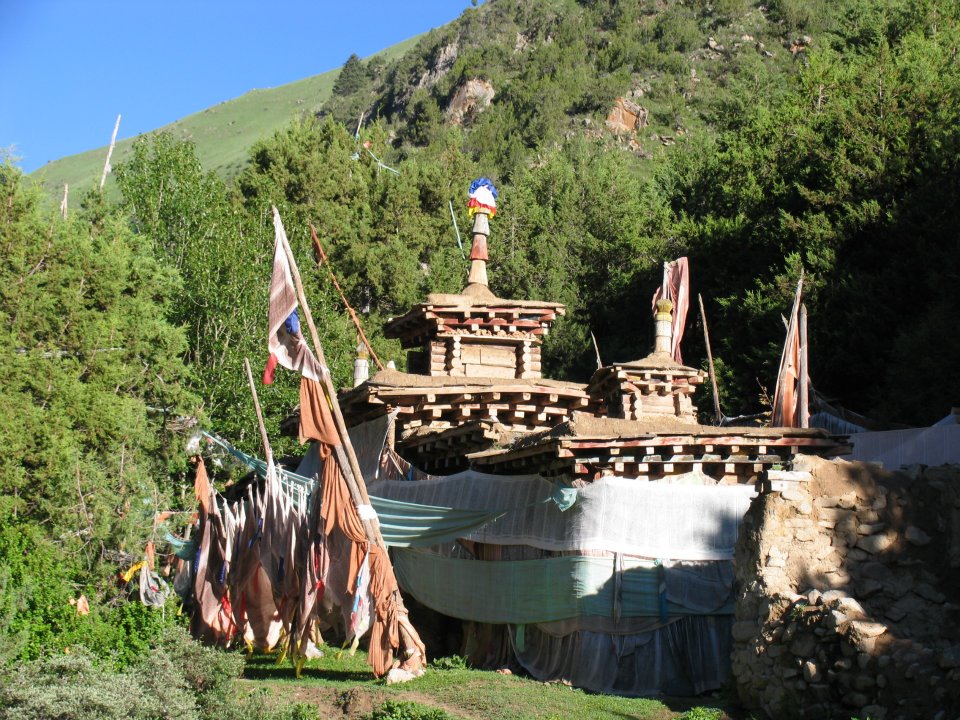 (The actual holy place at Shardza Hermitage where Shardza Tashi Gyaltsen attained the rainbow body of light.)
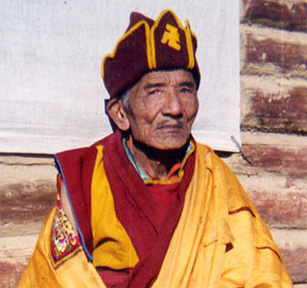
The current successor of Shardza Tashi Gyaltsen at the hermitage is Gyaltsab Thutop Namgyal.
Women of Tibet
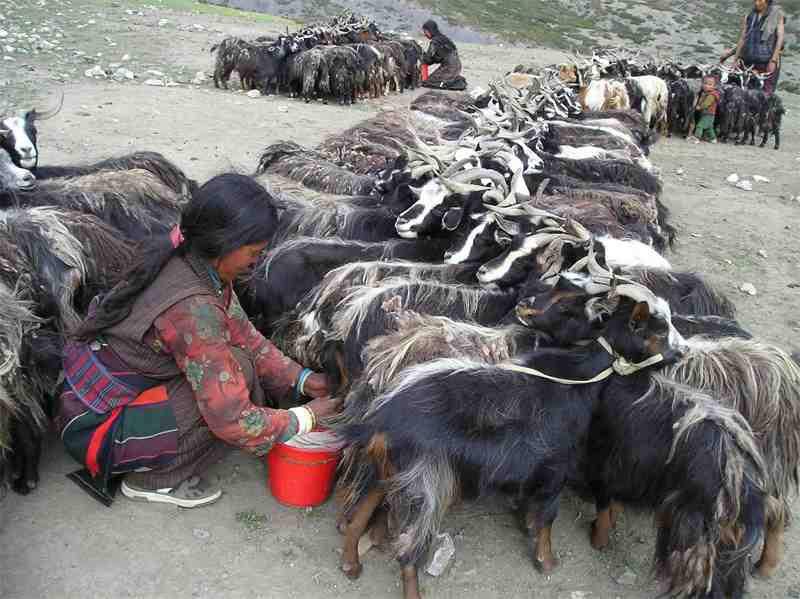
Tibetan Women Milking Goats
The Twelve Animals of Tibetan Astrology: The Tiger
 In Tibetan astrology, there is a twelve year cycle. Each of these years is characterized by a different animal and associated with one of the five elements. Therefore, a full cycle of the twelve animals being associated with each of the five elements takes sixty years. The twelve animals according to the Yungdrung Bön texts are the Rat, Elephant, Tiger, Rabbit, Dragon, Horse, Snake, Sheep, Garuda, Monkey, Dog and Pig. Each animal has an associated element for its life-force and a direction which is determined by the life-force element. Not only are these twelve animals associated with a particular year, they are also associated with particular months, days and hours.
2010 was the year of the Tiger. Therefore, people born during this year would be a Tiger and would have an emphasis of the specific qualities associated with Tiger. (It is important to remember that this year corresponds with the Tibetan lunar calendar which begins somewhere between February and mid-March each year.) 2010 was also governed by the element of Metal and was a male year. So, people born during this year would be Male Metal Tigers. The element which governs the life-force of the Tiger is Wood and its direction is East. So, if a Tiger person wanted to strengthen their life-force, they would focus upon strengthening the element of Wood internally and externally. Their positive direction is East. So, facing this direction while meditating, doing healing rituals or just relaxing and taking deep breaths is beneficial.
 In general, the Tiger is considered to be courageous, independent, unpredictable, artistic and passionate. The Tiger tends to go after life with passion and daring. Making its own path, it tends to gravitate towards unconventional lifestyles and avoids following traditions or social conventions simply because they are ‘supposed to’. The Tiger is a fierce and determined leader that can be quick-tempered and protective of its ego. The Tiger wants to live life to the fullest in its own way, and without being told what to do.
The Tiger‘s soul day is Thursday and the life-force day is Saturday. These are the best days for beginning new projects and activities that are meant to increase or develop something. The obstacle day is Friday. This day is best for cleansing and letting things go. It is not a favorable day for beginning new things.
Tiger years include: 1926, 1938, 1950, 1962, 1974, 1986, 1998, and 2010
If you were born during a previous year of the Tiger, this year as well as other Tiger years are considered a time of vulnerability to obstacles. This same astrological principal applies for all of the other eleven animal signs during their associated year. Therefore, it is recommended to engage in practices that support vitality, good fortune and spiritual merit such as hanging prayer flags, having a soul and life-force retrieval ritual performed, restoring any deterioration or violation of one’s spiritual commitments or any damaged relationship with one’s spiritual brothers and sisters, and/or performing prayers and rituals to remove obstacles. In general, making an effort to engage more with virtuous activities of body, speech and mind and committing to engage less with non-virtuous activities is supportive. According to the words of Buddha Tönpa Shenrap Miwoché, the practice of developing sincere unbiased and unlimited compassion is the greatest of all protections.
A common prayer within the Yungdrung Bön tradition that is used to remove obstacles is the Bar Che Lam Sel, The Spontaneous Wish-fulfillment of Removing Obstacles from the Path. The English, Spanish and Portuguese translations of this prayer are offered free for personal use on the Nine Ways Publications page. Click on the Publications tab above and scroll down to the download links for the prayer.
Raven Cypress Wood© All Rights Reserved
Don’t want to miss a post? Scroll to the bottom and click “Follow this blog.”
Culture: Winter Insect Summer Grass
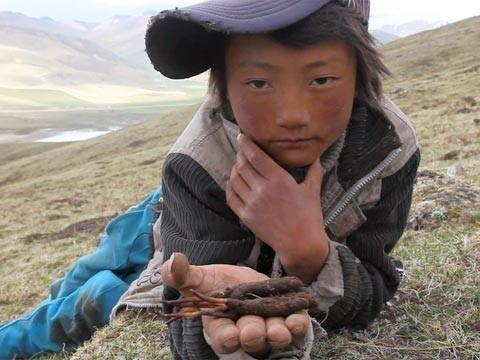
A Tibetan boy gathers yartsa gunbu
In the high altitudes of the Himalayas, grows a fungus that is a parasite to a moth caterpillar. It is known as Yartsa Gunbu, Winter Insect Summer Grass. For centuries, there have been Tibetan families who have made their living by gathering and selling this fungus. Because of the difficulty involved in harvesting it along with the high demand due to its medical benefits, it is one of the most highly priced and highly valued ingredients in Chinese Medicine. It is categorized as a tonic and prescribed to boost the immune system, as well as to increase strength and virility. It is most commonly used by consumers for its aphrodisiac qualities and has come to be called ‘Himalayan Viagra’. The market among Chinese men has escalated demand for Yartsa Gunbu to the point that it is increasingly difficult to find the fungus where once it grew in abundance. This has created a market of cultivating the fungus by growing it on peas, rice or other mediums.
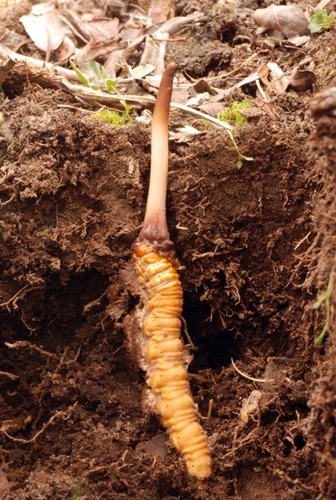
Photo by Daniel Winkler
Yartsa Gunbu is the fungus Cordyceps sinensis. The pupa of the moth burrows underground in the high altitude grasslands for up to five years. During this time, as it becomes infected with the fungus, the caterpillar moves closer to the soil’s surface. Eventually killing and mummifying the caterpillar, the fungus fills its entire body cavity. In the Spring once the snow melts, the fungus grows from the forehead of the caterpillar up to six inches above the ground. It then releases its spores which will wait for their future hosts.

Harvest is by hand and begins in May and lasts for 5-6 weeks. In 2013, over 53 tons of yartsa gunbu was harvested. Since 1997, prices have increased by over 500%. A single average-sized piece can cost over $16. A month’s supply of 30 pieces can cost a consumer over $465.00. This is the world’s most expensive fungus. Because of this, yartsa gunbu is not only used for its medicinal value, but also as a status symbol to show one’s wealth. In recent years, areas of Tibet have begun to enforce rules that no outsiders are allowed to harvest or export the fungus.
For more information about the Cordyceps fungus, see Daniel Winkler’s blog: http://mushroaming.com/blogs/cordyceps
 Nine Ways