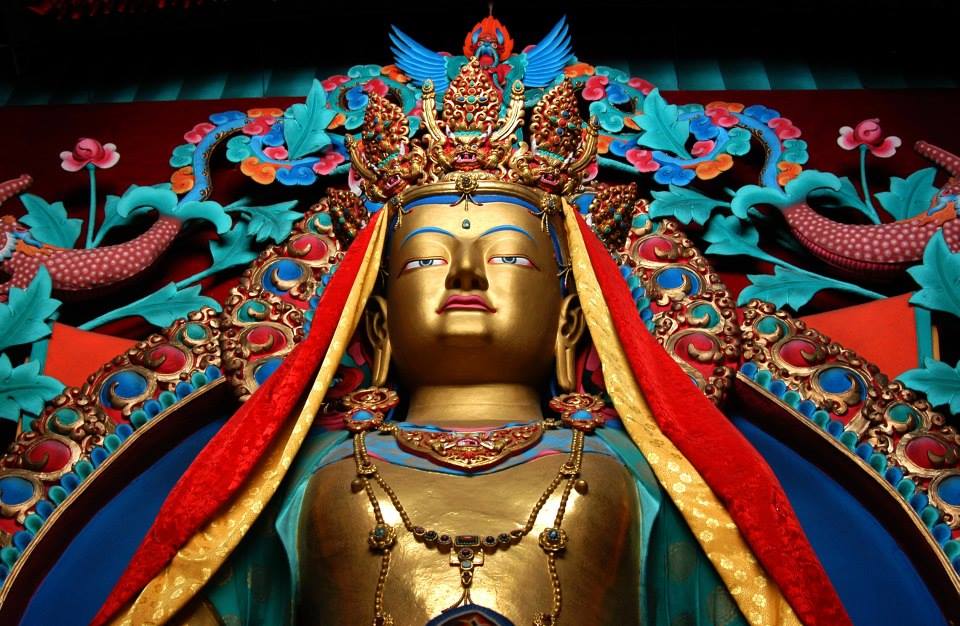
The Yungdrung Bön religious tradition was established by Buddha Tönpa Shenrap Miwoche over 18,000 years ago. He gave 84,000 different teachings in order to address the 84,000 kinds of suffering and provide a path to liberation for all sentient beings regardless of their circumstance or capacity. This vast ocean of teachings can be categorized in many different ways including The Nine Ways of Bön which are further divided into The Causal Ways and The Result Ways. The Causal Ways are the first through the fourth ways and are primarily concerned with alleviating one’s own individual suffering in the present lifetime. The Result Ways are the fifth through the ninth ways and are primarily concerned with attaining enlightenment for the benefit of all beings and performing practices to attain liberation, or to at least attain a better rebirth in order to benefit sentient beings. For this reason, The Result Ways are considered to have a higher view and to be more advanced.
The first of The Result Ways is The Fifth Way known as The Sutra that Establishes The Way of the Genyen, Those Who Serve Virtue. This category of teachings contain instructions for lay practitioners. These are practitioners who have taken vows to follow virtue and are known as a genyen. This is a compound of two words: ge [Tibetan: dge] generally translated as virtue, and nyen [Tibetan: bsnyen] generally translated as service, or drawing close to something. According to Buddha Tönpa Shénrap, in order to be considered his follower it is necessary to have received at least one vow. The most important is the vow of refuge. Having received this vow, the individual is now a follower of Yungdrung Bön and a disciple of Buddha Tönpa Shénrap. After this, the vow of bodhicitta, or developing the mind of enlightenment to benefit all beings, is received. These two vows are frequently given together. After this, it is not necessary to take further vows, but there are many different kinds of vows that can be taken as a practitioner of the Yungdrung Bön religious tradition. Some vows are taken for a single day, some for a lifetime, and some are taken until reaching enlightenment. Taking a vow and fulfilling it adds power to a spiritual activity that is performed. For example, if a practitioner recites a mantra 100,000 times, it generates great power and blessing. If that same practitioner first goes before a support of the body, speech, or mind of the Buddha and makes a vow to recite the mantra 100,000 times and then fulfills that vow, the benefit of that same recitation is greatly multiplied because of also having fulfilled a sacred vow.
Practitioners who receive vows to follow virtue according to The Fifth Way are known as lay practitioners, or genyen. When asked by Tsangpa Tsukpü to explain the meaning of the word “genyen,” The Teacher responded:
“Listen! Tsangpa Tsukpü, listen. As for this Bön door known as The Way of the Genyen, “ge” (virtue) means that which is without wrongdoing. Body, speech, and mind are used for virtue. This is known as “readily adopting virtue.” As for “nyen” (service), the true meaning of service is to serve in the correct way, to remain correct while being in the service of virtue and to engage in the true meaning.”
Brief Overview
Genyen teachings are classified as sutra with regards to the three classifications of sutra, tantra, and dzogchen. Because The Way of the Genyen contains the Buddha’s teachings on refuge and bodhicitta, cause and result, virtue and nonvirtue, the ten perfections, as well as the five paths and the ten grounds, it is considered the foundational teaching for all of the higher teachings. Accepting refuge and bodhicitta vows are the entrance to being considered one of Buddha Tönpa Shenrap Miwoché’s followers. After that, the practice of the ten virtues is a foundational practice that naturally develops into the practice of the ten perfections.
Therefore, refuge and bodhicitta vows are a prerequisite for receiving genyen vows. In general, actual genyen vows include four root vows and a branch vow that makes a total of five vows. The four root vows are (1) to not kill, (2) to not take what is not given, (3) to not engage in sexual misconduct, and (4) to not lie. When these four root vows are accepted and followed, this practitioner is considered a partial lay practitioner, or genyen. To be a full genyen, a fifth branch vow is taken. This fifth vow can be the choice of the disciple or spiritual master. It can be either a food vow such as to avoid garlic or meat, or a vow to avoid intoxication from substances such as alcohol and drugs. Additionally, those with genyen vows traditionally observe the one-day food vows of avoiding meat and alcohol on the four auspicious lunar days of the 8th, 15th, 22nd, and the 30th each month. Although there are only four root genyen vows, the practitioner can accept more vows of virtue if they so choose. However, the Buddha clearly stated that the individual should closely examine their circumstance and accept only those vows that are appropriate for them beyond the four root vows. In the teachings of The Fifth Way, there are fifteen points for the genyen: the five outer customs, the five inner vows described above, and the five intermediate practices.
There are three hagiographies of Lord Tönpa Shénrap Miwoché’s life. They are commonly known as the Do Düs which is the short version with only one volume, the Zer Mik which is the medium length version in two volumes, and the Zi Ji which is the long version with twelve volumes and a total of sixty-one chapters. This longer version is known as the Drima Mépa Ziji Raptu Barwé Do, The Sutra of Stainless Blazing Splendor commonly known by the short form Ziji, Blazing Splendor. It is classified as an aural transmission because it was spoken by the 8th century sage Mutsa Gyermé to the ear of the 14th century treasure discoverer Loden Nyingpo during a visionary encounter when the latter was twenty-five years old. The Zi Ji goes in to great deatil about the location of each of the Buddha’s teachings, who was in attendance, who requested the teaching and thus became its lineage holder, the offerings presented to him, and the miraculous events that occurred. The Way of the Genyen is taught within the chapter twelve of the Zi Ji.

The Teacher, Buddha Tönpa Shenrap Miwoche Teaches The Way of the Genyen
At the foot of the sacred Mount Po Thön on the Eastern Yungdrung Island within the divine holy land of Olmo Lungring, many mind heroes [Sanskrit: bodhisattvas], gods, demi-gods, lu, [Sanskrit: nagas], magical worldly protectors, human rulers, and spirits of the earth and sky were gathered together in order to receive blessings and instructions from the Teacher, the enlightened Lord Tönpa Shenrap Miwoché who had taken human form in order to teach in the human realm. Those in attendance presented an extraordinary array of wondrous offerings to the Glorious Presence. Leading the way, sixteen youthful boys and girls of the god realm played divine instruments such as conches, lutes, drums, and flutes, and they raised majestic flags and banners. The earth shook, flowers bloomed across the land, and wonderful sounds and rainbows came from the sky. At this, the Teacher was delighted and smiled. Then, the indestructible mind hero Tsangpa Tsukpü stood and offered a divine flower to the Teacher. Placing his hands together and bowing, he made this request.
“Teacher, the blazing splendor of your body overwhelms the four kinds of hindrances with its brilliance. The holy melody of your speech clears away the misery of cyclic existence. The enlightened intent of your mind dispels the darkness of ignorance. Your good qualities are like a wish-fulfilling tree, and your spontaneously accomplished activity teaches according to whatever is needed for those to be tamed. I offer homage and praise to you, the enlightened state of the highest Shen and spiritual master!
The continuous rain of nectar that falls as the elixir of quintessential instructions from the ocean of your pure nature of mind thoroughly moistens the rigidity of the mind-streams of the six kinds of sentient beings. And although the sprout of the mind of enlightenment has begun to grow, please ripen it into the fruit of authentic liberation.”
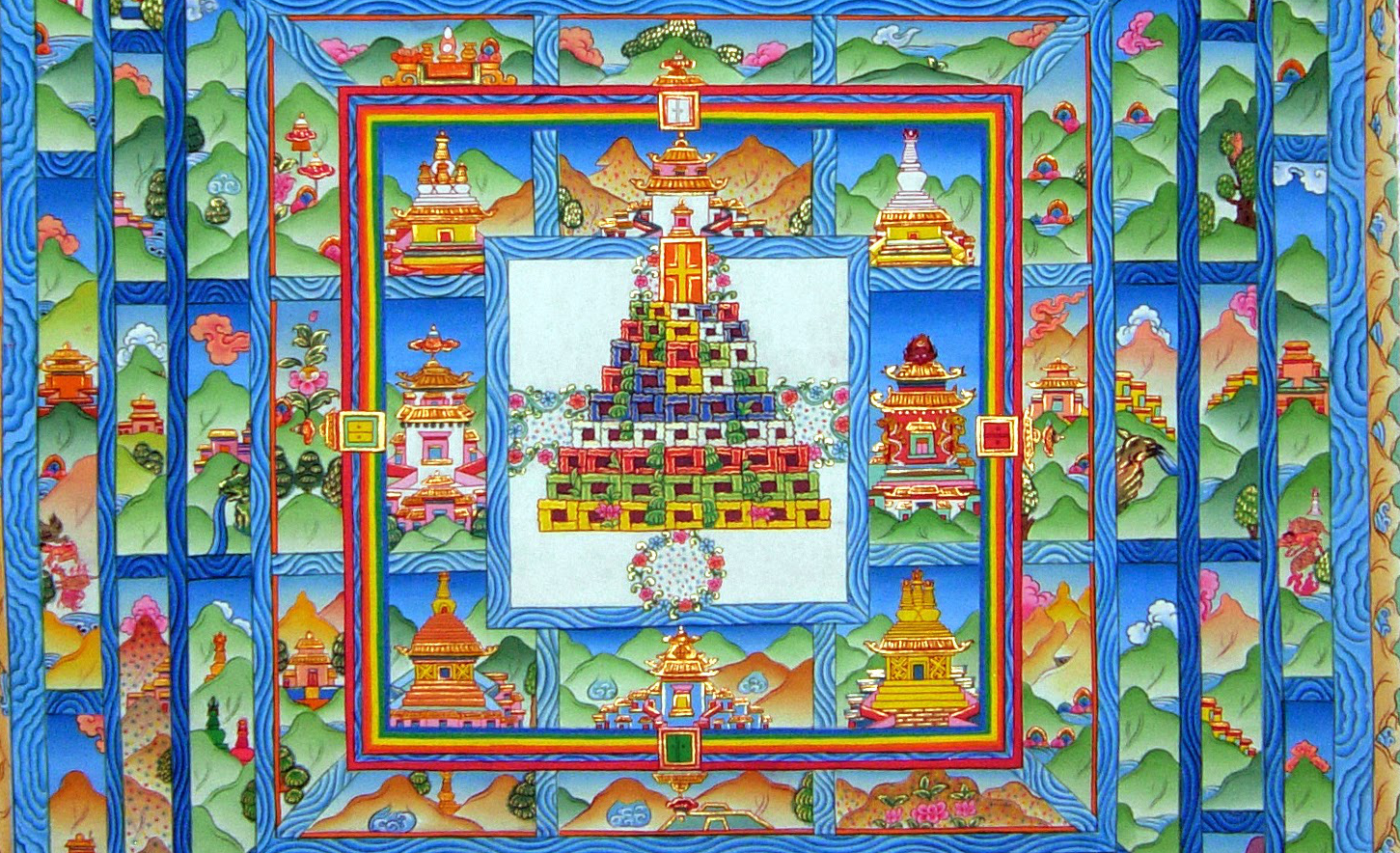
The Teacher Explains The Base-of-everything, Ignorance and Wisdom, and Virtue and Wrongdoing
In response to Tsangpa Tsukpü’s request, the Teacher began by addressing each of the individual groups present.
“Listen! Tsangpa Tsukpü and all of you gathered here. This Yungdrung Bön is precious. I will now explain the Bön that determines cause and effect. Listen closely to this! All you mind heroes, listen closely to this! If you do not listen well to this, then even an indestructible mind hero can be confused. Even an indestructible mind hero can misunderstand. Even an indestructible mind hero would then return to cyclic existence.
“Class of human beings, this Yungdrung Bön is precious. Listen closely to this! If you do not listen well to this, then even a human being can be confused. Even a human being can misunderstand. Even a human being would then return to cyclic existence. Listen carefully to this without confusion or laziness and you will attain the result of not returning to cyclic existence!”
Thus, he addressed each of the groups in attendance and urged them to listen carefully to his words. Using the example of a farmer who cultivates a good field by relying upon proper conditions and avoiding improper ones, the Teacher explained the base-of-everything, ignorance and wisdom, and virtue and wrongdoing. In the natural mind of enlightenment, the base-of-everything, both the seed of cyclic existence and ignorance and the seed of nirvana and wisdom arise. The base-of-everything itself is empty and unchanging like space, like a fertile field. It allows anything whatsoever to naturally arise, to naturally remain, and then to naturally dissolve. It itself is a birthless expanse that has the characteristic of being the ceaseless source of everything. Although both positive and negative things appear, the base-of-everything remains unchanged by whatever arises. If one does not realize this true, unchanging nature, there is the ignorance of grasping at whatever phenomena arises. That is the cause for cyclic existence. When the intellect conceptualizes this arising of phenomena, it activates the five afflictive emotions of ignorance which are anger, desire, mental darkness, jealousy and pride. These are the five kinds of ignorance. There are also five kinds of awareness wisdom. When everything that arises from the vast expanse of the base-of-everything naturally liberates, the five kinds of awareness wisdom arise. These are the loving kindness of the wisdom of emptiness, the clarity of mirror-like wisdom, the generosity of discriminating wisdom, the peacefulness of the wisdom of equanimity, and the openness of all-accomplishing wisdom.

“If sentient beings want to be liberated from the afflictive emotions and want to attain the five wisdoms, they should renounce activities of wrongdoing and nonvirtue and practice the Yungdrung Bön of engaging in activities of virtue. What are they? There are ten kinds of wrongdoing and nonvirtuous activity: killing, taking what is not given, sexual misconduct, idle chatter, harsh words, false speech, divisive speech, hostility or maliciousness, envy, and having wrong views towards virtue.
Because of the influence of hatred, one should abandon the act of killing. Furthermore, encouraging others to kill because of the influence of hatred should be abandoned. And rejoicing in others who kill because of the influence of hatred should be abandoned.”
Thus, in this way, the enlightened Lord Tönpa Shenrap Miwoché went on to enumerate the ten general activities of wrongdoing and nonvirtue that should be abandoned when motivated by any of the five types of ignorance. Additionally, encouraging others to perform these actions or beings joyful about others performing these actions motivated by any of the five types of ignorance should be abandoned.
The General Ten Acts of Wrongdoing and Nonvirtue
- Under the influence of anger, desire, mental darkness, jealousy or pride performing the act of killing, encouraging others to kill, or being happy about or rejoicing in the act of killing.
- Under the influence of anger, desire, mental darkness, jealousy or pride performing the act of taking what is not given, encouraging others to take what is not given, or being happy about or rejoicing in the act of taking what is not given.
- Under the influence of anger, desire, mental darkness, jealousy or pride performing the act of engaging in sexual misconduct, encouraging others to engage in sexual misconduct, or being happy about or rejoicing in sexual misconduct.
- Under the influence of anger, desire, mental darkness, jealousy or pride engaging in idle chatter, encouraging others to engage in idle chatter, or being happy about or rejoicing in the act of engaging in idle chatter.
- Under the influence of anger, desire, mental darkness, jealousy or pride using harsh words, encouraging others to use harsh words, or being about or rejoicing in the use of harsh words.
- Under the influence of anger, desire, mental darkness, jealousy or pride engaging in false speech, encouraging others to engage in false speech, and being happy about or rejoicing in the use of false speech.
- Under the influence of anger, desire, mental darkness, jealousy or pride using divisive speech, encouraging others to use divisive speech, or being happy about or rejoicing in the use of divisive speech.
- Under the influence of anger, desire, mental darkness, jealousy or pride having a mind that is hostile or malicious, encouraging others to have a mind that is hostile or malicious, or being happy about or rejoicing in others having a mind that is hostile or malicious.
- Under the influence of anger, desire, mental darkness, jealousy or pride being envious, encouraging others to be envious, or being happy about or rejoicing in others being envious.
- Under the influence of anger, desire, mental darkness, jealousy or pride holding wrong views towards virtue, encouraging others to hold wrong views towards virtue, or being happy about or rejoicing in others holding wrong views towards virtue.
The General Ten Acts of Virtue
In general, the ten acts of virtue are taught as the opposite of each of the ten acts of nonvirtue. These actions are performed from a motivation of helping other sentient beings rather than a motivation of self interest or neutrality in order to be considered acts of virtue. For example, just because a cow does not kill other animals for food, it is not considered an act of virtue because the act of not killing is just its natural behavior and has nothing to do with making a decision to protect life out of concern for other beings. Thus, engaging in virtue from a basis of compassion, as well as doing so in order to fulfill a sacred vow are important factors.
The Teacher elaborated on this while teaching The Way of the Genyen. Tsangpu Tsukpü asked:
“Good Teacher, if sentient beings in cyclic existences want to attain wisdom and therefore renounce the acts of wrongdoing and nonvirtue, what kind of virtuous behavior should they engage in?”
The Teacher replied:
“Tsangpu Tsukpü, it is like this. If sentient beings of cyclic existence who want to attain wisdom have renounced the acts of wrongdoing and nonvirtue, there are ten kinds of virtuous actions that they should perform: benefitting and assisting others, charitable giving, guarding discipline, recitations, peaceful speech with gentle words, speaking the truth, using speech that promotes harmony, having a loving and altruistic mind, having a peacefully divine mind that is not attached to an identity of being virtuous, and not having a distorted view or going astray from a mind of the authentic truth.
If sentient beings practice the ten virtues, they will strive to benefit others with a mind of loving kindness. They will encourage others to benefit sentient beings with a mind of loving kindness. And they will be glad and rejoice when others benefit sentient beings with a mind of loving kindness. They will give charitably with a mind of loving kindness. They will encourage others to give charitably with a mind of loving kindness. And they will be glad and rejoice when others give charitably with a mind of loving kindness.”
In this way, the enlightened Lord Tönpa Shenrap Miwoché explained each of the ten general activities of virtue that should be adopted. They are:
- Motivated by loving kindness, generosity, wisdom, peacefulness, or openness engaging in benefit for others, encouraging others to engage in benefitting others, or being glad and rejoicing when others engage in benefitting others.
- Motivated by loving kindness, generosity, wisdom, peacefulness, or openness giving charitably, encouraging others to give charitably, or being glad and rejoicing when others give charitably,
- Motivated by loving kindness, generosity, wisdom, peacefulness, or openness guarding discipline, encouraging others to guard discipline, or being glad and rejoicing when others guard discipline.
- Motivated by loving kindness, generosity, wisdom, peacefulness, or openness engaging in recitations and praise of the words of the enlightened ones, encouraging others to engage in recitations and praise of the words of the enlightened ones, or being glad and rejoicing when others engage in recitations and praise of the words of the enlightened ones.
- Motivated by loving kindness, generosity, wisdom, peacefulness, or openness speaking peacefully with gentle words, encouraging others to speak peacefully and use gentle words, or being glad and rejoicing when others speak peacefully and use gentle words.
- Motivated by loving kindness, generosity, wisdom, peacefulness, or openness speaking truthfully, encouraging others to speak truthfully, or being glad and rejoicing when others speak truthfully.
- Motivated by loving kindness, generosity, wisdom, peacefulness, or openness using speech that promotes harmony, encouraging others to use speech that promotes harmony, or being glad and rejoicing when others use speech that promotes harmony.
- Motivated by loving kindness, generosity, wisdom, peacefulness, or openness having a loving and altruistic mind, encouraging others to have a loving and altruistic mind, or being glad and rejoicing when others have a loving and altruistic mind.
- Motivated by loving kindness, generosity, wisdom, peacefulness, or openness having a peacefully divine mind of virtue that does not generate attachment, encouraging others to have a peacefully divine mind of virtue that does not generate attachment, or being glad and rejoicing when others have a peacefully divine mind of virtue that does not generate attachment.
- Motivated by loving kindness, generosity, wisdom, peacefulness, or openness not having a distorted view or going astray from a mind of the authentic truth, encouraging others to not have a distorted view or go astray from a mind of the authentic truth, and being glad and rejoicing when others do not have a distorted view or going astray from a mind of the authentic truth.
“Tsangpu Tsukpü, why is this so? It is because those who benefit others through the motivation of loving kindness are like a king of medicine that cures illnesses. I will very much receive them with the utmost delight. It is because those who give charitably through the motivation of loving kindness are like rain from the sky that benefits everything and everyone. I will very much receive them with the utmost delight. It is because those who guard their discipline through the motivation of loving kindness are like a crystal sphere of a divine friend untainted by any defects. I will very much receive them with the utmost delight. It is because those who recite mantra and scriptures are like the melodious song of the cuckoo. I will very much receive them with the utmost delight. It is because those who speak with a peaceful and pleasant voice using gentle words are like butter which is the best elixir. I will very much receive them with the utmost delight. It is because those who speak the truth and speak in a way that promotes harmony with words that are constant and unchanging are like a force of good fortune. I will very much receive them with the utmost delight. It is because those who have a mind of altruism are like a mother who loves everyone as though they were her only child. I will very much receive them with the utmost delight. It is because those who have a peaceful and divine mind are like the mythical trinya shara deer. I will very much receive them with the utmost delight. It is because those that have a virtuous mind that does not generate attachment are like a lotus that is unblemished by the mud. I will very much receive them with the utmost delight. It is because those who contemplate the true meaning have the mind-stream and knowledge of a mind hero. I will very much receive them with the utmost delight.
Listen, Tsangpa Tsukpü and everyone gathered here. Listen with your senses focused and without distraction. Throughout my beginning-less lifetimes, I have abandoned the ten nonvirtuous actions and adopted the ten virtuous actions. I have gathered countless accumulations and purified obscurations. Now, I am the glory of migrating beings and have come to be a teacher. All of you gathered here, in order to accomplish the result from the cause, abandon the ten nonvirtuous actions and adopt the ten virtuous actions. Now, I will teach the specifics of The Way of the Genyen. It will be entrusted to Tsangpa Tsukpü who should turn this wheel of Bön.”
Practicing the Ten Perfections
“Cause and effect are like cultivating a field. When seeds are planted first, seedlings come after. By relying upon seedlings, they will grow into flowers that will ripen into a harvest of nutritious food that will nourish sentient beings. Using this example, if faith and devotion are put first, diligence will come after. When faith and devotion are cultivated, diligence is swift. When diligence is applied before, the three kinds of wisdom arise as the result. The practice door of these three wisdoms of listening, reflecting, and then applying the practice is opened. Because these three kinds of wisdom go before, the resultant ten virtues come after. If one practices the ten virtues, one attains liberation. If one practices the ten nonvirtues, one goes to the lower realms. Since the ten virtues are put first, the result is the attainment of the ten perfections. These ten perfections of generosity, moral discipline, patience, diligence, power, concentration, compassion, aspiration, skillful means, and wisdom purify the mindstream. If these ten perfections are practiced, the indestructible ten grounds are sequentially ascended.
Although writing and arithmetic are difficult at the beginning, if you have an enthusiastic assistant, then it is easy. Although it is difficult to generate the four kinds of mind of enlightenment, it is easy if you take compassion as an example. Although it is difficult to practice generosity without bias, it is easy to give freely when motivated by the right circumstances. Although it is difficult to maintain moral discipline without error, it is easy to overcome the difficulty when there is the possibility of punishment. Although it is difficult to cultivate patient endurance, it is easy if you train the mind in illusion. Although it is difficult to generate intense diligence, it is easy if you compare the happiness and suffering of others with yourself. Although it is difficult to remain in meditative equipoise, it is easy to become stable if you continually extend your patience. Although it is difficult to powerfully practice virtue, it is easy to achieve if you broaden your mind. Although compassion and selflessness are difficult to generate, it is easy if one examines one’s own experience and knows the suffering of others to be felt the same. Although aspirations without expectation or doubt are difficult, it is easy if one relies on them impartially. Although supreme skillful means of dedicating merit without mental dullness is difficult, it is easy if it is guided by discipline. Wisdom without confusion is difficult, but if one trains the mindstream in the three wisdoms stated before, it is easily completed.”
The Ten Perfections
- Generosity without Bias
- Moral Discipline
- Patience
- Diligence and Zeal
- Power
- Concentration and Meditative Equipoise
- Compassion and Selflessness
- Aspiration without Expectation or Doubt
- Skillful Means and Dedicating the Merit
- Wisdom without Confusion

Further Activities of Cyclic Existence to Abandon
“Listen, Tsangpa Tsukpü, listen! The root of cause and effect is this: having turned the mind away from the actions of cyclic existence and cultivated delight in the meaning of liberation, if you single-pointedly practice enlightenment, you leave behind the wrongdoing of the ten nonvirtues. Because the ten nonvirtues are the root of falling into cyclic existence, one should abandon doing them, having them done, or rejoicing in them being done. Because the ten virtues and the ten perfections are the activities which are the cause for progressing towards liberation, it is important to adopt them with great certainty. This is the root of what is to be abandoned and what is to be adopted.”
Lord Tönpa Shenrap Miwoché then elaborated on the activities of cyclic existence that are to be abandoned in addition to the general ten nonvirtuous actions. (These lists vary slightly between texts, disciplines, and commentaries.)
The Five Acts that have an Immediate Result: Committing these acts, requesting someone else to commit these acts, or rejoicing when these acts are committed results in immediately being reborn in a hell realm after death without first experiencing the intermediate state.
- Killing One’s Mother
- Killing One’s Father
- Killing One’s Child
- Killing a Saint
- Causing Division within the Spiritual Community
The Four Acts that are Closely Related to the Five Acts that have an Immediate Result
- Killing an Innocent Religious Practitioner
- Killing a Human Being
- Intentionally Destroying a Representation of the Body, Speech, or Mind of an Enlightened One
- Renouncing One’s Personal Yidam or Denigrating the Words of an Enlightened One
The Four Substantial Acts
- Disturbing the Mind of a Holy Saint or Faithful Disciple
- Assisting or Working as a Butcher
- Interrupting the Virtuous Activities of People of Faith
- Corrupting the Vows of Virtue or Other Spiritual Commitments
The Eight Perversions
- Causing Fighting or War
- Incest
- Perverting the Words of the Buddha by Teaching Incorrect Precepts to the Religious Community
- Perverting Daily Activities by Intentionally Stirring Up the Five Poisons or Negative Emotions
- Creating Frightful or Loud Disturbances on a Mountain
- Poisoning Natural Water such as Rivers, Oceans, and Lakes
- Changing the Natural Course of Water
- Burning Down Forests
The Nine Delusions
- The Delusion of Mind that Grasps at Dreams
- The Delusion of Mind that Grasps at Illusory Existence
- The Delusion of Mind that is Completely Full of Thoughts
- The Delusion of Mind that Grasps at Desiring Something or Someone
- The Delusion of Mind that Grasps at an Identity
- The Delusion of Mind that Distracts the Conceptual Mind through the Senses
- The Delusion of Mind that Holds on to Malice Towards Others
- The Delusion of Mind that is Deceived by External Appearances
- The Delusion of Mind that has Affection for Cyclic Existence
Further Activities to Adopt that are the Actions of Liberation: These actions are the opposite of the negative actions listed above and are known as The Five Great Loving Kindnesses, The Five Reliances, The Four Respects, The Eight Aspirations, and The Nine Certainties.

The 20th century sage and fully ordained monk Shardza Tashi Gyaltsen integrated the practices of sutra, tantra, and dzogchen and attained realization and the body of rainbow light at the time of his passing beyond his physical body. Even with such vast realization, he was known to be very diligent about attending to even the smallest virtue or wrongdoing. He gave the following advice to his disciples.
“When discipline is completely pure, meditative stabilization and wisdom arise one from another. Therefore, this is the method for accomplishing perfect enlightenment. Now, this excellent physical body, which is the supreme support for the attainment of enlightenment, is even more precious than a wish-fulfilling jewel. When you obtain it, you should contemplate how the outer environment and the inner contents change. Guard your commitments and vows as you would your own eyes. Those who keep their commitments and vows undefiled will be able to accomplish whatever they do. Therefore, keeping your vows pure is crucial.
Train in having a good intention towards everyone, whether close or distant. Those who keep their intentions good are like gold and will obtain the fruition of purity. If your intentions are good, the paths and stages will be good. If your intentions are bad, the paths and stages will be bad. Even if you protect your commitments and vows as you would your eyes, if your intentions are bad, what good will it do? Even if you have great achievements, a high position, or great intelligence, if your intentions are bad, it will be like a dog dropping wrapped in silk. If your intentions are bad, it will not help to do retreat practice. If your intentions are bad, what good will it do to practice view and meditation? Therefore, it is crucial to examine the mind’s intentions. Do not compete with others, but generate pure perception.
If you want to be happy for yourself, strive to bring happiness to others. If you want to be great for yourself, tame your own mind. If you want to be high, always remain humble. If you want to benefit others, always strive to be virtuous. It is crucial to keep these points in mind. Do not interrupt your virtuous practices wherever you go.
Do not let your human life be wasted, but generate perseverance and take full advantage of this life of leisure and opportunity. Consider well how things change from moment to moment. What is the point of strength, fame, power and wealth? Do not be far from Bön, but keep your mind focused on it. Wherever you are born in cyclic existence, there is only suffering and no ultimate happiness whatsoever. To indulge in this life’s appearances is the basis of delusion. If you wish to be free from suffering in this life and the next, then be careful to adopt or avoid the smallest of actions which are the basis of either happiness or suffering.
Now, when you have the chance to encounter the Buddha’s teachings, do not be distracted by meaningless activities, but enter the teachings. Generate intense diligence from the depths of your heart, and, leaving behind both great and small affairs of this life, you must stop your mind’s preoccupations for only the present life and enter the path of virtue. If you do not apply yourself to Bön practice while you have time, then when you are on the verge of death, regrets will not help.”
Raven Cypress Wood ©All Rights Reserved. No content, in part or in whole, is allowed to be used without direct permission from the author.
All Translations from Tibetan by Raven Cypress Wood
Don’t want to miss a post? Scroll to the bottom and click “Follow this blog.”
This website and its content is kept free by the generous support of donors. Want to join the mandala of Nine Ways supporters? Follow this link https://ravencypresswood.com/donate/ It’s easy through Paypal and Zelle.
 Nine Ways