Blog Archives

The 84,000 Doors of Bön at Your Fingertips

mala

“The mala represents the destined connection with the Enlightened Beings.  The mala string represents the 84,000 doors of Bön.  The head bead represents the principal teacher.  The counting beads represent the Six Subduing Shen, the six enlightened Shen who tame the six realms of cyclic existence.”  ~from The Advice of Lishu Taring

The mala is called treng wa in Tibetan.  It consists of one hundred eight counting beads and one larger main bead, often referred to as the ‘head bead’ or the ‘lama bead’.  Malas can have spacer beads which are not counted during recitation of a mantra but are used for decorative purposes or to lengthen the mala and enable it to fit onto an individual’s wrist.  Various kinds of counters are often added to the mala so that the practitioner can keep count of the mantra recitations. Malas can be made from various materials.  Traditionally, these materials were symbolic because of their energetic qualities.  For example, tantric practitioners would often use malas made of bone to represent impermanence.

Before a mala is used, the practitioner will have it consecrated by a lama.  This blesses it and also removes any contamination that the materials might carry with them that could be an obstacle to obtaining the benefit of the recitations.  Although there are one hundred eight beads, a single round of recitations is counted as one hundred.  In this way, if any beads have accidentally been skipped during the recitation, they are accounted for with the ‘extra’ eight beads.  Many practices require a commitment to recite a minimum of one hundred thousand repetitions of a mantra.  Therefore, these ‘extra’ beads ensure that the commitment has been fulfilled.  In general, during recitation, the practitioner is not allowed to eat, drink, talk, sneeze, spit or cough. These activities expel or diminish the specific power of the mantra that is being cultivated.  Once the session of mantra recitation is complete, the mala is rubbed gently between the hands and blown upon by the practitioner.  In this way, the mala becomes further empowered and blessed by the mantra.

The mala is a sacred object and should not be worn as jewelry. It should be kept clean and not be handled by others.  By wearing the mala on the wrist or carrying it in a pocket on the body, it acts as a form of protection.  The mala is also sometimes used for divination or healing purposes.  Lamas will sometimes give away their mala intact, or one bead at a time.  Because of the power of the lama’s practice and recitation, this gift is a great blessing.

Raven Cypress Wood© All Rights Reserved
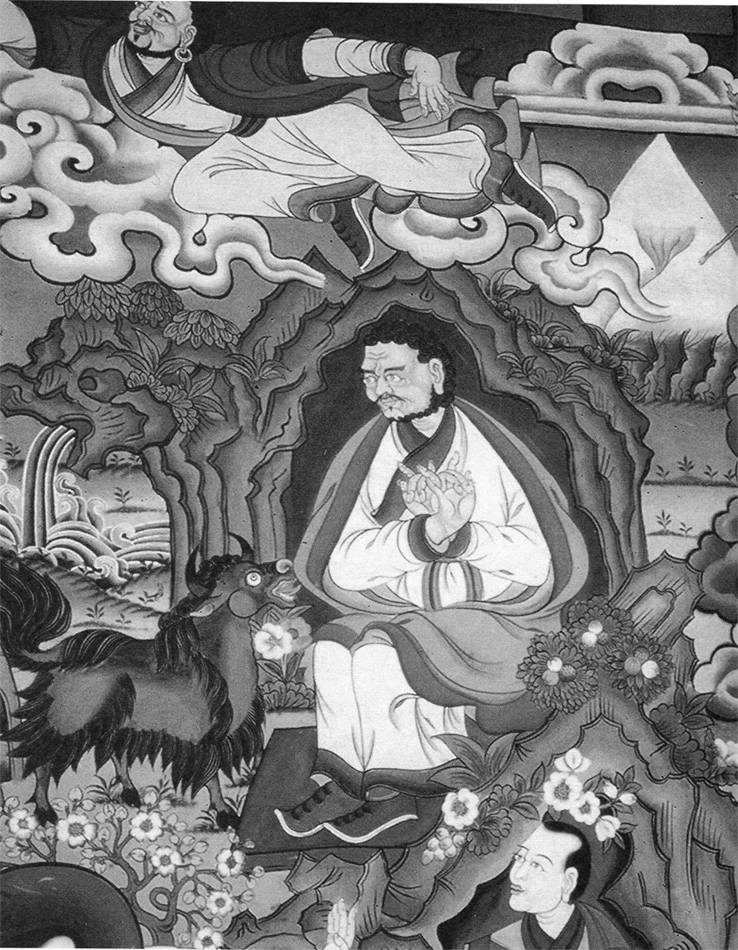
Practice of The Great Lama, Drenpa Namkha

drenpa namkha flying(Mural in Bhutan depicting the Great Lama, Drenpa Namkha)

According to the lunar calendar of the Yungdrung Bön, the 10th day of each month is the day set aside for the practice of the three sages: Drenpa Namkha and his two twin sons, Tséwang Rikdzin and Pema Tongdrul.  On this day, it is appropriate to pay homage and make offerings to these lamas as well as to recite the mantras associated with their respective practices.

The practices of Drenpa Namkha and Tséwang Rikdzin, are widespread in the Yungdrung Bön tradition.   In general, there have been three separate manifestations of Drenpa Namkha. Each was a reincarnation of the previous manifestation. There was the Drenpa Namkha of Tazik, Drenpa Namkha of Zhang Zhung, and Drenpa Namkha of Tibet.  Drenpa Namkha of the ancient kingdom of Zhang Zhung was a prince who lived during 914 BCE. He married an Indian Brahman girl and had twin sons, Tséwang Rikdzin and Pema Tongdrul, who were born in the year 888 BCE. This manifestation of Drenpa Namkha wrote many Dzogchen texts and is often referred to simply as La Chen, or The Great Lama.

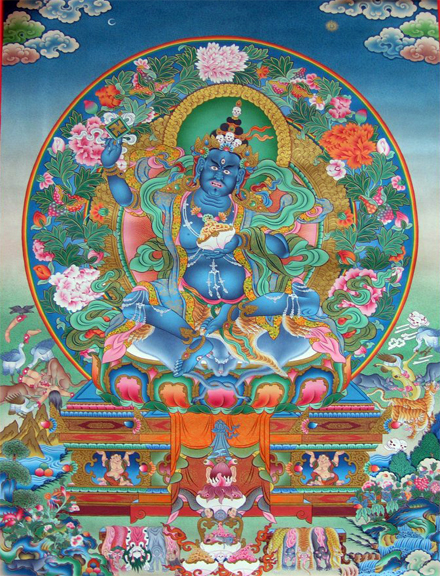
Drenpa Namkha edited(As a meditational deity, Drenpa Namkha is most often depicted in a semi-wrathful form, blue in color and holding a yungdrung in his right hand.)

Drenpa Namkha of Tibet was born in the year 753 CE in Southern Tibet. He was an accomplished practitioner and renowned scholar. During this time, the kingdom of Tibet was ruled by King Trisong Detsen. This king had many Bön priest in his court, including Drenpa Namkha.  When the king decided to convert the kingdom to the  new Indian religion of Buddhism, he began to drive out the Bön priests and to destroy their texts. The Bön lamas were given the choice of exile from the kingdom, suicide, or conversion to the new religion. Many lamas chose to escape with texts and to try and preserve the teachings elsewhere. Drenpa Namkha chose to stay and protect the teachings and the texts from within Tibet.  So, at the age of 31, he cut his own hair with a blade of gold and ordained himself a Buddhist with these words,

“A person who has attained realization would not make a distinction between his son and his enemy. I have no partiality for anything. Therefore, I shall be ordained.” (Translation by Samten Karmay from the Treasury of Good Sayings written by Shardza Tashi Gyaltsen.)

 After his conversion, he had many texts hidden within chortens, statues and columns at the monastery of Samye. He continued to compose texts and to teach. Among his many students was the king, Trisong Detsen himself. Years later, the king allowed him to openly return to his practice of the Yungdrung Bön teachings.

“Look upon me with your unbiased compassion morning and night during the past, present and future.  Turn back both seen and unseen enemies! My present and future Refuge and Protector, bless me to accomplish my intentions!”

~From the Prayer to Drenpa Namkha, translated by Raven Cypress Wood

Raven Cypress Wood ©All Rights Reserved. No content, in part or in whole, is allowed to be used without direct permission from the author.

Don’t want to miss a post? Scroll to the bottom and click “Follow this blog.”

Want to join the mandala of Nine Ways supporters? Follow this link https://ravencypresswood.com/donate/ It’s easy through Paypal, Zelle, and Venmo.

Iconography: Defining Space

Illustration from the book “Tibetan Thangkha Painting, Methods & Materials” by David & Janice Jackson

Before the artist begins sketching out the images that will appear on the thangkha, they must first determine the division of space on the canvas.  First, by using chalk lines and a compass, the true center of the canvas must be found.  Second, both the horizontal and the vertical axis must be established.  In this way, the artist can allocate space to the images according to hierarchy and the number of images that need to be represented.

outline guide for center and 4 directions for thangkha

Diagram 1: Common positions when depicting a central image and 4 retinue

Diagram 2: Common positions when depicting a central image and 8 retinue


These diagrams show the most common designations of space although there are variations.  However, even with variations, the position of the retinue in relation to one another remains the same.  The retinue are positioned according to their association with the directions.  In the text, the detail of the deities position begins with the center and is then listed the Bön way, or counter-clockwise, beginning with the East.  Referencing the diagrams above: 1=Center, 2=East, 3=North, 4=West, 5=South, 6=Southeast, 7=Northeast, 8=Northwest, and 9=Southwest.  Most often, but not always, the deities are the color associated with the direction.  East=yellow, North=green, West=red and South=blue.

The Deities of the Five Buddha Families

Here, the deities of the Five Buddha Families are positioned according to diagram 1 above.  In the center is the Enlightened One, Künang Kyapa and consort.  In the east is the Enlightened One, Salwa Rangjung and consort.  In the north is the Enlightened One, Gélha Garchuk and consort.  In the west is the Enlightened One, Jedrak Ngomé and consort.  And in the south is the Enlightened One, Gawa Döndrup and consort.

Direct Descendants of the Enlightened Lord Tönpa Shenrap Miwoché

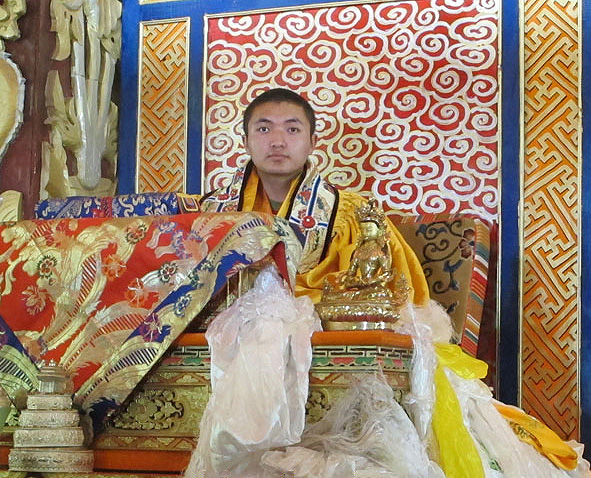
Over 18, 000 years ago, in the ancient realm of Olmo Lungrik, the founder of the Yungdrung Bön spiritual tradition was born.  The enlightened Lord Tönpa Shenrap Miwoche was born into the human realm as a prince.  He later adopted the life as a monastic in order to display the path of renunciation to his followers.  However, prior to this, he was married and had sons and daughters.  The direct descendants of this Shen lineage have continued until this very day.  Currently, there are two sons who are direct descendants of Lord Tönpa Shenrap.

Heir to the Shen Lineage, Tsukpu Namdrol Rinpoche, during a visit to the Yungdrung Bon monastery of Gangru Dargye located in Khyungpo, Tibet

Lamas of the Shen lineage

The two sons of the Shen lineage who are direct descendants of the Lord Tonpa Shenrap.

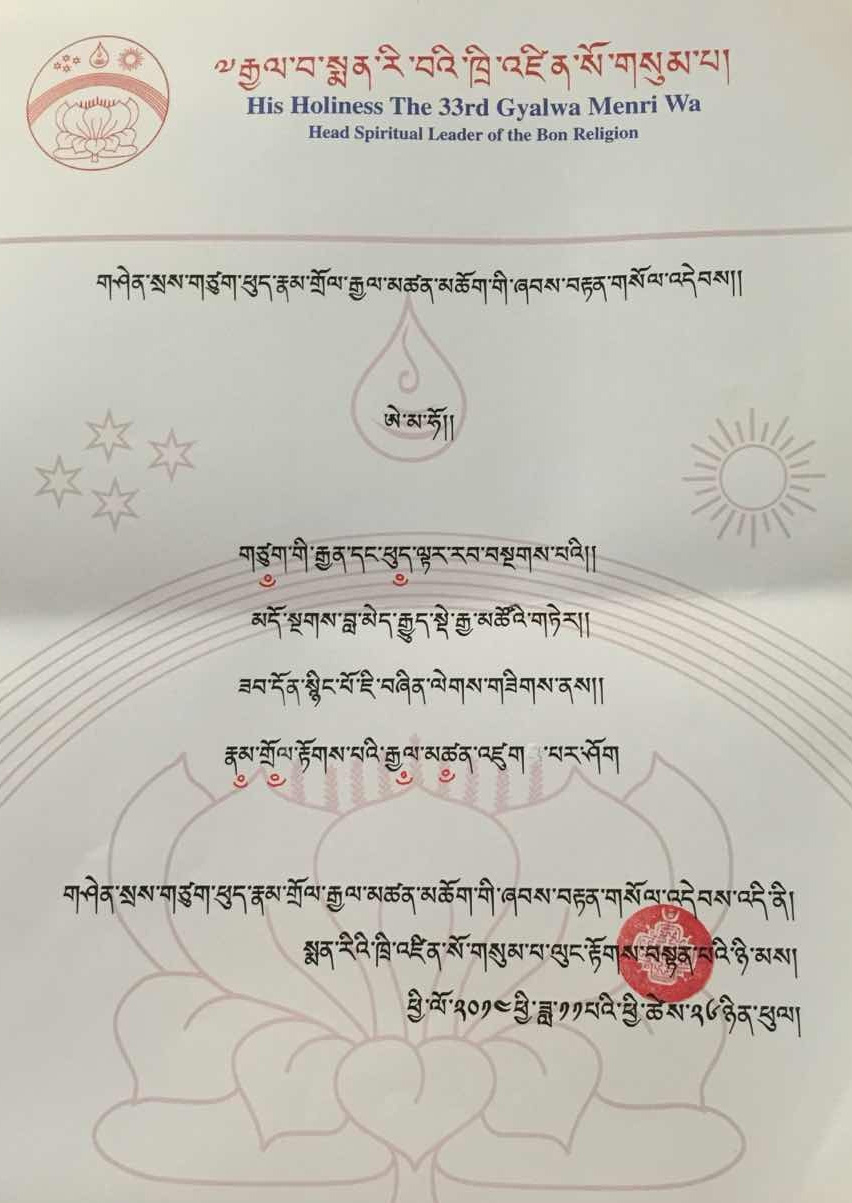
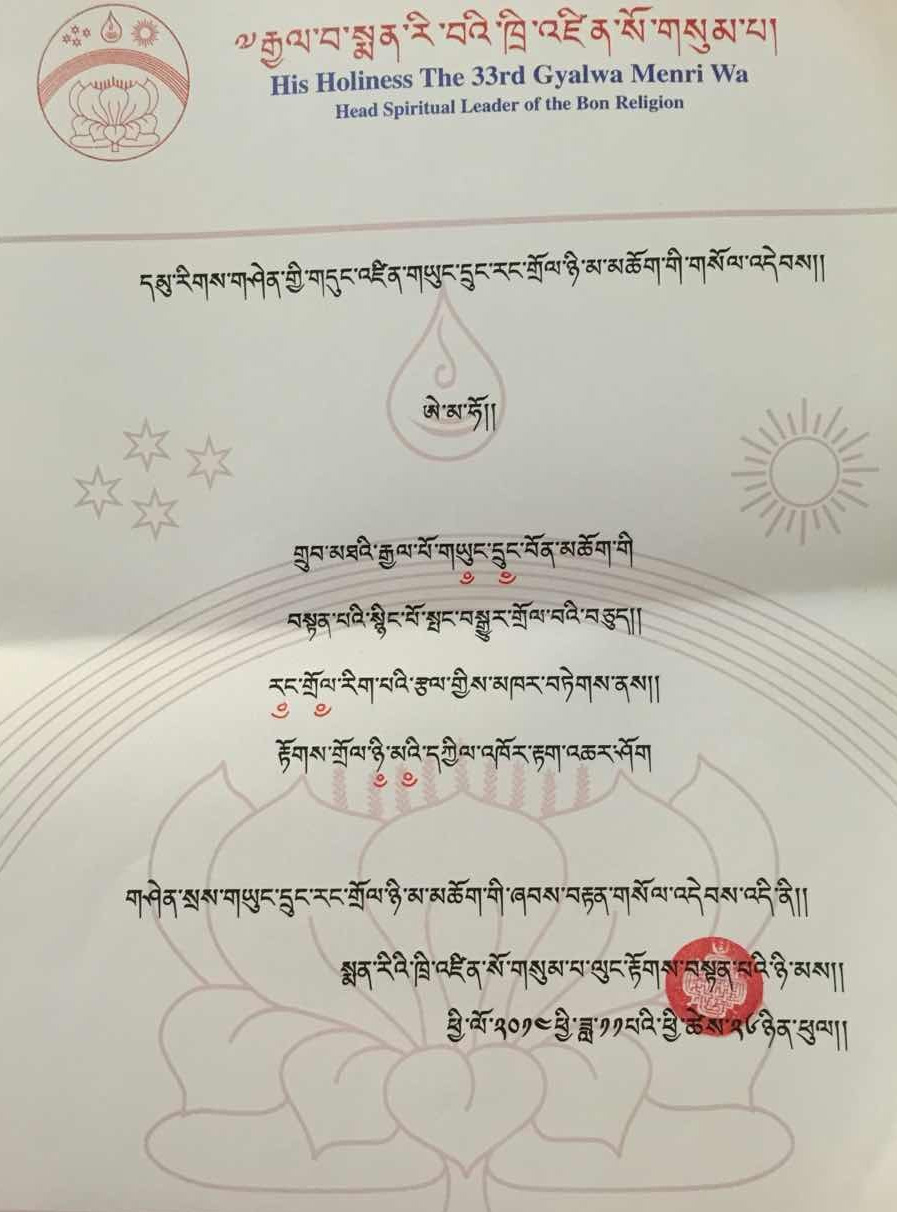
In November of 2014, His Holiness, the supreme 33rd Menri Trizen Lungtok Tenpé Nyima offered prayers to both descendants.

Shen Tsukpu Namdrol Rinpoche

Shen Tsukpu Namdrol Gyaltsen Rinpoche

prayer to Shen Tsukpu namdrol Gyaltsen written by 33 Menri trizen 2

Prayer of Stability for the Shen Heir, the Supreme Tsukpu Namdrol Gyaltsen

EMAHO!

Highest praise for the best of crown ornaments,

   Storehouse of the ocean of sutra, tantra and unsurpassed division of teachings,

From the proper understanding of the profound meaning of the innermost essence,

May the victory banner of liberation and realization be established!

Murik Shen Yungdrung Nyima

Murik Shen Yungdrung Rangdrol Nyima Rinpoche

Shen prayer to Yungdrung Nyima

Prayer for the Shen Heir, the Supreme Murik Shen Yungdrung Rangdrol Nyima

EMAHO!

Essence of the king of doctrines, the supreme Yungdrung Bön,

Distilled essence of the teachings of renunciation, transformation and liberation,

Having raised a stronghold through the dynamic energy of self-liberated awareness,

May the sun disc of realization and liberation eternally appear!

Composed by 33rd Menri Trizen Luntok Tenpé Namdak Rinpoche on the Western date of 11/26/2014

Translated by Raven Cypress Wood

The original article first appeared on the Tibetan language website Himalayan Bön and can be viewed here: http://www.himalayabon.com/article/poem/2015-01-02/518.html

The Sixth Way: The Way of the Fully Ordained

Yungdrung Bon nuns in Tibet. Photo credit: Mary Ellen McCourt

Within the Nine Ways of Bön, the Sixth Way is the Way of the Fully Ordained.  Or, literally translated, the Way of the Straight and Righteous.  This involves accepting the renunciation vows of a monk or nun and living accordingly.  A novice receives 25 vows that form the basis of taking the further vows of the fully ordained.  For monks, there are 250 vows for full ordination.  For nuns, there are 360 vows.  According to the words of the enlightened Lord Tönpa Shenrap:

“In front of the abbot, the teacher and the witness, accept the vows with joy, faith and devotion.  Abandon the karmic tendencies of the three poisons.”

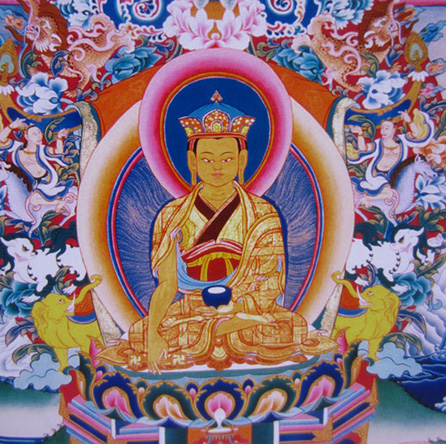
During Lord Tönpa Shenrap’s time in the human realm, he demonstrated the path of monastic discipline by becoming a monk.  At that time, he was known as Tritsuk Gyalwa.

Lord Tonpa Shenrap demonstrating the path of monastic discipline. In this form, he is known as Tritsuk Gyalwa.

“Don’t hate enemies or turn and go the other way.  Don’t be attached to friends and relatives.  Don’t cherish wordliness.  Body and mind should be single-pointed and at ease.  In your outer conduct, don’t act in an agitated manner.  In your inner ethics, don’t wander in to laziness.”

Raven Cypress Wood© All Rights Reserved
(This blog is offered for free to the worldwide students of Yungdrung Bön.  It is made possible by readers like you.  If you would like to join in making a gift of support for this blog or the translation work of Raven Cypress Wood, please go to https://www.paypal.com/home, click ‘Send’ and use Raven’s account rcw108@gmail.com.  Any amount is of great support!)