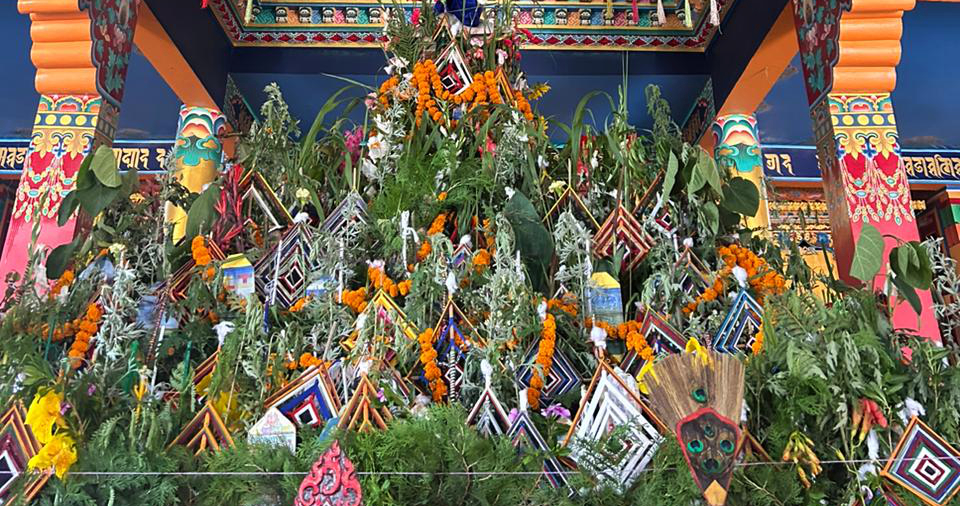
During the 12th-16th lunar days of the 5th lunar month, Menri Monastery together with the Rayna Menling Nunnery will conduct the annual Kha Long Sangwé Dō Chen, The Great Secret Dō Ritual of the Vast Sky. In 2025, these dates correspond with July 7th-11th. The purpose of this elaborate ritual cycle is to pacify or expel obstacles and malevolent energies, rebalance the five elements, attract good fortune, longevity, and positive circumstances, and to bring healing and harmony to the environment and its seen and unseen inhabitants. This ritual was taught directly by the enlightened Lord Tönpa Shenrap Miwoché as a skillful method to work with external, worldly forces that interfere with the happiness and success of sentient beings. These teachings are part of the Second Way of Bön, The Way of the Shen of the Phenomenal World. As in every teaching and ritual of the Yungdrung Bön, the foundation of the practice is unbiased, unlimited compassion. Even when so-called “malevolent spirits” are expelled because of their unwillingness to stop harming others, the expulsion is from a base of compassion for both those being harmed as well as for those causing the harm. By interrupting their harmful actions towards others, it also prevents them from accumulating negative karma. Additionally, every ritual concludes with prayers of aspiration that all beings be happy and peaceful, and ultimately to realize the ultimate state of enlightenment that is beyond any kind of suffering or unhappiness.
To support the ritual of The Great Secret Dō Ritual of the Vast Sky, a representation of the phenomenal world is created along with all the good and precious things within it. These things are offered to the enlightened ones, the worldly protectors, powerful spirits, and all the six kinds of sentient beings. By offering to the deities, the accumulation of merit is increased and previous negative actions are purified. By offering to the worldly protectors, they are delighted and continue to fulfill their vows of protection and bestowing abundance. By offering to the powerful spirits, we bring harmony to our relationship with them and pay any debts that might invoke their retribution. By giving to all the six kinds of sentient beings, we fulfill their desires and their minds become peaceful and satisfied.

About Namkha
In addition to the many offerings of torma, precious gems, foodstuffs, flowers and greenery, fragrant smells, soft materials, and so on; this ritual makes abundant use of the ritual object known as a namkha. The Tibetan term namkha literally translates as “sky” or “external space.” This term is often translated as “thread-cross.” There are many different kinds of namkha that have a diversity of form and function. Just as the shape, color, ingredients, and use of a torma is determined by its ritual purpose, so is the shape, color, and function of a namkha determined by its ritual purpose. As for the actual construction, a namkha is created by affixing thin pieces of bamboo or wood together to establish a frame. Then, beginning at the center and working outward, strands of colored wool, yarn, or thread are used to weave a net-like pattern over the frame. The length of the wood or bamboo is notched to allow the colored strands to catch and stay in place. There is a great variation in framework and patterns. For example, if the namkha is being used as a temporary abode of a deity or spirit, the pattern and colors used will be representative of the physical characteristics and hand objects of that deity or spirit. Namkha are used as a dwelling for deities or spirits during a ritual, to attract or repel specific energies and qualities, for protection from danger and disease, and as offerings, among other purposes.

Dō Rituals
Buddha Tönpa Shenrap Miwoché taught 365 different types of rituals. The Great Secret Dō Ritual of the Vast Sky is categorized as a dō type of ritual. Because many of the dō rituals make use of namkha, some Western scholars have erroneously stated that the terms dō [Tibetan: mdos] and namkha are synonymous. This is incorrect. There are dō rituals that do not use namkha, and there are many namkha that are used in rituals other than those categorized as dō. In general, dō rituals are the most important of the ransom rituals used for eliminating harm to the life force, diseases, danger, and other disturbances from nonhuman beings. In general, the nonhuman beings causing harm are offered an exchange of desirable things for the release of those being harmed. Namkha are used to invite the enlightened deities who are the objects of refuge for the ritual, and the protectors who subdue the malevolent forces. Other types of namkha are made as offerings to the deities and gifts of exchange for the ransom. Still other types of namkha act as supports for the return of the life force, and the rebalancing of the external, internal, and secret five elements. There are different kinds of dō rituals in order to appeal to the variety of nonhuman beings that create disturbances for humanity and the environment.

The scripture for the Kha Long Sangwé Dō Chen is almost one thousand pages in length. It includes chapters dedicated to instructions for the construction of ritual items, texts for the ransom rituals for men, women, and children, rituals for stopping and healing illness and contagious disease, rituals for renewing and fulfilling sacred vows, rituals for calling upon the magically powerful and benevolent worldly protectors, rituals for strengthening the life force and prosperity, rituals for appeasing the many kinds of nonhuman spirits, rituals for forcefully repelling negative forces, and so on. The overall purpose of all of these rituals is to bring peace and happiness within the world of appearances, and to generate faith in the Yungdrung Bön teachings which will guide all sentient beings to the ultimate goal of liberation from all the suffering of cyclic existence.

Raven Cypress Wood ©All Rights Reserved. No content, in part or in whole, is allowed to be used without direct permission from the author.
Did you enjoy this content? This article is made possible by generous donors who want content like this to continue to be available. Join the mandala of Nine Ways supporters by following this link: https://ravencypresswood.com/donate/
Don’t want to miss a post? Scroll to the bottom and click “Follow this blog.”


 Nine Ways