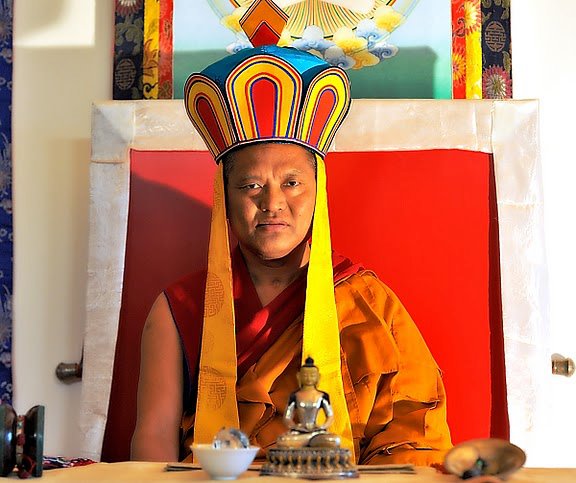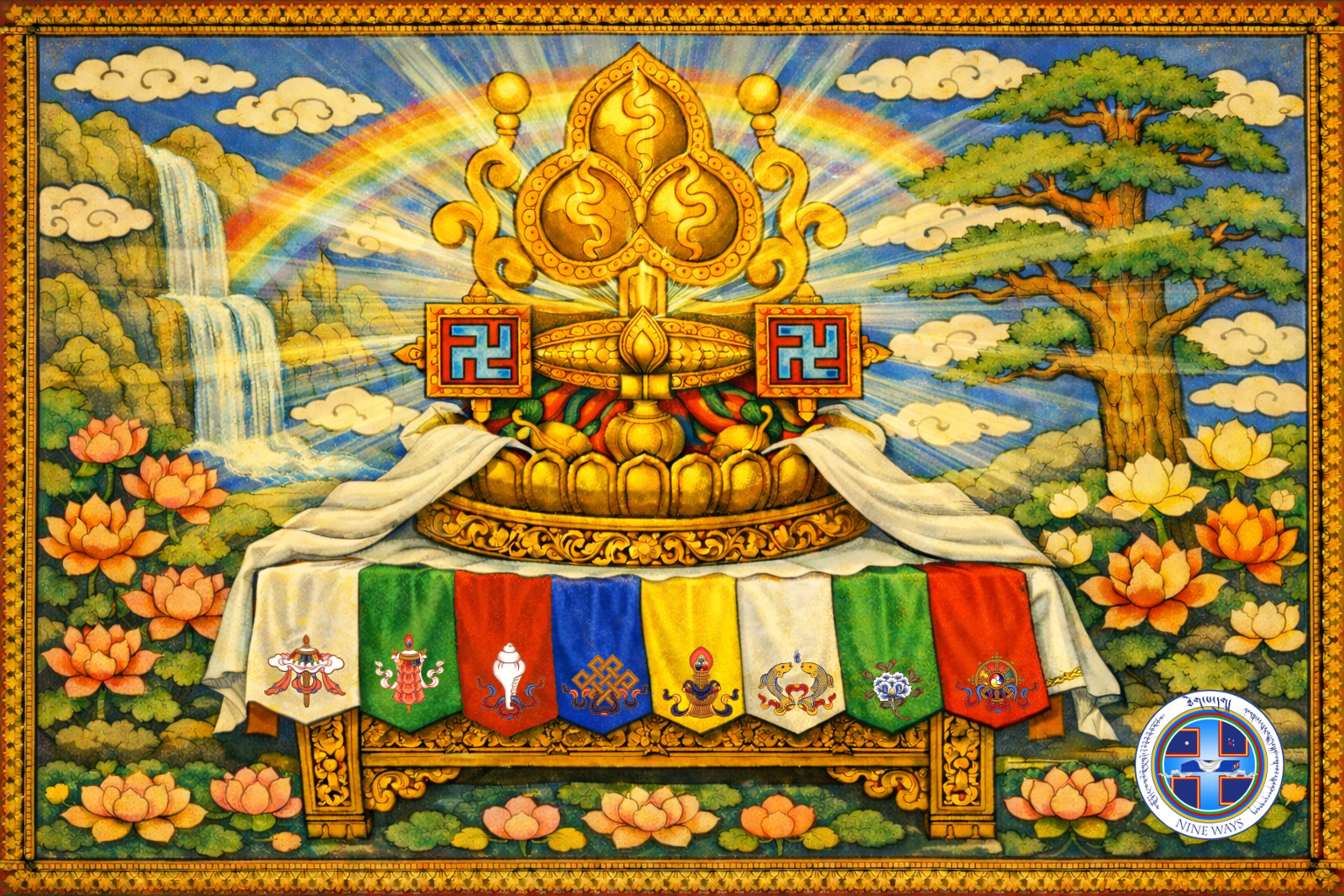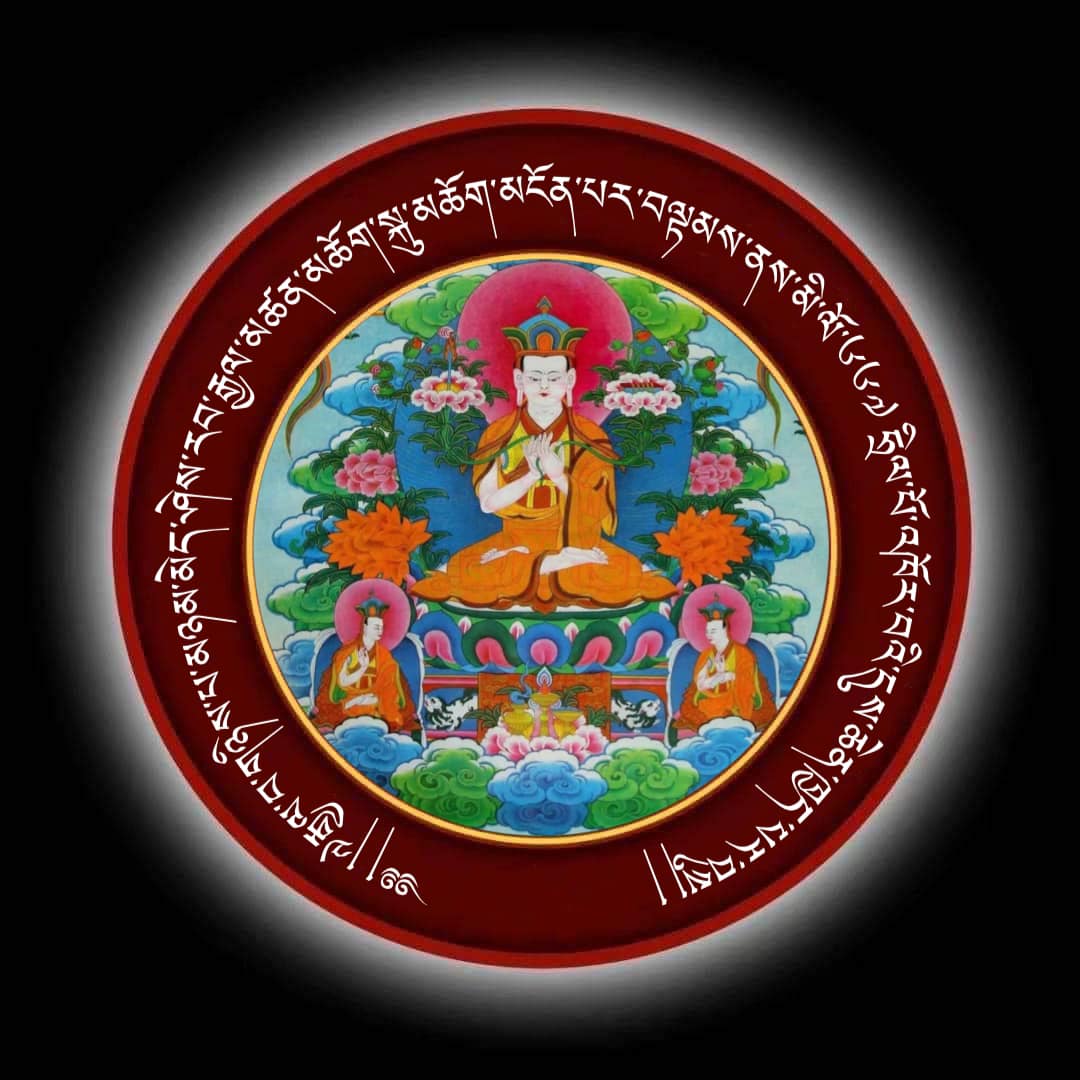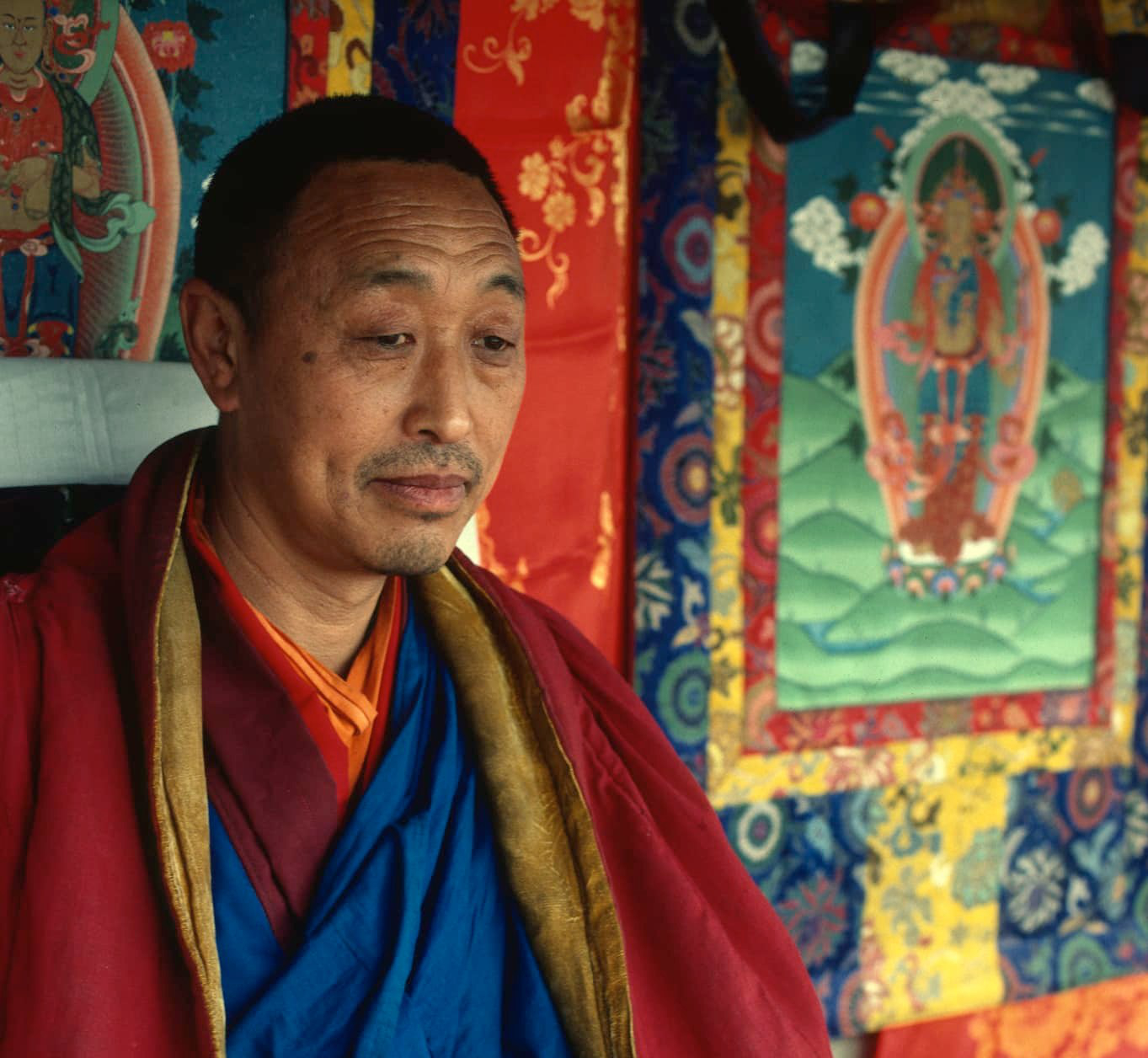
Close-up of traditional scroll painting depicting His Holiness the 33rd Menri Trizin Lungtok Tenpé Nyima Rinpoché
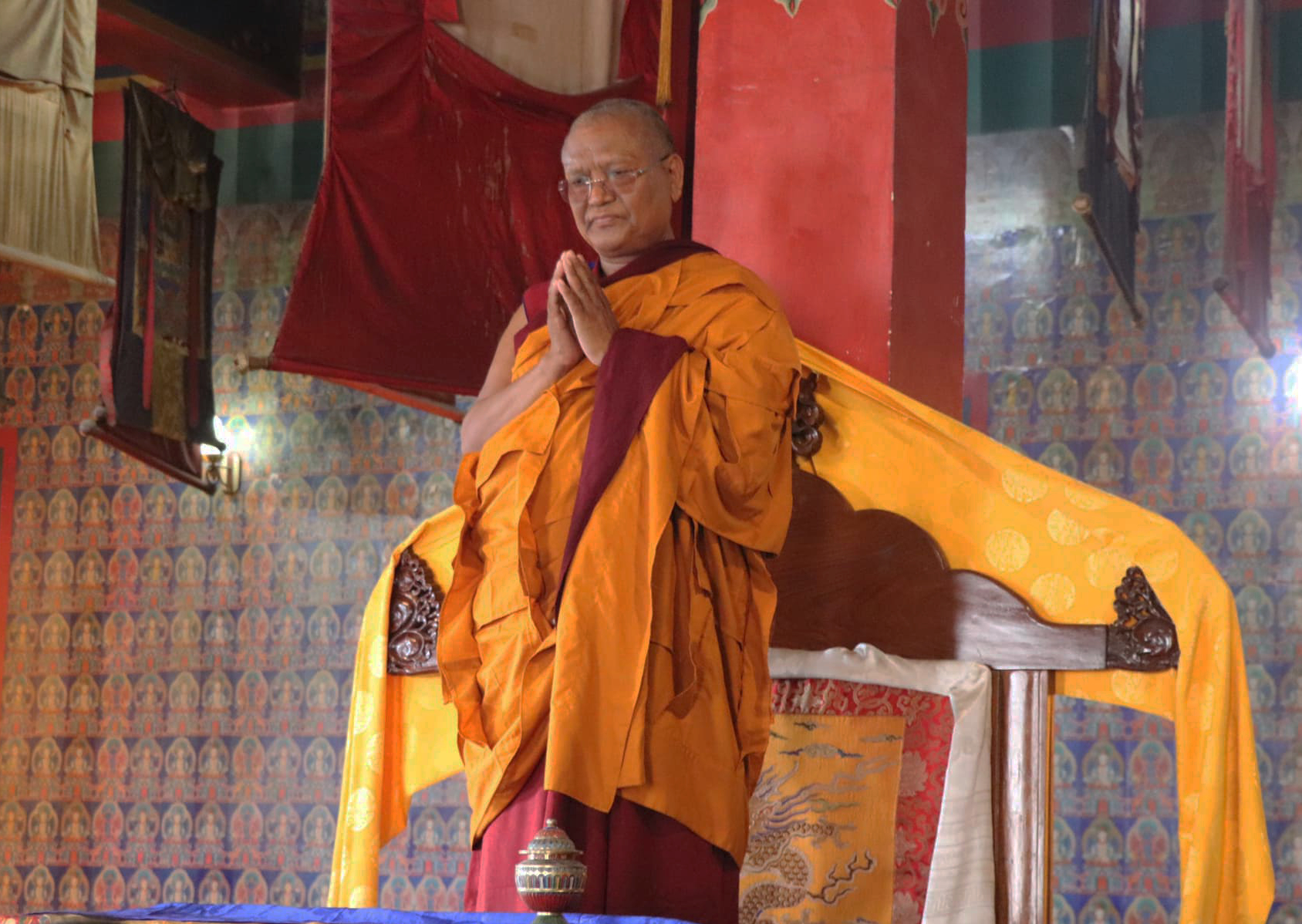
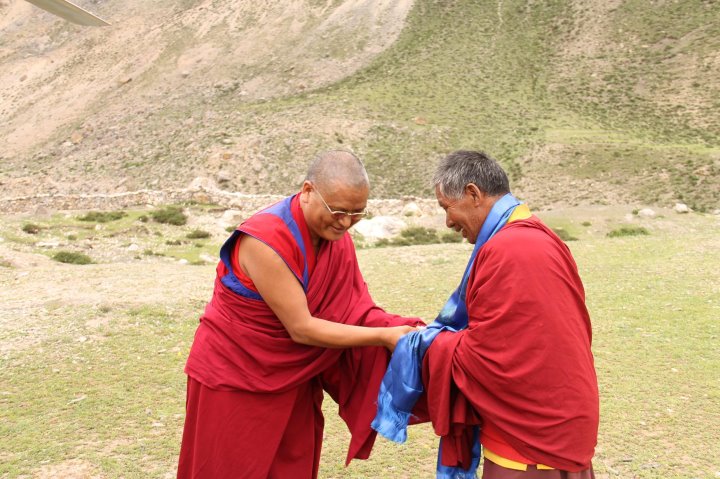
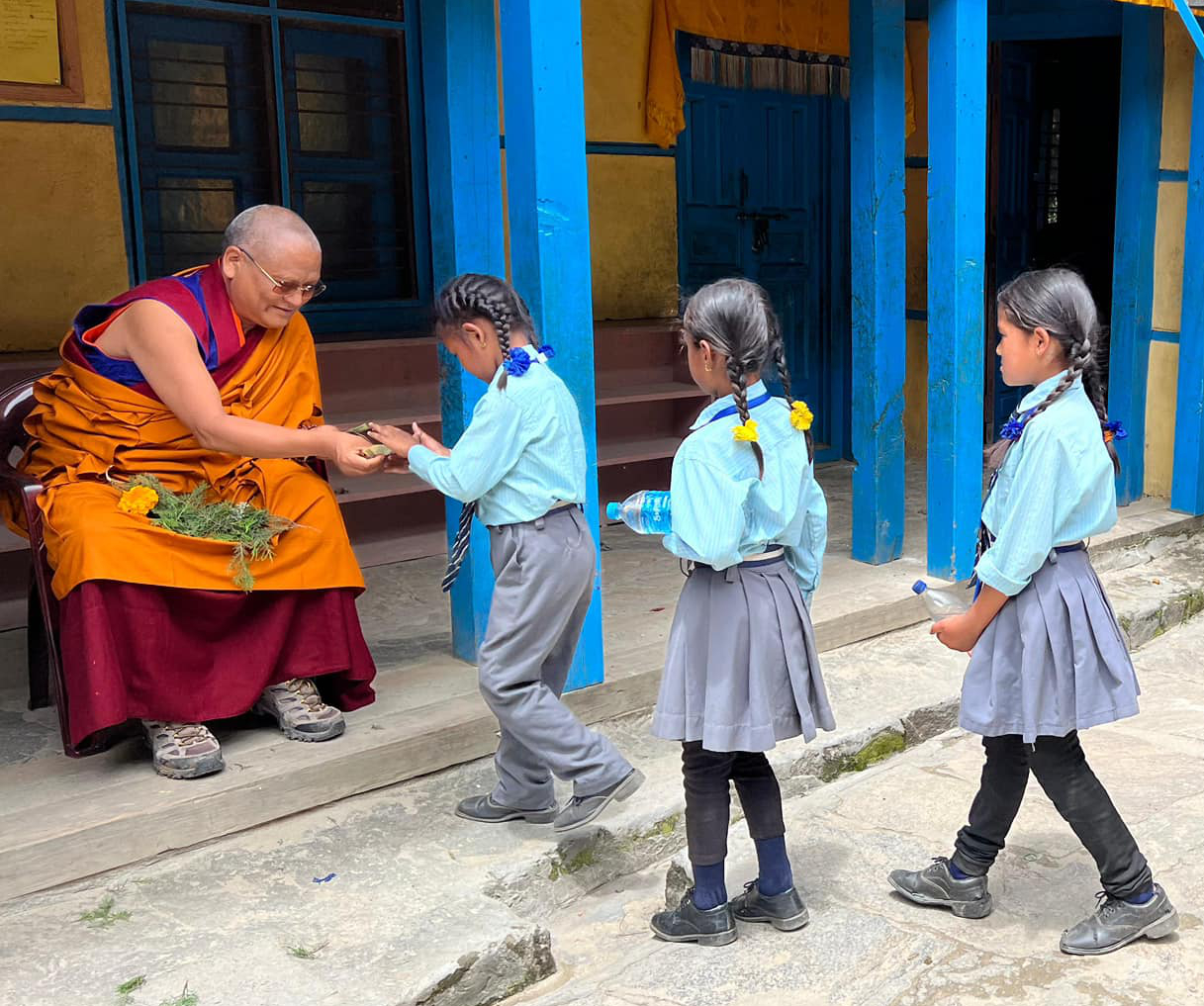
His Holiness the 33rd Menri Trizin Lungtok Tenpé Nyima Rinpoché was born in Tibet on the 15th day of the 5th lunar month in the Western year 1929 in the village of Kyongtsang in the far eastern province of Amdo. In 2025, this date corresponds with July 10th on the Western calendar.
When he was eight years old, his father took him to the nearby monastery of Phuntsok Dargyé Ling where he learned to read, write and chant. At the age of fourteen, he received instructions on the preliminary practices of dzogchen and completed the nine-hundred thousand accumulations three times. In 1945 at the age of seventeen, he received novice monk vows from Kyangtsang Lama Sherap Tenpé and was given the name Sherap Namdak. He completed his Geshé Degree at the age of twenty-five under the guidance of Lopön Tenzin Lodro Gyatso Rinpoché. The following year, he traveled South to the Bön province of Gyalrong, where he printed copies of the Bön Kanjur from traditional woodblocks. After gathering a vast amount of material and using mules to carry more than 100 volumes of the sacred texts, he made an arduous six-month journey back to his monastery. In 1956 at the age of twenty-eight, he traveled to the famous Yungdrung Ling Monastery and received monk vows from the Pönlop and was given the name Sangyé Tenzin. In 1960 at the age of thirty-two, as he passed through Mustang and Dolpo on his way to India, he borrowed many rare texts in order to reprint them in India and ensure their preservation.
In 1968, many esteemed Yungdrung Bön lamas gathered together in order to coordinate the process of selecting a successor of the late 32nd Menri Trizin. After several days of extensive prayers and rituals, Sangyé Tenzin’s name emerged as the one to hold the lineage of Nyammé Sherap Gyaltsen. In 1969 at the age of forty, after extensive preparatory initiations, he assumed his duties as the 33rd Abbot of Menri Monastery and began leading the effort to re-establish Menri Monastery in Dolanji, India.
His Holiness the 33rd Menri Trizin Rinpoche. Photo credit: Unknown
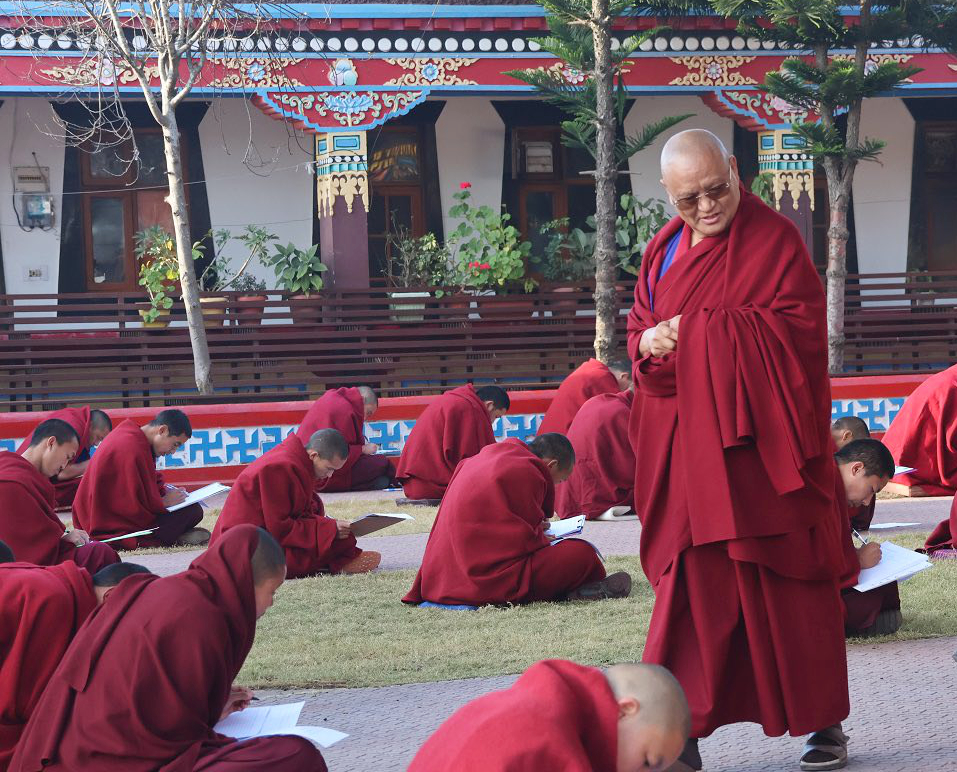
In 1970, he began construction of the main temple of Pal Shenten Menri Ling in Dolanji and lead efforts to restore Menri Monastery in Tibet. In 1972, he opened a dispensary at Pal Shenten Menri Ling that distributed medicine freely to the monks, the Tibetan settlers in the nearby village, as well as to the local Indians. In 1975, he began a school for the Bönpo children, and in 1978 he founded the dialectic school to continue the tradition of in-depth education of the traditional and philosophical sciences that results in the esteemed degree of geshe.
After many years of indescribable and tireless efforts on behalf of the Yungdrung Bön tradition as well as the worldwide Bön community and all sentient beings, he displayed the truth of impermanence and passed into nirvana on the 27th day of the 7th lunar month in the Western year 2017. The auspicious occasion of the celebration of his birth is an opportunity to generate great merit through spiritual practice and virtuous activities of body, speech and mind.
“EMAHO!
To the lama who is the embodiment of all of the victors and spiritual masters, who acts principally through the accomplishment of Bön for sentient beings who are as limitless as the sky,
I offer prostrations with my body, prostrating with my arms, legs and head!
I prostrate with my speech, chanting with a joyous and inspired melody!
I prostrate with my mind, paying homage with single-pointed motivation and devotion!
May the negative actions and defilements of my three doors become purified!
AH OM HUNG CHI PAR RAYNA KO PUNG AKSHO TRI TSE GU DÜN HRUN”
Did you enjoy this content? This article is made possible by generous donors who want content like this to continue to be available. Join the mandala of Nine Ways supporters by following this link: https://ravencypresswood.com/donate/
Don’t want to miss a post? Scroll to the bottom and click “Follow this blog.”
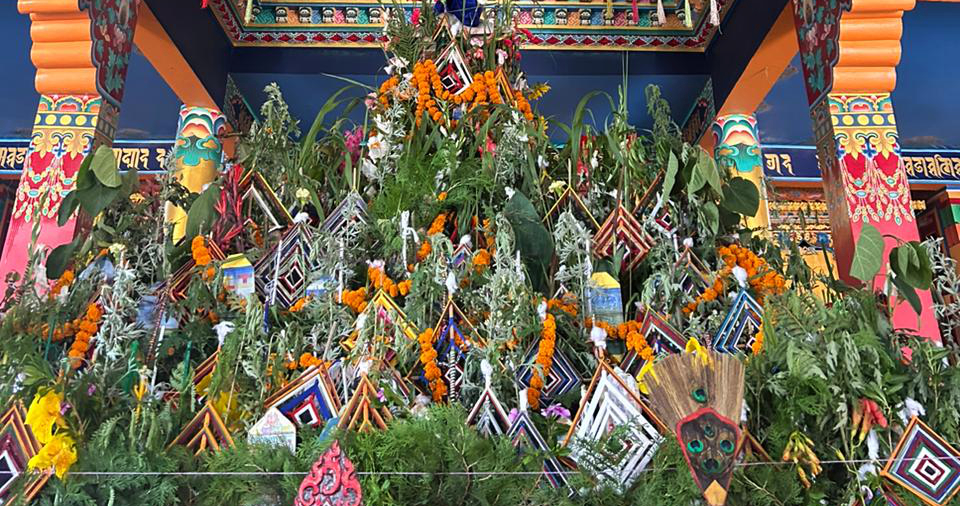
Representation of the phenomenal world with its wondrous and desirable contents created at Menri Monastery
During the 12th-16th lunar days of the 5th lunar month, Menri Monastery together with the Rayna Menling Nunnery will conduct the annual Kha Long Sangwé Dō Chen, The Great Secret Dō Ritual of the Vast Sky. In 2025, these dates correspond with July 7th-11th. The purpose of this elaborate ritual cycle is to pacify or expel obstacles and malevolent energies, rebalance the five elements, attract good fortune, longevity, and positive circumstances, and to bring healing and harmony to the environment and its seen and unseen inhabitants. This ritual was taught directly by the enlightened Lord Tönpa Shenrap Miwoché as a skillful method to work with external, worldly forces that interfere with the happiness and success of sentient beings. These teachings are part of the Second Way of Bön, The Way of the Shen of the Phenomenal World. As in every teaching and ritual of the Yungdrung Bön, the foundation of the practice is unbiased, unlimited compassion. Even when so-called “malevolent spirits” are expelled because of their unwillingness to stop harming others, the expulsion is from a base of compassion for both those being harmed as well as for those causing the harm. By interrupting their harmful actions towards others, it also prevents them from accumulating negative karma. Additionally, every ritual concludes with prayers of aspiration that all beings be happy and peaceful, and ultimately to realize the ultimate state of enlightenment that is beyond any kind of suffering or unhappiness.
To support the ritual of The Great Secret Dō Ritual of the Vast Sky, a representation of the phenomenal world is created along with all the good and precious things within it. These things are offered to the enlightened ones, the worldly protectors, powerful spirits, and all the six kinds of sentient beings. By offering to the deities, the accumulation of merit is increased and previous negative actions are purified. By offering to the worldly protectors, they are delighted and continue to fulfill their vows of protection and bestowing abundance. By offering to the powerful spirits, we bring harmony to our relationship with them and pay any debts that might invoke their retribution. By giving to all the six kinds of sentient beings, we fulfill their desires and their minds become peaceful and satisfied.
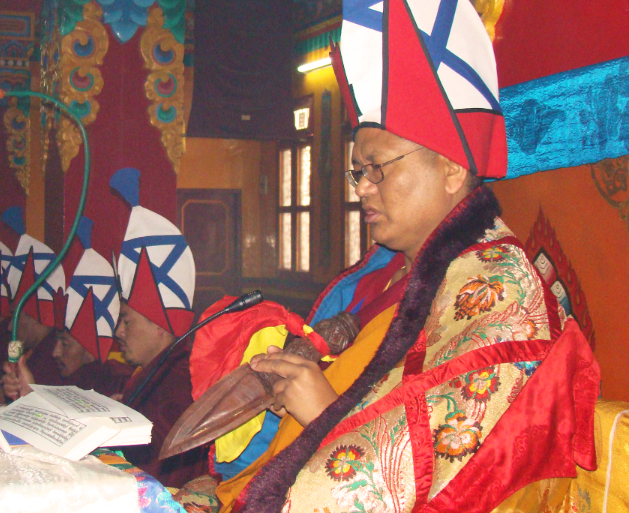
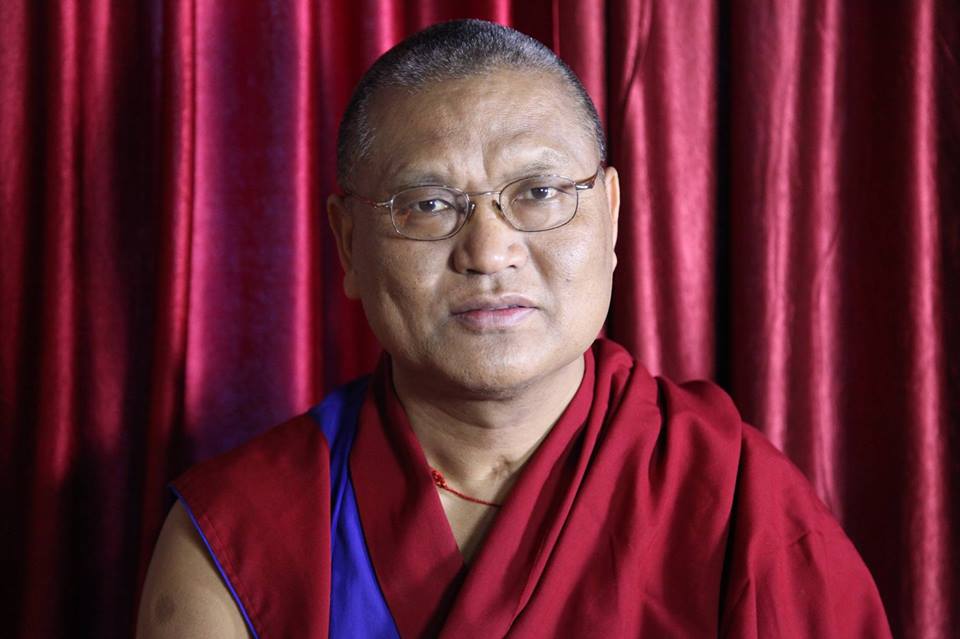
His Eminence Menri Pönlop Thrinley Nyima Rinpoche instructing the monks in creating namkha
About Namkha
In addition to the many offerings of torma, precious gems, foodstuffs, flowers and greenery, fragrant smells, soft materials, and so on; this ritual makes abundant use of the ritual object known as a namkha. The Tibetan term namkha literally translates as “sky” or “external space.” This term is often translated as “thread-cross.” There are many different kinds of namkha that have a diversity of form and function. Just as the shape, color, ingredients, and use of a torma is determined by its ritual purpose, so is the shape, color, and function of a namkha determined by its ritual purpose. As for the actual construction, a namkha is created by affixing thin pieces of bamboo or wood together to establish a frame. Then, beginning at the center and working outward, strands of colored wool, yarn, or thread are used to weave a net-like pattern over the frame. The length of the wood or bamboo is notched to allow the colored strands to catch and stay in place. There is a great variation in framework and patterns. For example, if the namkha is being used as a temporary abode of a deity or spirit, the pattern and colors used will be representative of the physical characteristics and hand objects of that deity or spirit. Namkha are used as a dwelling for deities or spirits during a ritual, to attract or repel specific energies and qualities, for protection from danger and disease, and as offerings, among other purposes.
Namkha created for the fire ritual of the deity Duk Kar, the White Umbrella Goddess
Dō Rituals
Buddha Tönpa Shenrap Miwoché taught 365 different types of rituals. The Great Secret Dō Ritual of the Vast Sky is categorized as a dō type of ritual. Because many of the dō rituals make use of namkha, some Western scholars have erroneously stated that the terms dō [Tibetan: mdos] and namkha are synonymous. This is incorrect. There are dō rituals that do not use namkha, and there are many namkha that are used in rituals other than those categorized as dō. In general, dō rituals are the most important of the ransom rituals used for eliminating harm to the life force, diseases, danger, and other disturbances from nonhuman beings. In general, the nonhuman beings causing harm are offered an exchange of desirable things for the release of those being harmed. Namkha are used to invite the enlightened deities who are the objects of refuge for the ritual, and the protectors who subdue the malevolent forces. Other types of namkha are made as offerings to the deities and gifts of exchange for the ransom. Still other types of namkha act as supports for the return of the life force, and the rebalancing of the external, internal, and secret five elements. There are different kinds of dō rituals in order to appeal to the variety of nonhuman beings that create disturbances for humanity and the environment.
Namkha of various auspicious symbols
The scripture for the Kha Long Sangwé Dō Chen is almost one thousand pages in length. It includes chapters dedicated to instructions for the construction of ritual items, texts for the ransom rituals for men, women, and children, rituals for stopping and healing illness and contagious disease, rituals for renewing and fulfilling sacred vows, rituals for calling upon the magically powerful and benevolent worldly protectors, rituals for strengthening the life force and prosperity, rituals for appeasing the many kinds of nonhuman spirits, rituals for forcefully repelling negative forces, and so on. The overall purpose of all of these rituals is to bring peace and happiness within the world of appearances, and to generate faith in the Yungdrung Bön teachings which will guide all sentient beings to the ultimate goal of liberation from all the suffering of cyclic existence.
Raven Cypress Wood and Khenpo Nyima Künchap Rinpoche prepare namkha for an elaborate ritual offering to the lu [Sanskrit: naga]
Did you enjoy this content? This article is made possible by generous donors who want content like this to continue to be available. Join the mandala of Nine Ways supporters by following this link: https://ravencypresswood.com/donate/
Don’t want to miss a post? Scroll to the bottom and click “Follow this blog.”
The 5th day of the 1st lunar month is the birth celebration of His Holiness the 1st Menri Trizin Nyammé Sherap Gyaltsen Rinpoché who is known as the second buddha in the Yungdrung Bön religious tradition. In 2025, this date coincides with March 4th on the Western calendar. His Holiness Nyammé Sherap Gyaltsen Rinpoché was a reincarnation of Yikyi Khye’u Chung, one of Buddha Tönpa Shenrap Miwoche’s sons. He reunited the three transmission lineages of sutra, tantra and dzogchen that had become widely dispersed, and he founded one of the largest Yungdrung Bön monasteries in Tibet, Tashi Menri Ling.
Born in 1356 C.E. in the region of Gyalrong into the esteemed Dru lineage, as a child, he could recite mantra and read scripture without having studied. At the age of ten, he decided to become a monk. In 1387 C.E. at the age of 31, he entered the prestigious Yeru Wensaka monastery and eventually became its abbot. While he was traveling in Eastern Tibet, Yeru Wensaka was destroyed by flooding and mudslides. Upon returning, he searched the ruins of the monastery for any salvageable artifacts. With these precious objects, he established Tashi Menri Monastery on higher ground within the same valley. It was 1405 C.E. and he was 50 years old.
Cloak belonging to the precious lord Nyammé Sherap Gyaltsen Rinpoche. Photo credit: Unknown
In 1415 C.E. at the age of 60, he left the shell of his physical body. His body levitated high into the air, but due to the fervent prayers of his disciples, the body returned to the earth. During the cremation, rainbows appeared and a large bird circled three times around the cremation area before disappearing into the West.
Today, Bönpos will spend the day with their eyes looking skyward. If they are lucky enough to be visited by a vulture on this day, it is said to be an auspicious sign of having directly received the blessings of the one known as the Second Buddha, the Unequaled One, His Holiness Nyammé Sherap Gyaltsen Rinpoché.
Among his numerous writings, is the commonly recited Eight-branched Aspiration Prayer, Mönlam Yenlak Gyepa. When offering aspiration prayers, we imagine that every sentient being is offering the prayers in unison with us. This limitless group of beings includes humans, nonhumans, unseen spirits, and those we consider “enemies.” All sound is perceived as the sound of the prayer being recited and the vastness of space is imagined as filled with buddhas and bodhisattvas that are delighted by the virtuous activity that spontaneously activates their immeasurable compassion. By offering the prayers in this way, and then dedicating the merit of the practice for the welfare of all sentient beings, the power of the practice is inconceivable and the benefit is sealed and can never be destroyed.
The English language translation of the Eight-branched Aspiration Prayer, Mönlam Yenlak Gyepa is publicly available for personal use and can be downloaded from the Publications page of this website. Click on the Publications tab above and then scroll down to the download link.
The Writings of His Holiness Nyammé Sherap Gyaltsen Rinpoche*
Cycle of Supplication and Aspiration Prayers
Praise of the Four Supreme Places of Refuge
Offering and Praise to Mawé Sengé
Supplication Prayer to the Mawé Sengé Lineage
Praise of Venerable Essence of [the] Dru [Family Lineage]
Eight Characteristics of Tséwang’s Eight Sacred Places
Stages of Chanted Supplications
Eight-branched Aspiration Prayer, A Ladder to Freedom
Homage to the Charactristics of the Aural Transmission Shenraps
The Gift of the Physical Body
Condensed Peaceful Chö of Gifting the Body
Command for the Gods and Demons
Cycle of Fumigation and Fulfillment
Stages of Preliminary Practices for a Completely Pure Fumigation Offering
A Small Collection Regarding the Medicine Deity Generation Stage
Supplication and Requesting Consideration from the Marvelous Ones
Invocation of the Practice Lineage
Special Fulfillment
A Completely Pure River of Requesting Consideration and Supplication
Burnt Offerings of the Treasury of Precious Terma
General Fulfillment from a Bundle of Precious Terma
A Precious Mala of Fumigation Offerings
Fumigation Offering to the Powerful Ones
Fumigation Offering to Sigyal
Fumigation Offering to Black Mule Sigyal from the Precious Terma
Sigyal’s Manifested Realization
Sigyal’s Threadcross Practice
A Brief Paper on Sigyal’s Threadcross
A Brief Paper on Black Mule Sigyal’s Feast Offering
Short Fulfillment Practice of Black Mule Sigyal
Practice of the Black Net Threadcross
The Shining Lamp of Realization of the Red and Black Threadcross
Commandments for the Avowed Guardians of the Teachings
Important Points regarding the Fulfillment of Midü Jampa
Fumigation Offering to Midü
Offering and Fulfillment to Drak Tsen
Fumigation Offering to Drak Tsen
Invocation of Nyipangsé
Command for Nyipangsé
Command for the Queen of the Drala
Gyalpo Sheltrap Torma Offering and Fulfillment
A Brief Invocation of Sheltrap
Praise in Appreciation of the Fumigation Offering
Supplement to the Fumigation Offering
Generation Stage for the Fulfillment Torma
Celebration of Nyammé Sherap Gyaltsen Rinpoche. Photo credit: Unknown
Cycle of Supplementary Texts for the Practices of Accomplishment
Destroying the Door to Negative Rebirths
Realization of the Completely Pure Lotus of the Vast Expanse
Mantric Accomplishment of Shenrap Nampar Gyalwa
Fire Offerings of Nampar Gyalwa
Realization of the Yungdrung Sutra of the Vast Expanse
Going for Refuge according to the Vast Expanse
Practice of Künzang’s Luminous AH
Stages of Meditative Stabilization
Text for Künzang’s Luminous AH
Stages of Realization for Walsé
Accomplishing the Essential Through the Realization of Walsé
Purification and Increase of Torma
Accomplishment of Sending Out and Gathering Back with Mantra Accumulation
Practice of the Secret Mantra Lineage
Realization of Black Garuda Walsé
Clarifying the Realization of Black Garuda Walsé
Expanding the Realization of the Amazing Trowo
Secret Quintessential Instructions for the General Practice of the Amazing Trowo
Invitation, Homage, and Confession of Wrongdoing for the Reversal Practice of the Great Red Trowo
Inviting the Wisdom Zema
Aspiration Prayer for Threadcross Practice
A Lamp that Clarifies the Meditative Focus of Secret, Greatly Wrathful Gekhö
Supplication to the Gekhö Lineage
Complete Supplication, A Rainshower of Blessings
Practice of the Secret Wrathful Lineage
The Irreversible Mantra of Gekhö, A Golden Razor
Supplement to Presenting Offerings to the Gekhö Deities
Realization of Walpur, Ornaments of Fire
Fulfillment of the Walpur Lineage
Outline for the Empowerment and Teachings of Walpur, A Rainshower of Blessings
Empowerment and Teachings of Walpur, A Rainshower of Blessings
Realization of Tséwang Tartuk
Accomplishment of Tséwang Tartuk
Fire Offerings to Tséwang
Introduction for Empowerments
Musical Notations for Festivals
Cycle of Science
Tikles and Channels of Relics and the Physical Body of Those Gone to Bliss
Clarification regarding the characteristics of colored powders, A Magical Mirror
Cycle of Authoritative Commentaries
Analyzing the Characteristics of The Magical Lamp Text
Analyzing the Characteristics of The Magical Lamp Autocommentary
Clarification of the Limits of All Knowable Things
Commentary Regarding the Sutric and Tantric Explanations of the Stages of the Vehicles
Text of the Grounds and the Paths
Autocommentary of Text of the grounds and the paths
A Clear Lamp for the Path of Liberation
Commentary Regarding the Clear Explanation of the Abridged Kham Gyé
Commentary Regarding the Two Truths in the Middle Way, A Magical Lamp
A Commentary of Clear Advice Regarding Monastic Discipline
Commentary of Condensed Discipline
Renewing Monastic Discipline
Commentary Regarding Cosmology
Clarifying Secret Points
Detailed Analysis of the Secret Vows
Hidden Commentary on the Mind of Enlightenment, Mandala of the Sun
* Although this list is extensive, it is not the complete list of compositions
Don’t want to miss a post? Scroll to the bottom and click “Follow this blog.”
This website has always been supported by the donations of the worldwide Yungdrung Bön community. Want to join the mandala of Nine Ways supporters? Follow this link https://ravencypresswood.com/donate/ It’s easy through Paypal and Zelle.
H.H. 34th Menri Trizin ceremonially grinding ingredients of the mendrup
Menri Monastery in Dolanji, India is currently conducting the Great Retreat of the Medicine with Swirling Rays of Light, Mendrup Ö Zer Khyilwa. (See previous article for the retreat schedule, description of the preliminary practices, and overview of the history and lineage of the great mendrup retreat: https://ravencypresswood.com/2024/04/13/the-great-retreat-of-the-medicine-with-swirling-rays-of-light/) There are many mendrup cycles within the Yungdrung Bön tradition with each relying upon a different yidam, or meditational deity. Some mendrup cycles are vast and complex and many others are much shorter and simpler. The Medicine with Swirling Rays of Light cycle is one of the most extensive and complex cycles and is according to the trowo, or wrathful deities. Although all the peaceful and wrathful deities are invoked during the mendrup ceremony, for the main practice of the Medicine with Swirling Rays of Light the primary yidam is the embodiment of Buddha Tönpa Shenrap’s Enlightened Mind, Trowo Tsochok Khagying.
Trowo Tsochok Khagying and his consort Khala Dukmo
Once the outer and inner preliminary practices and empowerments of the mendrup ritual are complete, the mandala palace surrounded by various offerings and the bags of mendrup ingredients becomes the focus of spiritual activity. From the beginning of the main ritual and until its conclusion, the main mantra for empowering the mendrup is recited continuously day and night. Within the main temple, designated monks take shifts reciting the mantra and circumambulating the mandala. Outside the main temple, everyone is encouraged to recite the mantra as much as possible and to circumambulate the temple complex. The medicinal ingredients of the mendrup ingredients alone are beneficial but they do not contain blessings. For that, it is necessary to perform the practice of the deities, make offerings and supplications, and especially to recite many hundreds of thousands of the mantra. In this way, power and blessings are conferred to the physical substances.
Mandala for the deities of absolutely complete and indestructible pacification used during the mendrup retreat
The mandala at the center of these activities supports the continual presence of the deities by being imbued with images and substances whose qualities correlate with those of the respective deities. Every element of color, shape, direction, and size has its own meaning and importance. A special vessel of mendrup ingredients is placed above the mandala in the center and in each of the cardinal and intermediate directions. These vessels in the center and the four cardinal directions contain ingredients associated with the qualities of their respective directions and are covered with silk cloths ornamented with the symbol of the respective directions. These directions of the mandala correspond with the geographical ones. The four vessels in the intermediate directions are covered in yellow.
The mandala palace surrounded by bags of mendrup ingredients connected by the zung tak cords
The center of the mandala is the seat of the principal deity Trowo Tsochok Khagying. This is the place of the Suchness Buddha Family. In this case the center is characterized by the color yellow, and associated with the element of earth. The yellow covering is ornamented with a white AH syllable which is the seed syllable of Trowo Tsochok Khagying, and a red MA syllable which is the seed syllable of his consort Khala Dukmo.
The East, which is always considered to be the front gate of the mandala, is the place of the Yungdrung Buddha Family. It is characterized by the symbol of a yungdrung and, in this case, the color white and the element of space.
The South is the place of the Jewel Buddha Family. It is characterized by the symbol of a wish-fulfilling jewel and the color blue, and is associated with the element of water.
The West is the place of the Lotus Buddha Family. It is characterized by the symbol of a pure lotus and the color red, and is associated with the element of fire.
The North is the place of the Wheel of Bön Buddha Family. It is characterized by an eight-spoked wheel of the Bön teachings and the color green, and is associated with the element of wind or air.
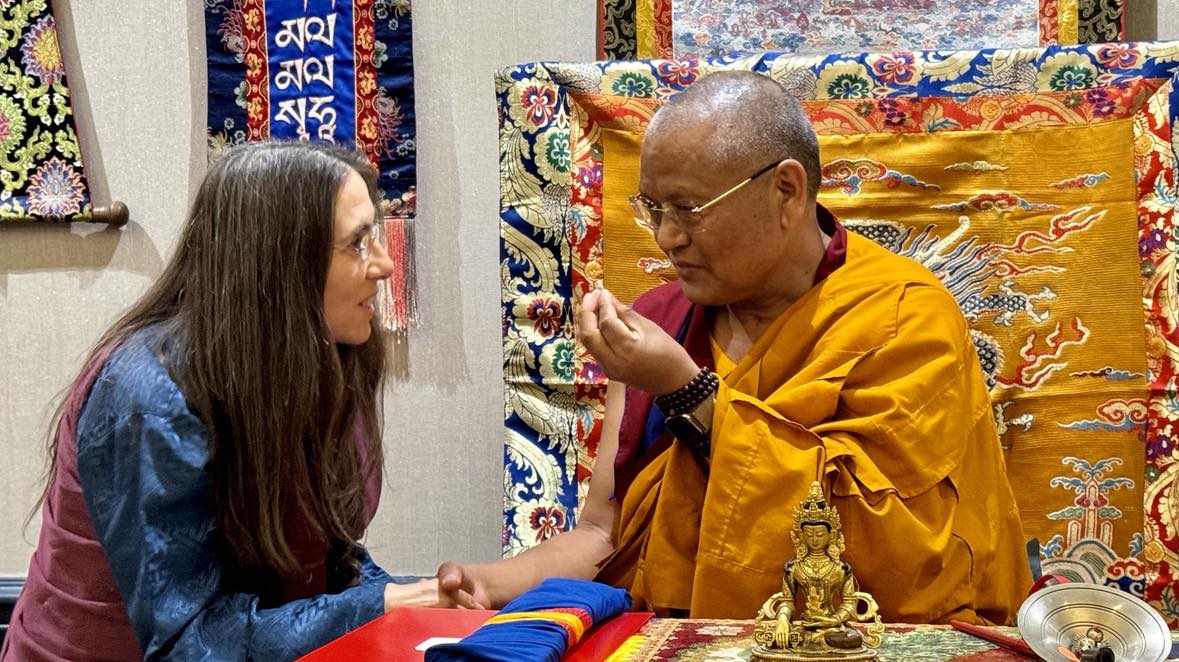
His Holiness the 34th Menri Trizin leads the practice of Medicine with Swirling Rays of Light with the zung tak cords reaching from the mandala to his throne
A cord is attached to each of the five main mendrup vessels in the center and cardinal directions. The color of this cord corresponds to its respective direction. These are the zung tak, or empowerment cords. They are stretched to the bags of mendrup ingredients surrounding the mandala, wound together, and then brought to the throne of the ceremony leader, in this case His Holiness 34th Menri Trizin Rinpoche. Throughout the performance of the rituals and mantra recitations, these empowerment cords are blown upon in order to carry the power and blessings to the physical substances. Similarly, having the cords connect the mandala to the bags of mendrup ingredients in the surrounding area imbues them with the power and blessings coming from the presence of the enlightened deities.
The nine vessels of mendrup ingredients after being ceremonially brought from the mandala palace
Once the requisite vessels of mendrup ingredients and offerings are placed above and surrounding the mandala, it is closed from view until the conclusion of the ritual. When necessary to interact with the immediate area of the mandala, those appointed to do so have the responsibility to abide by the tantric rules of behavior in order to not introduce any defilements or obstacles into the ritual environment. Once the rituals and mantric recitations are complete, the boundary is opened and the vessels of mendrup ingredients on the mandala and the bags surrounding it are ceremonially carried to where the ingredients are ground into a fine powder. First, the vessels from the mandala are opened and the ritual leaders ceremonially grind and mix the ingredients.
His Holiness 34th Menri Trizin Rinpoche and His Eminence Menri Pönlop Rinpoche ceremonially grind the ingredients from the central vessel of mendrup
However, the majority of ingredients are ground into a fine powder using modern methods and then distributed to the public. Major sponsors of the Great Retreat of Medicine with the Swirling Rays of Light will receive larger portions of the mendrup in appreciation for their support. Yungdrung Bön monasteries will receive a larger amount as well to dispense to their respective communities. Most of the mendrup will be stored at Menri and distributed over the coming years with the mindfulness that it must last until the next great mendrup retreat is performed which could be decades from now.
The primary mantra of the Medicine with Swirling Rays of Light is SO OM BA WA DÉ NA RA SA YA NA YU DRANG DU TSI SO THA.* This mantra is not like an ordinary sentence that can be translated into a conceptual meaning. The power of the mantra is beyond concepts. Yet, although it is not possible to be translated, specific qualities and associations can be made with each of the syllables. However, the practitioner should not restrict the power and blessings of the mantra to these limited intellectual understandings.
SO: syllable of enlightened body, enlightened speech, and enlightened mind; as well as the three enlightened bodies of the Bönku, Dzok ku, and Tülku
OM: syllable of the five wisdoms (1) the wisdom of emptiness, (2) mirror-like wisdom, (3) all-accomplishing wisdom, (4) discriminating wisdom, and (5) the wisdom of equanimity
BA WA: syllables of the high spiritual masters
DÉ NA: syllables of giving, of bestowing
RA SA YA NA: syllables of the highest and most extraordinary medicines that cure illness and pacify obstacles
YU DRANG: syllables of the Zhang Zhung language meaning du tsi
DU TSI: syllables of blessed nectar medicine that has the power and blessings to heal all illness and disturbances, and to support longevity and good fortune
SO THA *: syllable of transforming the impure body, speech, and mind of ordinary beings into enlightened body, speech, and mind. The syllables that dissolve all illness and obstacles into pure space.
When reciting, it is of the utmost importance to connect with the mantra as a request of the enlightened ones, the yidams, the khandro, and the lamas to bestow their blessings and to transform your impure body, speech, and mind into pure body, speech, and mind; and to remove all outer, inner, and secret obstacles. Reciting this mantra can transform any liquid into medicine which gives it the potency to pacify the afflictive emotions. For example, if one is drinking juice or milk the mantra can be recited and blown into the liquid. This transforms the liquid from an ordinary substance to a blessed substance.
Night-time circumambulation of the outside of Menri Monastery’s main temple
Mendrup can be taken by anyone at anytime for any condition. It is considered to be a single medicine for hundreds of illnesses. Its benefits are not restricted to human beings and can be given to animals or to the environment. The benefits of ingesting or wearing mendrup are unimaginable. It contains the blessings and power of the enlightened ones, the deities of medicine, the wisdom deities, the protectors, and the deities of wealth. It is said that even if one talks continuously for fifty years trying to explain every benefit of mendrup, the explanation would not be finished.
Having faith in the blessings and power of the mendrup gives energy, motivation, and openness to seek out and receive the medicine. Faith in the medicine has such power that even just seeing the mendrup can bring benefit and blessings. Simply by having the mendrup touch the tongue, it is possible to attain enlightenment. It is a single medicine for hundreds of ills. It has the potency to cure the three kinds of physical illnesses which arise from the imbalance of wind, bile, or phlegm. It supports longevity, personal power, vitality, and good fortune. It is like a wish-fulfilling jewel. It can bring food to the hungry and safety to those who need shelter, and so on. It opens the subtle wisdom channels within the body and blocks the movement of the winds related to the five poisons.
It can also be worn against the body for blessings and protection. Most amulets of the Yungdrung Bön tradition contain a small amount of mendrup as one of the required ingredients. If someone who is dying is given mendrup or a sachet of mendrup is placed around their neck, it will connect them with the peaceful and wrathful deities during the intermediate state after death and will ensure that they have a positive rebirth.
The mendrup ingredients are finely ground, packaged in small amounts, and then distributed for free to the public
Aside from requiring storage in a clean and respected place, there are only two restrictions associated with mendrup. First, it should never be traded or sold, but rather offered freely as a gift especially from a master to their students. Second, when ingesting the mendrup, meat should not be eaten soon afterwards. In general, it is taken each day in the early morning on an empty stomach. A small amount of the powdered substance is put into warm or cold water and allowed to dissolve slightly. Ideally, the main mantra is recited before drinking the liquid. Alternately, it can be placed directly into the mouth on the tongue and swallowed. A greater or lesser amount can be used, and it can be taken anytime day or night. However, whenever ingesting mendrup, one should be aware of receiving the unimaginable power and blessings of the enlightened deities that overcome all afflictions and suffering.
If you would like to make a donation to support this very auspicious occasion, you can do so through H.E. Menri Pönlop’s United States retreat center by following this link: http://kwling.org/ Follow the link and then click the donate button in the upper right of the page. You can make a notation that the donation is for the mendrup ceremony.
The Medical College of Sorig Bum Zhi Menri Ling grinding and processing the mendrup ingredients
General Overview of the Necessary Ingredients for Medicine with Swirling Rays of Light
All of the necessary ingredients and instructions for their proper collection are enumerated in the text of Medicine with Swirling Rays of Light, Mendrup Ö Zer Khyilwa.་ If they are counted individually, there are over 30,000 ingredients. This list is included as a mere example of the diversity of necessary ingredients. All ingredients should be of the highest quality and without faults or defilements. Sometimes, as in the case of many types of roots, a specific size and shape are necessary in order for them to be acceptable ingredients. Ingredients from sacred places such as Kongpo Bönri and Mt. Tisé are especially sought after. The collection of the ingredients needed can take many years and be quite costly.
One of the most important ingredients to be included is mendrup containing the essence of the previous ancient mendrup retreats. After that are the primary ingredients of arura, barura, and kyurara which in combination are considered to be a great panacea.
arura [Chebulic myrobalan, Terminalia Chebula]
barura [Terminalia belerica Roxb]
kyurura [Embelic Myrobalan, Emblica Officinalis]
The six excellent substances, the five grains, and the five precious things are also of primary importance. These substances are highly valued and are regularly added to torma, healing water, as well as being placed inside statues, wealth vases, chortens, and so on. The six substances are:
chu gong: It is a kind of essence of water sometimes translated as bamboo essence. There are three kinds of chu gong: (1) chu gong collected from wood or trees, (2) chu gong collected from rocks, and (3) chu gong collected from water
saffron, there are five types and the best quality should be chosen
cloves
nutmeg
green cardamom
black cardamom
The five grains: although it is common to add as many different kinds of grains as possible, it always includes:
barley
wheat
rice
beans
sesame
Precious things such as:
gold
silver
copper
metal
pearl
coral
turquoise
zi stone
crystal
white conch
There are many different kinds of plants, herbs, and trees that must be collected from many different geographical areas. These must be growing in the right place, be at the correct stage of growth, be gathered at the proper time of day, and be dried properly according to the character of the plant as well as the qualities to be enhanced. Thus, a plant that is gathered for its ability to bring warmth should be growing in the sun, gathered on a sunny day when it is warm, and be dried in the sun and heat. Sometimes the entire plant is used and other times only the flowers, leaves, stalk, buds, fruit, berries, pollen, seeds, or roots are needed. Quantities vary according to what can be acquired, the rarity of the ingredient, and the hazards in acquiring it.
Additional ingredients include the nine kinds of water which is water from:
the snow of a high mountain
a waterfall
river water
sacred lakes
ocean water
spring water
rain water
water that never freezes (There is drinkable water in the Himalayas that never freezes and is not a hot spring)
milk from a pure white cow
additional kinds of water are often added such as mineral water
There is a multitude of other ingredients. These include:
the three kinds of incense: white sandalwood, red sandalwood, valerian
white salt, black salt, and rock salt
molasses, dark brown sugar, and light brown sugar
crystallized sugar
unsalted curds
unsalted yogurt
unsalted butter from many different types of animals
milk from many different types of animals
honey
shellac resin
special cloth
a collection of various knotted threads
amber and a variety of other tree resins
sulphur
camphor
white and dark-colored grapes
calcite
many different kinds of oils
many different kinds of eggs
many different kinds of alcohol
Mendrup vessels from the mandala being uncovered
* The syllable “THA” is slightly aspirated and pronounced by placing the tongue behind the front teeth. This is different from a hard “TA” sound where the tongue is pressed against the roof of the mouth such as in the word “tower.” It is also different from the English language pronunciation of “TH” where the tongue is placed between the teeth such as in the word “thing.”
Don’t want to miss a post? Scroll to the bottom and click “Follow this blog.”
This website has always been supported by the donations of the worldwide Yungdrung Bön community. Want to join the mandala of Nine Ways supporters? Follow this link https://ravencypresswood.com/donate/ It’s easy through Paypal, Venmo and Zelle.
The altar for the deity surrounded by offerings and the powdered medicine
During the 3rd lunar month on the 3rd-18th lunar days which correspond with April 11th-26th on the Western calendar, Menri Monastery in Dolanji, India will perform the Great Retreat of Medicine with Swirling Rays of Light, also known as The Great Mendrup Retreat. This is one of the largest rituals within the Yungdrung Bön Religious tradition and has an unbroken lineage from the enlightened Lord Tönpa Shenrap. Once an individual is enthroned as the abbot of Menri Monastery, they are required to do three things: (1) establish a reliquary chorten for the previous abbot, and (2) bestow empowerments to disciples, and (3) perform a mendrup retreat at least once during their lifetime. His Holiness the 33rd Menri Trizin Lungtok Tenpé Nyima Rinpoche performed the great mendrup ritual three times: once before the establishment of Pal Shenten Menri Ling in India, once in 1988, and once again in 2009.
A bag containing the mendrup ingredients
Its takes years of preparation in order to properly gather the tens of thousands of herbs, minerals, precious substances, and so on. For example, similar to acquiring ingredients for traditional Tibetan medicine, plants that are used for their warming qualities must be gathered and dried in the sun, and plants that are used for their cooling abilities much be gathered and dried in the shade in cooler areas. All of the primary and secondary ingredients are outlined within the mendrup text. There are many many traditions and texts. In this case, the text being followed is Mendrup Özer Kyilwa, Accomplishment of Medicine with Swirling Rays of Light. This ritual was taught by Buddha Tönpa Shenrap Miwoché and first performed by Buddha Chimé Tsukphu. It was passed down through the generations of masters to the great lama Drenpa Namkha in the 7th centure C.E. At that time, the Yungdrung Bön religious tradition was undergoing severe persecution from the Buddhist king and this mendrup text along with many other texts were hidden in order to protect them from destruction. In that way, many of the Bön texts and religious items became hidden treasures.
After the time of strong persecution had passed, it is said that the text was brought out of hiding along with vessels of mendrup in 1108 C.E. by Rikdzin Chenpo Gyermi Nyi Ö. This was passed to the the 4th abbot of Yeru Wensaka, Nyima Gyaltsen Rinpoche. From that time until the destruction by flood of Yeru Wesanka, the mendrup retreat was performed once in the lifetime of eighteen abbots of Yeru Wensaka. Having received the transmissions and empowerments for the mendrup cycle, the founder and 1st abbot of Menri Monastery recovered the texts and the mendrup and used them to begin the tradition at Tashi Menri Monastery in Tibet. One of the most important mendrup ingredients is a small amount of the blessed medicine that was created in previous mendrup retreats and safeguarded to be used as an ingredient in subsequent mendrup rituals. In that way, every mendrup contains some amount of mendrup from ancient times.
Mendrup from various rituals
The Tibetan term mendrup [Wylie: sman sgrub] is a compound of two words: “men” generally meaning medicine, and “drup” meaning to accomplish or to achieve. Thus, the purpose of the ritual is create a medicine which is a consecrated and empowered panacea for both inner and outer ills and disturbances rather than a medicine for a specific illness. The final product is a consecrated and blessed, finely powdered substance that is distributed for free to the ordained, to laypersons, and to the general public. This blessed medicine is ingested orally, worn as a protective amulet, used as an offering, and included as an ingredient in many other rituals within the Yungdrung Bön religious tradition.
Mendrup
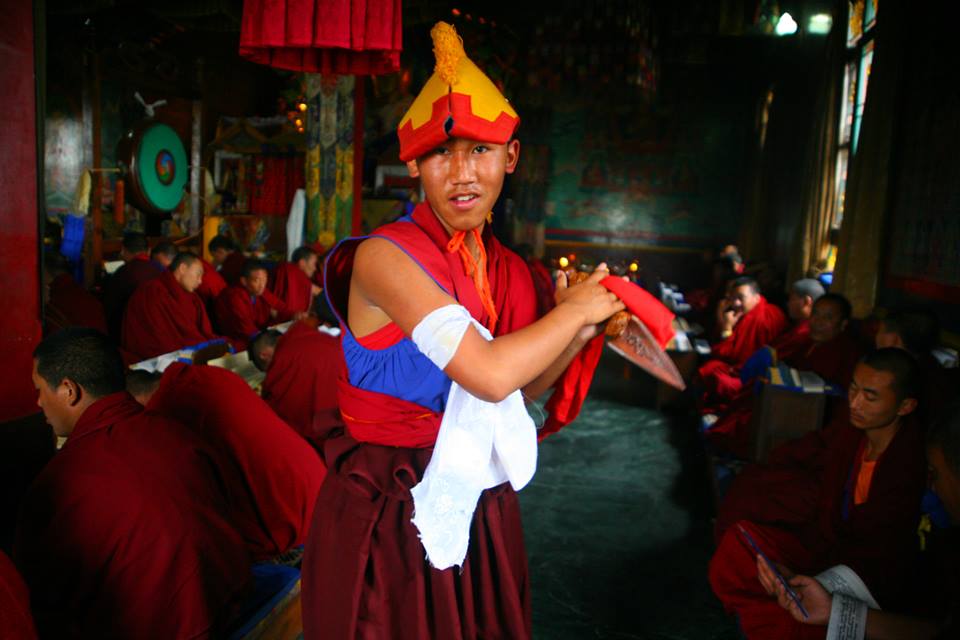
The retreat generally begins with the recounting of the origin, history, and purpose of the great mendrup retreat. Ritually, the retreat begins with a ransom ceremony in order to pacify and expel obstacles. Masked dances of the protectors are performed and a boundary is secured for the entire retreat space and all participants in order to keep out obstacles and to keep in the blessings and power generated during the retreat. After that, the ritual of Requesting Permission to Gather Soil addresses the earth spirits in order to request permission to gather soil in order to construct the necessary mandala palace for the deities.
Once the mandala is constructed and a large variety of wonderful offerings are placed, the enlightened deities and their retinue are invited to come and reside within the mandala palace. After this, no one other than those involved in the ritual are allowed to come near the mandala. Thus begins the period of the foundational practices of taking refuge, generating a mind of enlightenment, admitting wrongdoing and receiving purification, and so on. Once this foundation is complete, the main ritual of the mendrup ceremony begins by requesting and receiving consecration and blessings for the substances. During this time, the mantra of blessing nectar is continuously recited by both the ordained and the lay practitioners.
Mantra of Blessing Nectar for the Great Mendrup Ceremony: SO OM BA WA DÉ NA RA SA YA NA YU DRANG DUTSI SO THA
Masked dance of the enlightened protectors
The powdered mendrup is ingested daily, or as desired, either in water or by itself. The amount is usually a generous pinch, or about 1/4 teaspoon. It can also be placed in a locket and worn on the body. The traditional amulets worn by Yungdrung Bön followers contain mendrup as one of the required ingredients. It is also an ingredient in chortens, sa tsa, torma, and so on. When treated with faith and respect, the benefits of either ingesting or wearing mendrup are profound and immeasurable. When it is ingested or worn, the three poisons, the three kinds of illness [imbalances of wind, bile, or phlegm], and the three kinds of external disturbances [from the spirits above, the water spirits below, and the earth spirits in-between] are unable to become established and cause harm. When it is offered to the meditational deities or enlightened protectors, it purifies our sacred commitments with them and gives the ability for us to receive their blessings. In this life, it brings success to whatever goal or intention is wanted. It brings longevity, sharpens the intellect, brings wisdom, cures illness, and increases the life-force and prosperity. It is like a wish-fulfilling gem.
“Deities of the mandala will hold you within their compassion.
The poisons, illness, and malevolent forces will not be able to be established.
In this life, whatever is wanted will be accomplished.
And one will progress along the ground of the Great Seal.”
From the Result and Good Qualities of Accomplishing the Blazing Mountain of Blessed Nectar
His Holiness the 34th Menri Trizin ritually breaks the ground in order to obtain soil for the mandala of the deities
If you would like to make a donation to support this very auspicious occasion, you can do so through H.E. Menri Pönlop’s United States retreat center by following this link: http://kwling.org/ Follow the link and then click the donate button in the upper right of the page. You can make a notation that the donation is for the mendrup ceremony.
Schedule of Events at Menri Monastery
April 11th: Welcome and speeches, the ransom effigies are sent out in order to dispel obstacles
April 12th: The procession and ritual for Requesting Permission to Gather Soil, and preliminaries for the Nam Dak and Long Gyé empowerments
April 14th: His Holiness the 34th Menri Trizin will confer the actual Nam Dak and Long Gyé ritual cycle empowerments.
April 16th: His Holiness the 34th Menri Trizin will bestow the oral transmission of the peaceful, wrathful, and medicine texts to everyone in attendance. His Eminence Menri Pönlop Rinpoche will give a talk explaining the history and benefit of the great mendrup ceremony.
April 17th: There will be a showing of the sacred objects of Rayna Menling Nunnery and a tour of their facilities.
April 18th & 19th: There will be a two-day seminar of Zhangzhung and Tibetan studies.
April 20th: Teaching on the Four Wheels of Bön and teaching on the practice of tantra
April 21st: His Holiness the 34th Menri Trizin and His Eminence Menri Pönlop Rinpoche will lead the procession to visit the medical laboratory where the medicine containers will be opened and the ingredients will be mixed, purified, and ground into a fine powder.
April 22nd: There will be an exhibition of the ritual tools, costumes, and sacred items required for the practice of the Nine Ways of Bön.
April 25th: There will be a guided tour of the Mutri Tsépo Tibet-Zhangzhung Research Center.
April 26th: His Holiness the 34th Menri Trizin will bestow the empowerments of the Künzang A Sel [Clear AH of Künzang], Chi Pung Zhi Tro [Cycle of the Peaceful and Wrathful Deities], Ö Zer Khyilwa [Swirling Rays of Light], and the Trowo Tshé Drup [Trowo’s Accomplishment of Longevity].
April 27th: The monks, nuns, and lay disciples will form a procession carrying the medicines which will later be distributed to everyone present. The ceremony will conclude with an address by His Holiness the 34th Menri Trizin and His Eminence Pönlop Rinpoche.
Don’t want to miss a post? Scroll to the bottom and click “Follow this blog.”
This website has always been supported by the donations of the worldwide Yungdrung Bön community. Want to join the mandala of Nine Ways supporters? Follow this link https://ravencypresswood.com/donate/ It’s easy through Paypal and Zelle.