Blog Archives

Recitation of The Great Mantra at Samling

Ritual inside Samling Temple

From the 25th lunar day of the 9th month until the New Moon day of the 30th, Déden Samten Ling will conduct their annual practice and recitation of The Precious Lamp. These dates correspond with November 14th-20th, 2025 on the Western calendar. Déden Samten Ling, or simply Samling, is located in Dolpo, Nepal near the Tibet border and has been greatly beneficial to Yungdrung Bön especially in the preservation of its sacred scriptures. (For more about Samling, see previous article: https://ravencypresswood.com/2019/08/03/the-monastery-of-blissful-meditation-deden-samten-ling/

The Precious Lamp is the tantra of The Great Mantra of Yungdrung Bön, the mantra known as the MA TRI. Lord Tönpa Shenrap himself spoke about the benefits of the MA TRI mantra especially for sentient beings living during the dark era and encountering obstacles to practice and achievement.

“This Precious Lamp, the extracted heart essence of all of those who have gone to bliss, is the fundamental essence of the entire collection of sacred teachings. It is the quintessential essence of all Bön. It is the ultimate of all recitations. It is the highest of all views. It is the innermost essence of all meditations. It is the fulfillment of all activities. It is the most superior of all results. It is the heart elixir of the principal teachings. It is a sacred connection for sentient beings during a dark time. It is a key to the collection of sacred teachings. It is the lamp of the collection of oral transmissions. It is the refined gold of the quintessential instructions. It opens the door of intellectual confusion. It is a lamp that clears away the darkness of ignorance. So that sentient beings during the five hundred years-long time of darkness will not have to exert themselves in meditation or accomplishment, this mantra recitation is the practice advice. For those reasons, it is a sufficient recitation.”

“As for this Sufficient Recitation that is a Precious Lamp, for ordinary men and women at the time when their awareness becomes free from its physical container, if they merely remember this mantra when the four elements of their body disintegrate, that alone will keep them from descending to a lower rebirth and they will attain a blissful place of liberation. This mantra is a precious lamp of sufficient remembering.

If anyone who has generated the mind of enlightenment writes the mantra and places it above the doorway of a retreat place or a home, whoever enters that doorway will attain liberation. This mantra is a precious lamp of sufficient entering.”

Extract from The Thirty-two Benefits of the Sufficient Recitation that is a Precious Lamp
The MA TRI mantra displayed above the main door of a home.

The MA TRI mantra can be recited by anyone and is not required to be kept secret. It is one of Yungdrung Bön’s three essence mantras and is known as The Great Mantra. The complete mantra is OM MA TRI MU YÉ SA LÉ DU. There are many different melodies for its recitation. According to the text, when compassion is generated and its melody recited out loud, any sentient beings whose ear sense power perceives the mantric melody will attain liberation.

The profundity of the MA TRI mantra is inconceivable. It is said that if one wears it on the body, physical obscurations will be purified. If one recites it with speech, verbal obscurations will be purified. If one thinks of it in the mind, mental obscurations will be purified. If one recites the syllables continuously, there is no doubt that one will be reborn in a blissful realm immediately after death.

“The benefits of reciting this mantra just once are greater than filling all the worlds with the five precious substances and making offerings to the buddhas. All the aims of this life and the next will be accomplished.”

Commentary on the MA TRI mantra by Shardza Tashi Gyaltsen
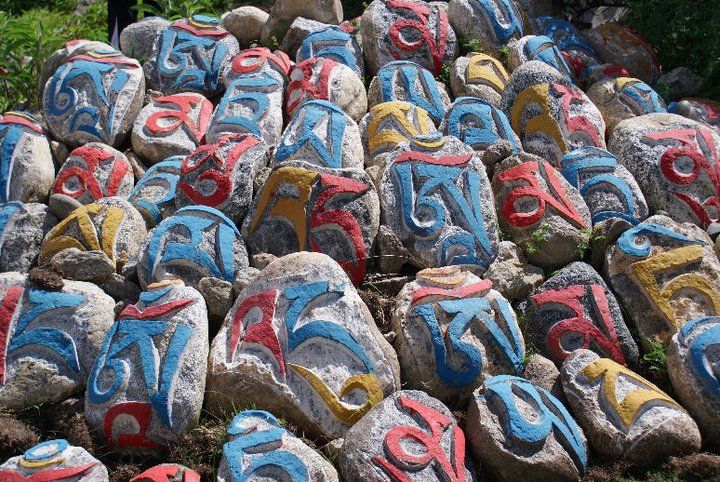
Each of the syllables of the MA TRI have a specific color that corresponds with the deity that manifest from their essence

Although the power of a mantra is not limited to what can be expressed through language and therefore cannot be defined through concepts, it is possible to make associations of the syllables with their manifested expression to give some idea of their unique significance. For the MA TRI mantra, the associations are:

  • OM has the nature of the state of Tönpa Shenrap Miwo Künlé Nampar Gyalwa who is principally related to a skillful method of compassionately taming migrating beings.
  • MA has the essence of Tükjé Jamma, the source of everything, the vast expanse of the mother’s womb, and the basis for omniscience. It represents the characteristics of the great mother Tukjé Jamma who is principally associated with wisdom.
  • TRI is the seed syllable of Mucho Demdruk who protects from heat and cold through great love. He is the Subduing Shen of the hell realms. Hatred dissolves into the vast expanse of love.
  • MU is the seed syllable of Sangwa Ngangring who satisfies hunger and thirst through great generosity. He is the Subduing Shen of the hungry ghosts. Desire and attachment dissolve into the vast expanse of generosity.
  • is the seed syllable of Tisang Rangzhi who removes stupidity and muteness with great wisdom. He is the Subduing Shen of the animals. Mental dullness dissolves into the vast expanse of wisdom.
  • SA is the seed syllable of Drajin Pungpa who tames jealousy through great openness. He is the Subduing Shen of humans. Jealousy dissolves into the vast expanse of great openness.
  • is the seed syllable of Chegyal Parti who destroys pride through great peacefulness. He is the Subduing Shen of the demi-gods. Pride dissolves into the vast expanse of peace.
  • DU is the seed syllable of Yeshen Tsukpu who tames laziness through great zeal. He is the Subduing Shen of the gods. Laziness dissolves into the vast expanse of diligence.
MA TRI prayer flags

Prayer flags of the MA TRI mantra are currently available for purchase from the Nine Ways Shop. Their small size is perfect for hanging above doorways. Visit the Nine Ways Shop by clicking the link at the top of this page. Items sold support the construction of a memorial chorten for Yangtön Lama Tashi Gyaltsen. [Please note that items only ship within the continental United States.]

Raven Cypress Wood ©All Rights Reserved. No content, in part or in whole, is allowed to be used without direct permission from the author.

Did you enjoy this content? This article is made possible by generous donors who want content like this to continue to be available. Don’t want to miss a post? Scroll to the bottom and click “Follow this blog.”

Join the mandala of Nine Ways supporters by donating through one of the services listed below.

Developing Knowledge & Wisdom through the Power of the Lion of Speech

Mawé Sengé, Lion of Speech, with a sword of knowledge and a scripture.

After the Tibetan New Year celebrations, students at Menri Monastery enter into an intensive retreat to cultivate the qualities of the wisdom deity Mawé Sengé, Lion of Speech. This retreat begins on the 24th lunar day of the 1st month and concludes on the 30th lunar day. In 2025, these dates are March 23rd – March 29th on the Western calendar. The purpose of this retreat is to receive the blessings and empowerment of the wisdom deity Mawé Sengé in order to develop and sharpen the students’ intellect to support their upcoming studies in the new school year. The practice of Mawé Sengé is performed many times each day and the mantra of the deity is recited as much as possible throughout the retreat with a minimum accumulation of one hundred thousand mantra recitations.

Mawé Sengé is the manifestation of the Dzok ku, the enlightened state that spontaneously expresses perfected qualities. If practiced regularly as a yidam deity, he clears away the darkness of confusion, develops the intellect, and gives a quick and steadfast memory without forgetfulness. If his practice is properly applied and accomplished, there are seven specific signs that arise. These are called The Seven Signs of Attaining Wisdom that Blazes Like Fire. These seven signs are:

  1. The sign of having removed the darkness of lack of knowledge from the intellect. Specifically, this refers to removing a weak or unclear intellectual understanding. 
  2. The sign of having the eye of wisdom. This is the attainment of clairvoyance, expansive knowledge and wisdom.
  3. The sign of being like a lion of glorious poetry. This refers to the ability to write expert discourses, specifically scholastic poems and compositions.
  4. The sign of the sun of superior knowledge arising. This refers to the capability of having clear knowledge, without any confusion, regarding the qualities of any knowable object. 
  5. The sign of attaining the recollection of intelligence that is never forgotten. This refers to a steadfast capability of remembering what has been learned without forgetfulness.
  6. The sign of being like a thunderbolt when debating. This refers to the capability to brilliantly overcome all others, without defeat or fear, when debating any subject whatsoever.
  7. The sign of the intellectual memory being fast like lightening. This refers to an extraordinary ability of having a clear and quick memory.

“I go for refuge to the wisdom deity for the intellect. I generate the supreme mind of enlightenment for the benefit of vigorous training in the highest wisdom. Having compassionately purified all karmic obscurations without exception, please bestow the attainments of an increased intellect, useful knowledge, and a divine voice!”  

— From The Short Practice of Mawé Sengé. Tibetan translation: Raven Cypress Wood

Mawé Sengé holding a sword and a butter lamp

In the Yungdrung Bön tradition, there are two principal forms of the wisdom deity Mawé Sengé. Both of these forms share most characteristics. However, one form holds a sword and a scripture as the hand objects. The other form holds a sword and a butter lamp. This second principal form of Mawé Sengé is according to the prayer, An Offering of Praise for the Supreme Wisdom Deity Sherab Mawé Sengé, A Garland of Utpala Flowers composed by the highly revered Nyammé Sherab Gyaltsen Rinpoche.

“With a sword of wisdom held in your right hand, you cut the root of deluded thoughts and self-grasping.

With a butter lamp of clarity held in your left hand, you dispel the dark intellect and ignorance of migrating beings.

In the space to your right and left, the sun and moon blaze with the splendor of the inseparability of method and knowledge.”

— Extract from An Offering of Praise for the Supreme Wisdom Deity Sherab Mawé Sengé, A Garland of Utpala Flowers

Tibetan translations by Raven Cypress Wood

Raven Cypress Wood ©All Rights Reserved. No content, in part or in whole, is allowed to be used without direct permission from the author.


Did you enjoy this content? This article is made possible by generous donors who want content like this to continue to be available. Join the mandala of Nine Ways supporters by following this link: https://ravencypresswood.com/donate/


Don’t want to miss a post? Scroll to the bottom and click “Follow this blog.”

The 84,000 Doors of Bön at Your Fingertips

mala

“The mala represents the destined connection with the Enlightened Beings.  The mala string represents the 84,000 doors of Bön.  The head bead represents the principal teacher.  The counting beads represent the Six Subduing Shen, the six enlightened Shen who tame the six realms of cyclic existence.”  ~from The Advice of Lishu Taring

The mala is called treng wa in Tibetan.  It consists of one hundred eight counting beads and one larger main bead, often referred to as the ‘head bead’ or the ‘lama bead’.  Malas can have spacer beads which are not counted during recitation of a mantra but are used for decorative purposes or to lengthen the mala and enable it to fit onto an individual’s wrist.  Various kinds of counters are often added to the mala so that the practitioner can keep count of the mantra recitations. Malas can be made from various materials.  Traditionally, these materials were symbolic because of their energetic qualities.  For example, tantric practitioners would often use malas made of bone to represent impermanence.

Before a mala is used, the practitioner will have it consecrated by a lama.  This blesses it and also removes any contamination that the materials might carry with them that could be an obstacle to obtaining the benefit of the recitations.  Although there are one hundred eight beads, a single round of recitations is counted as one hundred.  In this way, if any beads have accidentally been skipped during the recitation, they are accounted for with the ‘extra’ eight beads.  Many practices require a commitment to recite a minimum of one hundred thousand repetitions of a mantra.  Therefore, these ‘extra’ beads ensure that the commitment has been fulfilled.  In general, during recitation, the practitioner is not allowed to eat, drink, talk, sneeze, spit or cough. These activities expel or diminish the specific power of the mantra that is being cultivated.  Once the session of mantra recitation is complete, the mala is rubbed gently between the hands and blown upon by the practitioner.  In this way, the mala becomes further empowered and blessed by the mantra.

The mala is a sacred object and should not be worn as jewelry. It should be kept clean and not be handled by others.  By wearing the mala on the wrist or carrying it in a pocket on the body, it acts as a form of protection.  The mala is also sometimes used for divination or healing purposes.  Lamas will sometimes give away their mala intact, or one bead at a time.  Because of the power of the lama’s practice and recitation, this gift is a great blessing.

Raven Cypress Wood© All Rights Reserved

Sounds of Space

Tibetan ltrs assoc with space element     Each of the letters of the Tibetan alphabet are associated with one of the five elements according to their inherent sound.  The letters associated with the space element are AH, KA, KHA, GA NGA, and HA.

Blessing the Environment

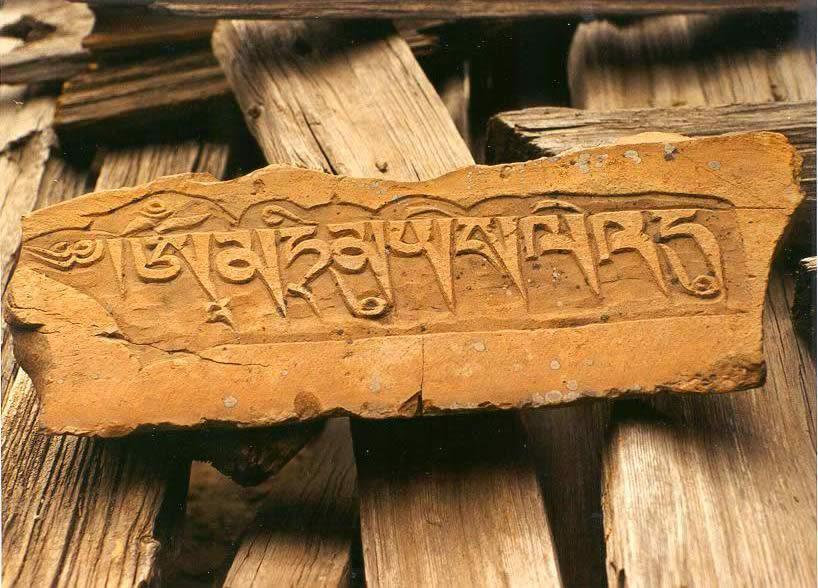
Matri mantra in stone with color

The Great Mantra of Yungdrung Bon, OM MA TRI MU YE SA LE DU, blesses the surrounding environment