Blog Archives

Annual Reading of the Enlightened Teachings of Lord Buddha Tönpa Shenrap

Nuns of Rayna Menling reading from the teachings of Buddha Tönpa Shenrap

Each year at Pal Shenten Menri Monastery and Rayna Menling Nunnery on the 14th and 15th lunar days of the 4th month, the enlightened teachings of Lord Buddha Tönpa Shenrap Miwoché are read out loud. In 2025, these dates coincide with June 10th and 11th on the Western calendar. The sacred volumes containing these teachings are carried by both the ordained and laypeople as they circumambulate the temple. As a sign of respect for the sacredness of these texts, they are carried above the waist. Most often, they are carried on the shoulder. After bringing them into the temples, offerings such as incense are presented, and the text are distributed to the ordained for two full days of reading. Reading the scriptures aloud is considered one of the thirteen activities for a meaningful human life. (See previous article: https://ravencypresswood.com/2020/03/21/the-thirteen-yungdrung-bon-activities-for-a-meaningful-human-life/) For those inspired to read the words of Buddha Tönpa Shenrap on these days, The Beneficial Mantric Praise of Künsal Jamma Chenmo, The Jamma Ngak Tö, is considered a root text for the practice of Sherap Jamma that was spoken by the Buddha himself. Through the verses of praise for each of the syllables of Jamma’s root mantra, the profundity of the innumerable manifestations of Jamma is revealed. The teaching and transmission for this text has been widely shared in both the East and West.

“The mantra of the twenty-one victors, the praise of the Victorious Jamma of Bön, was spoken by the Victor Tönpa Shenrap. These twenty-one verses are, without exception, beyond cyclic existence and a completely pure practice. By reciting out loud the twenty-one praises, one will obtain immeasurable benefits. Praise to Tönpa Shenrap for revealing these twenty-one praises of the root mantra!”

Extract from The Beneficial Mantric Praise of Künsal Jamma Chenmo
His Holiness the 34th Menri Trizen, His Eminence Menri Pönlop Rinpoche, and other monks of Menri Monastery carry texts containing the words of Buddha Tönpa Shenrap.

The canon of sacred Yungdrung Bön texts is divided into two categories. The first category of texts contains the teachings of the primordial enlightened ones and Lord Buddha Tönpa Shenrap. This category is known as Ka [Tibetan: bka’] meaning “enlightened words or speech.” These texts are further divided into four primary categories: (1) Dō [Tibetan: mdo], Sutra, (2) Bum [Tibetan: ‘bum], The Hundred Thousand, (3) Gyü [Tibetan: rgyud], Tantra, and (4) Dzö [Tibetan: mdzod] The Treasury. In some catalogues, there can also be a fifth category of miscellaneous texts. Although each Yungdrung Bön temple in Tibet had a significant collection of Ka scriptures, the collections were not necessarily complete. This was especially due to repeated persecution throughout history of the Yungdrung Bön tradition which necessitated the hiding of texts. It is thought that only one complete collection survived. According to a catalogue of the Ka done by the 23rd abbot of Menri there are a total of 175 volumes. This number can vary according to various collections due to the availability of texts that could be copied, whether only main titles were counted as a volume, and so on. Regardless, the Sutra section contains texts such as the hagiography of Buddha Tönpa Shenrap, The Ritual Practice of the Medicine Buddha, The Root Scripture for Jamma, the four volumes of medical texts, and so on. The Hundred Thousand section contains the sixteen volumes of the Khams Gyé, The Unsurpassed Scripture Regarding the Eight Realms, the Yum Dō, The Heart Sutra of the Mother of the Great Vehicle, and so on. The Tantra section includes the Buddha’s teachings of the Mother Tantras, the Father Tantras, Phurba, Walsé, and so on. The Treasury section includes the teachings of dzogchen such as The Aural Transmission of Zhang Zhung.

“Gyajin, a ruler of the gods, rose from his seat and, having removed his upper robe from one of his shoulders, he set his right knee upon the ground. Having placed his hands together, he made a request of The Teacher with these words: “Free from the fault of wrongdoing, you have perfected every good quality. You are the source from which arises all happiness and exalted qualities. Good omniscient Shenrap, what should one do to practice or make use of the Essence of the Mother of the Great Vehicle?”

In response to that, Shenrap bestowed his teaching. 

“Gyajin, ruler of the gods, and all you yungdrung sempa, when practicing or making use of the Essence of the Mother of the Great Vehicle, all phenomena that arise from worldly existence, that arise as precious ornaments, that arise as an appearance, that arise from emptiness, that arise from individual clarity, that arise from self-awareness, that arise from the changeless and indestructible vast expanse, or that arise from equanimity; are neither appearance nor emptiness, neither existent nor nonexistent, neither eternal nor nothingness, neither born nor negated. Why is that? All of those, in every way, are unobjectifiable. Even their self-nature is unobjectifiable. Therefore, they are primordially without a source and without a birth. They have no beginning. Abiding within the equanimity of no beginning is the unfabricated, perfected, single sphere.

Extract from The Heart Sutra of the Mother of the Great Vehicle to be published in the forthcoming A Mala of Blazing, Wish-fulfilling Jewels: A Collection of Daily Practices of the Yungdrung Bön Religious Tradition by Raven Cypress Wood
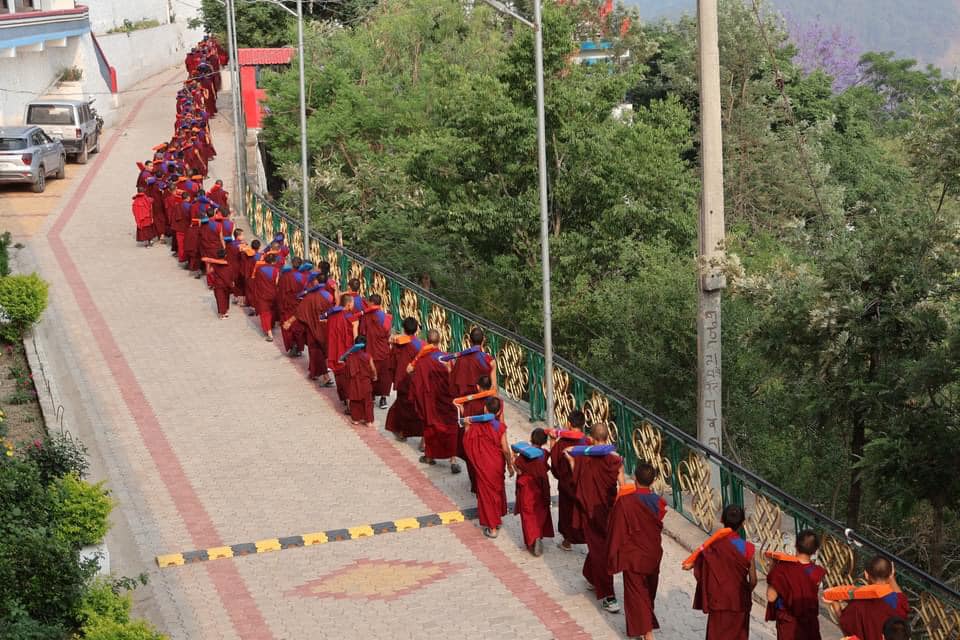
Monks and nuns of Menri Monastery circumambulating with the scriptures of the Ka.

The second category of canonical texts is known as the Ka Ten [Tibetan: bka’ brten], Relying upon the Words. The Bön canon is referred to within Bön texts as the Ka and the Ka Ten. (This differs from the Buddhist canon which is referred to as the Kangyur and the Tengyur.) The Ka Ten includes commentaries, practices, rituals, and so on that rely upon the scriptures of the Ka for the root text. In order for a text to be included in the Ka Ten, it must undergo a rigorous and methodical analysis. There are over 300 volumes included within the Ka Ten. Some catalogues do not include texts after the 14th century which are thought to be mainly texts of the New Bön tradition. Other catalogues do include these texts as well as the collective writings of other Bön sages such as Shardza Tashi Gyaltsen. Additionally, many texts are incredibly rare and are guarded from outsiders. Therefore, few if any copies of these texts exist. Some texts are considered valid to be included in the Ka Ten by some, while being considered invalid and thus excluded by others. Titles can be included within unrelated volumes or counted individually, and so on. Even so, it is generally accepted that there are over 300 volumes of Ka Ten scriptures. These volumes include commentaries and practices based upon scriptures of the Ka such as The Practice Manual of the Aural Transmission of Zhang Zhung by Dru Gyalwa Yungdrung, scriptures of philosophy and logic, biographies, historical accounts, compositions of sacred songs, poetry, and advice for disciples, collections of liturgical texts, and so on.

I, of inferior intelligence, but for the benefit of beings and for the sake of explaining at least part of the meaning, will explain the Sky Ladder to Freedom, an Abridged Commentary of the Meaning of the Heart’s Blood of Bön, the Mantric Praise of Jamma. If one were able to explain the commentary on the merits of Jamma in great detail including the characteristics of each of the deities, it would amount to twenty-one great chapters in many volumes. ”  

Extract from A Sky-Ladder to Freedom: An Abridged Commentary Regarding the Meaning of the Words of the Mantric Praise of Jamma, the Deity Who Protects From All Things composed by the great 23rd abbot of Menri Monastery His Holiness Nyima Tenzin Rinpoche
Traditionally wrapped and labeled Yungdrung Bön scriptures.

Tibetan translations by Raven Cypress Wood

Raven Cypress Wood ©All Rights Reserved. No content, in part or in whole, is allowed to be used without direct permission from the author.


This article is made possible by generous donors who want content like this to continue to be available. Want to join the mandala of Nine Ways supporters? Follow this link https://ravencypresswood.com/donate/


Don’t want to miss a post? Scroll to the bottom and click “Follow this blog.”

2025 Tibetan Astrology: The Year of the Wood Snake

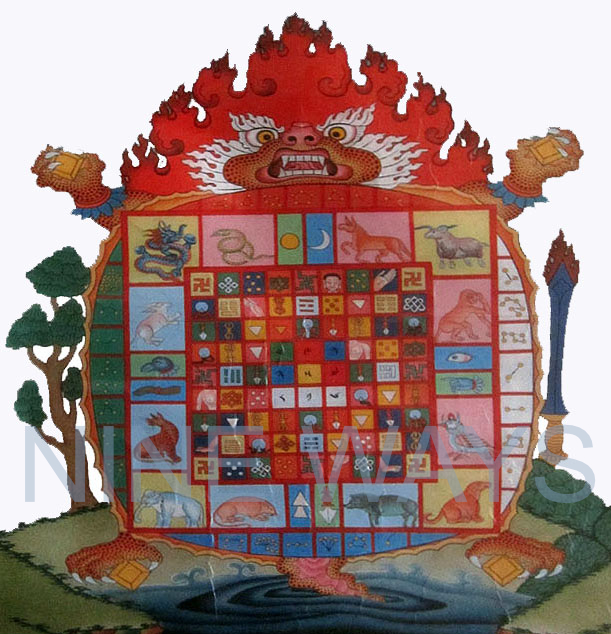
The twelve animals of Tibetan astrology according to the Yungdrung Bön texts are the Rat, Elephant, Tiger, Rabbit, Dragon, Horse, Snake, Sheep, Garuda, Monkey, Dog and Pig.  Each animal has a specific element associated with its life-force and a position direction determined by that element. Each year one of these twelve animals is associated with one of the five elements of: metal, wood, fire, water, or earth. In other contexts, metal is referred to as space, and wood is referred to as wind or air. It takes sixty years for all twelve animals to be associated with each of the five elements. When this happens, it is considered one complete cycle that repeats again and again.

The Royal Tibetan New Year begins on the first lunar day of the first lunar month. February 28, 2025 begins the Royal Tibetan New Year and the Year of the Wood Snake. Therefore, people born on or after February 28th will be a Wood Snake and will have an emphasis of the specific qualities associated with the Snake.

The 1st lunar day of the 12th lunar month is celebrated as New Year’s Day according to the custom of the ancient land of Zhang Zhung that included a vast geographical area including Tibet, parts of Nepal, and the area previously known as Persia. This is still celebrated in areas throughout the Himalayas as Sonam New Year, Himalayan New Year, or Peasants New Year. In 2025, this date coincides with January 30th. Additionally, the Chinese New Year in 2025 occurs on January 29th. Sometimes the Tibetan New Year and Chinese New Year fall on the same date, and sometimes not. This is due to a difference of how the years are calculated within the 60 year cycle.

People born during the year of the Snake will have an emphasis on the specific qualities associated with Snake. The element which governs the life-force of the Snake is Fire. So, if a Snake person wanted to strengthen their life-force, they would focus upon strengthening the element of Fire internally and externally. The positive direction is South. Facing this direction while meditating, doing healing practices, or just relaxing the mind is beneficial.

In general, a Snake person can see the depth of things and spends a lot of time thinking and processing. They can recognize the underlying motivation of others even if they do not recognize it within themselves and might use this to their advantage at times. A Snake person enjoys luxury and loves to be in elegant and beautiful surroundings. They can have an intolerance for hardship or discomfort. Generally magnetic and charming, they are socially graceful and often surrounded by admirers. However, they can become vengeful when angered. Thus, they benefit from the practicing tolerance and openness.

The Snake’s soul day is Tuesday and its life-force day is Friday. These are the best days for beginning new projects and activities that are meant to increase or develop something. The obstacle day is Wednesday. This day is best for purification and letting things go. It is not a favorable day for beginning new activities.

Snake years include: 1941, 1953, 1965, 1977, 1989, 2001, & 2013

If you were born during a previous year of the Snake, this year as well as other Snake years are considered a time of vulnerability to obstacles. This same astrological principal applies to the other eleven animal signs during their associated year. Therefore, it is recommended to engage in practices that support vitality, good fortune and spiritual merit such as hanging prayer flags, having a soul and life-force retrieval ritual performed, restoring any deterioration or violation of one’s spiritual commitments or any damaged relationship with one’s spiritual brothers and sisters, and/or performing prayers and rituals to remove obstacles. In general, making an effort to engage more with virtuous activities of body, speech and mind and committing to engage less with non-virtuous activities is supportive. According to the words of Buddha Tönpa Shenrap Miwoché, the practice of developing sincere, unbiased, and unlimited compassion is the greatest of all protections.

A common prayer within the Yungdrung Bön tradition that is used to remove obstacles is the Bar Che Lam Sel, The Spontaneous Wish-fulfillment of Removing Obstacles from the Path. The English, Spanish, and Portuguese translations of this prayer are offered free for personal use on the Nine Ways Publications page. Click on the Publications tab above and scroll down to find the download link for the prayer.

Raven Cypress Wood© All Rights Reserved

This article is made possible by generous donors who want content like this to continue to be available. Want to join the mandala of Nine Ways supporters? Follow this link https://ravencypresswood.com/donate/

Don’t want to miss a post? Scroll to the bottom and click “Follow this blog.”

2024: Year of the Male Wood Dragon

The Tibetan lunar new year of 2024 corresponds with February 10th on the Western calendar and is the start of the Year of the Male Wood Dragon. The Year of the Male Wood Dragon continues until February 27, 2025.

According to Tibetan astrology, there is a twelve year cycle with each year being characterized by a specific animal and associated with one of the five elements. A complete cycle of the twelve animals in association with each of the five elements takes sixty years. These twelve animals according to Yungdrung Bön astrological texts are the Rat, Elephant, Tiger, Rabbit, Dragon, Horse, Snake, Sheep, Garuda, Monkey, Dog, and Pig.  Each animal is associated with a specific element for its life-force as well as a specific direction which is determined by the life-force element.  Not only are these twelve animals associated with a particular year, they are also associated with particular months, days and hours.

For those born during a previous year of the Dragon, this year as well as all other Dragon years are considered a time when there is a great possibility of obstacles, illness, financial troubles, accidents, or harm to the reputation through scandal or gossip. This same astrological principal applies for all of the other eleven animal signs during their associated years. Therefore, it is recommended to be proactive in order to dispel or avert the obstacles. It is advised that Dragon people engage in practices that support vitality, good fortune, and spiritual merit such as hanging prayer flags, saving or protecting the life of other living beings, making sa tsa, repairing any deterioration or violation of one’s spiritual commitments or any damaged relationship with one’s spiritual brothers and sisters, and/or performing prayers and rituals to remove obstacles. Reciting the mantras of Duk Kar, Jamma, or the Medicine Buddha as well as invoking and making offerings to the protectors is of great benefit in providing protection and blessing.

Duk Kar, the White Umbrella Goddess of the Yungdrung Bön

Those people born during a Dog year also have the possibility of a significant obstacle during the Wood Dragon year. Legal difficulties, problems with business competitors, or other adversarial relationships could arise. Therefore, they are also advised to recite the mantras of Duk Kar, Jamma, or the Medicine Buddha and/or to repair roads or paths, make sa tsa, and perform rituals to reverse misfortune.

Those born under the sign of the Ox or the Sheep may experience accidents or illness. Reciting the Medicine Buddha mantra, caring for the physical health, being mindful to especially avoid contagious illness during the Wood Dragon year, and/or performing a ritual of ransom to reinforce the life force are all methods to avert the potential obstacle. To a much lesser degree, those born under the sign of the Mouse and the Monkey might also encounter obstacles, illness, or problems during the Wood Dragon year. 

In general, making an effort to engage more with virtuous activities of body, speech and mind and endeavoring to engage less with non-virtuous activities increases merit, removes obstacles, and supports all the forces of our vitality, health, and good fortune. According to the words of Buddha Tönpa Shenrap Miwoché, the practice of developing sincere, unbiased and unlimited compassion is the greatest of all protections.

A common prayer within the Yungdrung Bön tradition that is used to remove obstacles is the Bar Che Lam Sel, The Spontaneous Wish-fulfillment of Removing Obstacles from the Path. The English, Spanish and Portuguese translations of this prayer are offered free for the personal use of any sincere practitioner. Click on the Publications tab above and scroll down to the download links for the prayer.

Thangkha depiction of Yungdrung Bön astrological symbols. Private collection: Raven Cypress Wood

People born during Dragon years will have an emphasis of the specific qualities associated with the Dragon. The element which governs the life-force of the Dragon is Earth and its direction is Southeast. Therefore, if a Dragon person wanted to strengthen their life-force, they would focus upon strengthening the element of Earth internally and externally. The positive direction is Southeast. Facing this direction while meditating, doing healing rituals, or just relaxing and taking deep breaths is beneficial for those with the Dragon as their natal animal..

In general, the Dragon is flamboyant and impulsive.  It has a fiery disposition whose energy and drive seem endless. Convinced of its superiority of destiny and vision, it wants to live life to its fullest and is often frustrated and impatient with the perceived limitations of others and circumstances. The Dragon always wants more. It has lots of charisma, wit, and enthusiasm that is admired by others and are thus often placed in leadership roles. The Dragon can also be unrealistic in its demands and can become angry to the point of deeply wounding others due to its lack of tact.  However, the Dragon easily forgives, and is sincere and generous in its relationships. The Dragon‘s intentions are clear since it is difficult for it to conceal whatever it is feeling.

The Dragon’s soul day is Sunday and its life-force day is Wednesday. These are the best days for beginning new projects and activities. The obstacle day is Thursday.  This day is best for cleansing and letting things go and for not taking risks or speaking mindlessly. It is not a favorable day for beginning new things such as starting a fundraising effort, signing contracts, groundbreaking for construction, and so on.

Dragon years include: 1940, 1952, 1964, 1976, 1988, 2000, & 2012

Don’t want to miss a post? Scroll to the bottom and click “Follow this blog.”

Want to join the mandala of Nine Ways supporters? Follow this link https://ravencypresswood.com/donate/  It’s easy through Paypal and Zelle.

Raven Cypress Wood ©All Rights Reserved. No content, in part or in whole, is allowed to be used without direct permission from the author.

Yungdrung Bön Auspicious Days for Spiritual Practice

The Supreme Shen Buddha Tönpa Shenrap Miwoché.

According to the Yungdrung Bön religious tradition, each month there are auspicious days which are determined by the teaching activities of the Supreme Shen Buddha Tönpa Shenrap. These are lunar dates according to the Tibetan lunar calendar.

30th Day of the Month, New Moon: On this day, Buddha Tönpa Shenrap taught the beings in the formless realm. This is a good day to purify wrong views. The power of any virtuous activity or meditation performed on this day is doubled. Also, because of its significance in the lunar cycle, it is one of the four monthly auspicious days to perform prayers and virtuous activities, and for those with genyen or monastic vows to avoid eating meat.

1st Day of the Month: On this day, Buddha Tönpa Shenrap taught the space gods in the highest and purest of places in the formless realm. This is a good day to purify greed and attachment and engage in acts of generosity.

8th Day of the Month: On this day, Buddha Tönpa Shenrap taught the clear-light gods. This is a good day to purify broken vows and to recite one of the three essence mantras of the Yungdrung Bön tradition. Also, because of its significance in the lunar cycle, it is one of the four monthly auspicious days to perform prayers and virtuous activities, and for those with genyen or monastic vows to avoid eating meat.

14th Day of the Month: On this day, Buddha Tönpa Shenrap taught the Gaden gods of the form realm. This is a good day to purify sexual misconduct and desire.

15th Day of the Month: On this day, Buddha Tönpa Shenrap taught the gods of the desire realm atop Mt. Meru. This is a good day to purify the killing of someone important such as a lama, a family member or another practitioner in either this or a previous life. Also, because of its significance in the lunar cycle, it is one of the four monthly auspicious days to perform prayers and virtuous activities, and for those with genyen or monastic vows to avoid eating meat.

16th Day of the Month: On this day, Buddha Tönpa Shenrap taught the four great gods of the desire realm and the four great kings. This is a good day to purify disagreements or misunderstandings with parents, a lama, or another practitioner from either this or a previous life.

19th Day of the Month: On this day, Buddha Tönpa Shenrap taught the Tsang Ri gods of the form realm. This is a good day to purify any accidental killing.

22nd Day of the Month: On this day, Buddha Tönpa Shenrap taught the demi-gods of the desire realm who reside on the sides of Mt. Meru. This is a good day to purify the killing of a human being or lying to the lama. Also, because of its significance in the lunar cycle, it is one of the four monthly auspicious days to perform prayers and virtuous activities, and for those with genyen or monastic vows to avoid eating meat.

29th Day of the Month: On this day, Buddha Tönpa Shenrap taught the lu [Sanskrit: naga] of the desire realm. This is a good day to purify stealing during this or a previous life.

The practice of the admission of wrongdoing and purification is a powerful and effective method to purify non-virtuous activities of body, speech and mind and repair our sacred vows and commitments. The efficacy of the practice relies upon the so-called “four powers.” These are 1) the power of witness, 2) the power of openly admitting without reservation the actions of wrongdoing and non-virtue, 3) the power of heartfelt remorse, and 4) the power of vowing to not repeat the negative activities.

“The infallible fruit of both good and bad actions is certain. May I be watchful to accept or reject situations! Having depended upon the practice of admitting wrongdoing by means of the four powers, may all karmic potentialities and defilements be purified!”

— From The Ocean of Instructions Regarding the A Tri Teachings by Shardza Tashi Gyaltsen Rinpoche

For the power of witness, the practitioner goes before a sacred object of refuge such as a shrine, a real or visualized image of an enlightened being, or a chorten. Then, the practitioner connects with the actual presence of the enlightened beings in the sky before them. For the second power which is the admission of wrongdoing, the practitioner brings into their awareness all of the non-virtuous activities of body, speech and mind that have been committed in this life, as well as any unremembered activities from this or previous lives. This includes activities of direct or indirect involvement, as well as encouraging or celebrating the non-virtuous activities of others. For the third power, the practitioner generates an intense remorse for all of these actions. For the fourth power, the practitioner makes a firm commitment to not repeat these non-virtuous activities in the future and to instead engage in activities of virtue. In this way, the negative actions and their consequences are purified. At the conclusion of the practice, the practitioner imagines and feels the blessings of the enlightened beings completely purifying them in the form of pure, wisdom light.

“I openly admit to the gathering of buddhas all non-virtue that has arisen from the five poisons from beginning-less time until this very moment. I generate intense remorse for these actions of non-virtue and immorality that I have committed in the past.  I vow that from now on, I will not commit those acts again.  Instead, I will delight in accumulating virtue.” 

— From Homage to the Lord Tönpa Shenrap Miwo

All translations from the Tibetan by Raven Cypress Wood ©All Rights Reserved. No content, in part or in whole, is allowed to be used without direct permission from the author.

Don’t want to miss a post? Scroll to the bottom and click “Follow this blog.”
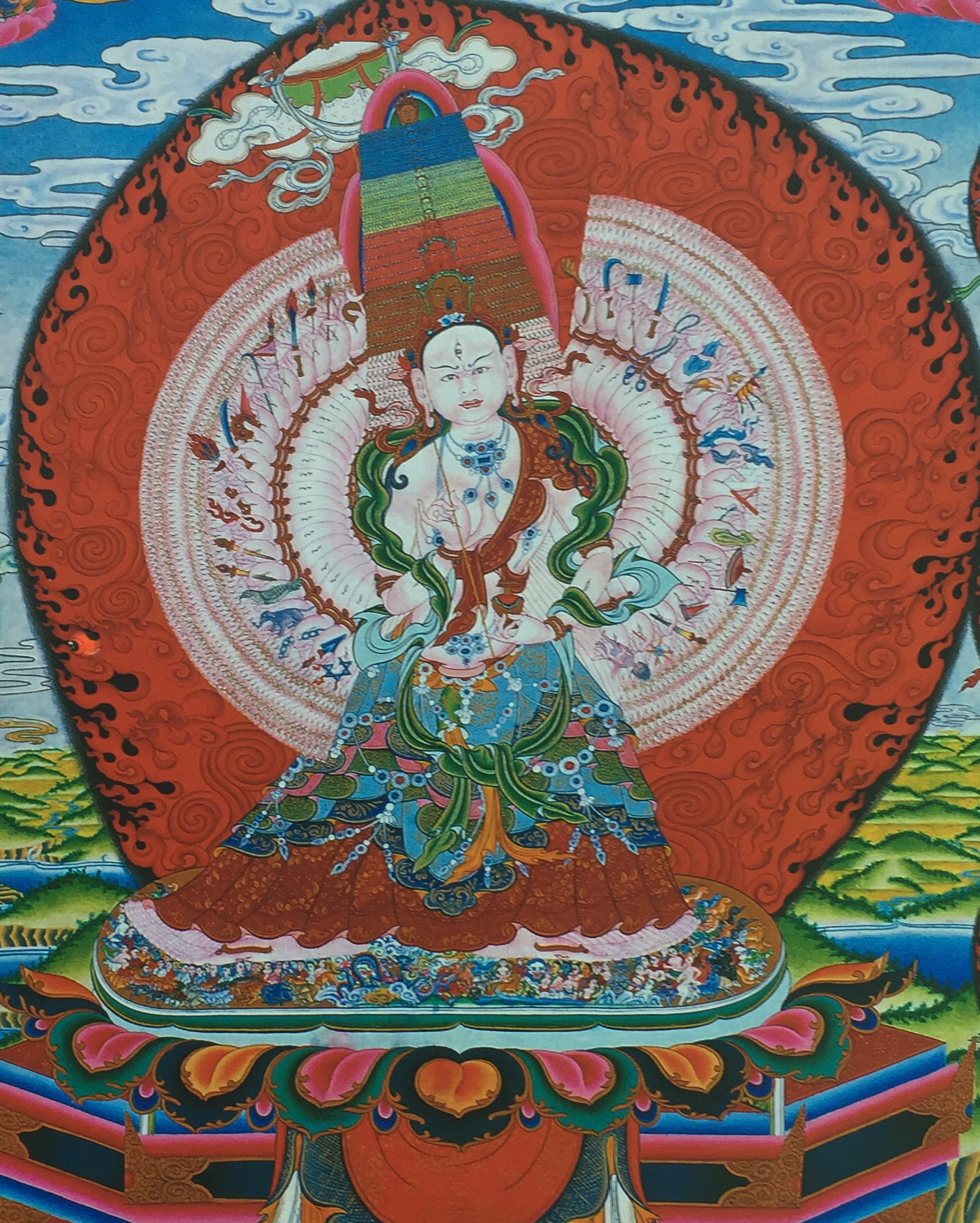
The Twelve Animals of Tibetan Astrology: The Pig

In Tibetan astrology, there is a twelve-year cycle.  Each of these years is characterized by a different animal and associated with one of the five elements.  Therefore, a full cycle of the twelve animals being associated with each of the five elements is sixty years.  The twelve animals according to the Yungdrung Bön texts are the Rat, Elephant, Tiger, Rabbit, Dragon, Horse, Snake, Sheep, Garuda, Monkey, Dog and Pig.  Each animal is associated with a specific element for its life-force as well as a specific direction which is determined by the life-force element.  Not only are these twelve animals associated with specific years, they are also associated with specific months, days and hours.

Feb 05, 2019 begins the Tibetan New Year, or Losar, and the year of the Earth Pig.  People born during a Pig year will have an emphasis of the specific qualities associated with the symbol of the Pig.  (These years correspond with the Tibetan lunar calendar and begin sometime between late January and early April.)   According to Tibetan astrology, the element which governs the life-force of the Pig is Water and its positive direction is North.  So, if a Pig person wanted to strengthen their life-force, they would focus upon strengthening the element of Water internally and externally.  Because the positive direction is North, facing this direction while meditating, engaging in healing practices or just relaxing and taking deep breaths is beneficial.

In general as an astrological symbol, the Pig person is honest and uncomplicated. A Pig person is straight-forward, but not in an aggressive way. They are often seen as “good, down-to-earth” people by others. This is because the Pig person does not harbor hidden agendas. They can be trusted and relied upon. In general, they have many friends to whom they are generous and jovial, and are always willing to be helpful. However, the Pig person can have difficulty setting boundaries and saying ‘no.’ And because they tend to be naive, it is possible for them to be taken advantage of by others. Although the Pig person is generous, they also enjoy having money for themselves and living in leisure and comfort. For this reason, the pursuit of pleasure and entertainment can become imbalanced and lead to excess.

The Pig’s soul day is Wednesday and its life-force day is Tuesday.  These are the best days for beginning new projects and activities that are meant to increase or develop something.  The obstacle day is Saturday.  This day is best for purification and letting things go.  It is not a favorable day for beginning new activities or risky activities.

Pig years include: 1935, 1947, 1959, 1971, 1983, 1995, 2007, and 2019

If you were born during a previous year of the Pig, this year as well as other Pig years are considered a time of vulnerability to obstacles. This same astrological principal applies for all of the other eleven animal signs during their associated year. Therefore, it is recommended to engage in practices that support vitality, good fortune and spiritual merit such as hanging prayer flags, having a soul and life-force retrieval ritual performed, restoring any deterioration or violation of one’s spiritual commitments or any damaged relationship with one’s spiritual brothers and sisters, and/or performing prayers and rituals to remove obstacles. In general, making an effort to engage more with virtuous activities of body, speech and mind and committing to engage less with non-virtuous activities is supportive. According to the words of Buddha Tönpa Shenrap Miwoché, the practice of developing sincere unbiased and unlimited compassion is the greatest of all protections.

A common prayer within the Yungdrung Bön tradition that is used to remove obstacles is the Bar Che Lam Sel, The Spontaneous Wish-fulfillment of Removing Obstacles from the Path. The English, Spanish and Portuguese translations of this prayer are offered free for personal use on the Nine Ways Publications page. Click on the Publications tab above and scroll down to the download links for the prayer.

Raven Cypress Wood© All Rights Reserved

Don’t want to miss a post? Scroll to the bottom and click “Follow this blog.”