
Having taught the foundation of refuge, the mind of enlightenment, virtue and nonvirtue, and the ten perfections; the Teacher, Buddha Tönpa Shenrap, then explained the source of the The Fifth Way and the path of the genyen, or lay practitioner. (See previous article detailing The Way of the Genyen: Part One: Right Mind, Right Conduct.) There are four root sutras that form the base of the teachings. These sutras cover subjects such as how phenomenal existence and the four elements came into being as the outer container, how the six kinds of beings and the three realms came into existence as the inner contents, the root causes of both cyclic existence and nirvana, the meaning and purpose of enlightenment, the meaning and purpose of the enlightened ones of the three times, the meaning and nature of wisdom and ultimate reality, and so on. The Teacher then described the different ways that his 84,000 teachings could be classified. For example, they can be classified into the three kinds of subjects: advanced, medium, and easy. This classification is a result of the three kinds of capacities of sentient beings: advanced, average, and lesser. In this way, there are teachings for the path of liberation for every sentient being regardless of their ability or circumstance.
Then, Tsangpa Tsukpu addressed the Teacher.
“The state of your omniscient emanation is supreme in every way! As for The Way of the Genyen, how does one engage in the conduct? What is the order of practice? We have weak intellects. Protector of beings, omniscient one, please explain this to us.”
Building the First Chorten
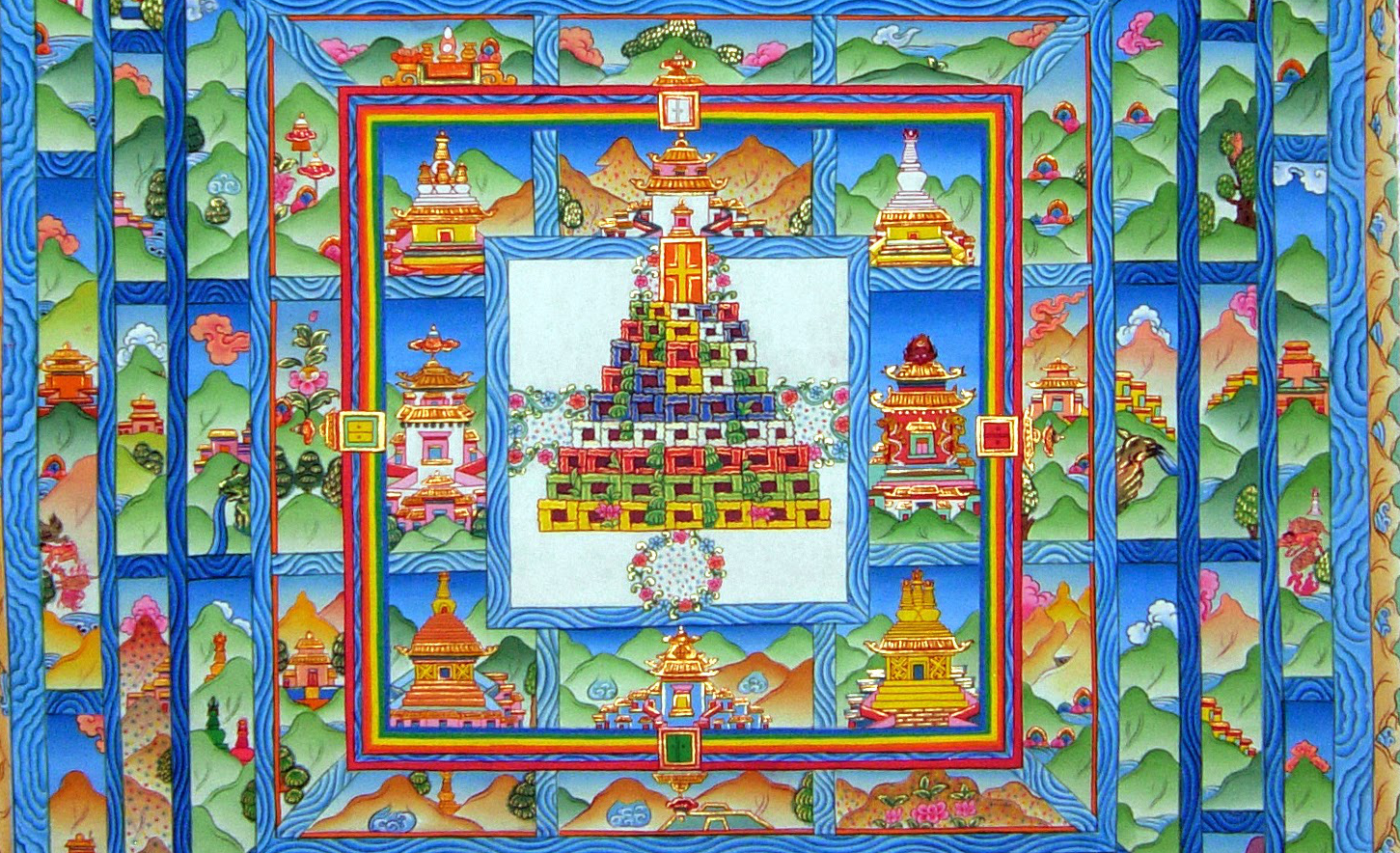
In response to this request, the Teacher told those in attendance that in order to give an example to future generations of how to purify obscurations and complete the accumulations, it was important to create a support for making offerings to the enlightened ones. Thus, he instructed them in building the first chorten [Sanskrit: stupa]. The Tibetan word “chorten” is a compound of two words that literally mean “support for offerings.” Within the Yungdrung Bön teachings, the Buddha taught many different types of chortens for different purposes. Some chortens are meant to be built with physical substances. Others are meant to be created with the mind through visualization. The specific chorten that was built for the teachings of The Way of the Genyen was The Elegant Indestructible Chorten, or Yungdrung Kolek Chorten. This is the most commonly built type of chorten in the Yungdrung Bön tradition because of its versatility. It can be used for multiple purposes such as being a support for generating merit through circumambulation, prostrations, and offerings, or it can be used as a repository for the relics of realized ones, or as skillful means to suppress negativity in a geographical area, and so on.
The Elegant Indestructible Chorten that was built in the mystical land of Olmo Lungring according to the Teacher’s instructions was to be used as a temple for his teaching. It was grand and extraordinary in every way. It had beautiful details such as golden pillars, turquoise beams, and bright images of lotuses, rainbows, clouds, and stars. Each part of the chorten’s structure and decoration was meaningful and created according to the detailed direction of the Teacher. It was constructed by a group of gods, lu, and human beings who were motivated by performing acts of virtue. They completed the work in fifteen days. Then, the Teacher performed an extensive consecration and gave it the name “Yungdrung Kolek Chorten, The Elegant Indestructible Chorten.” Then, once the assembly had gathered within the chorten, he began teaching the specific vows and practices for those who take vows according to The Way of the Genyen.

The Five Outer Customs, The Five Inner Vows, and The Five Practices In-Between
The Five Outer Customs
“Tsangpa Tsukpü, any sons or daughters who want to renounce wrongdoing and nonvirtue and adopt the activities of virtue, should go before an abbot, a master, and a witness who are themselves engaged in proper conduct and discipline, who guide migrating beings, who have clear awareness, who have power and never forget the true meaning, who aspire to pure virtue, and who have experience with many followers; and receive the rules and customs of a genyen, or lay practitioner. By acting in accordance with the five outer customs of clothing, the five inner lifetime vows, and the five activities in-between, they enter The Way of the Genyen. For the five outer customs first there is a shirt for the upper part of the body, second there is a skirt for the lower part of the body, third is cloth shoes, fourth is the robe, and fifth is the overcoat.”
These clothes are similar to those worn by monks and nuns but with differences. For example, the robe or zen worn by a genyen has fringe on the two ends whereas this is not allowed on the zen for monks and nuns. Followed literally, this kind of dress might be difficult for those in Western countries where this could conflict with cultural norms and possibly even create misunderstandings or negative thoughts towards the practitioner and the Bön religion. Therefore, it is beneficial to reflect upon the deeper meaning of these five points. The purpose of The Way of the Genyen is to practice virtue and purity from a motivation of putting others first and not causing harm to other sentient beings while working on behalf of their liberation from suffering. In that way, the advice to wear clothes and shoes made of cloth or fiber rather than animal skins supports the practice of a genyen. Wearing simple clothing without elaborate ornamentation or styles that indicate status or power similarly supports the practice of a genyen. Wearing clothes from a motivation of being modest and humble rather than causing envy or jealousy also supports the practice of a genyen. So, although one might not wear the specific shirt described by the Teacher, it is still important to reflect upon one’s dress and appearance and consider whether it is in harmony or contradiction with the essence of the genyen teachings. For example, in his advice to Khandro Choza Bönmo regarding mantra recitation and foods to avoid, the realized yogi Lishu Taring told her that eating salt destroys the potency of one full day of mantra recitation. The cause of this defilement was created in the past when salt was loaded in bags onto the backs of pack animals who would then walk for many days carrying the salt bags over great distances. By the time the salt bags were removed, they would have adhered to the sides of the animal. Removing the bags would then rip away some of the animal’s hide causing them great pain and suffering. Thus, the salt became defiled because of being the cause of great suffering to another sentient being. In modern times however, vehicles are used to transport salt and this defilement is not created. Thus, the cause for avoiding salt no longer applies. Similarly, one can examine the Teacher’s instruction on clothing for a genyen and also clarify the points with the master giving the vows.
The Five Inner Vows or Disciplines
“The five inner disciplines are to accept vows to abandon killing out of hatred, to abandon taking what is not given out of desire, to abandon acting superficially or deceitfully without regard for cause and effect because of mental darkness or ignorance, to abandon performing arrogant actions out of pride, and to abandon speaking harsh words, idle speech, lying, and divisive speech out of jealousy.”
Here, the description of the five vows varies slightly from the specific lifetime genyen vows that are customarily given. As for the traditional five lifetime vows, the 23rd Menri Trizen Nyima Tenzin Rinpoche wrote the following commentary:
“As for the vows of a layperson, there are five kinds of lifetime vows. To abandon killing, to abandon taking what is not given, to abandon unclean, wrong kinds of sexual conduct, and to abandon false speech are the four roots. Abandoning one from the four kinds of food is the fifth as a branch vow. Some masters have taught that abandoning alcohol is definitely the branch vow.
Furthermore, there is the genyen of renouncing a single thing which is to abandon killing. Additionally, there is the genyen of renouncing a couple things which adds the vow to abandon taking what is not given. Then, there is the genyen of renouncing most of the things which adds the vow to abandon the wrong kinds of sexual behavior. The genyen that also accepts the vow to abandon false speech and renounce the four kinds of food is a complete genyen that has renounced according to the five kinds of established disciplines. Because of that, this is a genyen of pure conduct that has renounced the basic kinds of impure conduct.”
Lifetime Vows of a Partial Genyen: one can accept only the first vow, the first two vows, or the first three vows. Some masters also advise that an individual can accept the four root vows without also accepting the fasting vows. It is up to the individual according to the their capacity and circumstance. These are lifetime vows.
- To Abandon Killing
- To Abandon Taking what is Not Given
- To Abandon Sexual Misconduct
- To Abandon False Speech, or Lying
Lifetime Vows of a Full Genyen: one accepts all four root vows plus a branch vow related to food and or intoxicants. It is also traditional for a full genyen to observe the one-day fasting vows of avoiding meat and intoxicants on the four auspicious lunar days each month which are the 8th, 15th/full moon, 22nd, and the 30th/new moon. These are lifetime vows.
- To Abandon Killing
- To Abandon Taking what is Not Given
- To Abandon Sexual Misconduct
- To Abandon False Speech, or Lying
- To Abandon either Intoxicants or a specific food such as meat or garlic. Additionally, to observe the one-day fasting vows on the four auspicious lunar days each month.
The Five Practices In-Between
- The Discipline of Purification with Lustral Water
- Performing Prostrations and Circumambulations
- Creating Chortens and Sa Tsa (This will be covered in a future article.)
- Offering Pure Water Torma (This will be covered in a future article.)
- The Seven-Branches of Daily Activity

The Teacher spoke to Tsangpa Tsukpü, the disciple entrusted with the lineage of The Fifth Way of the Genyen.
“Tsangpa Tsukpü, Listen! Anyone who has entered the door of the Bön of the genyen who rises in the morning between dawn and sunrise and purifies with lustral water, worships the the three supports of the enlightened ones and the five deities, he or she will be liberated from the bondage of the five realms of cyclic existence.”
The Five Genyen Yidam Deities
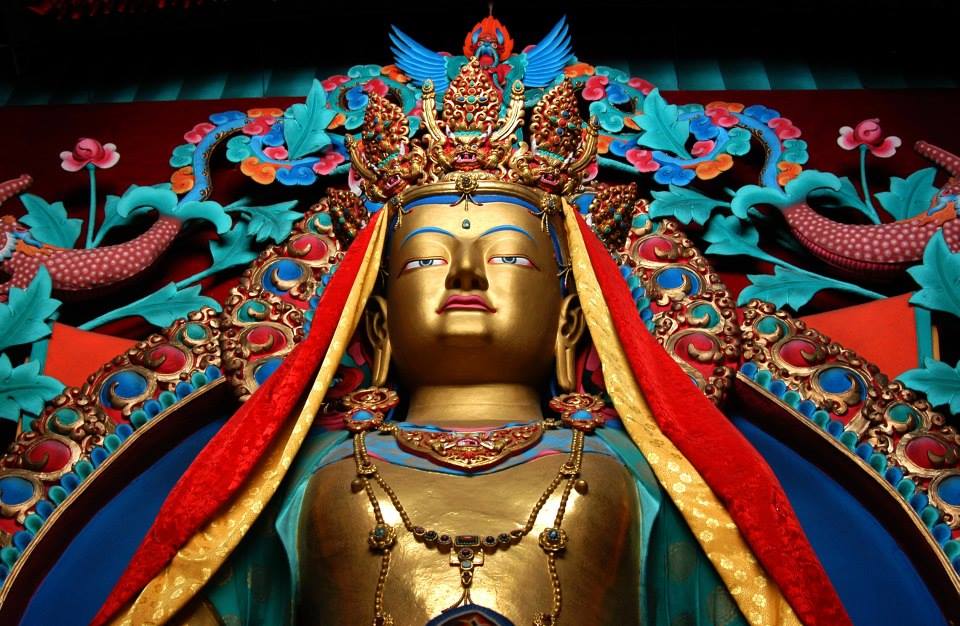
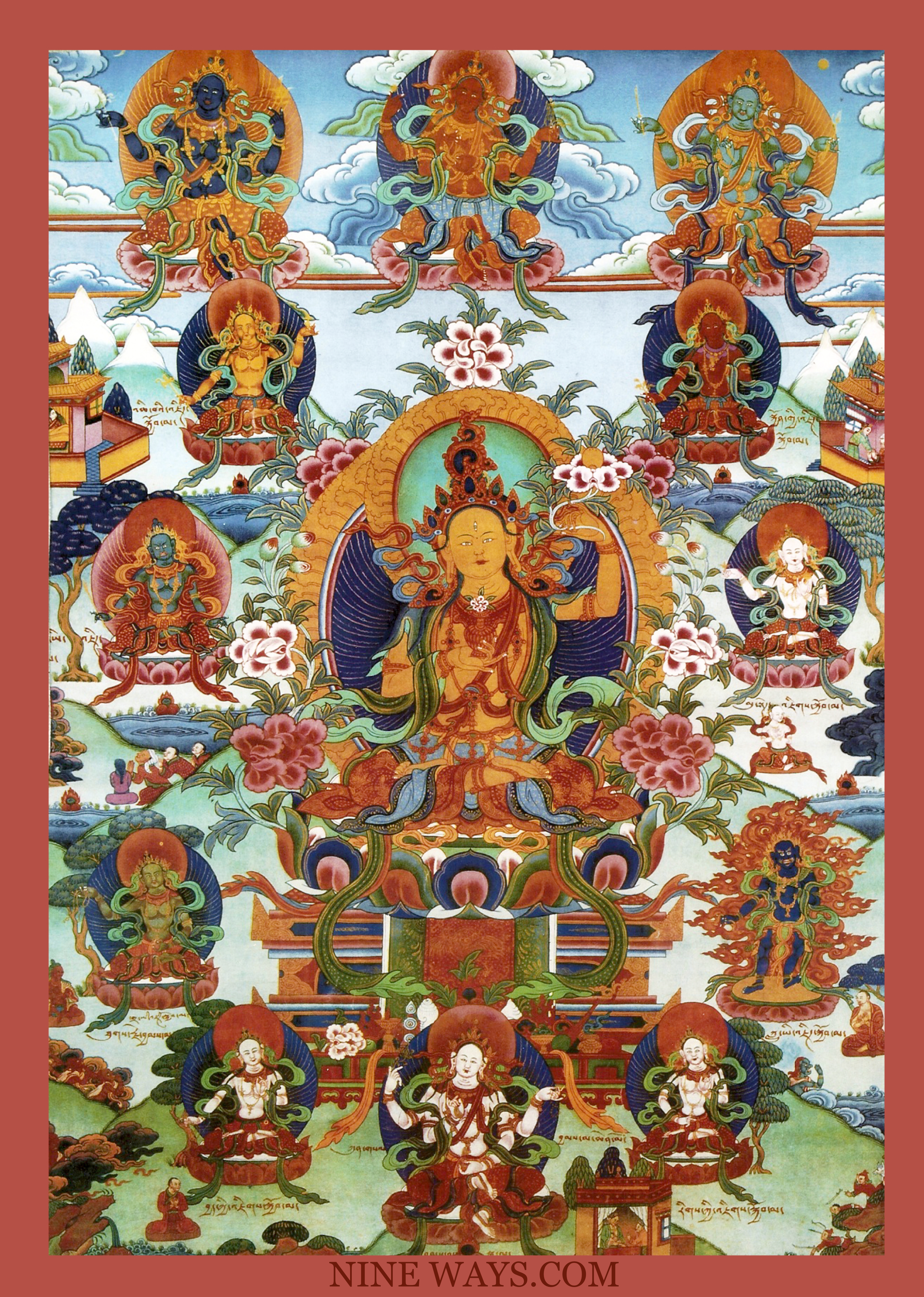
The Five Practices In-Between are performed in the presence of the five yidam deities of The Fifth Way of the Genyen. Principal among these deities is Shenlha Ökar, the white light deity of the Shen. In essence, Shenlha Ökar embodies ones personal root lama together with all other lamas and teachers that have kindly given instructions and guidance. At the same time, he is an enlightened being who manifests in a peaceful form of pure light and spontaneously bestows all perfected qualities and wisdoms. He emanates a retinue who have a similar form and essence but who also have distinct characteristics. All five deities have a peaceful appearance with a single face, two arms, two crossed legs, and are adorned with the fifteen ornaments of the body of perfected qualities.
- Shenlha Ökar, or Küntu Zangpo: He abides in the center and is white like the clear moon and his two hands are in equipoise holding the symbolic syllable AH. When visualized during the practice of purification with lustral water, he holds a wish-fulfilling jewel and is known as Shenlha Ökar. He has a golden crown ornament and is adorned with ornaments of the five kinds of jewels. He sits on a lion throne upon cushions of a sun, moon, and lotus. Behind him is a Yungdrung Kolek Chorten. His wisdom form conquers anger, and through his river of the wisdom of emptiness the afflictions and obscurations due to anger are purified.
- Damtsik Gyalpo Shérik Lha, or Rangsal Sherik kyi Lha: King of vows and commitments, the deity of self luminous knowledge and awareness. He abides in the East, is golden, and holds a vase of nectar. When visualized during the practice of purification with lustral water, he holds the syllable AH. He has a turquoise crown ornament and sits on an elephant throne upon cushions of a sun, moon, and lotus. His wisdom form conquers ignorance and mental darkness, and through his river of mirror-like wisdom the afflictions and obscurations due to ignorance and mental darkness are purified.
- Lekyi Gyalpo Tsé’i Lha or Yungdrung Tsé’i Gyalpo: King of Indestructible Longevity, King of Activities. He abides in the North, is green, and holds a crystal-colored phurba with a yungdrung. He has a coral crown ornament and sits on a horse throne upon cushions of a sun, moon, and lotus. His wisdom form conquers pride, and through his river of the wisdom of equanimity the afflictions and obscurations due to pride are purified.
- Wanggi Gyalpo Yéwang Lha, or Jinlap Wanggi Lha : King of Empowerments and Primordial Empowerment Deity or Deity of Blessings and Empowerments. He abides in the West, is red, and holds a scripture. When visualized during the practice of purification with lustral water, he is copper-colored. He has a white crystal crown ornament and sits on a turquoise dragon throne upon cushions of a sun, moon, and lotus. His wisdom form conquers desire, and through his river of discriminating wisdom the afflictions and obscurations due to desire are purified.
- Yigé’i Gyalpo Yé Si Lha, or Lhayé Si Trulgyi Gyalpo: King of Letters and Deity of Primordial Existence, King of Magic. He abides in the South, is blue, and holds a dark-blue, six-spoked wheel of the elements. He has a golden crown ornament and sits on a garuda throne upon cushions of a sun, moon, and lotus. His wisdom form conquers jealousy, and through his river of all-accomplishing wisdom the afflictions and obscurations due to jealousy are purified.
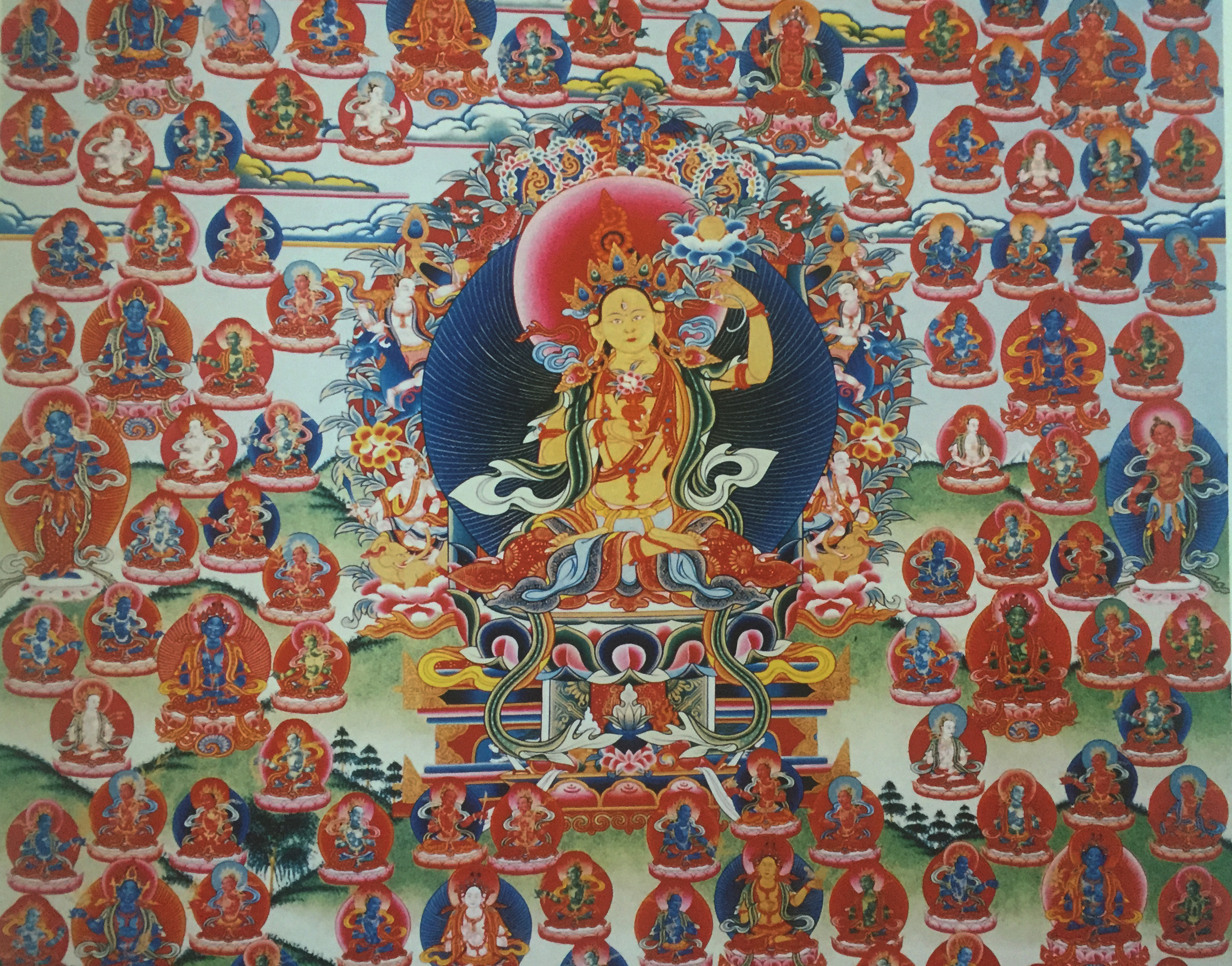
These five principal deities are surrounded in the sky by the eight perfected deities who purify the eight consciousnesses and karmic potentialities, the four shen who open the doors of the mandala and who tame beings and have control over the four elements and the four seasons and who purify the four kinds of birth, and the thousand buddhas of the fortunate age in the outer perimeter. It is possible to simplify the visualization by imagining the central deity as the embodiment of all of these enlightened ones who bestows all wisdom and purifies all afflictions and obscurations.
The Discipline of Purification with Lustral Water
The discipline of purification with lustral water is the first daily practice of a genyen. It is performed between dawn and sunrise. A clean, unblemished and undamaged vessel, especially made of gold, silver, or copper, is filled with water. At least a small amount of saffron is added, and other herbs such as mendrup can be added if they are available. Rays of light from the heart centers of each of the five yidam deities radiate to the water and it instantly becomes a nectar of wisdom. Thus, the water is transformed from an ordinary substance to a wisdom substance. Water does not have to be freshly prepared each morning, but can be prepared and then kept in a clean place and used until more is needed. This practice can be done any time that it is needed, but is especially performed first thing in the morning. There are many different prayers for the practice with lustral water, known as trü. The Cleansing Rite Supplication prayer is one of the most commonly performed prayers for trü and it is also quite succinct. (The English translation of this prayer is freely available for personal use from the Publications page of this website.) During Buddha Tönpa Shenrap Miwoché’s teaching of The Fifth Way of the Genyen, he offered a trü prayer supplicating each of the genyen yidam deities and asking for their wisdom blessing. (As a gift to the worldwide Yungdrung Bön sangha, this prayer that was given by the Teacher himself for purification with lustral water has been translated into English and added to the list of freely offered translations on the Publications page of this website. It is entitled The Bön Activity of Ablution for Cleanliness and Purification.)
In Shardza Tashi Gyaltsen Rinpoche’s Wish-fulfilling Jewel of Daily Activities, he gives detailed instruction for the yoga of purification with lustral water at dawn. He concludes with the following advice.
“Thus, one should purify oneself by washing the face, sprinkling with water, drinking water, and so forth. For the inner cleansing, meditate on Shenlha at the crown of your head and perform the purification of nectar falling from the hundred syllable mantra. The secret cleansing is to meditate upon yourself as Shenlha and then to emanate and reabsorb pure rays of purifying light. Do this as much as you can.”
From Shardza Tashi Gyaltsen Rinpoche’s Wish-fulfilling Jewel of Daily Activities

Performing Prostrations, Circumambulations, and The Seven Branches of Activity
In the presence of any of the three supports of enlightened body, speech, and mind, prostrations performed with the body are according to the Yungdrung Bön religious tradition. Prostrations with speech are done through recitations and supplications. Prostrations with the mind are done in this context by focusing upon the five yidam deities and single-pointedly practicing with faith and devotion.
Again from Shardza Rinpoche’s Wish-fulfilling Jewel of Daily Activities within the section on the yoga of prostrating, admission of wrongdoing and purification, and receiving vows at the peak of sunrise:
“Meditate on the three jewels in the sky in front of you and recite this mantra seven times: AH MIR TA YÉ MI DZA YÉ SOHA. Because of that, a single prostration becomes ten thousand prostrations. Then, from dawn until sunrise pay homage with prostrations and recitations to the enlightened ones.”
Wish-fulfilling Jewel of Daily Activities
With faith and devotion, once can circumambulate any of the three supports of enlightened body, speech, and mind. In the Yungdrung Bön religious tradition, circumambulations are performed counter-clockwise. His Eminence Menri Yongdzin Pönlop Yangtön Thrinley Nyima Rinpoche has offered a practical explanation for the distinction between the Buddhist and Bönpo directions for circumambulating.
“When one circumambulates, you must go in the direction of the mantras that are written on the object that you are circumambulating. You start at the first syllable and move towards the last syllable. Buddhists paint their mantra inside the temple or chorten. And so, they travel clockwise. Because of that, you would have to go clockwise. Bönpos paint their mantra on the outside, so then you have to go counter-clockwise, the way of the mantra.”
Thus, when circumambulating a Bön temple, statue, text, chorten, and so on; one must go counter-clockwise. Likewise, even if one is a Bönpo, if circumambulating a Buddhist temple or chorten etc., it is proper to go in the clockwise direction. In general however, when walking or moving about during ordinary life, it is common for Bönpo practitioners to imagine their root lama or yidam in the sky above their left shoulder. In this way, no matter where they are going, they are circumambulating with their bodies, feeling devotion with their mind, and performing recitations with their speech.
The Seven Branches of Daily Activity
- The Discipline of Cleansing with Lustral Water
- Prostrations and Circumambulations
- Admission of Wrongdoing and Purification
- Offering
- Rejoicing
- Dedicating the Merit of the Virtuous Activity
- Making Prayers of Aspiration
With the exception of creating chortens, sa tsa, and offering water torma, the five practices in-between have overlap with The Seven Branches of Daily Activity. Within The Way of the Genyen, there are specific prayers given by Lord Buddha Tönpa Shenrap Miwoche for each of these practices while supplicating each of the five genyen yidam deities. There are also many other similar prayers in the Yungdrung Bön religious tradition. Some are shorter and some are longer. The practitioner can choose which prayers to perform according to their time and preference. With the exception of the discipline of cleansing with lustral water, The Eight-branched Aspiration Prayer written by the second buddha, Nyamme Sherap Gyaltsen Rinpoche is a succinct and clear prayer that includes these branches of activity. (The English translation of this prayer is freely available for personal use on the Publications page of this website.)
Admission of Wrongdoing and Purification
For any practitioner who has received any kind of vows, it is important to always keep them in mind and to be diligent to keep them correctly according to the instructions of the master who bestowed them. If any vows should become degenerated or broken, it is important to practice admission of wrongdoing and purification in order to renew the vows. Both Buddha Tönpa Shenrap, Shardza Rinpoche, and other spiritual masters have advised doing this as part of the daily morning practices. Additionally, many masters including Shardza Rinpoche advise doing this again in the evening upon reviewing one’s activities throughout the day in order to begin the yoga of sleep in the evening.
“When you arise from the evening session of meditation, examine whether or not there has been a fault in your mind stream that has violated any vows throughout the day. If you are aware that you have committed a fault or transgression, engage in the appropriate admission and purification according to that transgression.”
Excerpt from Wish-fulfilling Jewel of Daily Activities by Shardza Rinpoche
Admission of wrongdoing and purification is a translation of the Tibetan word shakpa [Tibetan: bshags pa]. This literally means “to openly reveal, or to confess.” For the practice of shakpa to be effective in purifying wrongdoing and degeneration of vows, it must engage with all of the four powers.
The Four Powers of Admission of Wrongdoing and Purification
- The Power of the Superior Witness: In this case, we have taken vows before the enlightened ones, and they are therefore the superior witness for our admission of wrongdoing. For the genyen, one can invite the five yidam deities specifically, or Shenlha Okar as the embodiment of all five yidam deities and the master from whom one received their vows. One can also go before one of the three kinds of support of enlightened body, speech, and mind, and/or the spiritual master.
- The Power of Sorrowful Remorse: It is said that the practitioner should intensely reflect upon their wrongdoing and the inevitable karmic result of their actions until their hair stands on end and the bones shake.
- The Power of Promising to Not Repeat the Actions: Having felt a great remorse for wrongdoing, one firmly promises to not repeat the actions and to no longer be driven by the five kinds of ignorance.
- The Power of Engaging in the Antidote: Rather than acting from a motivation of ignorance, one promises to act from a motivation of wisdom and engage with the appropriate antidote. For example, if one has the fault of being short tempered, one promises to engage with loving kindness.
Thus, when these four powers are all present, one then imagines that a shower of wisdom light spontaneously radiates from the hearts of the superior witness and completely pervades the body, speech, and mind. All wrongdoing and defilements from nonvirtue are instantly purified and one’s body, speech, and mind is unified with enlightened body, speech, and mind. In The Way of the Genyen, the Teacher gives the example of supplicating to each of the five yidam deities and admitting wrongdoing according to each action motivated by each of the five kinds of ignorance, the eight consciousnesses, and the sense powers. Then, the vows to abandon each of the specific negative actions are repeated, and one promises to devote oneself to each of the individual antidotes and wisdoms. Because acts of nonvirtue and wrongdoing create a kind of stain on the mind stream that blocks the experience and realization of wisdom, this practice is important for all spiritual practitioners.
The 12th century master, Metön Sherap Özer, composed a short but quite profound prayer for this practice.
“(I prostrate to the body of Shenrap Gyalwa who establishes the happiness of migrating beings! In the sky in front of me, seated on cushions of a sun, moon, and lotus is Shenrap Tritsuk Gyalwa.* He has the clothing and attributes of a completely pure saint.)
Homage! Buddhas of the three times, before your eyes, I confess the dormant potentiality of the three poisons. Five Buddha Family lineages, before your eyes, I openly admit and confess to engaging with the five poisons. Shenrap Tritsuk Gyalwa, before your eyes, I openly admit and confess to not maintaining discipline according to the scriptures. Khenpo and Lopön, before your eyes, I openly admit and confess both large and small transgressions. Enlightened ones who have gone to bliss, before your eyes, I openly admit and confess to not maintaining the oral transmissions in the correct way. Venerable lama, before your eyes, I openly admit and confess to having had only a small amount of devotion and respect. Gathering of yidam deities, before your eyes, I confess to accepting and rejecting incorrect things. Mother and sister khandro, before your eyes, I confess to not properly guarding my commitments. Bön religious guardians, before your eyes, I confess to not making regular monthly and yearly offerings in the past. Spiritual brothers and sisters, before your eyes, I confess to having had only a small amount of respect and pure vision. Greatly kind mother and father, before your eyes, I confess to not repaying even a single one of your kindnesses. Migrating sentient beings, before your eyes, I confess to having had only a small amount of compassion and loving kindness. Being influenced by ignorance, a lack of understanding, misunderstanding, and delusion, may the previous actions of defilements and non-virtuous activities not have any power! May temporary conditions not have any power! May any longstanding defilements not have any power! May karmic debts of the future not arise! May conditions for delusion in the intermediate state after death not arise! May I not deviate from the path of liberation! May I experience the dynamic energy of the supreme attainment of the stainless wisdom of equanimity!”
Purifying Remorse and Confession composed by Meton Sherap Ozer

Offering
The purpose for offering is to develop our generosity and complete the two accumulations of merit and wisdom. When offering, there are four important points: the giver, the recipient, the offering, and the purpose. In this context, the genyen is offering to the five yidam deities. Offerings can be material objects, imagined offerings generated by the mind, as well as our meditative experiences. One does not have to own an object in order to offer it. Walking into a store, all the beautiful and desirable things can be mentally offered. Walking outside, the beautiful sights, sounds, and smells of nature can be mentally offered. Whatever we offer, it is increased by the mind many thousands of times so that the universe is filled with wonderful things. Ultimately, offerings are given without attachment and with the view of the empty nature of both the giver and the recipient. As a general daily practice, there are five kinds of offerings: butter lamps, water, incense, food, and flowers. (For detailed information about this daily practice, see previous article: The Five Daily Offerings)
Rejoicing
Whatever acts of virtue or spiritual practices that we perform or that we are aware of others performing, we rejoice in them. This supports our practice of joyful effort and increases the power and motivation of our practice.
Dedicating the Merit of Virtuous Activity
Dedicating the merit of the virtuous activity of our body, speech, and mind for the benefit and enlightenment of all of the six kinds of sentient beings is considered great skillful means. It is said that whether one recites a single mantra or presents the buddhas with the universe filled with gold, it is important to dedicate the merit. In this way, it is always preserved and cannot be lost, like adding a spoonful of water to an ocean. Otherwise, a single instant of anger can destroy it, like the power of a single match to destroy a forest of a thousand trees.
Making Prayers of Aspiration
By making prayers of aspiration, we expand our mind and plant seeds that will ripen in the future when our prayers meet with the right secondary conditions. Prayers of aspiration should be made with devotion and free of expectation and doubt. There are countless prayers of aspiration, known as mönlam, in the Yungdrung Bön religious tradition. One of the commonly performed prayers is The Aspiration Prayer of the Ten Grounds. This prayer is based upon the practice of the ten perfections and supplicates Sherap Jamma who is the source of The Perfection of Wisdom teachings. (The English translation of this prayer is freely available for personal use on the Publications page of this website.)
“(First: The Ground of Immense Joy) Upon the ground of immense joy, having cleansed and
purified the stain of greed and having perfected the great accumulation of generosity, may I see the face
of Jinpa Jamma, the Loving Mother of Generosity!
(Second: The Ground of Stainless Crystal) Upon the ground of stainless crystal, having cleansed and
purified the stain of immorality and having perfected the great accumulation of moral discipline, may I
see the face of Tsultrim Jamma, the Loving Mother of Moral Discipline!Excerpt from Aspiration Prayer of the Ten Grounds from the Mönlam Namsum
(Third: The Ground of Radiance) Upon the ground of radiance, having cleansed and purified the stain
of insensitivity and impatience and having perfected the great accumulation of patience, may I see the
face of Zöpa Jamma, the Loving Mother of Patience!”

The Teacher, the enlightened Lord Tönpa Shenrap, concluded his teaching on The Seven Branches of Virtuous Conduct with these words to the gathered assembly.
“This is called The Seven Branches of Virtuous Conduct of the Shen of Tsangpa Tsukphü. You should be very diligent in this teaching of the door of The Way of the Genyen. You should be devoted to it continuously. You should make a commitment to it and keep it properly in mind. Therefore, once you have purified all the sufferings, misdeeds, and obscurations of the afflictions, you will attain the fruit of pure wisdom. Therefore, you should make great effort in this pure Bön practice.”
*This is the name taken by Buddha Tonpa Shenrap when he showed the example of accepting vows of renunciation and followed the path of a fully ordained monk.
Raven Cypress Wood ©All Rights Reserved. No content, in part or in whole, is allowed to be used without direct permission from the author.
All Translations from Tibetan by Raven Cypress Wood
Don’t want to miss a post? Scroll to the bottom and click “Follow this blog.”
This website and its content is kept free by the generous support of donors. Want to join the mandala of Nine Ways supporters? Follow this link https://ravencypresswood.com/donate/ It’s easy through Paypal and Zelle.







 Nine Ways