The Twelve Animals of Tibetan Astrology: The Garuda

In Tibetan astrology, there is a twelve year cycle.  Each of these years is characterized by a different animal and associated with one of the five elements.  Therefore, a full cycle of the twelve animals being associated with each of the five elements is sixty years.  The twelve animals according to the Yungdrung Bön texts are the Rat, Elephant, Tiger, Rabbit, Dragon, Horse, Snake, Sheep, Garuda, Monkey, Dog and Pig.  Each animal is associated with a specific element for its life-force as well as a specific direction which is determined by the life-force element.  Not only are these twelve animals associated with a particular year, they are also associated with particular months, days and hours.
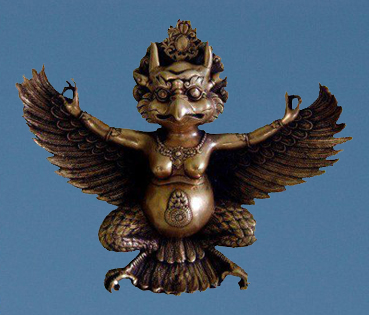
A bronze image of a Garuda

Feb 27, 2017 begins the Tibetan New Year and the year of the Fire Garuda.  (For the Yungdrung Bön, it is the year of the Garuda.  Others use the symbol of the rooster.)  The Garuda is a bird both historical and mythical in scope similar to the Thunderbird.  It is intricately associated with Lord Tönpa Shenrap Miwoché and the ancient kingdom of Zhang Zhung and Mount Tisé a.k.a. Mount Kailash. People born during a Garuda year will have an emphasis of the specific qualities associated with Garuda.  (These years correspond with the Tibetan lunar calendar and begin sometime between late January and early April.)   In astrology, the element which governs the life-force of the Garuda is Metal (space) and its direction is West.  So, if a Garuda person wanted to strengthen their life-force, they would focus upon strengthening the element of Metal internally and externally.  Because the positive direction is West, facing this direction while meditating, engaging in healing practices or just relaxing and taking deep breaths is beneficial.

In general as an astrological symbol, the Garuda person has a zest for life and is uncomfortable with the limitations of tradition and convention.  The Garuda has confidence in itself and is ambitious with goals that can often seem unrealistic to others.  However, it is a perfectionist and a master of organization that is able to find a way to accomplish difficult tasks.  The Garuda‘s joy and charisma attracts many friends who benefit from its spontaneous generosity.  Its flair for life and confidence in itself also attracts the attention of powerful people who help the completion of its goals.  In some, this unshakable confidence might lend itself to conceit and self-centeredness.  The Garuda finds the most joy when it remains balanced rather than caught in a cycle of highs and lows.

The Garuda‘s soul day is Friday and its life-force day is Thursday.  These are the best days for beginning new projects and activities that are meant to increase or develop something.  The obstacle day is Tuesday.  This day is best for purification and letting things go.  It is not a favorable day for beginning new activities.

Garuda years include: 1933, 1945, 1957, 1969, 1981, 1993, 2005, and 2017

If you were born during a previous year of the Garuda, this year as well as other Garuda years are considered a time of vulnerability to obstacles. This same astrological principal applies for all of the other eleven animal signs during their associated year. Therefore, it is recommended to engage in practices that support vitality, good fortune and spiritual merit such as hanging prayer flags, having a soul and life-force retrieval ritual performed, restoring any deterioration or violation of one’s spiritual commitments or any damaged relationship with one’s spiritual brothers and sisters, and/or performing prayers and rituals to remove obstacles. In general, making an effort to engage more with virtuous activities of body, speech and mind and committing to engage less with non-virtuous activities is supportive. According to the words of Buddha Tönpa Shenrap Miwoché, the practice of developing sincere unbiased and unlimited compassion is the greatest of all protections.

A common prayer within the Yungdrung Bön tradition that is used to remove obstacles is the Bar Che Lam Sel, The Spontaneous Wish-fulfillment of Removing Obstacles from the Path. The English, Spanish and Portuguese translations of this prayer are offered free for personal use on the Nine Ways Publications page. Click on the Publications tab above and scroll down to the download links for the prayer.

Raven Cypress Wood© All Rights Reserved
Sacred Form

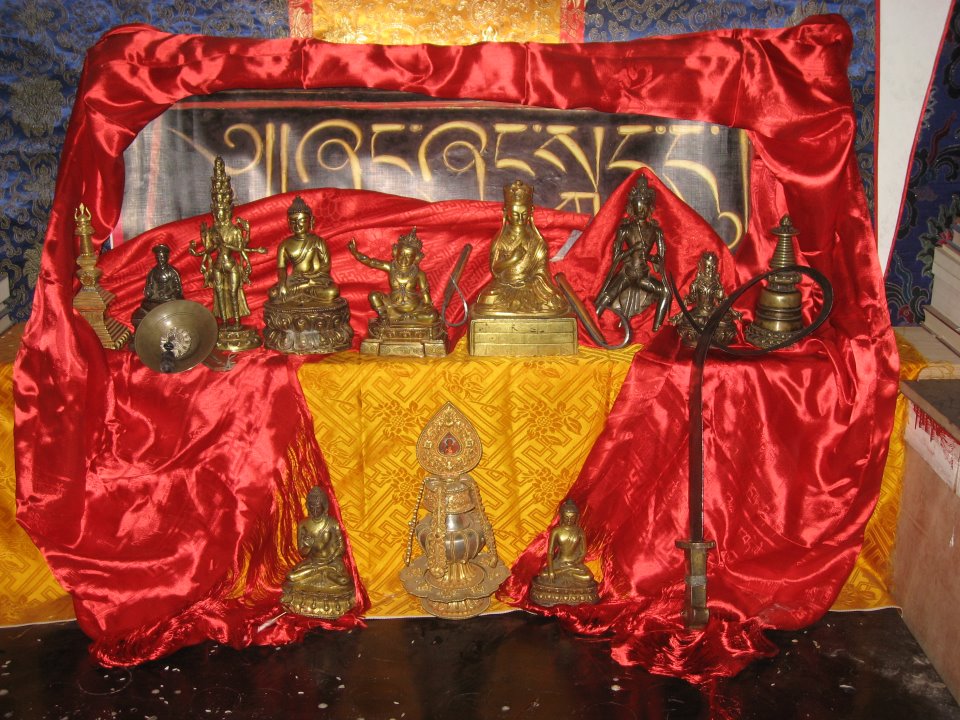
A Collection of Sacred Yungdrung Bon Objects. Photo credit: Unknown

Blessings of the Lama

HE Menri Lopon Thrinley Nyima Rinpoche prepares to perform a consecration ritual. Photo credit: Raven Cypress Wood

Victory Over Ignorance

Gyaltsen or Sign of Victory

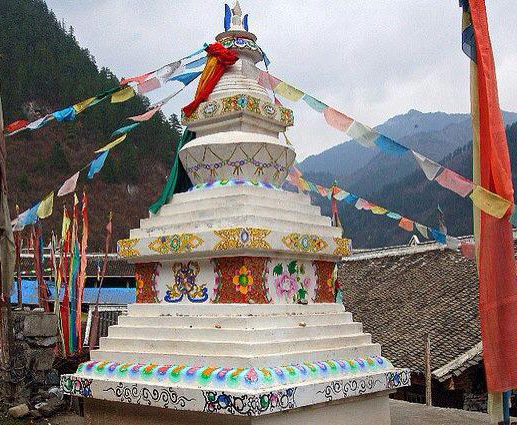
As one of the Eight Auspicious Symbols, the gyaltsen or sign of victory, symbolizes victory over all obstacles especially the demon of ignorance.

Mandala of the Divine: The Yungdrung Bön Altar

menri-shrine-edit

Special ceremony altar at Menri Monastery in Dolanji, India. Photo credit: Unknown.

In the Yungdrung Bön religious tradition, the principal altar is referred to as the ‘Mandala of the Divine’, or the ‘Upper Mandala.’  Once properly established, the altar becomes the sacred place in which to host the majestic presence and blessings of the deities.  In this way, it becomes a powerful support for spiritual practice and the development of the practitioner.  From the Benefits of the Recitation Practice which is a Precious Lamp:

“Whoever goes before a lama, a lopon or one of the three supports (statue, text or chorten) and recites the MA TRI mantra while prostrating or circumambulating, their aspiration will be quickly accomplished.”

Regardless of the size of the altar display, the practitioner imagines the offerings and the presence of the deities as boundless and unlimited.  It is important that the area be clean and be respected as a sacred place even if the altar is a single butter lamp,

Traditionally, the altar is located in a higher place such as the top most floor of a building.  Ideally, the altar faces East and is seen as one enters the room where it is located.  If facing East is not possible, South is second best although sometimes West or North are the only available options.  Ideally, the altar has three, four or five levels.  Whatever is placed upon the altar should be clean, undamaged and have a sacred purpose.  The altar is sometimes painted and sometimes covered with silk.  Although there are specific rituals that specify the use of white or black cloths, in general the colors of white, black and green are not appropriate for the altar.  When the text specifies placement of items to the ‘left’ or ‘right’, the perspective is always that of the deities.  Therefore, ‘left’ becomes the practitioner’s ‘right’ when facing the altar.  For example, according to the text the protectors red offering of tea or rakta is placed on the left and the white offering of alcohol is placed on the right.  However, for the practitioner facing the altar, the red offering of tea or rakta is to their right, and the white offering of alcohol is to their left.  Below, ‘right’ and ‘left’ are from the perspective of the practitioner facing the altar.

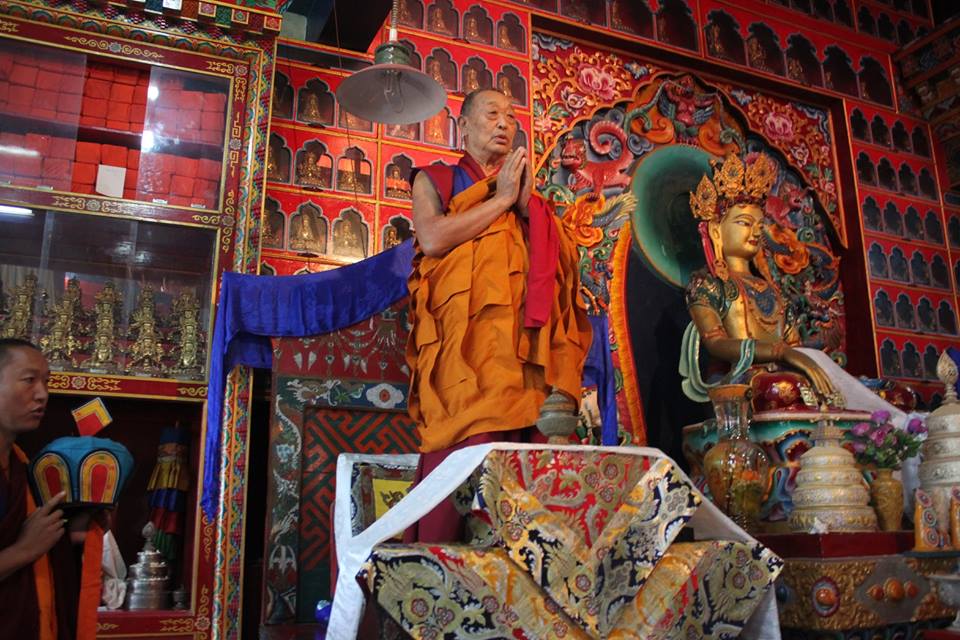
HH 33rd Menri Trizen. Behind him and to the left are texts wrapped in red cloth on shelves above the deity statues. Photo Credit: Unknown.

The Higher Levels of the Altar: It is important to have representations of enlightened Body, Speech and Mind on the altar.  Enlightened Body is represented by statues and images such as thangkas, enlightened Speech is represented by texts, and enlightened Mind is represented by the chorten. Yungdrung Bön scriptural texts are always placed in the highest possible position with nothing on a level above them.  They are considered even more important than an image of the Buddha because they contain the actual teachings and guidance that leads sentient beings out of their suffering.  Sometimes they are placed on the same level with the deity statues due to limited space.

The Elegant Yungdrung Bon Chorten

Generally, statues and yidam torma are placed on the level below the texts.  Images of high lamas are placed below the statues.  If there is only a single lama image, it should be placed in the center.  If there is more than one lama image, the image of the highest status lama is placed to the practitioner’s left and the second highest status lama is placed to the right.  The third highest status lama image is placed to the left of the first image, etc.

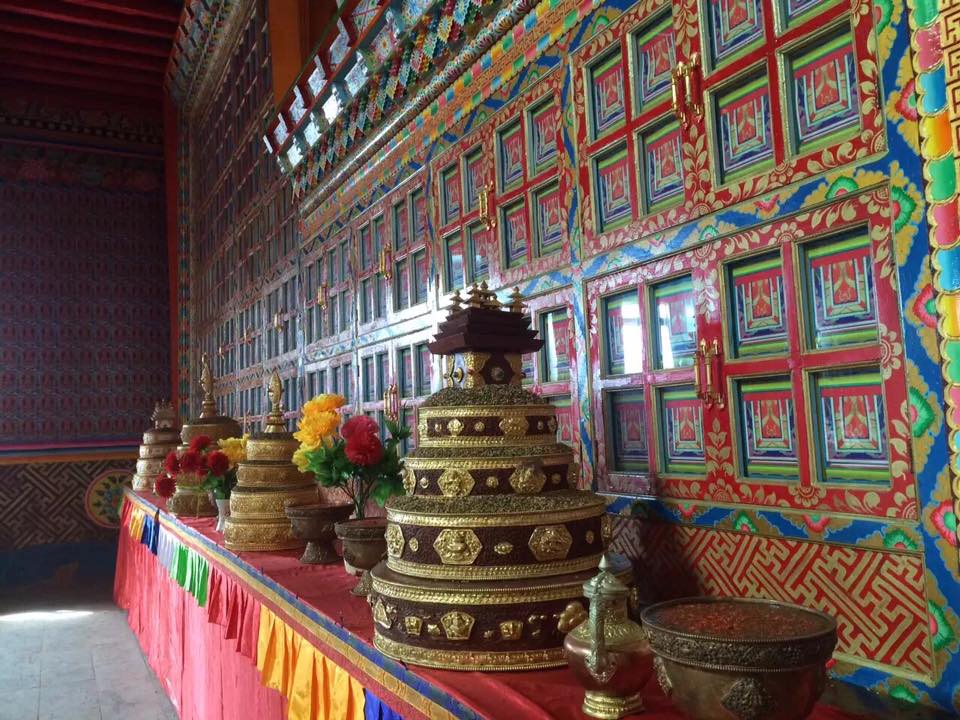
The Lower Levels of the Altar: Offerings to the deities are placed on the lower levels of the altar.  Most important are the five daily offerings of butter lamps, incense, clean water, food and flowers.  (See previous post The Five External Daily Offerings https://ravencypresswood.com/2017/01/14/the-five-daily-offerings/.)  Mandala rings are ritually filled with dry barley or rice and placed as an offering.  If there is only one mandala, it is placed in the center.  If there are two mandalas, they are placed to the left and right.  Flowers are placed to the side of the altar and burning incense is placed below.

Mandala offering with the unique Yungdrung Bon square top. Photo credit: Unknown.

Once everything has been properly established, the altar is ritually cleansed with the sprinkling of clean water and the smoke of pure incense together with their respective mantra.  Everything is imagined as being completely pure.  The practitioner then performs at least three prostrations of body, speech and mind with a heart of devotion.  At this time, the altar has been ‘opened’.  From this time until it is ‘closed’ in the evening, one must perform prostrations before approaching the altar.  Out of respect, whenever approaching the altar when it is ‘open’, the mouth is covered as a way to keep it completely pure and clean.

According to the texts, the altar is opened in the morning ‘when the birds leave their nest’ and closed in the afternoon when ‘the birds return to their nest.’  This is generally considered to be dawn and late afternoon before sunset.  When acquiring items for the altar, setting it up, and opening and closing it each day, one imagines that by engaging in this virtuous activity, that the five poisons of ignorance, anger, attachment, pride and jealousy are purified.

Raven Cypress Wood ©All Rights Reserved