Category Archives: Zhang Zhung Nyen Gyu

The Time to Practice The Greatly Fierce, Secret Gekhö

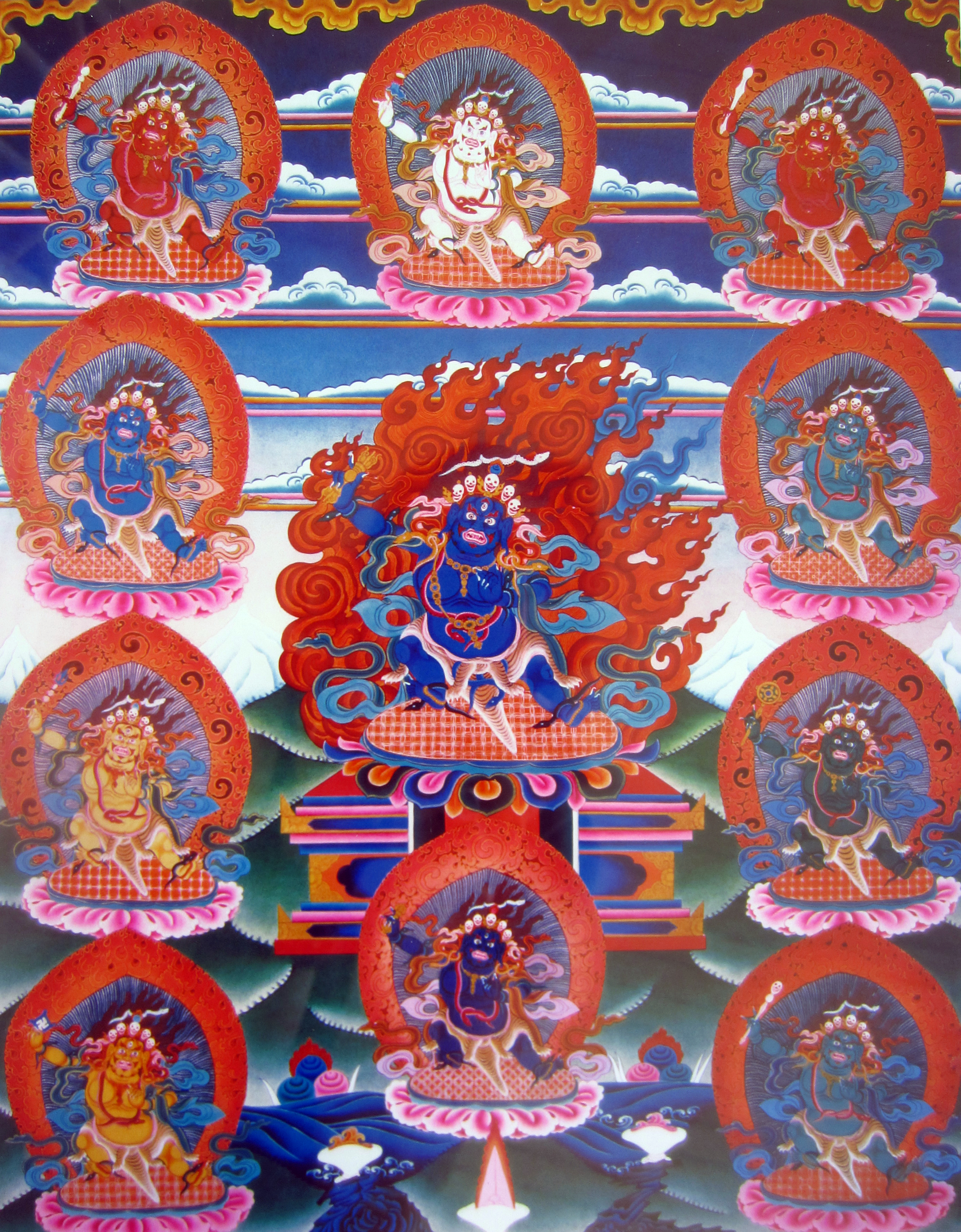
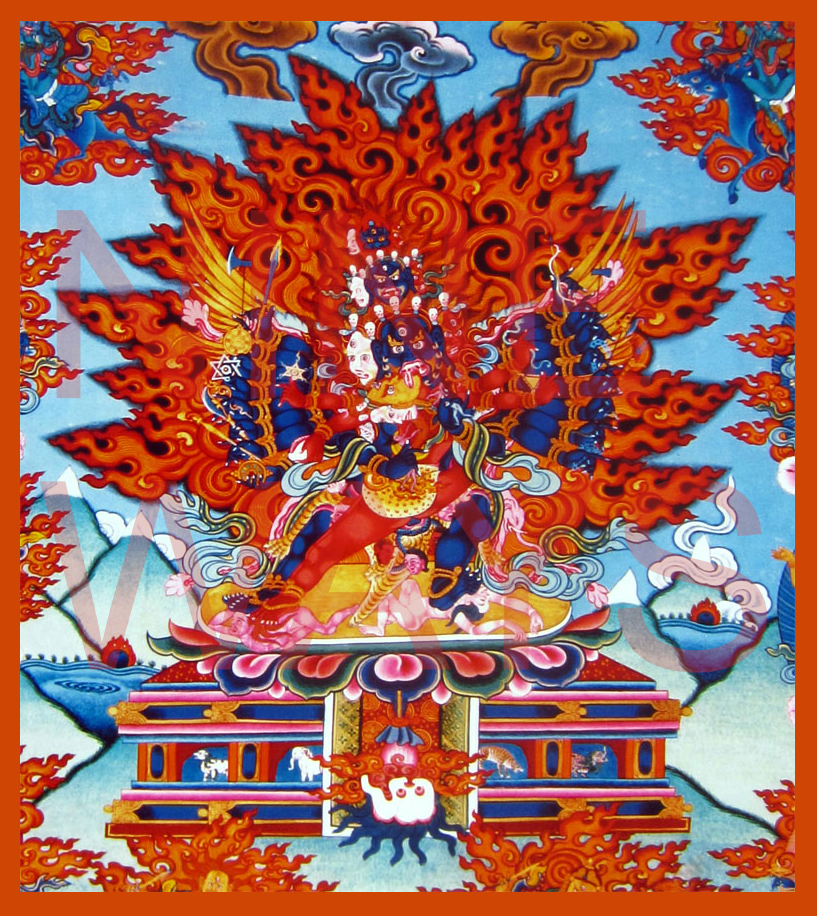
Walchen Gekho with his consort, Queen of the Drala

Each year from the 22nd-29th lunar days of the Eighth Tibetan month, Menri Monastery in Dolanji, India holds an intensive retreat for the fierce yidam Walchen Gekhö. Specifically, they perform the practice from the text compiled by the Second Buddha Nyammé Sherap Gyaltsen Rinpoche, “Gekhö Sangwa Drakchen, The Greatly Fierce, Secret Gekhö.” In 2023, these lunar dates correspond with October 6th-13th on the Western calendar.

The tantric cycle of Gekhö contains 360 deities. Within the cycle of the Father Tantras, Walchen Gekhö is the manifestation of enlightened quality among the Five Supreme Embodiments. (See previous post: https://ravencypresswood.com/2016/06/05/the-five-supreme-embodiments/

Gekhö is a deity associated with the ancient land of Zhang Zhung, and his tantric practice was widespread throughout the kingdom. In the Zhang Zhung language, “Gekhö” means “demon tamer.” It is said that he originally descended upon the sacred mountain of Gang Tisé (also known as Mount Kailash), and that he and his retinue dwell there. However, even though there is a close association with an earthly abode, he is not a worldly guardian. Rather, he is the embodiment of enlightened quality that manifests as a meditational deity who protects Yungdrung Bön practitioners.

“In order to lead those who have not gained realization, Walchen Gekhö possesses the Five Bodies and the Five Primordial Wisdoms. Through the truth of pacification, and through these forceful, wrathful means, those who are untamed will be tamed!”

From the Essence Practice of the Fierce Champion, Zhang Zhung Meri

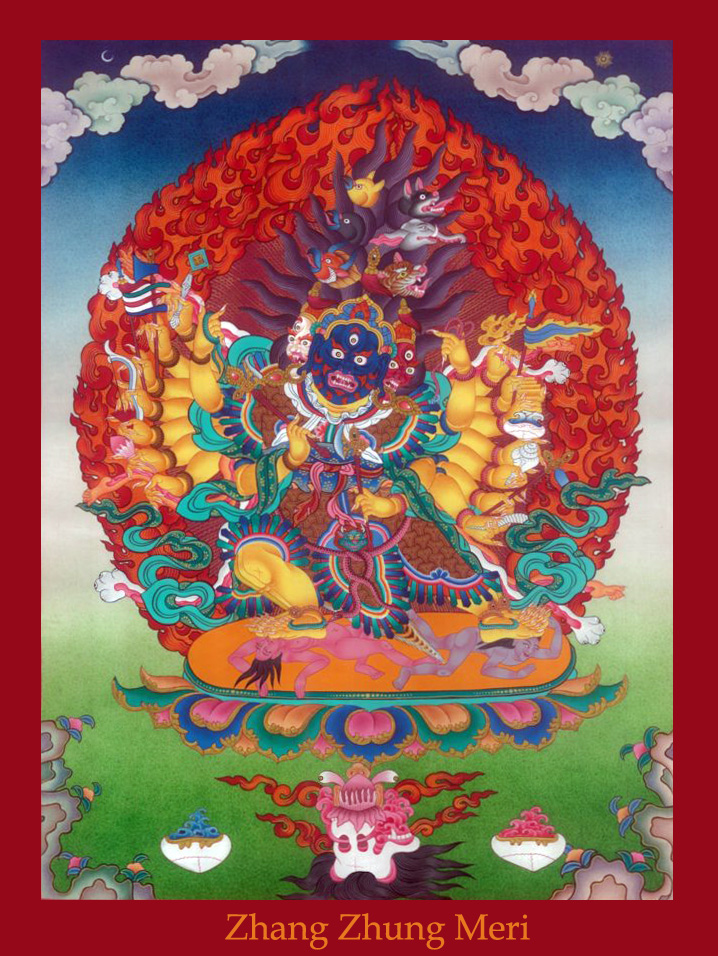
One manifestation of Walchen Gekhö is Zhang Zhung Meri. This yidam deity is closely associated with the dzogchen practice of the Zhang Zhung Nyen Gyü, The Aural Transmission of Zhang Zhung. The view of dzogchen is, by definition, perfected and beyond needing to apply any methods to develop or perfect it. However, because the practitioners of dzogchen have not yet fully realized this primordial perfection, the deity Zhang Zhung Meri offers protection and support while they are on the path of realization.
“É AH

Namo!

Buddhas of the three times, please listen and pay heed to me!

Having ignorance and a body of flesh, because of the influence of the material body and the afflictive emotions, I am not connected with the five wisdom bodies but are connected with deluded thoughts and afflictive emotions. I offer this open admission of wrongdoing to the buddhas of the three times. Please bestow the vivid accomplishment of the Five Enlightened Bodies to me!

Without the activities of compassionate, skillful means, and because of the afflictive emotion of pride that grasps at an identity, I have committed wrongdoing by elevating myself and lowering others, and I have acted from wrong views. I request tolerance from Ati Muwér! Please bestow the accomplishment of being equal to the changeless state!

Not equal with the state of powerful compassion, and overcome with the contamination of the cumulative actions of ignorance and hatred such as causing killing and condemnation, I openly admit my wrongdoing to the state of Walchen Gékhö. Please bestow the accomplishment of uninterrupted compassion! 

Because of anger and hatred that are produced, and not having a mind of loving kindness, I have been involved in killing and cutting the life force. I openly admit my wrongdoing to the gathering of Gékhö deities. Please bestow the accomplishment of being endowed with compassion and a mind of loving kindness!

Because of not being endowed with a state of clear wisdom, I have been lazy and acted from a clouded mind and delusion. I have improperly exploited and taken advantage of others. I openly admit my wrongdoing to the root deity Walchen Gékhö. Please bestow the accomplishment of a state of all-clear wisdom!

Because of having a hateful mind and not speaking truthfully, through pride and meaningless words, I have accumulated anguish [for others]. Because of the activity of deluded speech, I could become mute [in the future]. I openly admit my wrongdoing to the root deity Walchen Gékhö. Please bestow the accomplishment of a pleasant voice of truthful words!

Not having a mind of supreme generosity and devotion, I have been overcome by attachment, desire, and aggression. Because of the karma of improper, aggressive desire, I could become a cannibal-like spirit [in the future]. I openly admit my wrongdoing to the root deity Walchen Gékhö. Please bestow the accomplishment of a great rainfall of generosity!

Without a suitable intellect and not being broadminded, and because of the influence of jealousy, I have exalted myself and lowered others. Because of that, I could always be born as a human in an outlying, savage place [in the future]. I openly admit my wrongdoing to the root deity Walchen Gékhö. Please bestow the accomplishment of an easygoing, greatly broad mind! 

Not endowed with the compassionate state of the four elements, and with an imperfect nature in respect to the four times, I grasp the illusory body. I openly admit my wrongdoing to the state of the four mothers who are doorkeepers of the four times. Please bestow the accomplishment of overcoming phenomenal appearances!

From compassion, the four emanated sons display a spectacular form and perform wrathful activity. Enemies and obstructers are their servants who are entrusted to act. I openly admit my wrongdoing to the four youths who are emanations. Please bestow the accomplishment of attaining generosity and the two accomplishments! 

Not connected with the skillfulness of the primordial nature where there is no duality of true or untrue words, whatever is in contradiction to the enlightened mind of Kuji Mangké, I openly admit to the state that is equal with the natural mind. Please bestow the accomplishment of attaining the fulfillment of compassionate activities!” 

From The Irreversible Golden Razor, Scripture for the Accomplishment of the Secret, Greatly Fierce Demon Subduer, Walchen Gékhö

All translations from the Tibetan by Raven Cypress Wood ©All Rights Reserved

Raven Cypress Wood ©All Rights Reserved. No content, in part or in whole, is allowed to be used without direct permission from the author.

Don’t want to miss a post? Scroll to the bottom and click “Follow this blog.”

Want to join the mandala of Nine Ways supporters? Follow this link https://ravencypresswood.com/donate/ It’s easy through Paypal and Zelle.
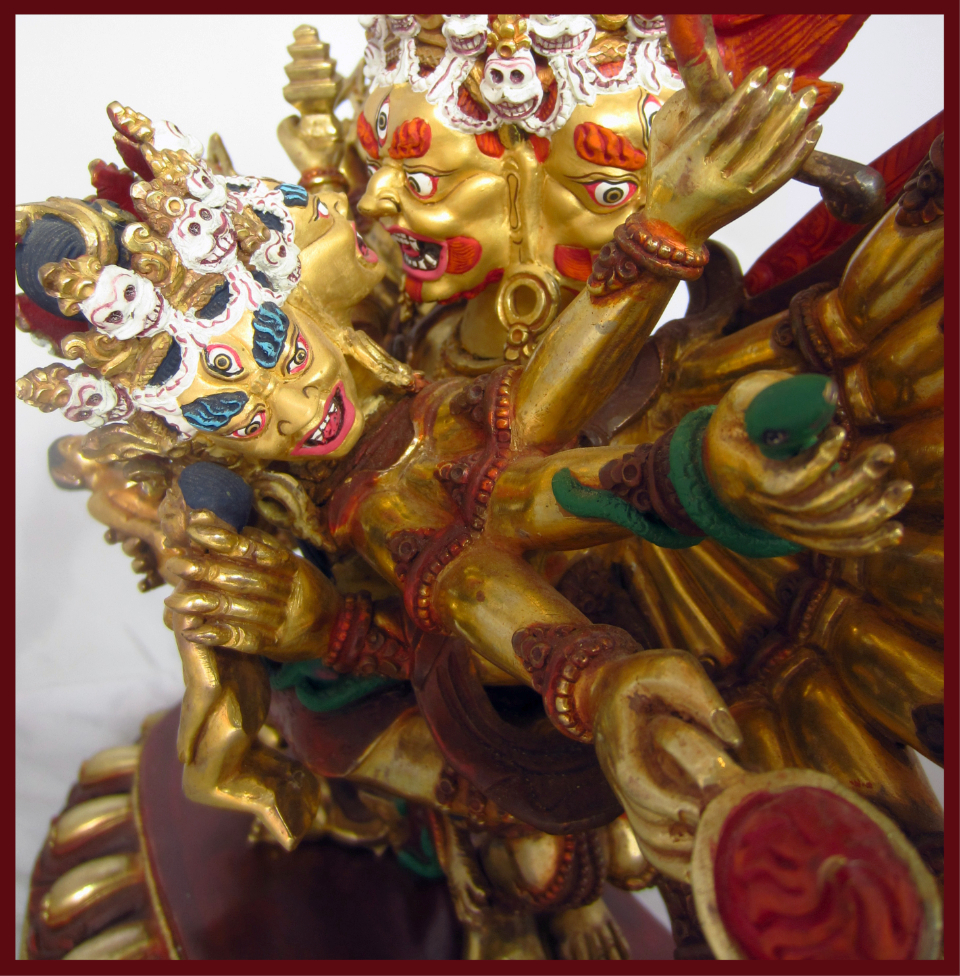
Walchen Gekhö and consort statue. Photo credit: Raven Cypress Wood

The Field of Accumulation: The Yidams

Tsok zhing according to Menri

Tsok zhing according to MenriThe Yungdrung Bon Merit Field of the Menri Tradition

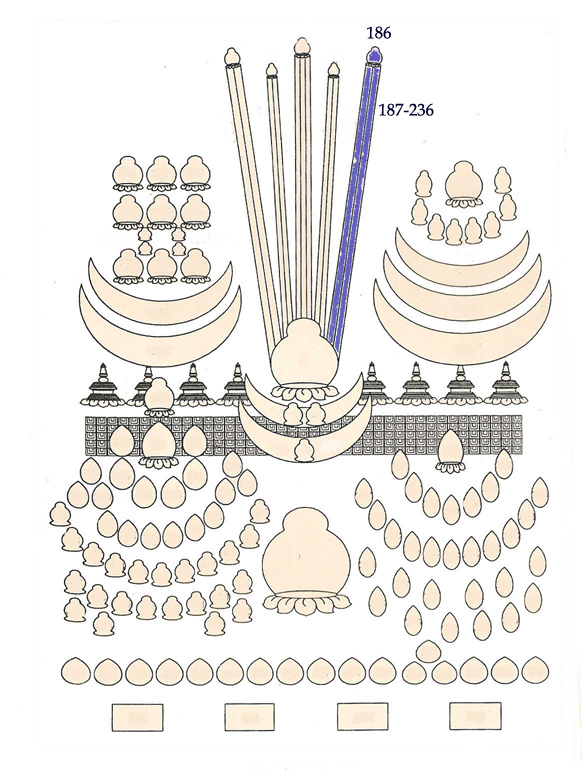
In the Yungdrung Bön tradition, the place where the deities and objects of veneration are gathered is called the “Tsok Zhing”, the “Field of Accumulation”.  It is also sometimes translated as the “Field of Merit” or the “Merit Field” because what is being accumulated by paying homage and making offerings to this place is merit, or virtue.  This is the Merit Field according to the Menri Tradition from a drawing done by the great master and scholar HE Yongdzin Tenzin Namdak Rinpoche.

Yidams are deities who have their own individual cycles of practice with the aim of acquiring the qualities and blessings of the yidam being meditated upon.  In general, these cycles of practice are centered around an individual retreat in which the practitioner focuses upon self-transformation into the deity, recitation of the deity’s mantra, along with any other ritual or meditation specific to the deity which support the attainment of the deities qualities and blessings.  There are yidams specific to a family lineage, to monastic lineages as well as personal yidams.  Some of the vows associated with yidam practice are general to all, and some vows are specific to each yidam.  Some yidams are represented more than once to signify their different tantric cycles.

#2-4, 14 & 18: The Five Supreme Embodiments of the Father Tantra (See previous post:https://ravencypresswood.com/2016/06/05/the-five-supreme-embodiments/)

1. Zhiwa Künnang Khyappa: This yidam represents all peaceful yidams

2. Trowo Tsochok Khagying: This yidam is an embodiment of the Enlightened Mind of Buddha Tönpa Shenrap Miwoche.

3. Walsé Ngampa: This yidam is an embodiment of the Enlightened Body of Buddha Tönpa Shenrap Miwoche.

The Yidam Walse Ngampa, Embodiment of the Enl ightened Body

4. Lhago Tokpa: This yidam is an embodiment of the Enlightened Speech of Buddha Tönpa Shenrap Miwoche.

5. Sangwa Ying Rol

6. Tséwang Rikdzin: As a long life deity, this yidam is white in color.

7. Magyü Sangchok Tartuk: This yidam is the principal deity of the Mother Tantra and is also known as Tukjé Galpo.

8. Drenpa Namkha

9. Bumpa

10. Rampa

11. Rolpa

12. Dütsi Yungdrung Khyilwa

13. Takla Pudri Marpo

14. Gekho Sangwa Drakchen:  This yidam is the embodiment of the Enlightened Qualities of Buddha Tönpa Shenrap Miwoche.

15. Trowo Druksé Chempa: This yidam is the Embodiment of the Enlightened Activities of Buddha Tönpa Shenrap Miwoche.

16. Meri Walchen Gekho

17. Chidul Yidam Gyatso Trogyal Raksha Khagying

18. Sangpur

19. Walsé Khyungnak Trowo Karpo

20.Wal Khyung Marpo

Yidams of the Other Tantras

#22-#25 The Four Principal Enlightened Ones (See previous post https://ravencypresswood.com/2016/08/20/the-four-principal-enlightened-ones/)

21. Gyepa Kunnang Khyapa

22. Tönpa Shenrap Miwo

23. Sipa Sangpo Bumtri

24. Lhachen Shenlha Ökar

25. Yumchen Satrik Érsang

26. Shenrap Nampar Gyalwa

27. Namdak

28. Jamma

29. Mélha

30. Kéngtsé Lenmé

31. Sherab Mawé Séngé

The Yidam Mawe Senge

32. Dülchok Tönpa Tritsuk Gyalwa

33. Jamma

34. Namdak

35. Mönlam Taye

36. Menlha

37. Künying

38. Gényen Tékpa Lha

39. Jamden

40. Dükhor

41. Künrik

42. Gyalwa Gyatso

43. Namjom

The Yidam Namjom, aka Nampar Jompa, and his emanations.

The Field of Accumulation: The Ocean of Khandro

Tsok zhing according to Menri

Tsok zhing according to MenriThe Yungdrung Bon Merit Field of the Menri Tradition

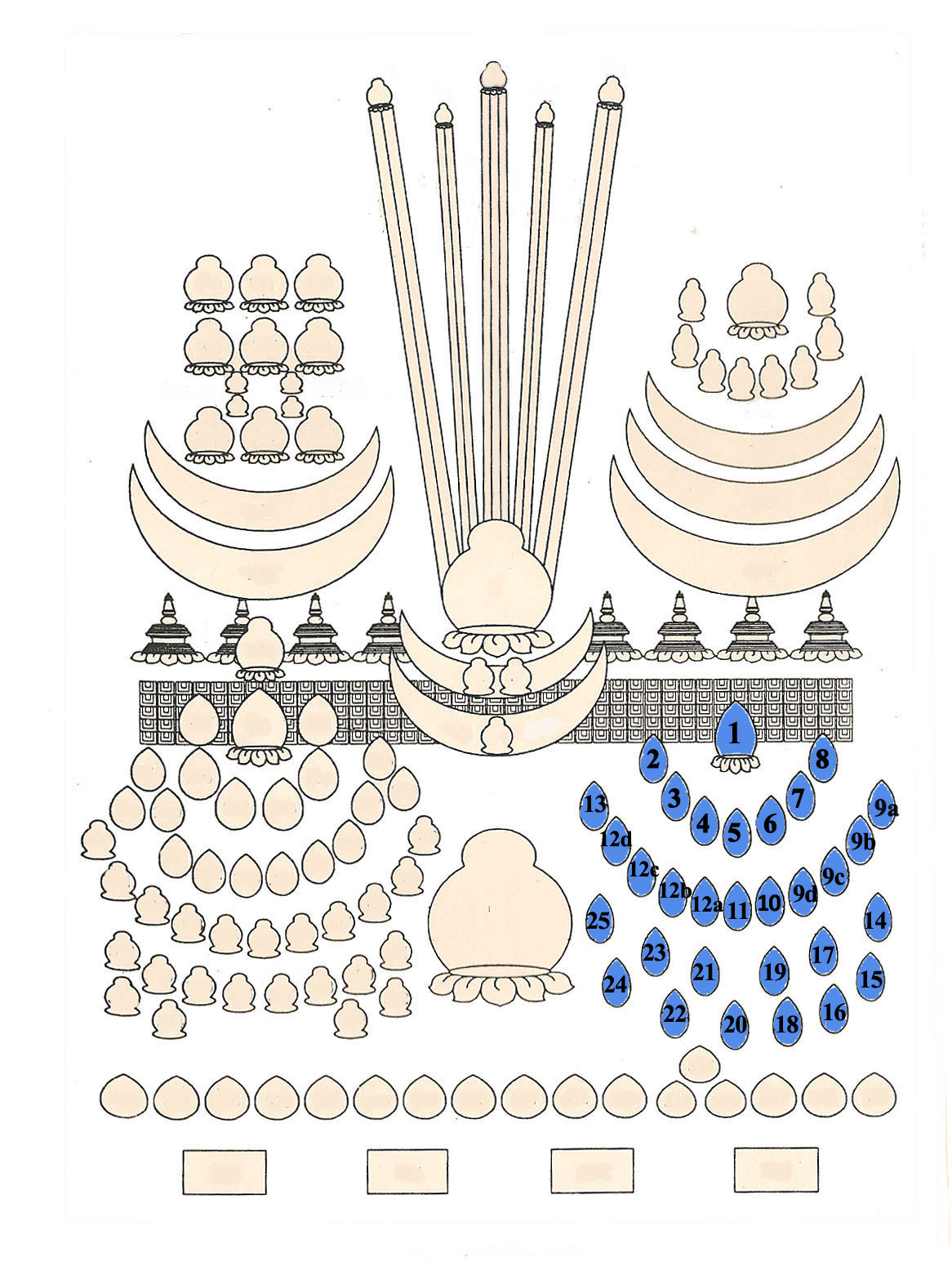
In the Yungdrung Bön tradition, the place where the deities and objects of veneration are gathered is called the “Tsok Zhing”, the “Field of Accumulation”.  It is also sometimes translated as the “Field of Merit” or the “Merit Field” because what is being accumulated by paying homage and making offerings to this place is merit, or virtue.  This is the Merit Field according to the Menri Tradition from a drawing done by the great master and scholar HE Yongdzin Tenzin Namdak Rinpoche.

outline-guide-for-tsok-zhing-ocean-of-khandros

The Ocean of Khandro are depicted as figures #1-25.   Khandro (Sanskrit: dakini) literally translates as ‘sky-goer’ or ‘one who moves in the sky’.  Khandro are a class of female beings who protect and serve the religious tradition as well as bestow spiritual attainments.   Khandro can be classified in many ways.  The classification below is according to the Tsok Zhing text.  Each of the khandro are adorned with the six bone ornaments.

#1-8 Wisdom Khandro

1. Kalpa Zangmo,  she has one face and four arms
2. Miyo Tenma
3. Dekma Kündrol
4. Kyema Ötso, Khandro of the Mother Tantra
5. Namkha Déden
6. Dakpa Kündü
7. Salwa Dröbéb
8. Tukjé Kündrol, Khandro of Tummo and Tsa Lung

Khandro Kalpo Zangmo

#9-13 Action Khandro

9a. Ürgyen Khandro, Khandro from Ürgyen
9b. Ürgyen Khandro, Khandro from Ürgyen
9c. Ürgyen Khandro, Khandro from Ürgyen
9d. Ürgyen Khandro, Khandro from Ürgyen
10. Choza Bönmo, Khandro of the female lineage of the Yétri Tasel Dzogchen
11. Öden Barma, Consort of Yidam Drenpa Namkha
12a. Gyagar Khandro, Khandro from India
12b. Gyagar Khandro, Khandro from India
12c. Gyagar Khandro, Khandro from India
12d. Gyagar Khandro, Khandro from India
13. Drushé Khandro, Khandro from Drusha

#14-25 Animal-headed Khandro

14. Durjé Ü, Heron-headed Khandro
15. Pharwé Ü, Coyote-headed Khandro
16. Chusin Ü, Crocodile-headed Khandro
17. Duktrul Ü, Poisonous Snake-headed Khandro
18. Chè Chang Ü, Jackal-headed Khandro
19. Sengé Ü, Lion-headed Khandro
20. Khyungi Ü, Garuda-headed Khandro
21. Takgi Ü, Tiger-headed Khandro
22. Zikgi Ü, Leopard-headed Khandro
23. Domgi Ü, Bear-headed Khandro
24. Drékyi Ü, Yellow Bear-headed Khandro
25. Khaté Ü, Crow-headed Khandro

Raven Cypress Wood ©2015


The Field of Accumulation: The Gathering of Buddhas

Tsok zhing according to Menri

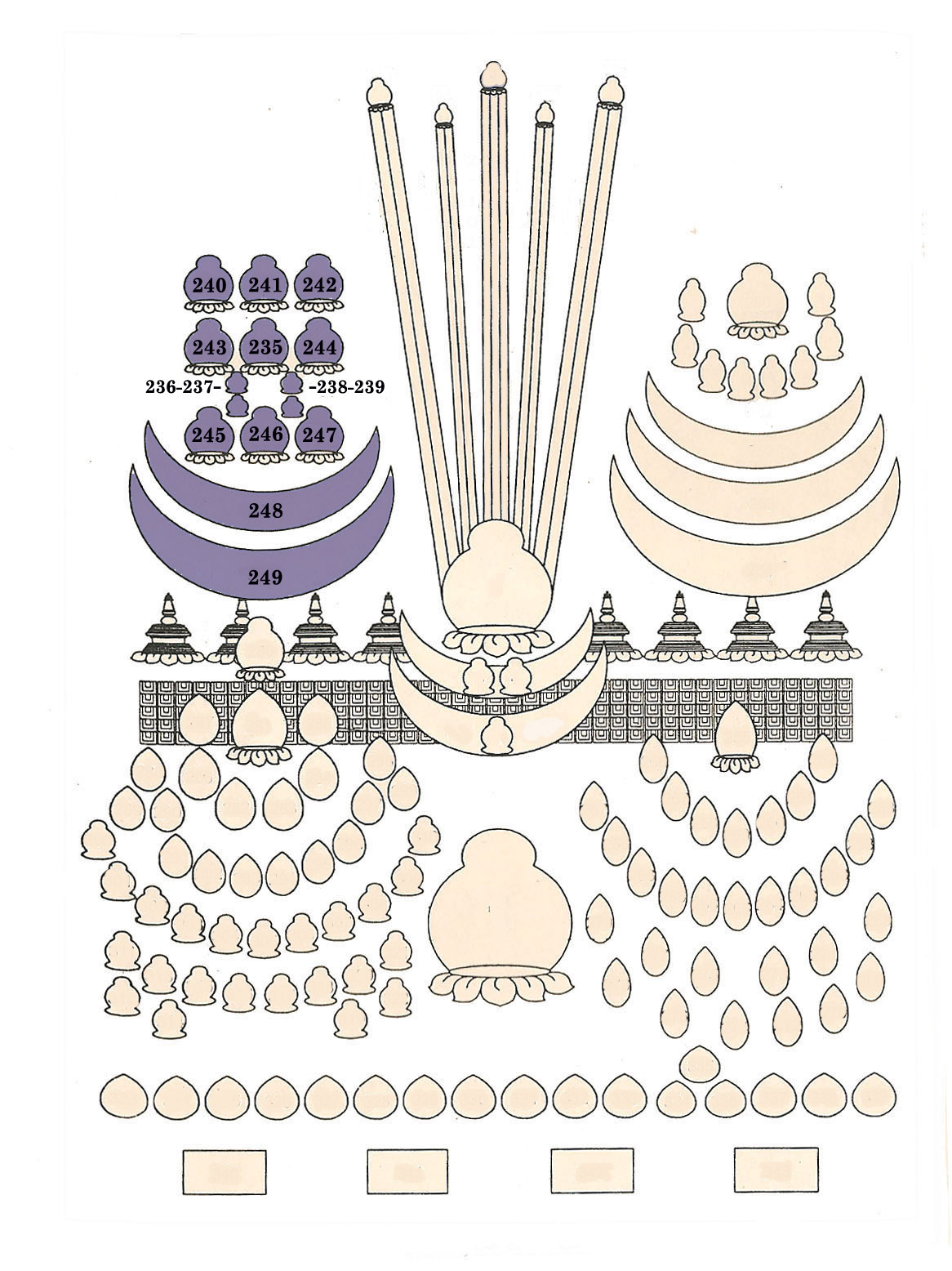
In the Yungdrung Bön tradition, the place where the deities and objects of veneration are gathered is called the “Tsok Zhing”, the “Field of Accumulation”.  It is also sometimes translated as the “Field of Merit” or the “Merit Field” because what is being accumulated by paying homage and making offerings to this place is merit, or virtue.  This is the Merit Field according to the Menri Tradition from a drawing done by the great master and scholar His Eminence Yongdzin Tenzin Namdak Rinpoche.

Outline guide for tsok zhing 235-249

This is the gathering of all of the Enlightened Beings.

235. Gyalwa Shenrap Miwo Künlé Nampar Gyalwa, the Completely Victorious in Every Way, Shenrap Miwo.  16,017 BC – 7,817 BC.  He is the Enlightened Being of the present time and founder of the Yungdrung Bön religious tradition.  He appeared in the human realm when the human life-span was generally 100 years long.  There are three versions of his life history: short, medium and long.  The short version is within a text commonly referred to as the Do Dü.  It is a terma, or rediscovered text, and has twenty-four chapters within one volume.  The medium length version is within a text commonly referred to as the Zer Mik.  It is also a terma and has eighteen chapters in two volumes.  The long version is within a text commonly referred to as the Zi Ji.  It is part of a group of orally transmitted texts and has sixty-one chapters in twelve volumes.

236. Yungdrung Tsukshen Gyalwa.

237. Sebu Malo.  One of the main disciples of Shenrap Miwo.

238. Sebu Yulo. One of the main disciples of Shenrap Miwo.

239. Tobu Bumsang.  He was the eldest son of Tönpa Shenrap Miwo.  He led a group of disciples who primarily practiced the dzogchen teachings.

#240-246 Enlightened Beings that Appeared in Past Eons

240. Nangwa Rangjung Tukjéchen.  This Enlightened Being appeared in the world when the human life-span was generally 100,000 years long.

241. Gewa Khorwa Kündren.  This Enlightened Being appeared in the world when the human life-span was generally 80,000 years long.

242. Künshé Nyonmong Duksek. This Enlightened Being appeared in the world when the human life-span was generally 60,000 years long.

243. Lékpa Tsemé Tukjéchen. This Enlightened Being appeared in the world when the human life-span was generally 40,000 years long.

244. Nyompa Tamche Khyenzik. This Enlightened Being appeared in the world when the human life-span was generally 20,000 years long.

245. Jampa Trigyal Khukpa. This Enlightened Being appeared in the world when the human life-span was generally 10,000 years long.

246. Dakpa Togyal Yékhyen.This Enlightened Being appeared in the world when the human life-span was generally 1,000 years long.  He was the eldest brother of Tönpa Shenrap Miwo in the celestial realm.

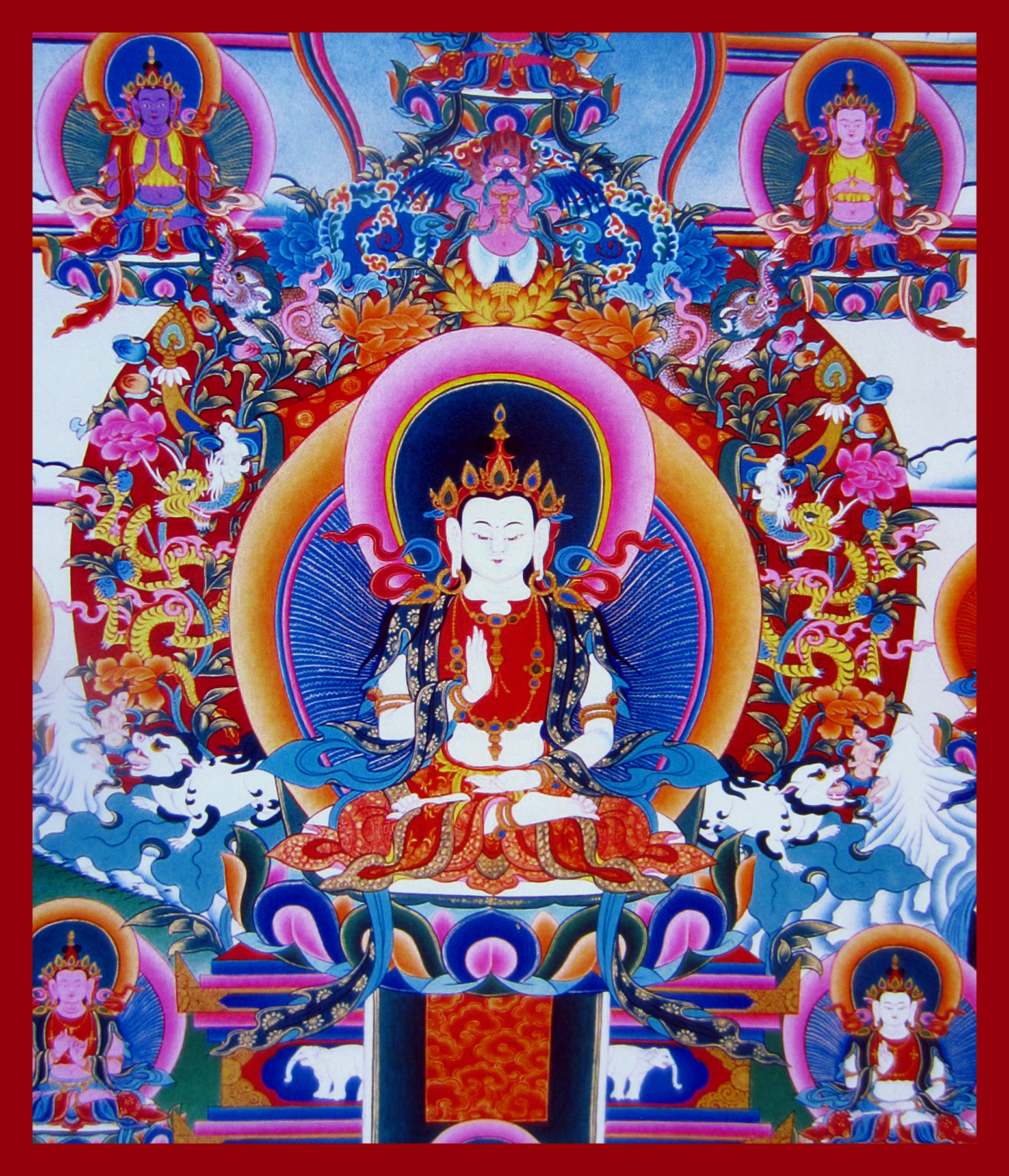
Jamden Rangma Medron, the Buddha prophesized to appear in the future

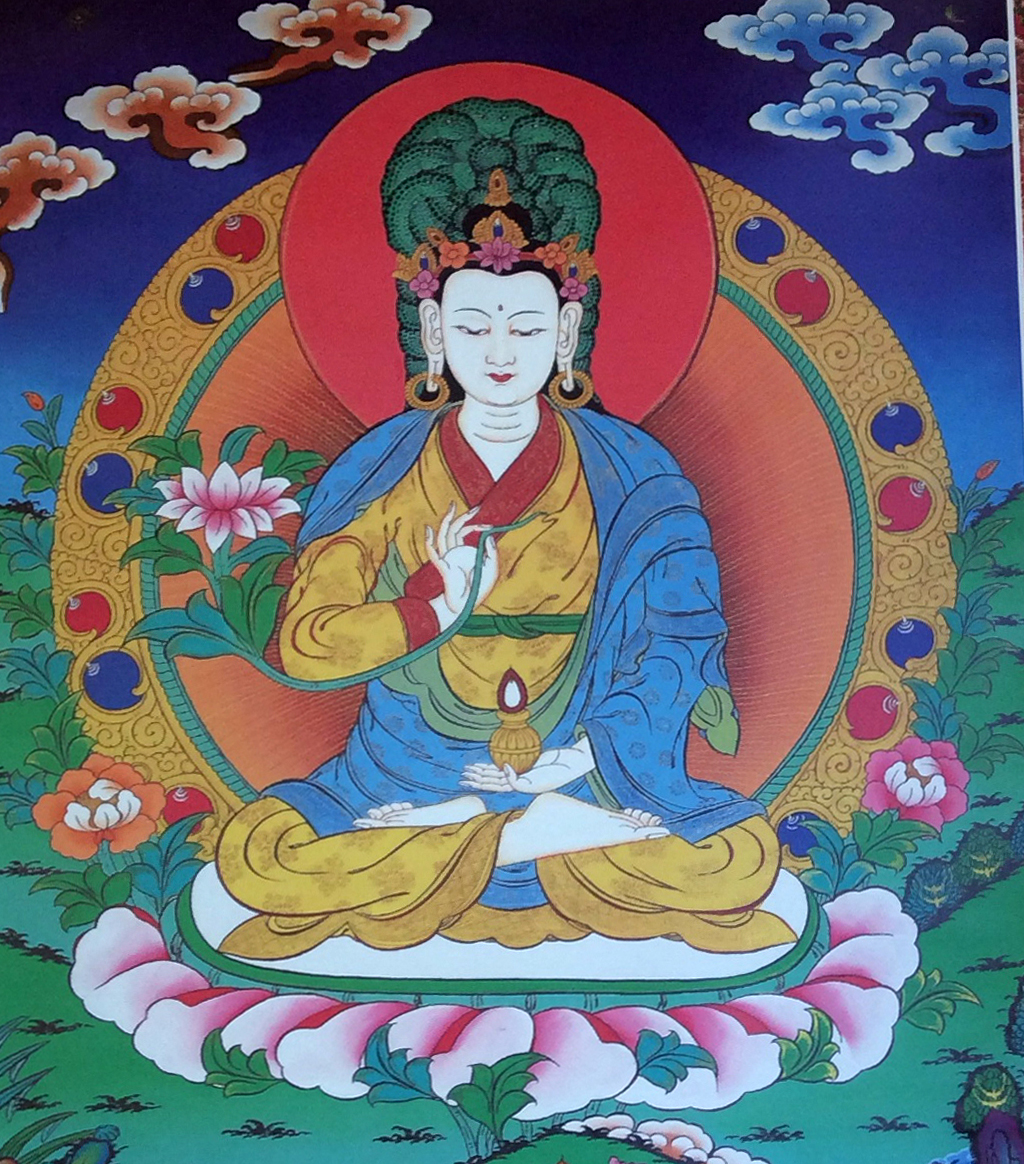
247. Jamden Rangma Médron.  This Enlightened Being is prophesized to be the Buddha of the Future and will appear in this world when the human life-span has declined to be only 10 years long.  He was the younger brother of Tönpa Shenrap Miwo in the celestial realm.  He is depicted upon a throne held aloft by elephants and seated upon cushions of a sun, moon, and lotus.  His right hand is held in a mudra of contemplation at the center of his heart and his left hand is held in the mudra of equipoise.  His body is the color of clear crystal and upon his head is a crown of precious jewels.

248. The 1002 enlightened Beings of the Fortunate Eon.

249. All of the Enlightened Beings found throughout the ten directions.

The Field of Accumulation: Lamas of the Renowned Three Cycles of Secret Mantra

Tsok zhing according to Menri

In the Yungdrung Bön tradition, the place where the deities and objects of veneration are gathered is called the “Tsok Zhing”, the “Field of Accumulation”.  It is also sometimes translated as the “Field of Merit” or the “Merit Field” because what is being accumulated by paying homage and making offerings to this place is merit, or virtue.  This is the Merit Field according to the Menri Tradition from a drawing done by the great master and scholar His Eminence Yongdzin Tenzin Namdak Rinpoche.

Outline guide for tsok zhing TANTRA

This is the lineage of tantra and these lineage masters wear the clothes of yogis, tertons or revealers of hidden sacred treasure, or monks accordingly.  These profoundly pure masters of tantra have all accomplished the attainments of practice.

1. Trulshen Nangden was the incarnation of Lord Tönpa Shenrap before he manifested in Olmo Lungrik.  Transforming himself into a blue cuckoo, he alighted upon the shoulder of the deity Zangza Ringtsun.  This caused a subtle, internal heat.  As a result, he was miraculously born to her as Chimé Tsukpü.

2. Zangza Ringtsun was an emanation of the enlightened wise, loving Mother, Sherap Chamma who received the teachings of the Secret Mother Tantra from the primordial Buddha.

3. Chimé Tsukpü was miraculously born to Zangza Ringtsun.

4. Sangwa Düpa is cited in some texts as the previous incarnation of Buddha Shakyamuni.

5. Takla Mebar was a prince of Tazik.

6. Lhashen Yongsu Dakpa spread the teachings among the gods.

7. Milu Samlek was known for his intelligence and wrote separate commentaries for each of the three cycles of the Mother Tantra: outer, inner, and secret.  He spread the teachings in the human realm.

8. Ludrup Yeshe Nyingpo was born to parents who had been childless for a long time.  After making offerings and praying to the lu, or naga, a child was born to them.  He spead the teachings among the lu.

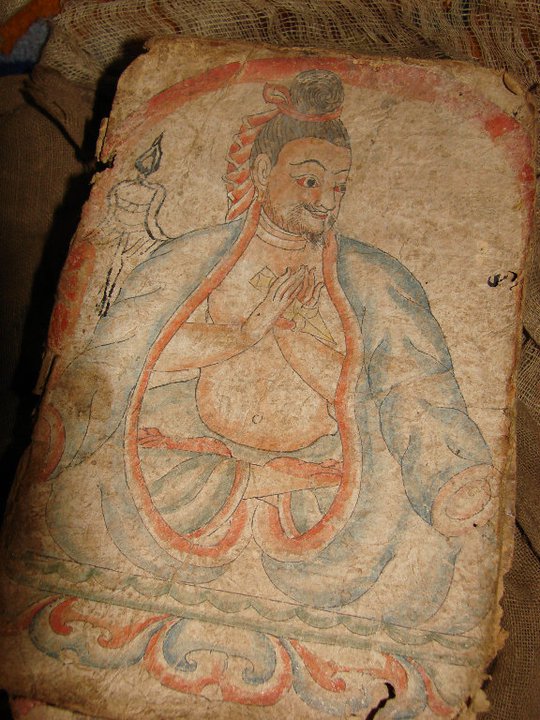
Lama Ludrup Yeshe Nyingpo

9. Nangwa Dokchen transmitted the teachings to the son of the first Tibetan king.

10. Mutri Tsenpo was the son of the first Tibetan king, Nyatri Tsenpo.  He invited one hundred eight esteemed scholars of Zhang Zhung to Tibet.  After him, these teachings were not taught for three generations due to political obstacles.

11. Hara Chipar received the teachings from the four magical khandro of the elements of earth, fire, water and air in order to keep the teachings from further decline.

12. Takwer Liwer was a female practitioner and achieved supernatural powers.  She could tame wild animals and also transform herself into anything that she wished.  The spirits of earth and water obeyed her commands.  After living for three hundred sixty years, she achieved the fruit of realization, the rainbow body of light.

13. Anu Traktak practiced on Mount Tise (Kailash) and lived for two hundred fifty-five years.

14. Sené Ga’u was born in Zhang Zhung and had many teachers.  It is said that he could cure leprosy simply by looking at the patient.  He achieved the rainbow body of light.

15. Tami Teké lived for two hundred seventy-seven years and achieved supernatural powers.

16. Shebu Rakhuk lived for two hundred years and achieved supernatural powers.

17. Zingwa Tüchen was a Chinese practitioner and lived for two hundred sixty-one years.

18. Pébön Toktsé

19. Pébön Toktrul lived for one hundred thirty-five years.

The Four Great Scholars: 20-23 These four scholars translated many Yungdrung Bön texts from the Zhang Zhung language into Tibetan.

20. Tonggyung Tüchen

21. Shari Uchen was a previous manifestation of the modern day saint, Shardza Tashi Gyaltsen Rinpoche.

22. Gyimte Machung

23. Chetsa Kharbu

24. Hripa Gyermé

25. Mutsa Gyermé gave the text Zi Ji to the 14th century master, Loden Nyingpo in a vision.

26. Drenpa Namkha was born in 753 AD.  In general, there are three Drenpa Namkha that are incarnations of the previous one.  1) Drenpa Namkha of Tazik 2)Drenpa Namkha of Zhang Zhung who was a prince and is commonly referred to as La Chen, the great lama.  It was this Drenpa Namkha that married an Indian Brahman girl and had twin sons, Tsewang Rikdzin and Pema Tongdrol.  3) Drenpa Namkha of Tibet who saved many Yungdrung Bön texts from destruction during the persecution of Bön by the Tibetan kind Trisong Detsen.  See previous post, “Practice of the Great Lama, Drenpa Namkha.”

ZZ Drenpa Namkha maybe

Lama Drenpa Namkha

27. Shenchen Luga 996-1035 was a manifestation of Tonggyung Tüchen and was a terton, or treasure discoverer, one who discovers texts and/or sacred objects that are hidden. He had many disciples who began religious centers in their respective home villages.

28. Germi Nyi Öd was born in Zhang Zhung and was a terton.  He lived for three hundred years.

29. Matön Sidzin was a terton who discovered many texts including a ritual invocation of the protector Sipe Gyalmo.

30. Yiltön Khyungö Tsal was born in 1198 and was a great terton who discovered many texts including the main ritual text for the protector and yidam Gekho,

31. Druchen Namkha Yungdrung

32. Wangden Zhuye Lekpo was one of Shenchen Luga’s main disciples and served him as an attendant. He founded the famous Ri Zhing Monastery.

33. Patön Palchok Zangpo was one of the final disciples to meet Shenchen Luga.

34. Me’u Lhari Nyenpo composed a summary of the long version of the Yungdrung Bön Prajnaparamita that was discovered as terma by Shenchen Luga.

35. Drusha Khyungi Gyaltsen was the son of Druchen Namkha Yungdrung.

36. Drusha Jetsun

37. Drutön Nyigyal

38. Yorpo Mépal 1134-1168

39. Nyi Tsultrim Gyaltsen

40. Drogön Dutsi Gyaltsen

41. Drogön Lodro Gyaltsen 1198-1263 was also known as Azha Lodro Gyaltsen.

42. Dulwa Gyaltsen

43. Drutön Gyalwa Yungdrung

44. Namkha Özer

45. Sonam Gyaltsen

46. Sonam Lodro

47. Namkha Sonam

48. Tsewang Gyaltsen

49. Namkha Rinchen

50. Namgyal Kara

51. Khedrup Rinchen Lodro