Category Archives: Uncategorized

The Field of Accumulation: The Lineage of the Three-fold Cycle of Dzogchen Proclamations

Tsok zhing according to Menri

Tsok zhing according to MenriThe Yungdrung Bon Merit Field of the Menri Tradition

In the Yungdrung Bön tradition, the place where the deities and objects of veneration are gathered is called the “Tsok Zhing”, the “Field of Accumulation”.  It is also sometimes translated as the “Field of Merit” or the “Merit Field” because what is being accumulated by paying homage and making offerings to this place is merit, or virtue.  This is the Merit Field according to the Menri Tradition from a drawing done by the great master and scholar HE Yongdzin Tenzin Namdak Rinpoche.
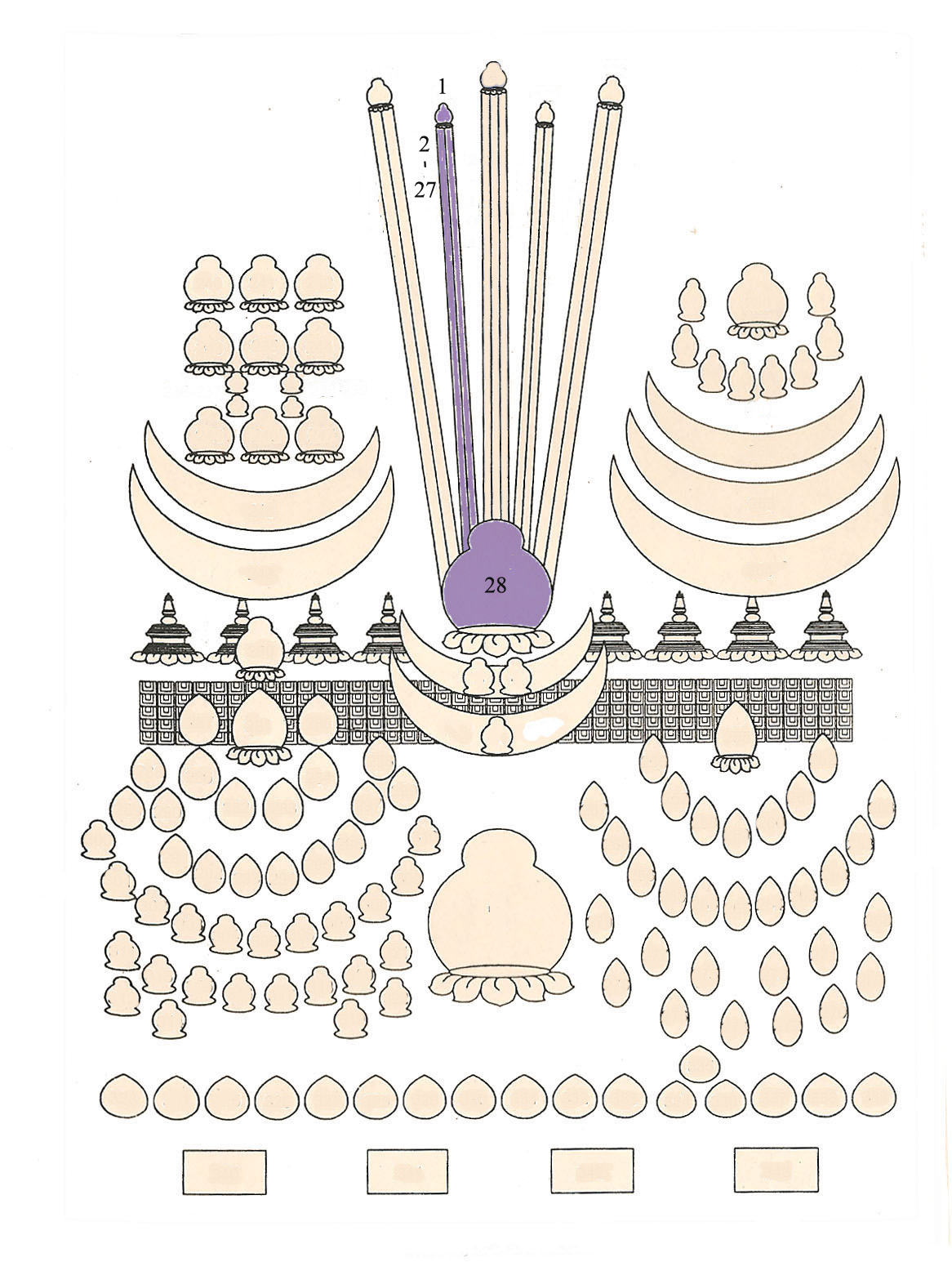
Outline guide for tsok zhing Dzogchen Drakpa Korsum

Diagram highlighting the placement of the Dzogchen Lineage within the Merit Field thangkha.

#1-28 depicts the Lineage of the Three-fold Cycle of Dzogchen Proclamations. In Tibetan, the Dzogchen Drakpa Korsum Gyü.

1. The source of the lineage, the White Light Deity, Shenlha Ökar.  He appears in the form of dzok ku, the enlightened Body of the Perfected Qualities and wears the corresponding ornaments.  His compassion is all-pervasive.

2. The Five Victorious Families who have gone beyond bliss, aka The Five Buddha Families.

3. Chimé Tsukphü.  He was the previous existence of the enlightened Lord Tönpa Shenrab Miwoche immediately before descending from heaven to earth.

4. Lhashen Yongsu Dakpa.  He was the shen of the gods who received the teachings from Chimé Tsukphü.

5. Milu Samlek.  He was the shen of the humans who received the teachings from Chime Tsukphü. He was born a prince in the ancient land of Tazik as his father, the king, was about to die.  He was known for his intelligence even as a young man.

#6-10  The Transmission of the Changeless Sages

6. Lushen Yeshé Nyingpo.  He is the shen of the lu, aka nagas, who received the teachings from Chime Tsukphü.

7. Ödzer Pakmé.  He was a master from Tazik.

8. Münpo Künsal

9. Trulshen Nangden

10. Sangwa Düpa.  He was a chief disciple of Chimé Tsukphü. He was born a prince of Tazik.
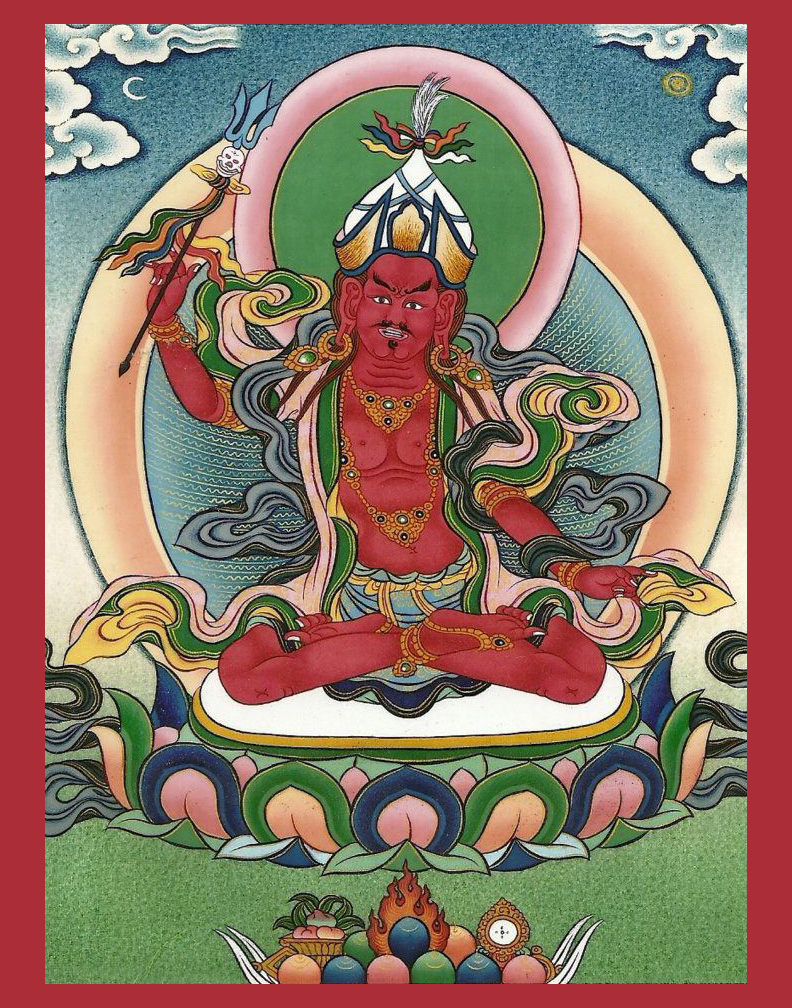
Translator and great yogi, Lama Tonggyung Tuchen

#11-14 The Transmission of the Scholarly Translators

11. Tonggyung Tüchen

12. Sé Bön Shari Uchen 

13. Chétsa Kharbu

14. Nyachen Lishu Taring.  A king and queen found a beautiful young girl in a forest. They named her Takza Liwer. Some time later, through the performance of ritual, she transformed herself into a man. However, she was still female when she wrote the root text for The Three-fold Cycle of Dzogchen Proclamations in the 8th century.  As a male, he became heir to the kingdom and was called Nyachen Lishu Taring.

15. Dé Bön Gyimtsa Machung  

16. Drupchen Chogye

17. Choza Bönmo

18. Zhotön Ngödrup Drakpa. He was an emanation of Lishu Taring and a tertön, or treasure revealer,  who rediscovered hidden texts behind a statue of Vairochana in Lhodrak that were hidden by Lishu Taring during a time of persecution for the Yungdrung Bön.

19. Gyaton Jodé

20. Zhikpo Nangseng

21. Kyotön Ngakpal

22. Yotön Lhunpal

23. Sengé Drukdra

24. Bönzhik Lodé

25. Tokden Yungrin

26. Khetsün Sherdrüp

27. Yonten Sengé

28. The Second Victor and founder of Tashi Menri Monastery, Nyammé Sherap Gyalsten 1356-1415.
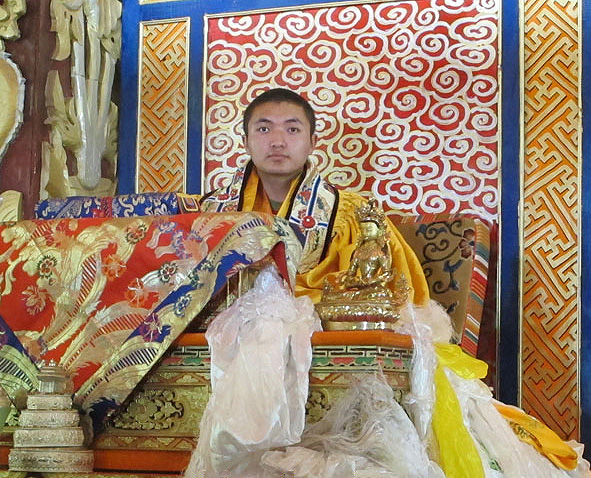
Direct Descendants of the Enlightened Lord Tönpa Shenrap Miwoché

Over 18, 000 years ago, in the ancient realm of Olmo Lungrik, the founder of the Yungdrung Bön spiritual tradition was born.  The enlightened Lord Tönpa Shenrap Miwoche was born into the human realm as a prince.  He later adopted the life as a monastic in order to display the path of renunciation to his followers.  However, prior to this, he was married and had sons and daughters.  The direct descendants of this Shen lineage have continued until this very day.  Currently, there are two sons who are direct descendants of Lord Tönpa Shenrap.

Heir to the Shen Lineage, Tsukpu Namdrol Rinpoche, during a visit to the Yungdrung Bon monastery of Gangru Dargye located in Khyungpo, Tibet

Lamas of the Shen lineage

The two sons of the Shen lineage who are direct descendants of the Lord Tonpa Shenrap.

In November of 2014, His Holiness, the supreme 33rd Menri Trizen Lungtok Tenpé Nyima offered prayers to both descendants.

Shen Tsukpu Namdrol Rinpoche

Shen Tsukpu Namdrol Gyaltsen Rinpoche

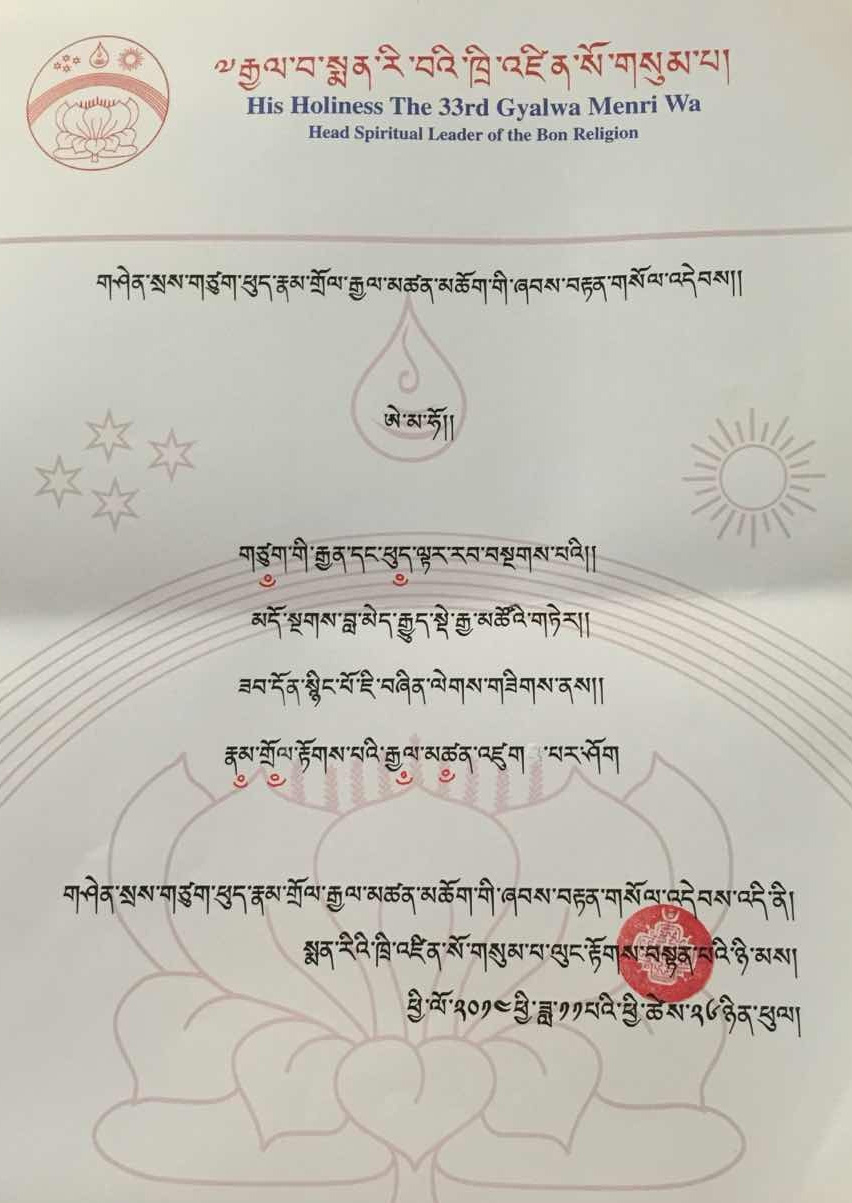
prayer to Shen Tsukpu namdrol Gyaltsen written by 33 Menri trizen 2

Prayer of Stability for the Shen Heir, the Supreme Tsukpu Namdrol Gyaltsen

EMAHO!

Highest praise for the best of crown ornaments,

   Storehouse of the ocean of sutra, tantra and unsurpassed division of teachings,

From the proper understanding of the profound meaning of the innermost essence,

May the victory banner of liberation and realization be established!

Murik Shen Yungdrung Nyima

Murik Shen Yungdrung Rangdrol Nyima Rinpoche

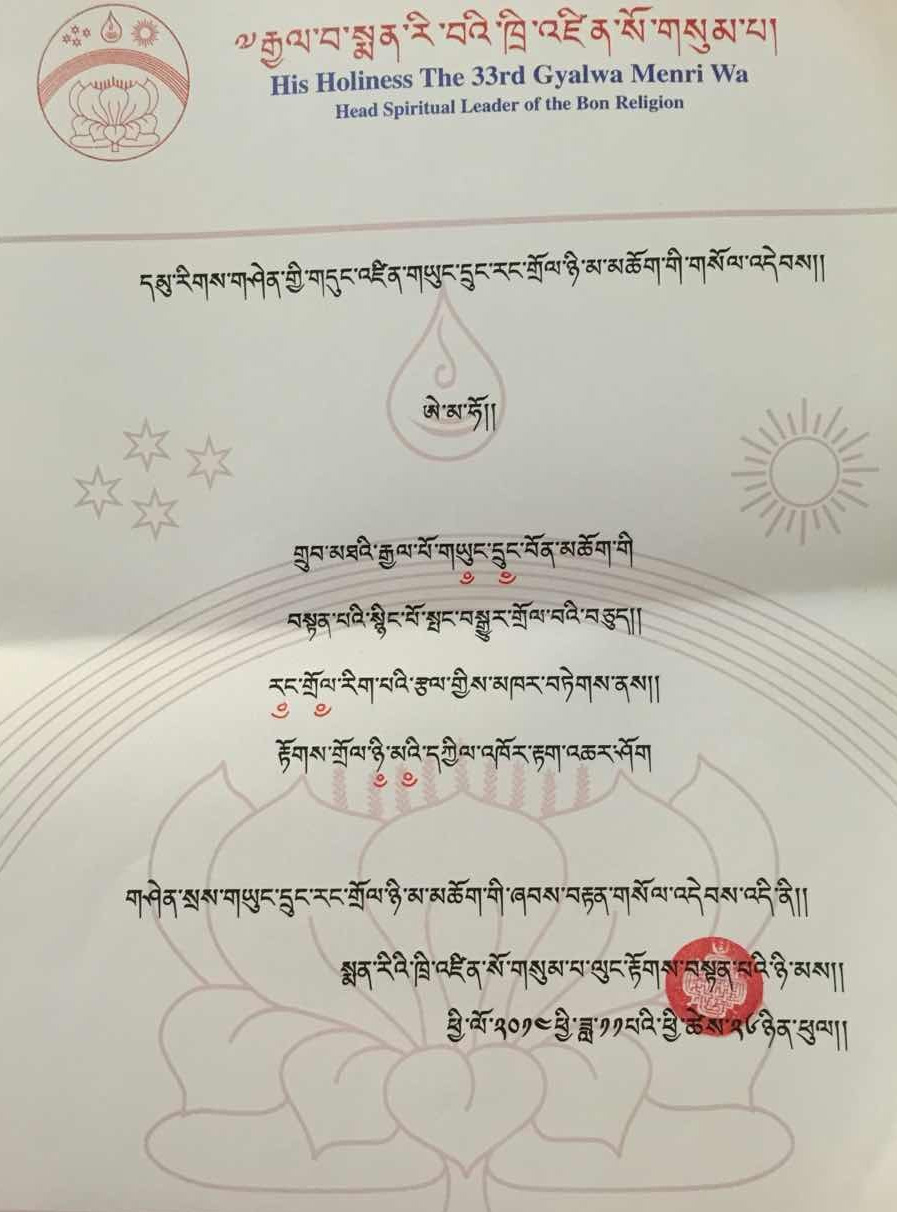
Shen prayer to Yungdrung Nyima

Prayer for the Shen Heir, the Supreme Murik Shen Yungdrung Rangdrol Nyima

EMAHO!

Essence of the king of doctrines, the supreme Yungdrung Bön,

Distilled essence of the teachings of renunciation, transformation and liberation,

Having raised a stronghold through the dynamic energy of self-liberated awareness,

May the sun disc of realization and liberation eternally appear!

Composed by 33rd Menri Trizen Luntok Tenpé Namdak Rinpoche on the Western date of 11/26/2014

Translated by Raven Cypress Wood

The original article first appeared on the Tibetan language website Himalayan Bön and can be viewed here: http://www.himalayabon.com/article/poem/2015-01-02/518.html

Raising Prayers to the Sky

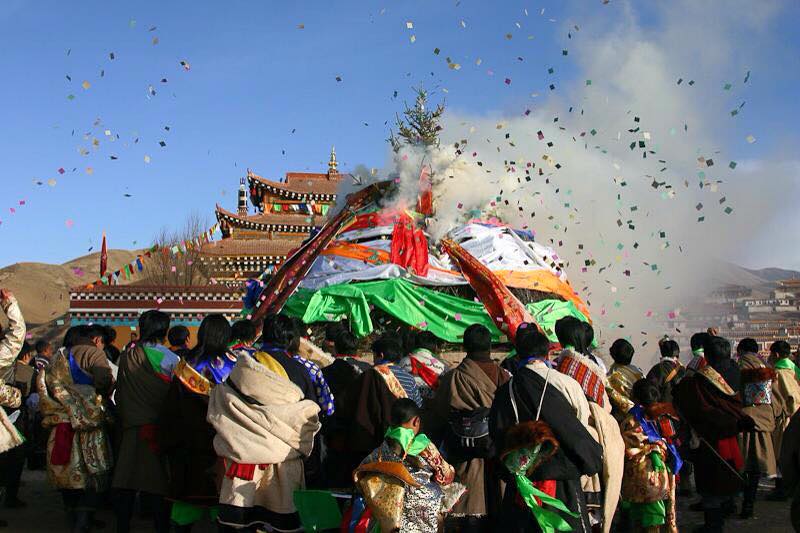
raising lungta at Nangzhik monastery

Tibetan New Year celebration at the Yungdrung Bon monastery of Nangzhik in Eastern Tibet. Photo credit: Unknown

The Twelve Animals of Tibetan Astrology: The Sheep

In Tibetan astrology, there is a twelve year cycle.  Each of these years is characterized by a different animal and associated with one of the five elements.  Therefore, a full cycle of the twelve animals being associated with each of the five elements takes sixty years.  The twelve animals according to the Yungdrung Bön texts are the Rat, Elephant, Tiger, Rabbit, Dragon, Horse, Snake, Sheep, Garuda, Monkey, Dog and Pig.  Each animal is associated with a specific element for its life-force as well as a specific direction which is determined by the life-force element.  Not only are these twelve animals associated with a particular year, they are also associated with particular months, days and hours.

2015 is the year of the SheepTherefore, people born during this year would be a Sheep and would have an emphasis of the specific qualities associated with Sheep.  (This year corresponds with the Tibetan lunar calendar and began February 19, 2015.)  2015 is also governed by the element of Wood and is a female year.  So, people born during this year would be a Female Wood Sheep.  The element which governs the life-force of the Sheep is Earth and its direction is Southwest.  So, if a Sheep person wanted to strengthen their life-force, they would focus upon strengthening the element of Earth internally and externally.  The positive direction Southwest.  So, facing this direction while meditating, doing healing rituals or just relaxing and taking deep breaths is beneficial.

astrology sheep greenIn general, the Sheep is considered to be a friendly and kind-hearted person who is gentle and easy-going.  Although they have a strong sense of fairness and right behavior, they are quick to forgive.  They prefer an uncomplicated life that is harmonious.  However, in the face of danger, they can be ferocious in their attempt to protect themselves or others.  They are independent thinkers but often work best as part of a team.  Sheep are often religious and can be interested in the supernatural.  Although they tend to be very creative, the creativity must have a practical purpose.  They thrive within a stable and loving relationship.

The Sheep’s soul day is Friday and the life-force day is Monday.  These are the best days for beginning new projects and activities that are meant to increase or develop something.  The obstacle day is Thursday.  This day is best for cleansing and letting things go.  It is not a favorable day for beginning new things.

Sheep years include: 1943, 1955, 1967, 1979, 1991, & 2003

If you were born during a previous year of the Sheep, this year as well as other Sheep years are considered a time of vulnerability to obstacles. This same astrological principal applies for all of the other eleven animal signs during their associated year. Therefore, it is recommended to engage in practices that support vitality, good fortune and spiritual merit such as hanging prayer flags, having a soul and life-force retrieval ritual performed, restoring any deterioration or violation of one’s spiritual commitments or any damaged relationship with one’s spiritual brothers and sisters, and/or performing prayers and rituals to remove obstacles. In general, making an effort to engage more with virtuous activities of body, speech and mind and committing to engage less with non-virtuous activities is supportive. According to the words of Buddha Tönpa Shenrap Miwoché, the practice of developing sincere unbiased and unlimited compassion is the greatest of all protections.

A common prayer within the Yungdrung Bön tradition that is used to remove obstacles is the Bar Che Lam Sel, The Spontaneous Wish-fulfillment of Removing Obstacles from the Path. The English, Spanish and Portuguese translations of this prayer are offered free for personal use on the Nine Ways Publications page. Click on the Publications tab above and scroll down to the download links for the prayer.

Raven Cypress Wood© All Rights Reserved

Don’t want to miss a post? Scroll to the bottom and click “Follow this blog.”

Prayers for Good Luck

Yungdrung Bon Monks performing the lha sang, or offering of purifying smoke ritual.  This ritual is traditionally performed during the Tibetan New Year’s celebrations.  In 2015, that will be February 19th.  Photo credit: Unknown