
Yungdrung Bon monks gathered inside the temple of Menri Monastery in Dholanji, India. Photo credit: Unknown
Yungdrung Bon monks gathered inside the temple of Menri Monastery in Dholanji, India. Photo credit: Unknown
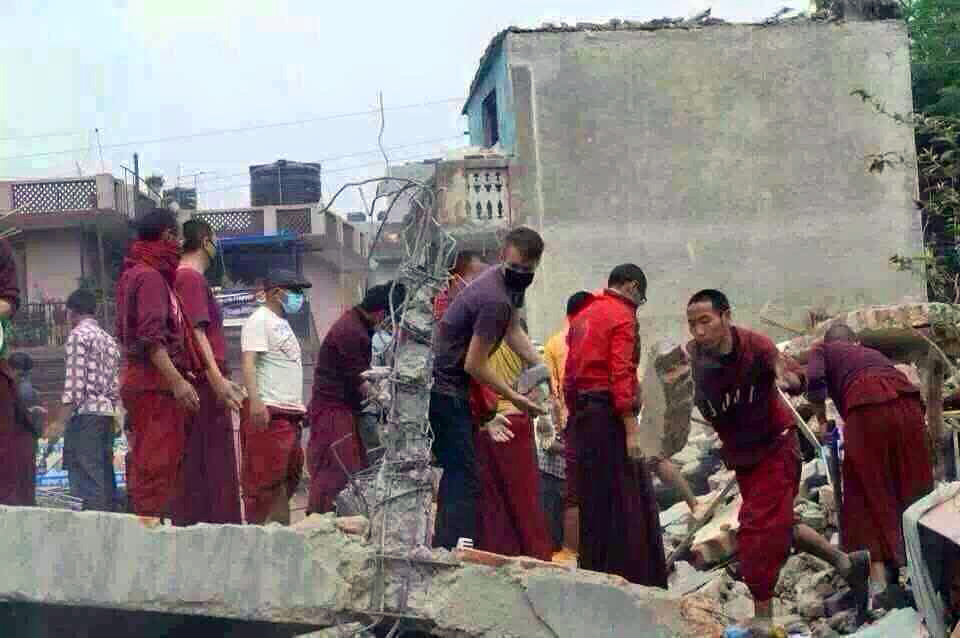
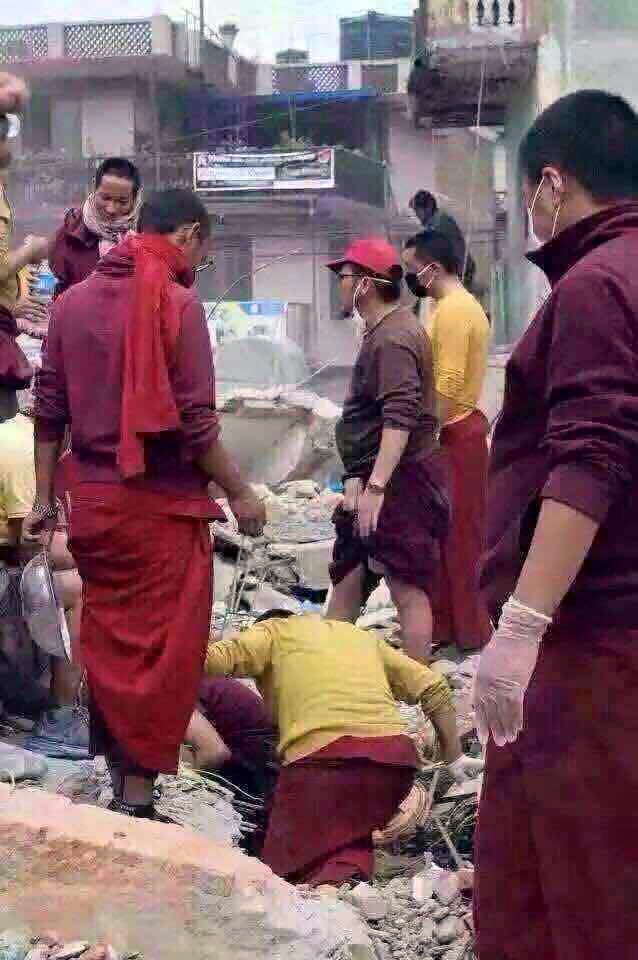
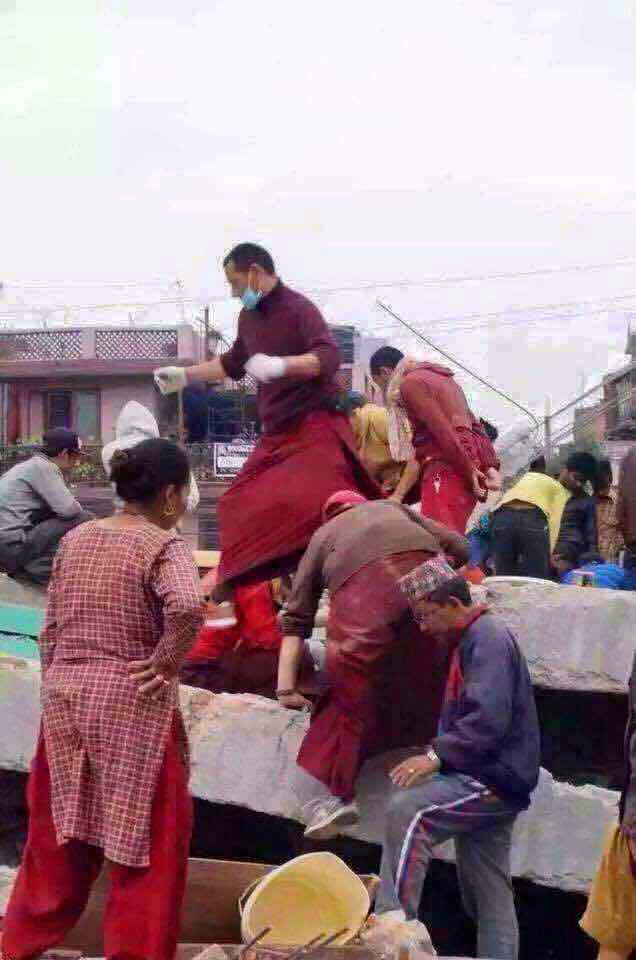
Monks from the Yungdrung Bon Monastery of Triten Norbutse located near Kathmandu, Nepal help to free neighbors from collapsed buildings after the devastating earthquake. Photo credit: Unknown


Zi bead found in Western Tibet. Photo credit: Unknown
Recently, an archaeology professor working in the Ngari region of Western Tibet, South of the Ganges River, discovered an ancient zi from a gravesite. This was the area of the ancient kingdom of Zhang Zhung.
The original article can be read in full at the Himalaya Bon Tibetan language website: http://himalayabon.com/news/2015-04-10/574.html

Illustration from the book “Tibetan Thangkha Painting, Methods & Materials” by David & Janice Jackson
Before the artist begins sketching out the images that will appear on the thangkha, they must first determine the division of space on the canvas. First, by using chalk lines and a compass, the true center of the canvas must be found. Second, both the horizontal and the vertical axis must be established. In this way, the artist can allocate space to the images according to hierarchy and the number of images that need to be represented.

Diagram 1: Common positions when depicting a central image and 4 retinue

Diagram 2: Common positions when depicting a central image and 8 retinue
These diagrams show the most common designations of space although there are variations. However, even with variations, the position of the retinue in relation to one another remains the same. The retinue are positioned according to their association with the directions. In the text, the detail of the deities position begins with the center and is then listed the Bön way, or counter-clockwise, beginning with the East. Referencing the diagrams above: 1=Center, 2=East, 3=North, 4=West, 5=South, 6=Southeast, 7=Northeast, 8=Northwest, and 9=Southwest. Most often, but not always, the deities are the color associated with the direction. East=yellow, North=green, West=red and South=blue.

The Deities of the Five Buddha Families
Here, the deities of the Five Buddha Families are positioned according to diagram 1 above. In the center is the Enlightened One, Künang Kyapa and consort. In the east is the Enlightened One, Salwa Rangjung and consort. In the north is the Enlightened One, Gélha Garchuk and consort. In the west is the Enlightened One, Jedrak Ngomé and consort. And in the south is the Enlightened One, Gawa Döndrup and consort.

Each of the five colors of prayer flags correspond with the five elements. Hanging them in clean, high places where the wind activates their qualities is a way to develop and strengthen the five elements within one’s own body, speech and mind.
 Nine Ways