
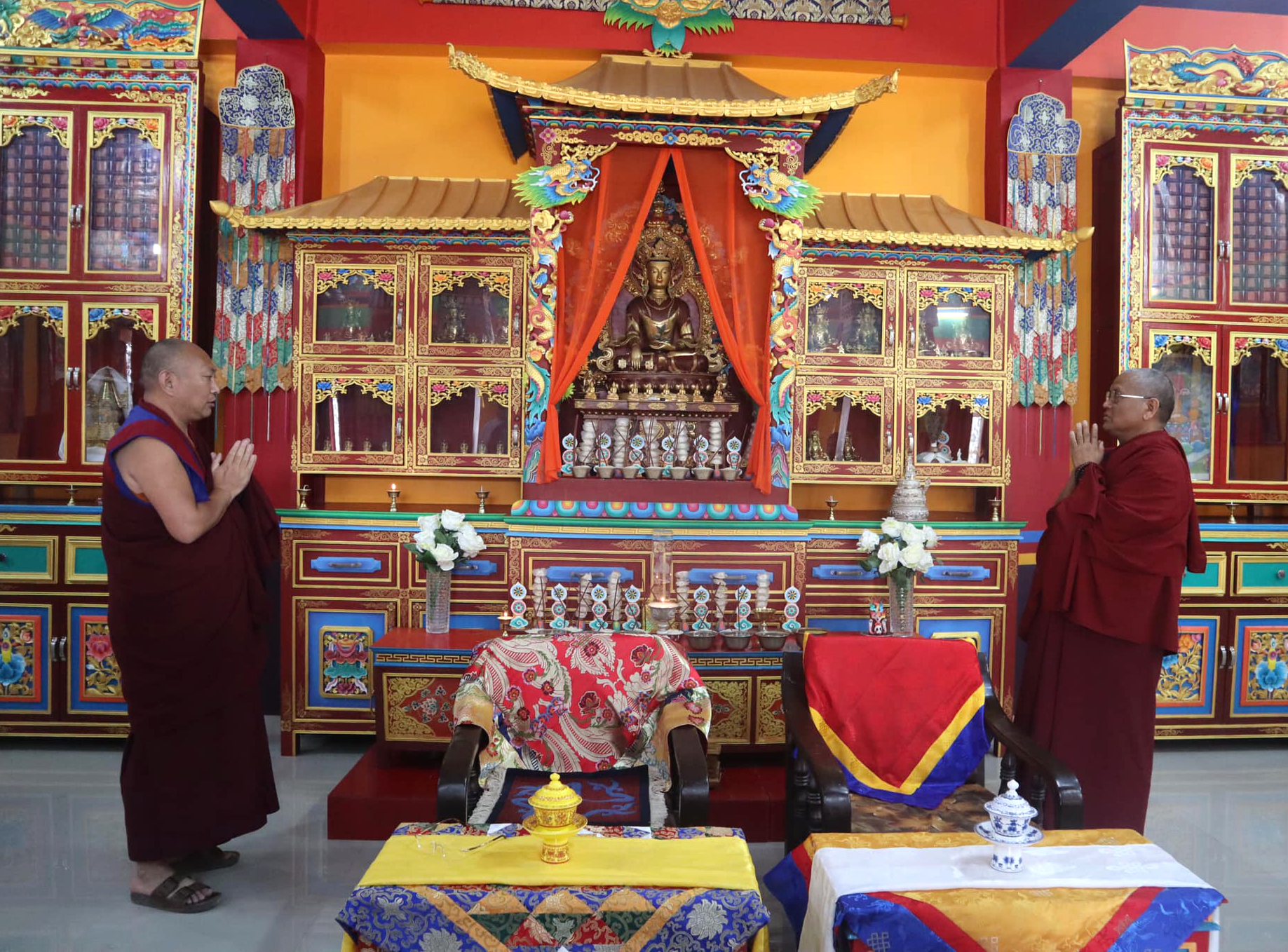
Menri Monastery in Dolanji, India is currently conducting the Great Retreat of the Medicine with Swirling Rays of Light, Mendrup Ö Zer Khyilwa. (See previous article for the retreat schedule, description of the preliminary practices, and overview of the history and lineage of the great mendrup retreat: https://ravencypresswood.com/2024/04/13/the-great-retreat-of-the-medicine-with-swirling-rays-of-light/) There are many mendrup cycles within the Yungdrung Bön tradition with each relying upon a different yidam, or meditational deity. Some mendrup cycles are vast and complex and many others are much shorter and simpler. The Medicine with Swirling Rays of Light cycle is one of the most extensive and complex cycles and is according to the trowo, or wrathful deities. Although all the peaceful and wrathful deities are invoked during the mendrup ceremony, for the main practice of the Medicine with Swirling Rays of Light the primary yidam is the embodiment of Buddha Tönpa Shenrap’s Enlightened Mind, Trowo Tsochok Khagying.

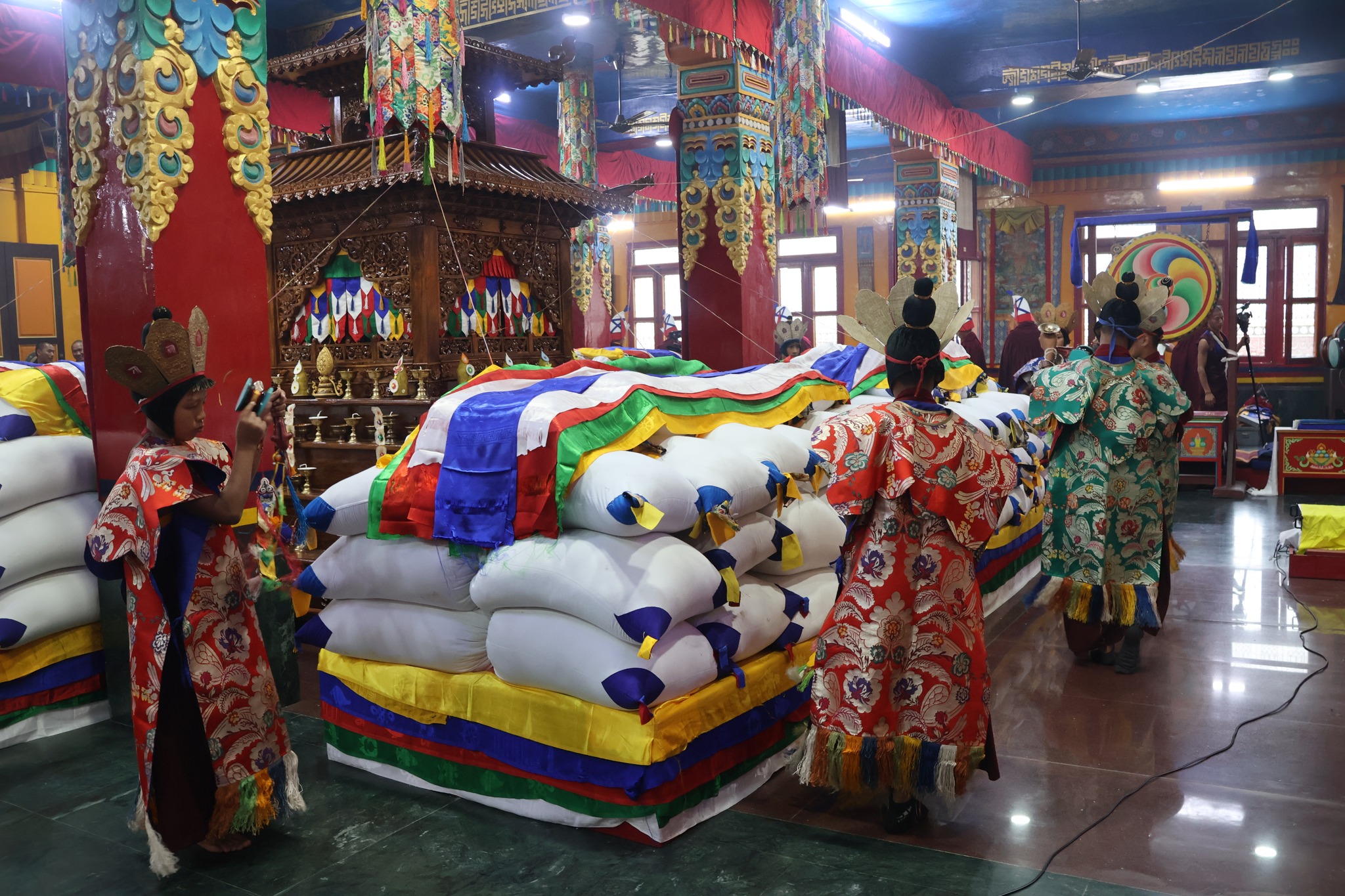
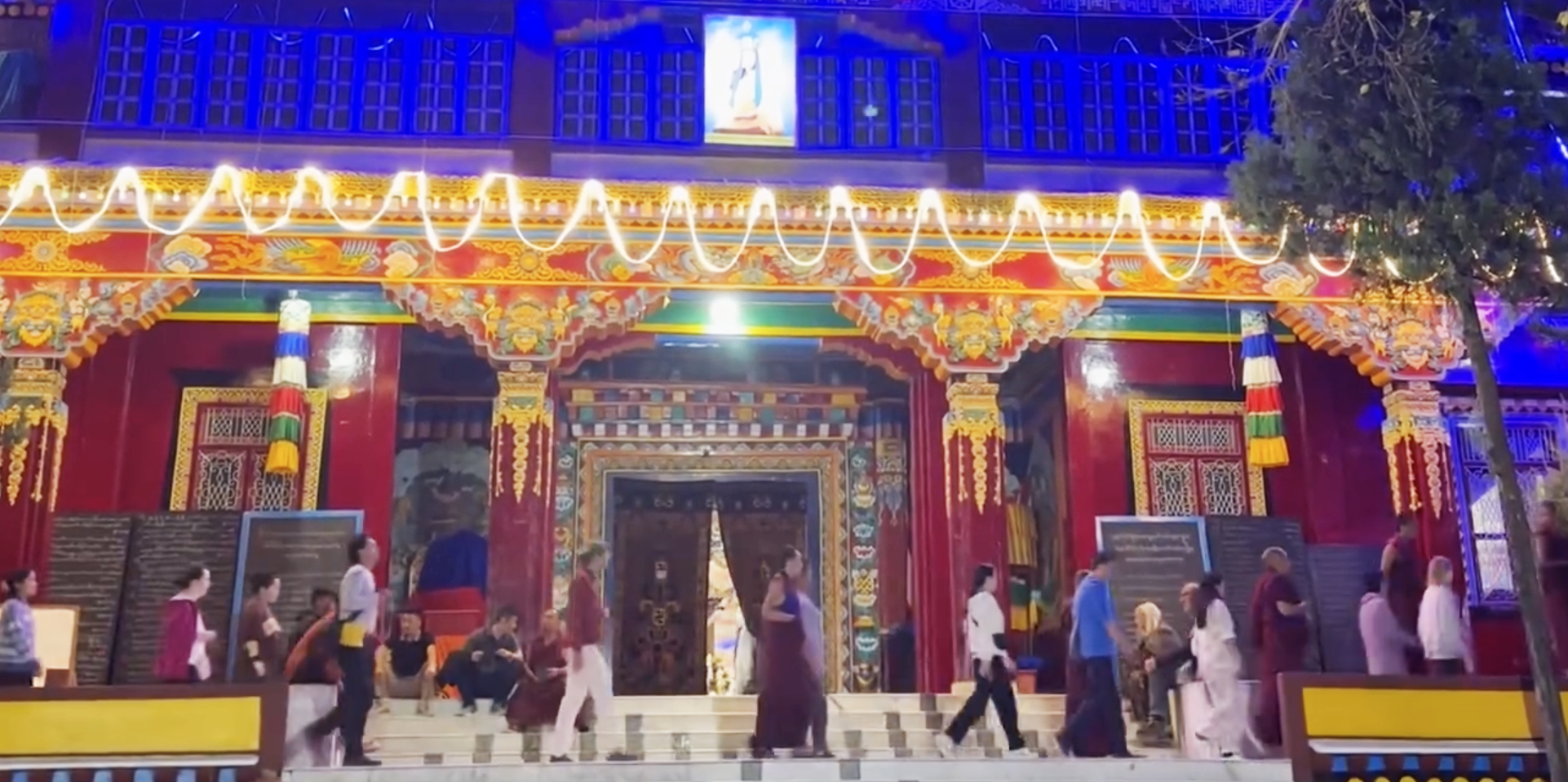
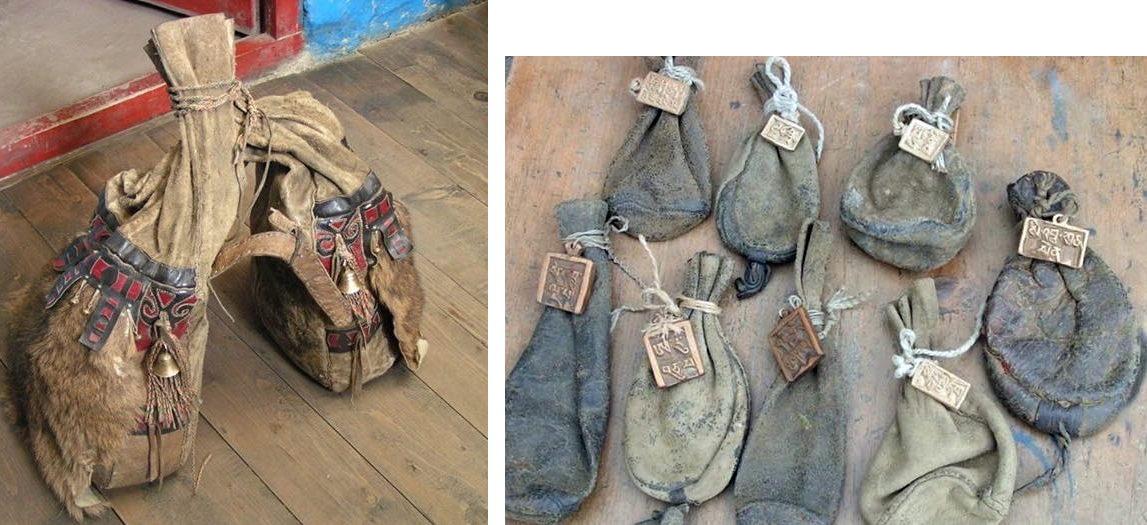
Once the outer and inner preliminary practices and empowerments of the mendrup ritual are complete, the mandala palace surrounded by various offerings and the bags of mendrup ingredients becomes the focus of spiritual activity. From the beginning of the main ritual and until its conclusion, the main mantra for empowering the mendrup is recited continuously day and night. Within the main temple, designated monks take shifts reciting the mantra and circumambulating the mandala. Outside the main temple, everyone is encouraged to recite the mantra as much as possible and to circumambulate the temple complex. The medicinal ingredients of the mendrup ingredients alone are beneficial but they do not contain blessings. For that, it is necessary to perform the practice of the deities, make offerings and supplications, and especially to recite many hundreds of thousands of the mantra. In this way, power and blessings are conferred to the physical substances.
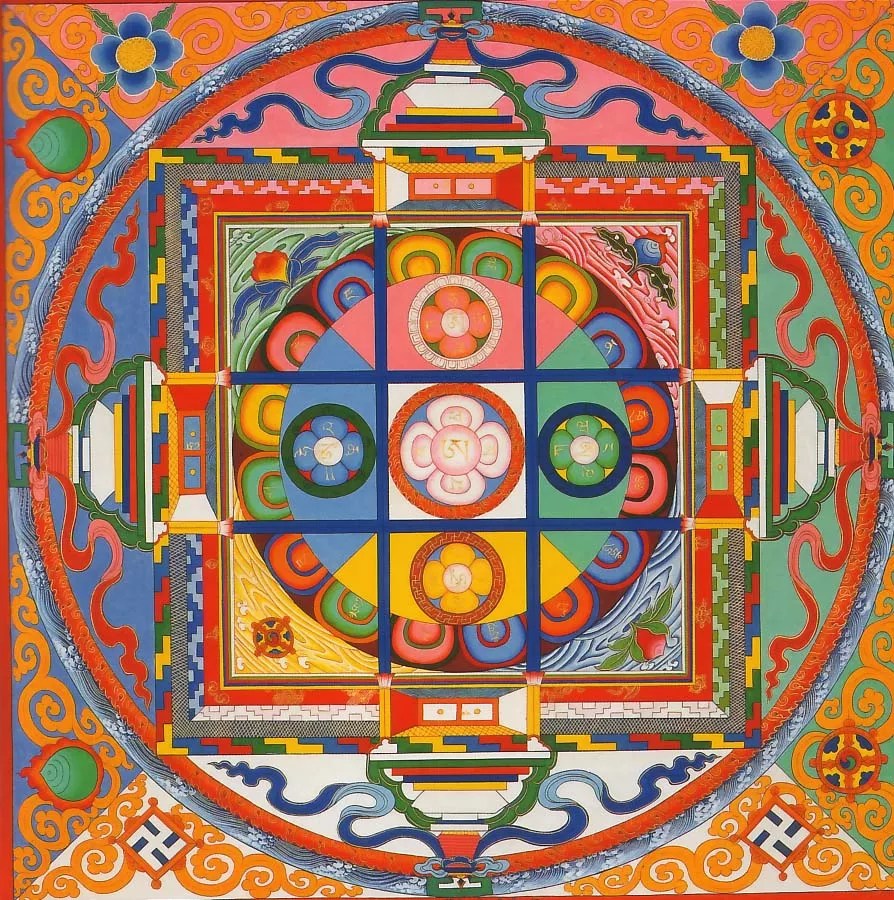
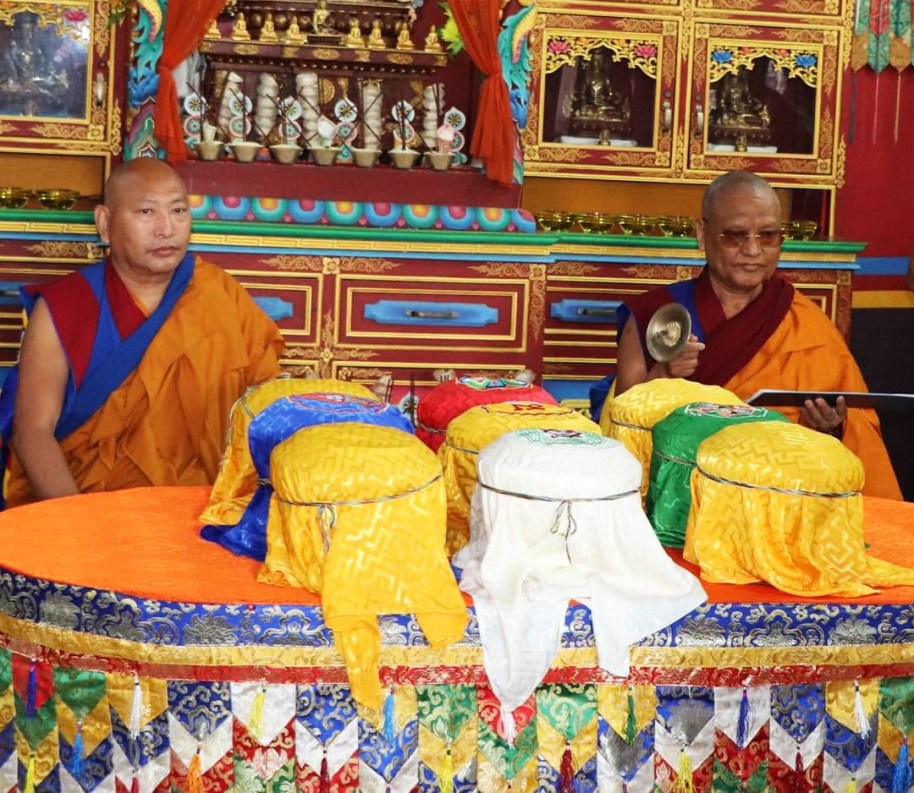
The mandala at the center of these activities supports the continual presence of the deities by being imbued with images and substances whose qualities correlate with those of the respective deities. Every element of color, shape, direction, and size has its own meaning and importance. A special vessel of mendrup ingredients is placed above the mandala in the center and in each of the cardinal and intermediate directions. These vessels in the center and the four cardinal directions contain ingredients associated with the qualities of their respective directions and are covered with silk cloths ornamented with the symbol of the respective directions. These directions of the mandala correspond with the geographical ones. The four vessels in the intermediate directions are covered in yellow.
The center of the mandala is the seat of the principal deity Trowo Tsochok Khagying. This is the place of the Suchness Buddha Family. In this case the center is characterized by the color yellow, and associated with the element of earth. The yellow covering is ornamented with a white AH syllable which is the seed syllable of Trowo Tsochok Khagying, and a red MA syllable which is the seed syllable of his consort Khala Dukmo.
The East, which is always considered to be the front gate of the mandala, is the place of the Yungdrung Buddha Family. It is characterized by the symbol of a yungdrung and, in this case, the color white and the element of space.
The South is the place of the Jewel Buddha Family. It is characterized by the symbol of a wish-fulfilling jewel and the color blue, and is associated with the element of water.
The West is the place of the Lotus Buddha Family. It is characterized by the symbol of a pure lotus and the color red, and is associated with the element of fire.
The North is the place of the Wheel of Bön Buddha Family. It is characterized by an eight-spoked wheel of the Bön teachings and the color green, and is associated with the element of wind or air.

A cord is attached to each of the five main mendrup vessels in the center and cardinal directions. The color of this cord corresponds to its respective direction. These are the zung tak, or empowerment cords. They are stretched to the bags of mendrup ingredients surrounding the mandala, wound together, and then brought to the throne of the ceremony leader, in this case His Holiness 34th Menri Trizin Rinpoche. Throughout the performance of the rituals and mantra recitations, these empowerment cords are blown upon in order to carry the power and blessings to the physical substances. Similarly, having the cords connect the mandala to the bags of mendrup ingredients in the surrounding area imbues them with the power and blessings coming from the presence of the enlightened deities.
Once the requisite vessels of mendrup ingredients and offerings are placed above and surrounding the mandala, it is closed from view until the conclusion of the ritual. When necessary to interact with the immediate area of the mandala, those appointed to do so have the responsibility to abide by the tantric rules of behavior in order to not introduce any defilements or obstacles into the ritual environment. Once the rituals and mantric recitations are complete, the boundary is opened and the vessels of mendrup ingredients on the mandala and the bags surrounding it are ceremonially carried to where the ingredients are ground into a fine powder. First, the vessels from the mandala are opened and the ritual leaders ceremonially grind and mix the ingredients.

However, the majority of ingredients are ground into a fine powder using modern methods and then distributed to the public. Major sponsors of the Great Retreat of Medicine with the Swirling Rays of Light will receive larger portions of the mendrup in appreciation for their support. Yungdrung Bön monasteries will receive a larger amount as well to dispense to their respective communities. Most of the mendrup will be stored at Menri and distributed over the coming years with the mindfulness that it must last until the next great mendrup retreat is performed which could be decades from now.
The primary mantra of the Medicine with Swirling Rays of Light is SO OM BA WA DÉ NA RA SA YA NA YU DRANG DU TSI SO THA.* This mantra is not like an ordinary sentence that can be translated into a conceptual meaning. The power of the mantra is beyond concepts. Yet, although it is not possible to be translated, specific qualities and associations can be made with each of the syllables. However, the practitioner should not restrict the power and blessings of the mantra to these limited intellectual understandings.
SO: syllable of enlightened body, enlightened speech, and enlightened mind; as well as the three enlightened bodies of the Bönku, Dzok ku, and Tülku
OM: syllable of the five wisdoms (1) the wisdom of emptiness, (2) mirror-like wisdom, (3) all-accomplishing wisdom, (4) discriminating wisdom, and (5) the wisdom of equanimity
BA WA: syllables of the high spiritual masters
DÉ NA: syllables of giving, of bestowing
RA SA YA NA: syllables of the highest and most extraordinary medicines that cure illness and pacify obstacles
YU DRANG: syllables of the Zhang Zhung language meaning du tsi
DU TSI: syllables of blessed nectar medicine that has the power and blessings to heal all illness and disturbances, and to support longevity and good fortune
SO THA *: syllable of transforming the impure body, speech, and mind of ordinary beings into enlightened body, speech, and mind. The syllables that dissolve all illness and obstacles into pure space.
When reciting, it is of the utmost importance to connect with the mantra as a request of the enlightened ones, the yidams, the khandro, and the lamas to bestow their blessings and to transform your impure body, speech, and mind into pure body, speech, and mind; and to remove all outer, inner, and secret obstacles. Reciting this mantra can transform any liquid into medicine which gives it the potency to pacify the afflictive emotions. For example, if one is drinking juice or milk the mantra can be recited and blown into the liquid. This transforms the liquid from an ordinary substance to a blessed substance.
Mendrup can be taken by anyone at anytime for any condition. It is considered to be a single medicine for hundreds of illnesses. Its benefits are not restricted to human beings and can be given to animals or to the environment. The benefits of ingesting or wearing mendrup are unimaginable. It contains the blessings and power of the enlightened ones, the deities of medicine, the wisdom deities, the protectors, and the deities of wealth. It is said that even if one talks continuously for fifty years trying to explain every benefit of mendrup, the explanation would not be finished.
Having faith in the blessings and power of the mendrup gives energy, motivation, and openness to seek out and receive the medicine. Faith in the medicine has such power that even just seeing the mendrup can bring benefit and blessings. Simply by having the mendrup touch the tongue, it is possible to attain enlightenment. It is a single medicine for hundreds of ills. It has the potency to cure the three kinds of physical illnesses which arise from the imbalance of wind, bile, or phlegm. It supports longevity, personal power, vitality, and good fortune. It is like a wish-fulfilling jewel. It can bring food to the hungry and safety to those who need shelter, and so on. It opens the subtle wisdom channels within the body and blocks the movement of the winds related to the five poisons.
It can also be worn against the body for blessings and protection. Most amulets of the Yungdrung Bön tradition contain a small amount of mendrup as one of the required ingredients. If someone who is dying is given mendrup or a sachet of mendrup is placed around their neck, it will connect them with the peaceful and wrathful deities during the intermediate state after death and will ensure that they have a positive rebirth.

Aside from requiring storage in a clean and respected place, there are only two restrictions associated with mendrup. First, it should never be traded or sold, but rather offered freely as a gift especially from a master to their students. Second, when ingesting the mendrup, meat should not be eaten soon afterwards. In general, it is taken each day in the early morning on an empty stomach. A small amount of the powdered substance is put into warm or cold water and allowed to dissolve slightly. Ideally, the main mantra is recited before drinking the liquid. Alternately, it can be placed directly into the mouth on the tongue and swallowed. A greater or lesser amount can be used, and it can be taken anytime day or night. However, whenever ingesting mendrup, one should be aware of receiving the unimaginable power and blessings of the enlightened deities that overcome all afflictions and suffering.
If you would like to make a donation to support this very auspicious occasion, you can do so through H.E. Menri Pönlop’s United States retreat center by following this link: http://kwling.org/ Follow the link and then click the donate button in the upper right of the page. You can make a notation that the donation is for the mendrup ceremony.

General Overview of the Necessary Ingredients for Medicine with Swirling Rays of Light
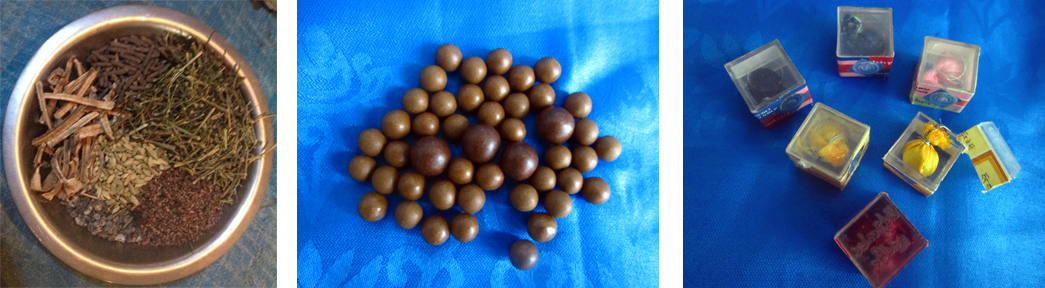
All of the necessary ingredients and instructions for their proper collection are enumerated in the text of Medicine with Swirling Rays of Light, Mendrup Ö Zer Khyilwa.་ If they are counted individually, there are over 30,000 ingredients. This list is included as a mere example of the diversity of necessary ingredients. All ingredients should be of the highest quality and without faults or defilements. Sometimes, as in the case of many types of roots, a specific size and shape are necessary in order for them to be acceptable ingredients. Ingredients from sacred places such as Kongpo Bönri and Mt. Tisé are especially sought after. The collection of the ingredients needed can take many years and be quite costly.
One of the most important ingredients to be included is mendrup containing the essence of the previous ancient mendrup retreats. After that are the primary ingredients of arura, barura, and kyurara which in combination are considered to be a great panacea.
- arura [Chebulic myrobalan, Terminalia Chebula]
- barura [Terminalia belerica Roxb]
- kyurura [Embelic Myrobalan, Emblica Officinalis]
The six excellent substances, the five grains, and the five precious things are also of primary importance. These substances are highly valued and are regularly added to torma, healing water, as well as being placed inside statues, wealth vases, chortens, and so on. The six substances are:
- chu gong: It is a kind of essence of water sometimes translated as bamboo essence. There are three kinds of chu gong: (1) chu gong collected from wood or trees, (2) chu gong collected from rocks, and (3) chu gong collected from water
- saffron, there are five types and the best quality should be chosen
- cloves
- nutmeg
- green cardamom
- black cardamom
The five grains: although it is common to add as many different kinds of grains as possible, it always includes:
- barley
- wheat
- rice
- beans
- sesame
Precious things such as:
- gold
- silver
- copper
- metal
- pearl
- coral
- turquoise
- zi stone
- crystal
- white conch
There are many different kinds of plants, herbs, and trees that must be collected from many different geographical areas. These must be growing in the right place, be at the correct stage of growth, be gathered at the proper time of day, and be dried properly according to the character of the plant as well as the qualities to be enhanced. Thus, a plant that is gathered for its ability to bring warmth should be growing in the sun, gathered on a sunny day when it is warm, and be dried in the sun and heat. Sometimes the entire plant is used and other times only the flowers, leaves, stalk, buds, fruit, berries, pollen, seeds, or roots are needed. Quantities vary according to what can be acquired, the rarity of the ingredient, and the hazards in acquiring it.
Additional ingredients include the nine kinds of water which is water from:
- the snow of a high mountain
- a waterfall
- river water
- sacred lakes
- ocean water
- spring water
- rain water
- water that never freezes (There is drinkable water in the Himalayas that never freezes and is not a hot spring)
- milk from a pure white cow
- additional kinds of water are often added such as mineral water
There is a multitude of other ingredients. These include:
- the three kinds of incense: white sandalwood, red sandalwood, valerian
- white salt, black salt, and rock salt
- molasses, dark brown sugar, and light brown sugar
- crystallized sugar
- unsalted curds
- unsalted yogurt
- unsalted butter from many different types of animals
- milk from many different types of animals
- honey
- shellac resin
- special cloth
- a collection of various knotted threads
- amber and a variety of other tree resins
- sulphur
- camphor
- white and dark-colored grapes
- calcite
- many different kinds of oils
- many different kinds of eggs
- many different kinds of alcohol

* The syllable “THA” is slightly aspirated and pronounced by placing the tongue behind the front teeth. This is different from a hard “TA” sound where the tongue is pressed against the roof of the mouth such as in the word “tower.” It is also different from the English language pronunciation of “TH” where the tongue is placed between the teeth such as in the word “thing.”
Raven Cypress Wood ©All Rights Reserved. No content, in part or in whole, is allowed to be used without direct permission from the author.
Don’t want to miss a post? Scroll to the bottom and click “Follow this blog.”
This website has always been supported by the donations of the worldwide Yungdrung Bön community. Want to join the mandala of Nine Ways supporters? Follow this link https://ravencypresswood.com/donate/ It’s easy through Paypal, Venmo and Zelle.



 Nine Ways