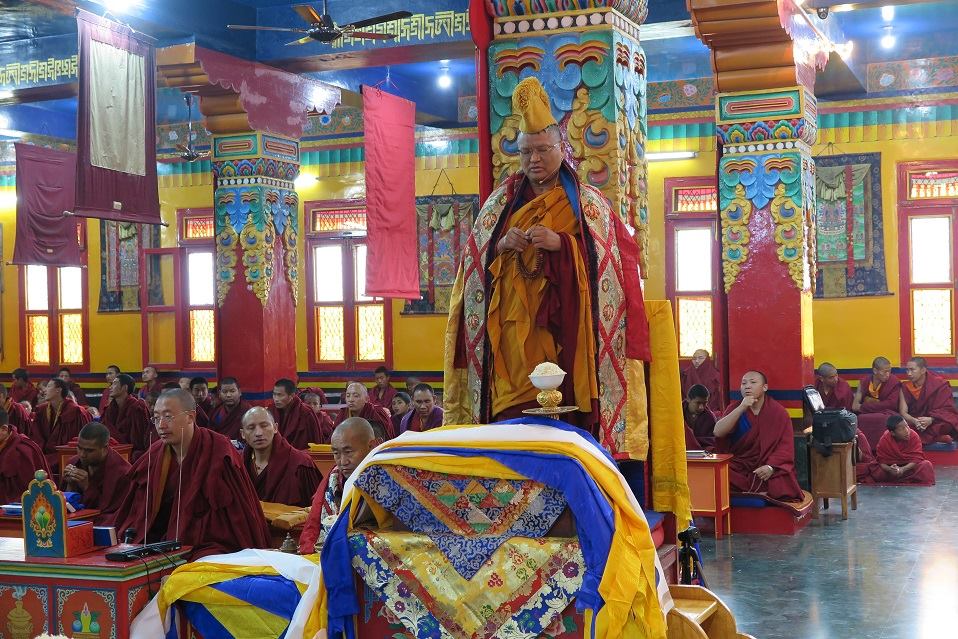
HE Menri Lopon Thrinley Nyima Rinpoche during Losar festivities at Menri Monastery in Dolanji, India
HE Menri Lopon Thrinley Nyima Rinpoche during Losar festivities at Menri Monastery in Dolanji, India
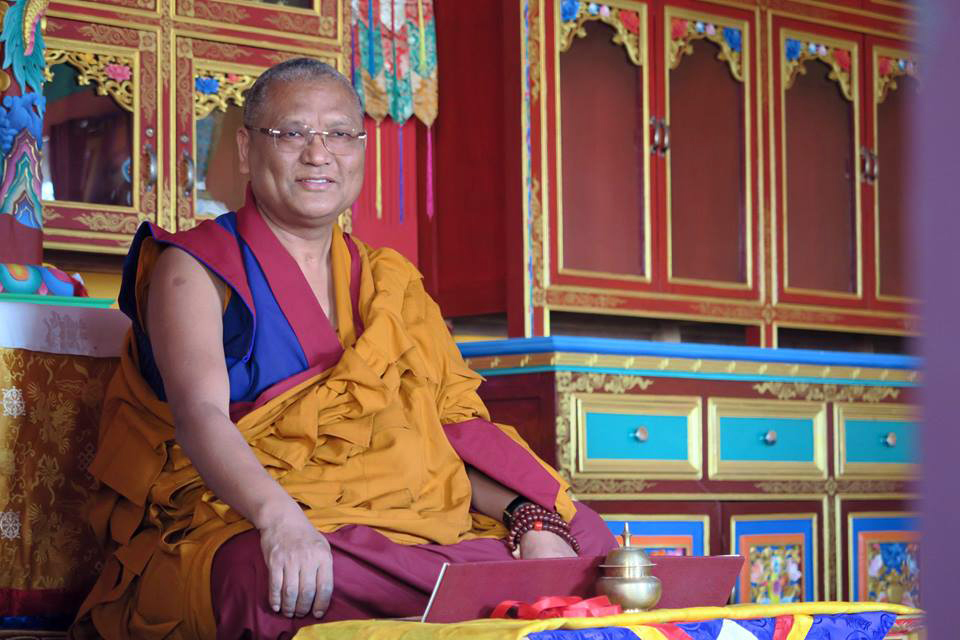
His Eminence Menri Lopon Yangton Thrinley Nyima Rinpoche

A Condensed Prayer of Aspiration
I pray to the Supreme Refuge, my root lama,
During this and all my future lives,
May I directly realize the nature of my mind, free from elaboration,
And may I have the capability to continually practice without interruption!”
~Written by 25th Menri Trizen HH Nyima Tenzin Rinpoche B. 1813-D. 1875. Translated by Raven Cypress Wood©
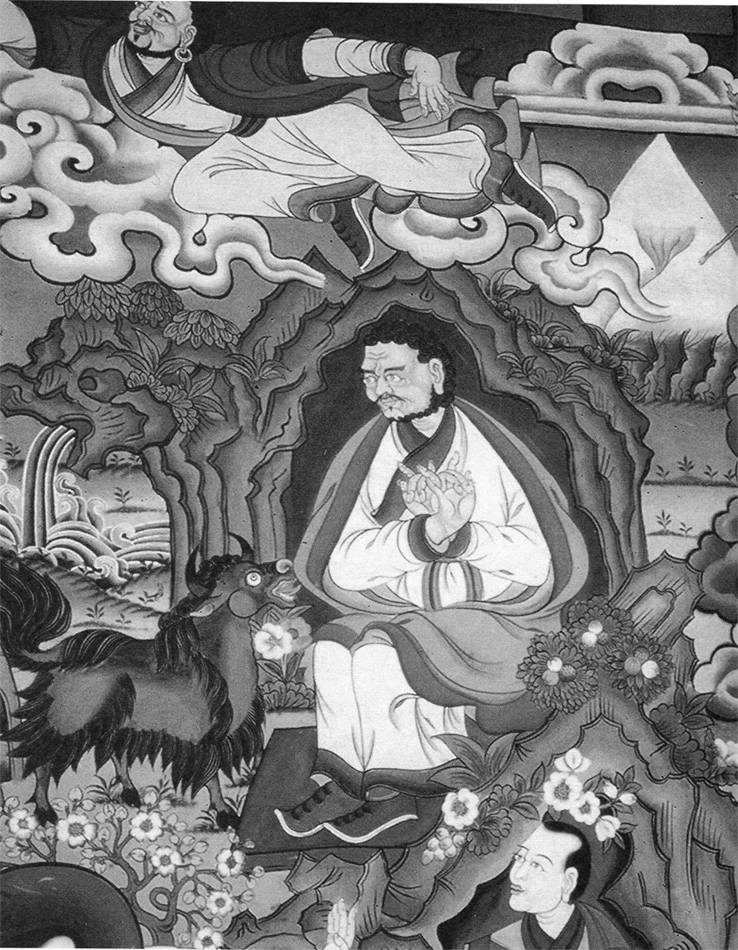 (Mural in Bhutan depicting the Great Lama, Drenpa Namkha)
According to the lunar calendar of the Yungdrung Bön, the 10th day of each month is the day set aside for the practice of the three sages: Drenpa Namkha and his two twin sons, Tséwang Rikdzin and Pema Tongdrul. On this day, it is appropriate to pay homage and make offerings to these lamas as well as to recite the mantras associated with their respective practices.
The practices of Drenpa Namkha and Tséwang Rikdzin, are widespread in the Yungdrung Bön tradition. In general, there have been three separate manifestations of Drenpa Namkha. Each was a reincarnation of the previous manifestation. There was the Drenpa Namkha of Tazik, Drenpa Namkha of Zhang Zhung, and Drenpa Namkha of Tibet. Drenpa Namkha of the ancient kingdom of Zhang Zhung was a prince who lived during 914 BCE. He married an Indian Brahman girl and had twin sons, Tséwang Rikdzin and Pema Tongdrul, who were born in the year 888 BCE. This manifestation of Drenpa Namkha wrote many Dzogchen texts and is often referred to simply as La Chen, or The Great Lama.
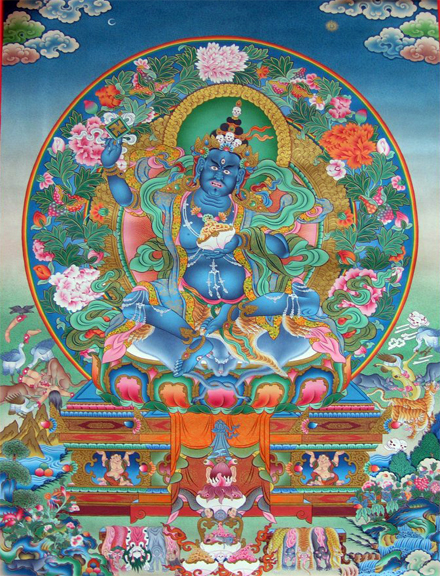 (As a meditational deity, Drenpa Namkha is most often depicted in a semi-wrathful form, blue in color and holding a yungdrung in his right hand.)
Drenpa Namkha of Tibet was born in the year 753 CE in Southern Tibet. He was an accomplished practitioner and renowned scholar. During this time, the kingdom of Tibet was ruled by King Trisong Detsen. This king had many Bön priest in his court, including Drenpa Namkha. When the king decided to convert the kingdom to the new Indian religion of Buddhism, he began to drive out the Bön priests and to destroy their texts. The Bön lamas were given the choice of exile from the kingdom, suicide, or conversion to the new religion. Many lamas chose to escape with texts and to try and preserve the teachings elsewhere. Drenpa Namkha chose to stay and protect the teachings and the texts from within Tibet. So, at the age of 31, he cut his own hair with a blade of gold and ordained himself a Buddhist with these words,
“A person who has attained realization would not make a distinction between his son and his enemy. I have no partiality for anything. Therefore, I shall be ordained.” (Translation by Samten Karmay from the Treasury of Good Sayings written by Shardza Tashi Gyaltsen.)
After his conversion, he had many texts hidden within chortens, statues and columns at the monastery of Samye. He continued to compose texts and to teach. Among his many students was the king, Trisong Detsen himself. Years later, the king allowed him to openly return to his practice of the Yungdrung Bön teachings.
“Look upon me with your unbiased compassion morning and night during the past, present and future. Turn back both seen and unseen enemies! My present and future Refuge and Protector, bless me to accomplish my intentions!”
~From the Prayer to Drenpa Namkha, translated by Raven Cypress Wood
Raven Cypress Wood ©All Rights Reserved. No content, in part or in whole, is allowed to be used without direct permission from the author.
Don’t want to miss a post? Scroll to the bottom and click “Follow this blog.”
Want to join the mandala of Nine Ways supporters? Follow this link https://ravencypresswood.com/donate/ It’s easy through Paypal, Zelle, and Venmo.

In the Yungdrung Bön tradition, the place where the deities and objects of veneration are gathered is called the “Tsok Zhing”, the “Field of Accumulation”. It is also sometimes translated as the “Field of Merit” or the “Merit Field” because what is being accumulated by paying homage and making offerings to this place is merit, or virtue. This is the Merit Field according to the Menri Tradition from a drawing done by the great master and scholar His Eminence Yongdzin Tenzin Namdak Rinpoche.
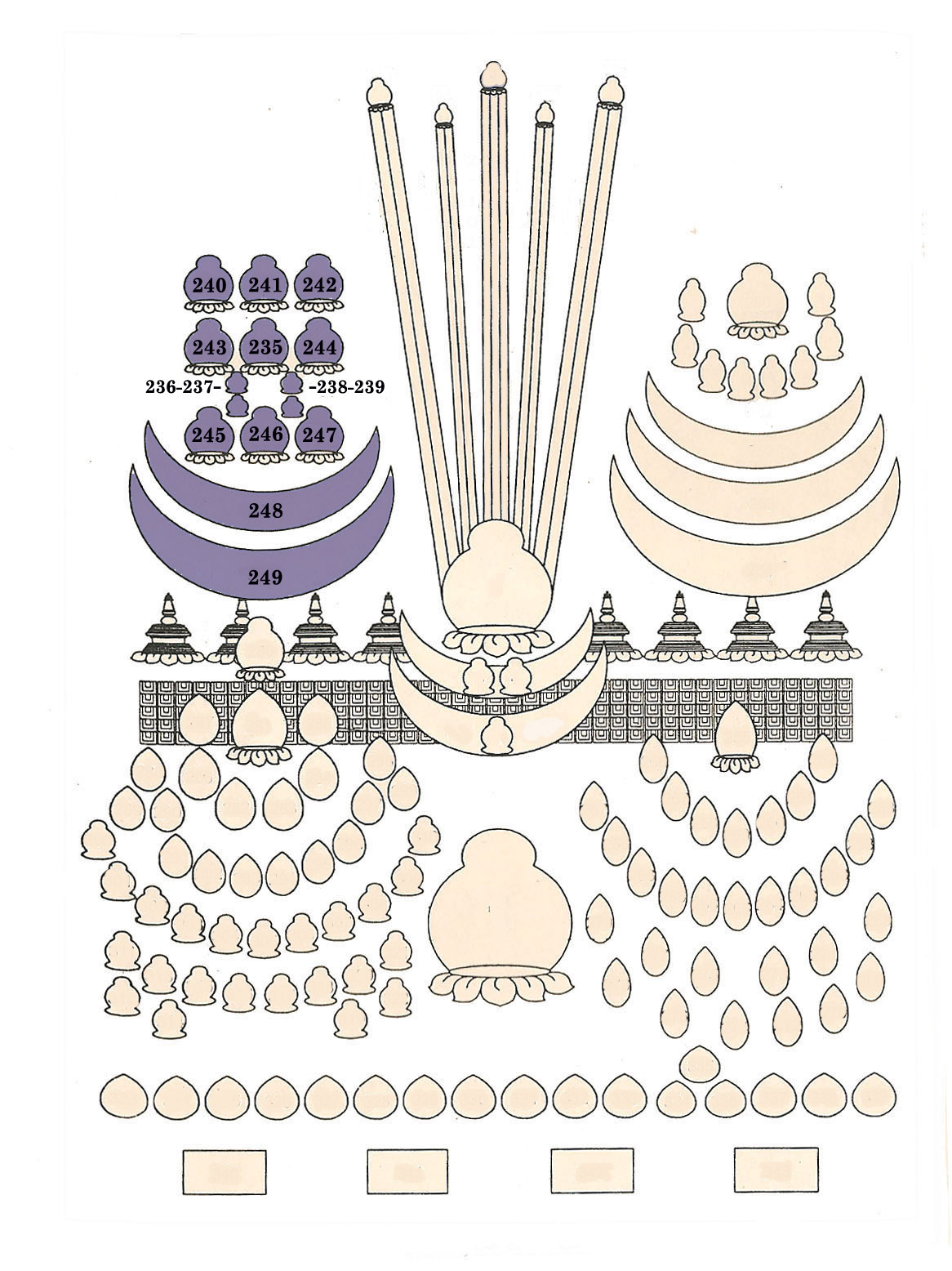
This is the gathering of all of the Enlightened Beings.
235. Gyalwa Shenrap Miwo Künlé Nampar Gyalwa, the Completely Victorious in Every Way, Shenrap Miwo. 16,017 BC – 7,817 BC. He is the Enlightened Being of the present time and founder of the Yungdrung Bön religious tradition. He appeared in the human realm when the human life-span was generally 100 years long. There are three versions of his life history: short, medium and long. The short version is within a text commonly referred to as the Do Dü. It is a terma, or rediscovered text, and has twenty-four chapters within one volume. The medium length version is within a text commonly referred to as the Zer Mik. It is also a terma and has eighteen chapters in two volumes. The long version is within a text commonly referred to as the Zi Ji. It is part of a group of orally transmitted texts and has sixty-one chapters in twelve volumes.
236. Yungdrung Tsukshen Gyalwa.
237. Sebu Malo. One of the main disciples of Shenrap Miwo.
238. Sebu Yulo. One of the main disciples of Shenrap Miwo.
239. Tobu Bumsang. He was the eldest son of Tönpa Shenrap Miwo. He led a group of disciples who primarily practiced the dzogchen teachings.
#240-246 Enlightened Beings that Appeared in Past Eons
240. Nangwa Rangjung Tukjéchen. This Enlightened Being appeared in the world when the human life-span was generally 100,000 years long.
241. Gewa Khorwa Kündren. This Enlightened Being appeared in the world when the human life-span was generally 80,000 years long.
242. Künshé Nyonmong Duksek. This Enlightened Being appeared in the world when the human life-span was generally 60,000 years long.
243. Lékpa Tsemé Tukjéchen. This Enlightened Being appeared in the world when the human life-span was generally 40,000 years long.
244. Nyompa Tamche Khyenzik. This Enlightened Being appeared in the world when the human life-span was generally 20,000 years long.
245. Jampa Trigyal Khukpa. This Enlightened Being appeared in the world when the human life-span was generally 10,000 years long.
246. Dakpa Togyal Yékhyen.This Enlightened Being appeared in the world when the human life-span was generally 1,000 years long. He was the eldest brother of Tönpa Shenrap Miwo in the celestial realm.
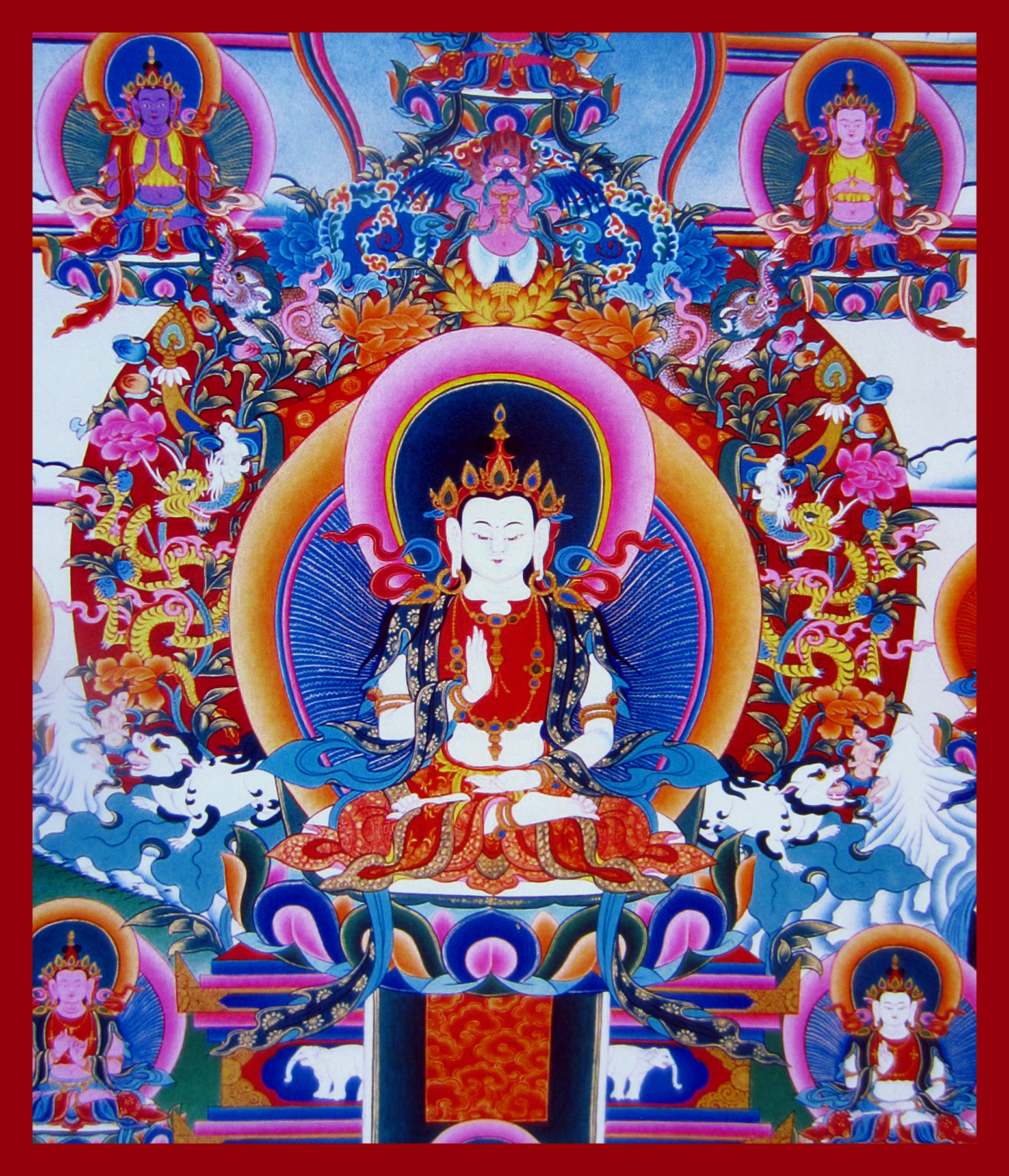
Jamden Rangma Medron, the Buddha prophesized to appear in the future
247. Jamden Rangma Médron. This Enlightened Being is prophesized to be the Buddha of the Future and will appear in this world when the human life-span has declined to be only 10 years long. He was the younger brother of Tönpa Shenrap Miwo in the celestial realm. He is depicted upon a throne held aloft by elephants and seated upon cushions of a sun, moon, and lotus. His right hand is held in a mudra of contemplation at the center of his heart and his left hand is held in the mudra of equipoise. His body is the color of clear crystal and upon his head is a crown of precious jewels.
248. The 1002 enlightened Beings of the Fortunate Eon.
249. All of the Enlightened Beings found throughout the ten directions.

HE Menri Lopon Yangton Thrinley Nyima Rinpoche bestows empowerment upon the Dolpo community
 Nine Ways
