Category Archives: Tibetan Culture & History

The Eight Auspicious Symbols

The Eight Auspicious Symbols displayed on a shrine before an image of Lord Tonpa Shenrap at Triten Norbutse Monastery. Photo credit: Raven Cypress Wood

In the Yungdrung Bön tradition, the Eight Auspicious Symbols are displayed in order to bring good luck and increase positive circumstances.  In the Tibetan language, they are called Tashi Dze Gye.  Each symbol has a specific meaning and energy.

endless knot 2 largerThe Glorious Endless Knot, Tibetan: Pal Be’u, symbolizes the interdependence of all things.  It also represents activities and knowledge.

Conch shellThe White Conch Shell, Tibetan: Düng Kar, symbolizes the far-reaching sound of the Buddha’s teachings as well as melodious sound in general.

wheelThe Wheel, Tibetan: Khorlo, sometimes referred to as The Wheel of Dharma, symbolizes the Buddha’s teachings.  Each aspect of the wheel such as the rim, the hub and the spokes all have meaning according to the context within which the wheel appears.

Golden fishThe Golden Fish, Tibetan: Ser Nya, symbolize freedom and liberation, as well as skill with handicrafts and power in the hands for healers.
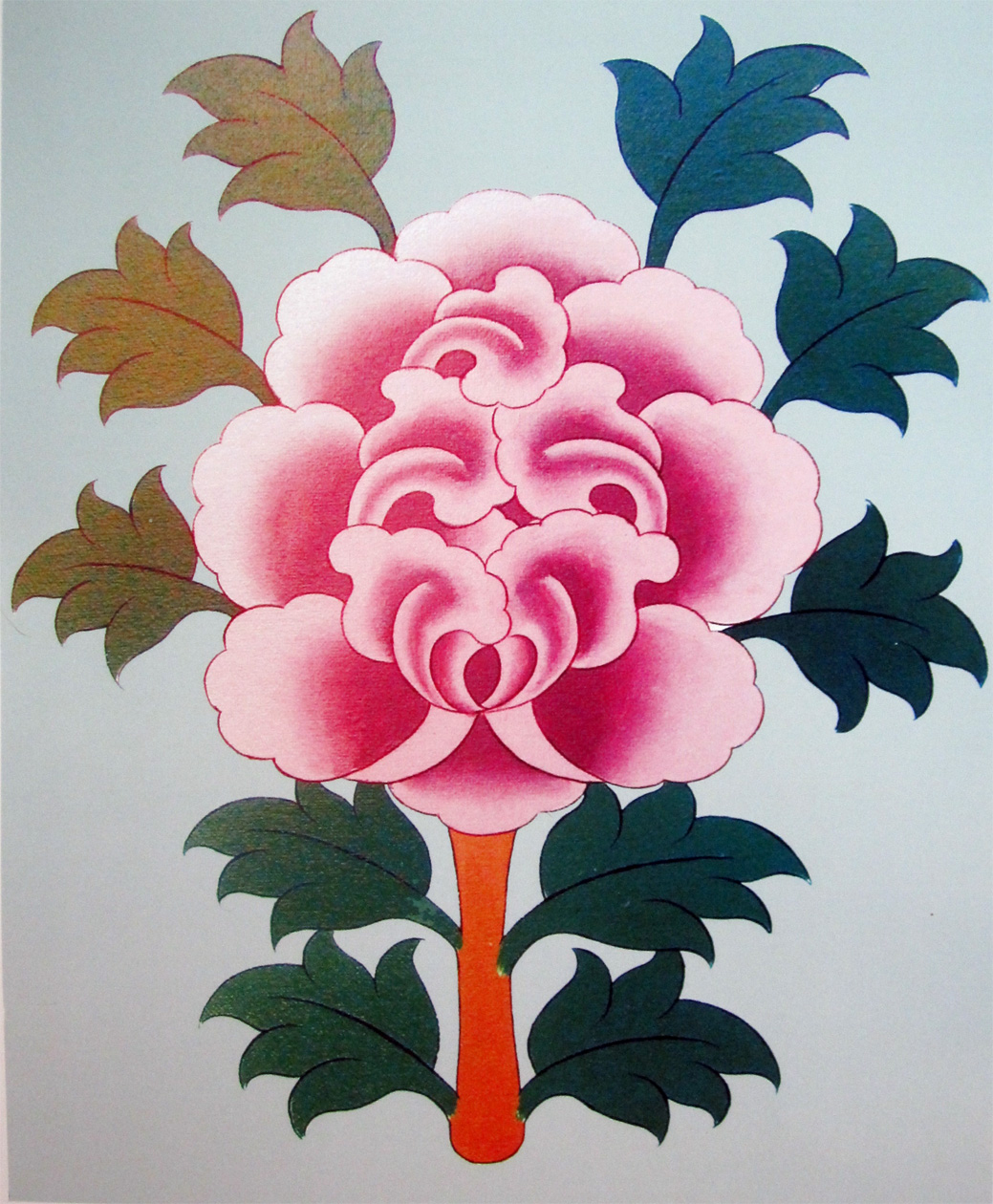
LotusThe Lotus, Tibetan: Pema, symbolizes purification.

Victory BannerThe Victory Banner, Tibetan: Gyaltsen, symbolizes victory over all obstacles, as well as gaining happiness.
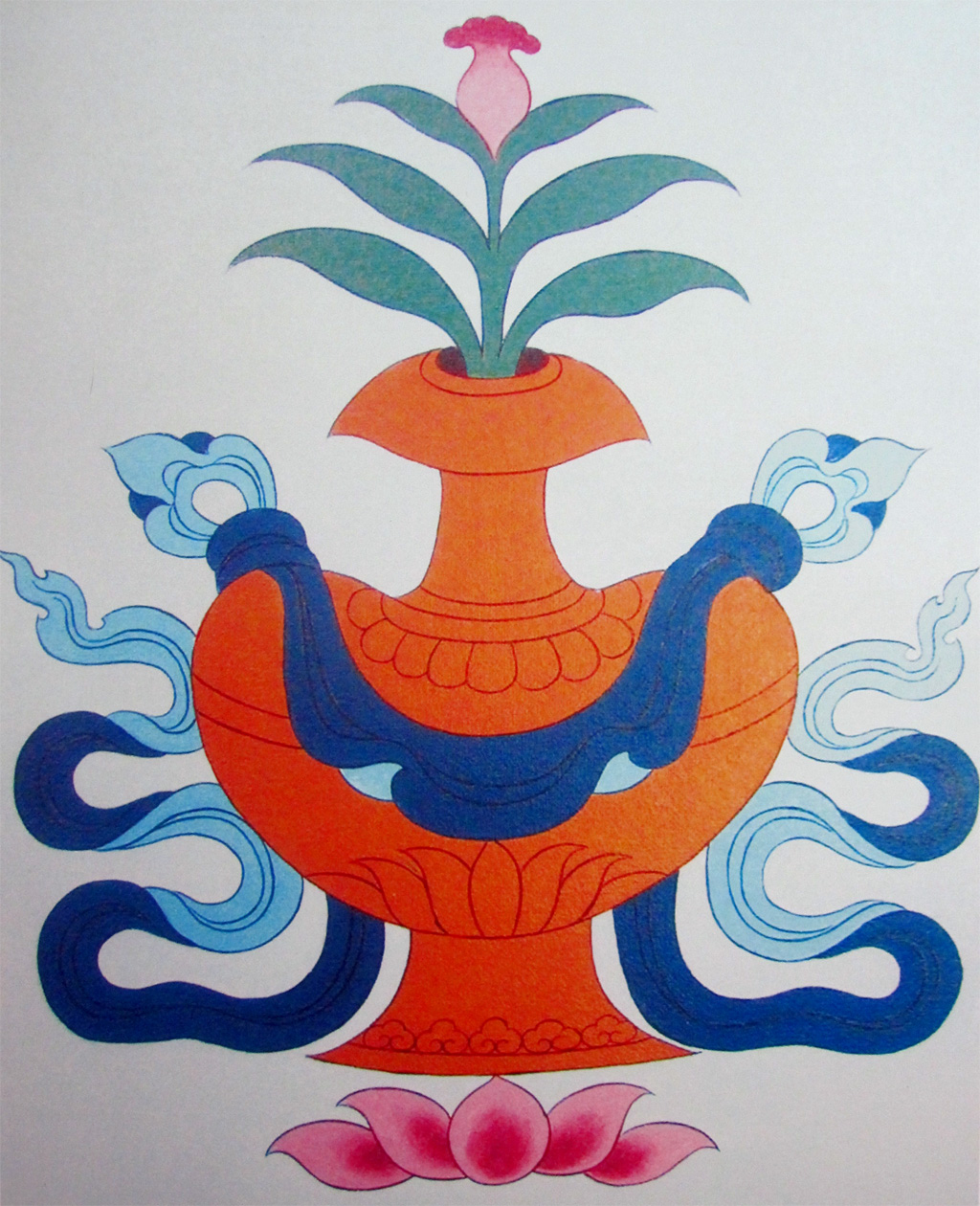
VaseThe Vase, Tibetan: Bumpa, symbolizes wealth and virtues.
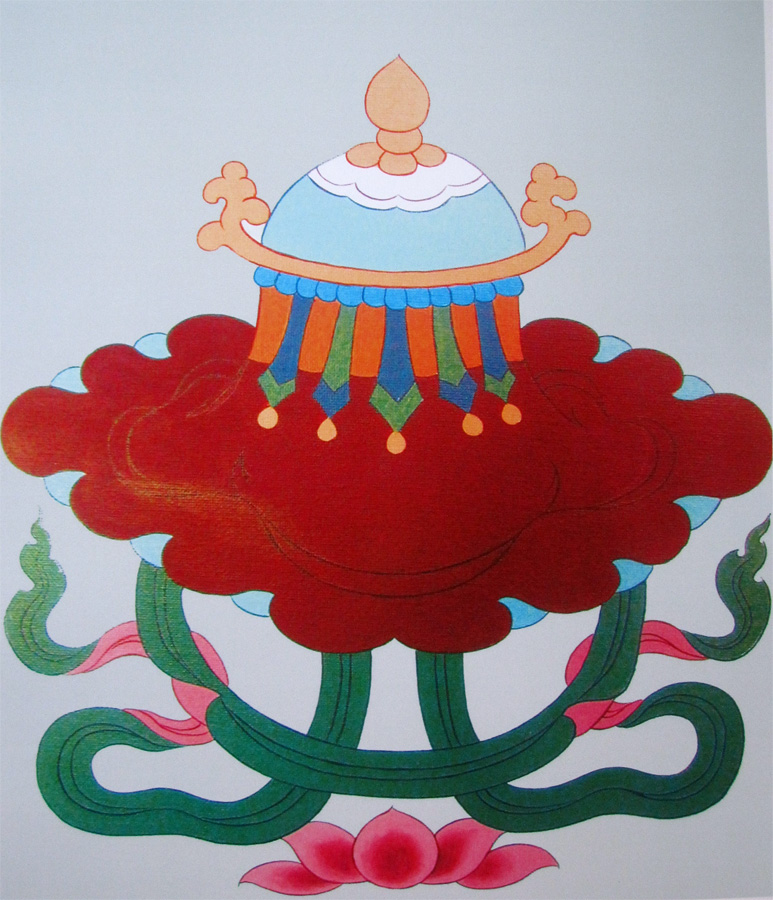
paraso 2lThe Parasol, Tibetan: Duk, symbolizes being protected from suffering as well as prosperity and good luck for the head.

Spiritual Community

Yungdrung Bon monks gathered inside the temple of Menri Monastery in Dholanji, India.  Photo credit: Unknown


Discovery from an Ancient Kingdom

gzi found in Ngari region of Western Tibet

Zi bead found in Western Tibet. Photo credit: Unknown

Recently, an archaeology professor working in the Ngari region of Western Tibet, South of the Ganges River, discovered an ancient zi from a gravesite. This was the area of the ancient kingdom of Zhang Zhung.

The original article can be read in full at the Himalaya Bon Tibetan language website: http://himalayabon.com/news/2015-04-10/574.html

Iconography: Defining Space

Illustration from the book “Tibetan Thangkha Painting, Methods & Materials” by David & Janice Jackson

Before the artist begins sketching out the images that will appear on the thangkha, they must first determine the division of space on the canvas.  First, by using chalk lines and a compass, the true center of the canvas must be found.  Second, both the horizontal and the vertical axis must be established.  In this way, the artist can allocate space to the images according to hierarchy and the number of images that need to be represented.

outline guide for center and 4 directions for thangkha

Diagram 1: Common positions when depicting a central image and 4 retinue

Diagram 2: Common positions when depicting a central image and 8 retinue


These diagrams show the most common designations of space although there are variations.  However, even with variations, the position of the retinue in relation to one another remains the same.  The retinue are positioned according to their association with the directions.  In the text, the detail of the deities position begins with the center and is then listed the Bön way, or counter-clockwise, beginning with the East.  Referencing the diagrams above: 1=Center, 2=East, 3=North, 4=West, 5=South, 6=Southeast, 7=Northeast, 8=Northwest, and 9=Southwest.  Most often, but not always, the deities are the color associated with the direction.  East=yellow, North=green, West=red and South=blue.

The Deities of the Five Buddha Families

Here, the deities of the Five Buddha Families are positioned according to diagram 1 above.  In the center is the Enlightened One, Künang Kyapa and consort.  In the east is the Enlightened One, Salwa Rangjung and consort.  In the north is the Enlightened One, Gélha Garchuk and consort.  In the west is the Enlightened One, Jedrak Ngomé and consort.  And in the south is the Enlightened One, Gawa Döndrup and consort.

Direct Descendants of the Enlightened Lord Tönpa Shenrap Miwoché

Over 18, 000 years ago, in the ancient realm of Olmo Lungrik, the founder of the Yungdrung Bön spiritual tradition was born.  The enlightened Lord Tönpa Shenrap Miwoche was born into the human realm as a prince.  He later adopted the life as a monastic in order to display the path of renunciation to his followers.  However, prior to this, he was married and had sons and daughters.  The direct descendants of this Shen lineage have continued until this very day.  Currently, there are two sons who are direct descendants of Lord Tönpa Shenrap.

Heir to the Shen Lineage, Tsukpu Namdrol Rinpoche, during a visit to the Yungdrung Bon monastery of Gangru Dargye located in Khyungpo, Tibet

Lamas of the Shen lineage

The two sons of the Shen lineage who are direct descendants of the Lord Tonpa Shenrap.

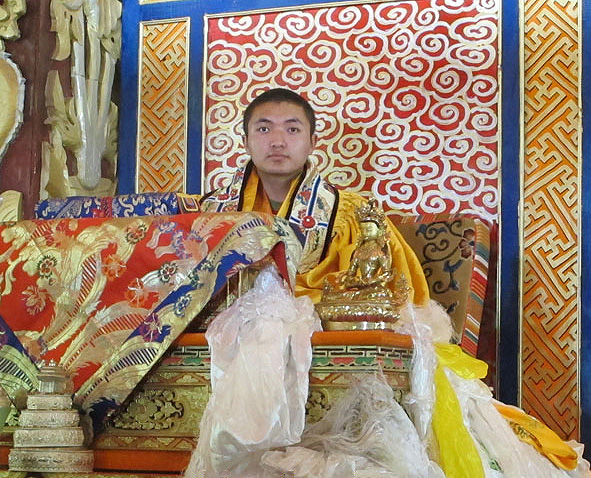
In November of 2014, His Holiness, the supreme 33rd Menri Trizen Lungtok Tenpé Nyima offered prayers to both descendants.

Shen Tsukpu Namdrol Rinpoche

Shen Tsukpu Namdrol Gyaltsen Rinpoche

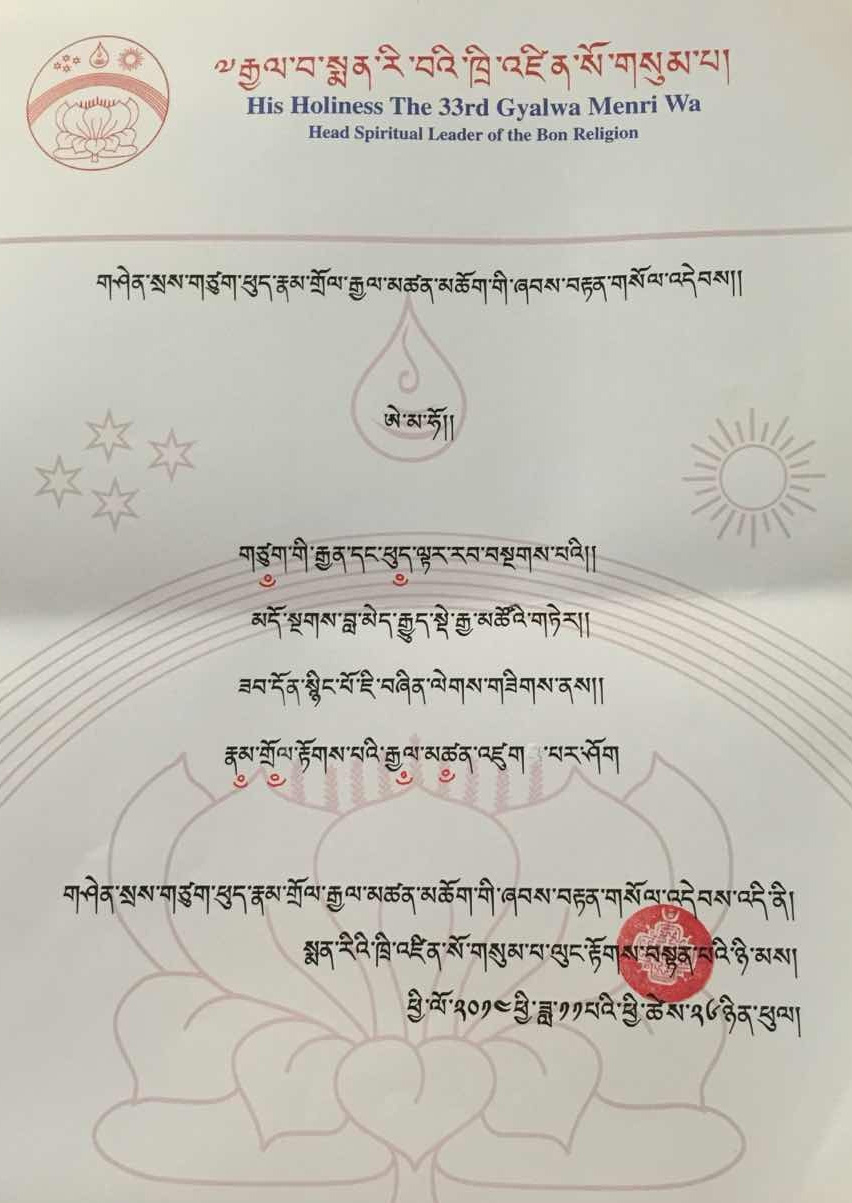
prayer to Shen Tsukpu namdrol Gyaltsen written by 33 Menri trizen 2

Prayer of Stability for the Shen Heir, the Supreme Tsukpu Namdrol Gyaltsen

EMAHO!

Highest praise for the best of crown ornaments,

   Storehouse of the ocean of sutra, tantra and unsurpassed division of teachings,

From the proper understanding of the profound meaning of the innermost essence,

May the victory banner of liberation and realization be established!

Murik Shen Yungdrung Nyima

Murik Shen Yungdrung Rangdrol Nyima Rinpoche

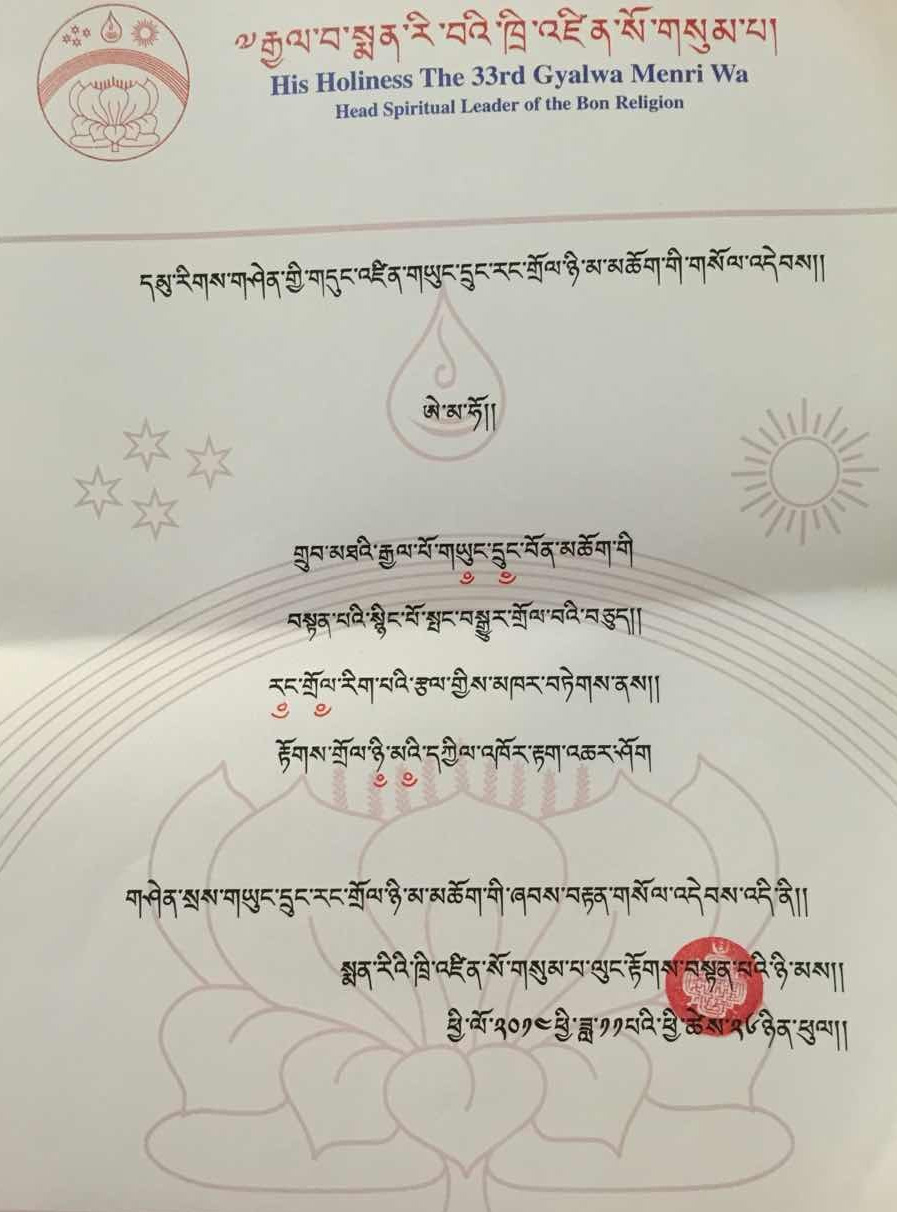
Shen prayer to Yungdrung Nyima

Prayer for the Shen Heir, the Supreme Murik Shen Yungdrung Rangdrol Nyima

EMAHO!

Essence of the king of doctrines, the supreme Yungdrung Bön,

Distilled essence of the teachings of renunciation, transformation and liberation,

Having raised a stronghold through the dynamic energy of self-liberated awareness,

May the sun disc of realization and liberation eternally appear!

Composed by 33rd Menri Trizen Luntok Tenpé Namdak Rinpoche on the Western date of 11/26/2014

Translated by Raven Cypress Wood

The original article first appeared on the Tibetan language website Himalayan Bön and can be viewed here: http://www.himalayabon.com/article/poem/2015-01-02/518.html