Category Archives: Tibetan Culture & History

The Fifth Way: In the Service of Virtue

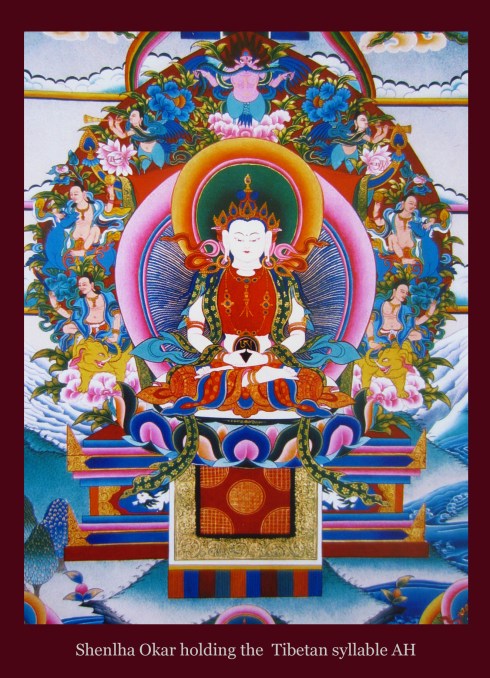
Central Figure of the Tibetan Thangkha Painting Related to The Fifth Way

Within the Nine Ways of Bön, the Fifth Way is called The Way of the Virtuous Lay Practitioners and specifies the proper conduct and commitments of a lay person taking vows. This Fifth Way is the first of the Nine Ways classified as ‘Ways of the Result’ or ‘Bön of the Fruit.’ In the Tibetan language, a lay practitioner is called ‘gen nyen’ [Tib. dge bsnyen] which literally translates as ‘one who serves virtue’ or ‘one who draws near to virtue.’ When asked the meaning of these concepts, the enlightened all-knowing teacher, Buddha Tönpa Shenrap Miwo answered,

“Virtuous means without negative actions. This is one who is committed to serve virtue through their body, speech and mind. Service means serving without holding contradictory views and properly remaining steadfast in service to virtue.”

In general, the lay practitioner commits to practicing the ten virtuous actions and renounces the ten non-virtuous actions of body, speech and mind.  Buddha Tönpa Shenrap defines this kind of renunciation as 1) not performing the actions, 2) not requesting or encouraging others to perform them and 3) not feeling pleased that others have performed the negative actions. Similarly, one commits to 1) acting according to the ten virtuous actions, 2) encouraging others to participate in these activities and 3) feeling joy that others have performed virtuous actions. This is the inner practice.

The Three Virtuous Actions of the Body:

  1. Rather than killing, protecting the life of other beings.
  2. Rather than stealing, practicing generosity.
  3. Rather than engaging in sexual misconduct or causing others to break their vows, keeping one’s own vows and respecting the vows of others.

The Four Virtuous Actions of Speech:

  1. Rather than lying, speaking the truth.
  2. Rather than creating discord, speaking in a way that brings people together.
  3. Rather than using hurtful speech, speaking gently and kindly.
  4. Rather than gossiping or mindlessly talking, speaking in a useful way or reciting prayers.

The Three Virtuous Actions of the Mind:

  1. Rather than coveting the possessions and accomplishments of others, being generous and open.
  2. Rather than wishing harm to others or feeling resentful, cultivating the desire to help others.
  3. Rather than holding wrong views, practicing the teachings of Yungdrung Bön and establishing a true and authentic view.

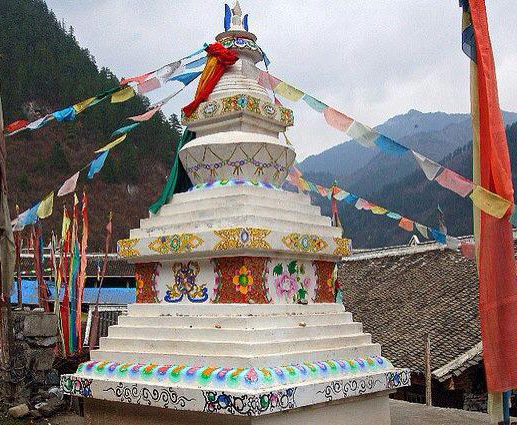
When asked to teach the outward form of the lay practitioner, The All-knowing Teacher, Tönpa Shenrap first instructed the gathered assembly to construct the first Elegant Yungdrung Chorten [Sanskrit: stupa] according to his detailed instructions. Once completed, he consecrated the chorten and then began teaching the outer forms and behavior of a gen nyen or lay practitioner.

Elegant Yungdrung Bon Chorten edit

The Elegant Yungdrung Chorten which represents the stages of enlightenment

The practitioner must go before a pure lama who guides disciples and take the appropriate vows. According to a commentary written by the 23rd abbot of Menri Monastery, His Holiness Nyima Tenzin Rinpoché:

“As for the vows of a gen nyen: There are five kinds of lifetime vows.  To abandon killing, to abandon taking what is not given, to abandon impure, wrong kinds of sexual conduct, and to abandon false speech are four.  Abandoning one of the four kinds of food is the fifth.  Some people have taught abandoning alcohol as a branch vow.

This is the gen nyen of completely renouncing according to the five kinds of established laws.  Because of that, the gen nyen of pure behavior has renounced the basic kinds of impure activity.”

As for killing, one must abandon killing in anger especially another human being. One must abandon stealing, especially when it is driven by desire. One must avoid sexual contact that is damaging or abusive, one must avoid harmful speech especially if it creates a division within the spiritual community, and one must avoid lying especially about one’s spiritual experiences and attainments. As for the fifth which is a branch vow, one renounces either one of the four kinds of food. In this context, the four kinds of food are 1) meat, 2) garlic, 3) solid food after the mid-day meal, and 4) intoxicants such as drugs and alcohol. Regarding drugs and alcohol, the deeper meaning is the renunciation of intoxication which is an obstacle to mindfulness and incites negative behavior.

According to Buddha Tönpa Shenrap in The Nine Ways of Bön,

“As for the lifelong inner rules, one must abandon killing due to the influence of anger, abandon taking what is not given due to the influence of desire or attachment, abandon acting secretly to get what one wants without consideration of cause and effect due to the influence of ignorance, abandon performing unclean work due to the influence of pride, and abandon rough and abusive speech, meaningless talk, and telling lies. One must apply one’s self to their opposites.”

The Buddha goes on to describe the outer practices.

“As for the five intermediate principles, one should perform pure water-cleansing rites, perform prostrations and circumambulations with devotion and aspiration, create and place tsa tsa, and offer torma. Presenting offerings is a branch of gathering the [two] accumulations.”

All translations and content by Raven Cypress Wood ©All Rights Reserved. No content, in part or in whole, is allowed to be used without direct permission from the author.

Don’t want to miss a post? Scroll to the bottom and click “Follow this blog.”
Offering Everything that is Good

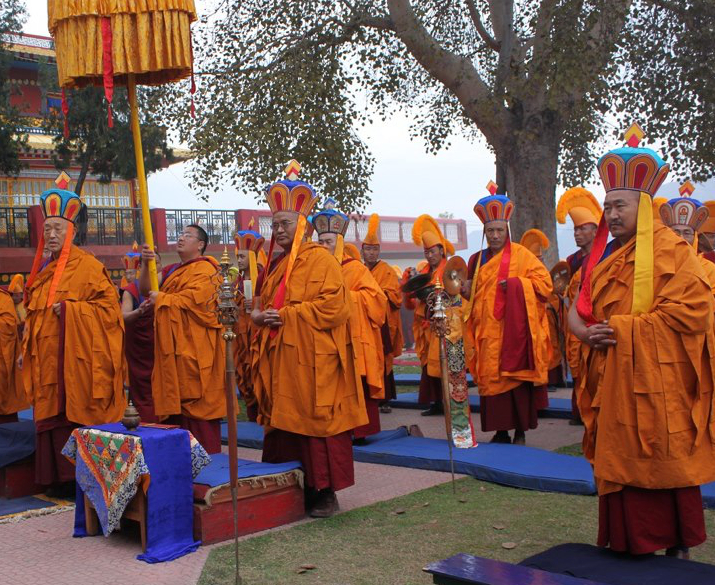
Women of Lubrak, Mustang symbolically offering the entire internal and external universe to the places of refuge. Photo credit: Unknown.

“EMAHO!

To the great, unmatched lama possessing characteristics,

I present unequaled external, internal, and secret offerings.

Externally, I offer the environment and the beings within it.

Furthermore, I offer my own body and its vitality as an ornament.

I present these offerings with non-attachment.

Internally, I offer the arising of my mental and physical aggregates.

I offer my accumulated realization that whatever arises as subject and object is illusory.

Furthermore, I present these offerings within the vast space of self-liberation.

Secretly, I offer the natural radiance of my unborn mind, which is

unceasing and understands whatever arises as enlightened manifestation and wisdom.

Furthermore, I present these offerings within a completely vast and all-pervasive space.”

— Extract from Offerings for the Lama

All translations and content by Raven Cypress Wood ©All Rights Reserved. No content, in part or in whole, is allowed to be used without direct permission from the author.

Don’t want to miss a post? Scroll to the bottom and click “Follow this blog.”
The Monastery of Blissful Meditation: Déden Samten Ling

Samling Temple complex. Photo credit: Unknown

The high altitude temple of Déden Samten Ling, or in its shortened form simply Samling, has been significant in the preservation of the Yungdrung Bön religious tradition. The main temple was established more than 900 years ago by Yangtön Gyaltsen Rinchen in a remote and mountainous region of Dolpo, Nepal near the Tibetan border. Since that time, this monastery, as well as others in Dolpo, has been maintained by a hereditary line of lamas within the Yangtön family. (For more information about the prestigious Yangtön family lineage, see previous post: https://ravencypresswood.com/2017/05/27/yangton-sherap-gyaltsen/)

map of dolpo copy

According to a text detailing the history of the Yangtön family lineage, some time during the 13th century Yangtön Gyaltsen Rinchen was staying near Mt. Tisé in Western Tibet [Mt. Kailash] when he was visited in a dream by the Bönpo sage and great lama Drenpa Namkha who instructed him to travel to Dolpo and build a temple. Having traveled the long distance to Dolpo and searched throughout its rugged terrain, Yangtön Gyaltsen Rinchen had a series of auspicious dreams while staying in the area of Bijer that convinced him that he had finally found the proper place to construct a Yungdrung Bön temple.

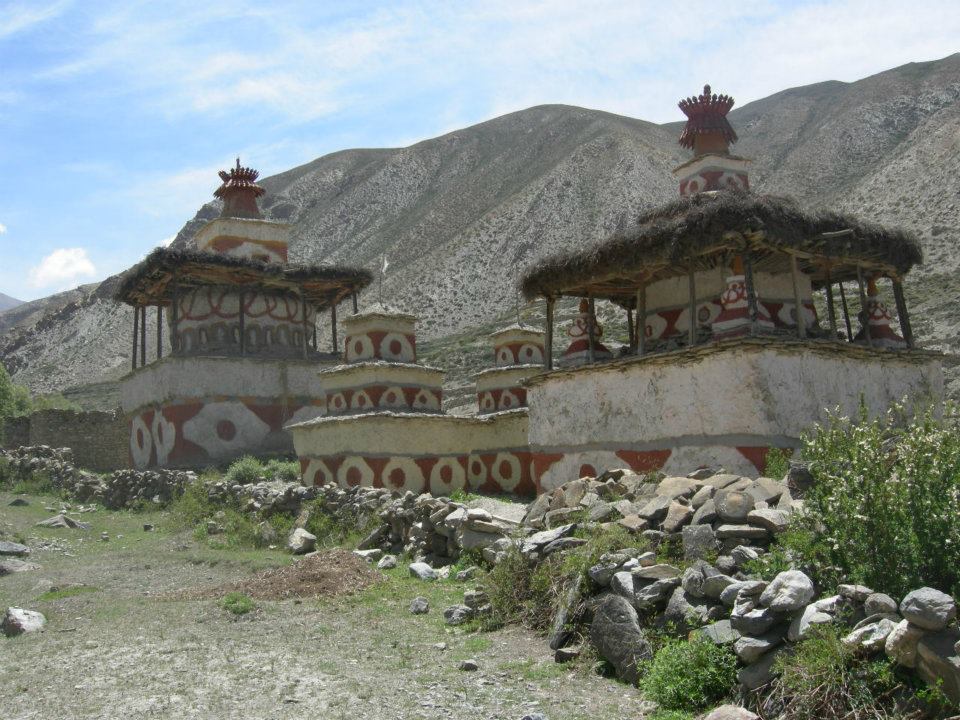
Chortens of Samling. Photo credit: Unknown.

He became the first of many Yangtön lamas at Samling to collect and preserve sacred Yungdrung Bön texts. Because of this, many volumes of scripture have been preserved throughout the course of many centuries. It was during a trip to Samling Monastery in 1961 C.E. that Dr. David Snellgrove discovered a copy of the Zi Ji, a hagiography of Buddha Tönpa Shenrap. He subsequently wrote and published extracts from this text as one of the first English language translations of a Yungdrung Bön text, The Nine Ways of Bön. The Zi Ji volume that he consulted for his translation was estimated to be approximately 400 years old.

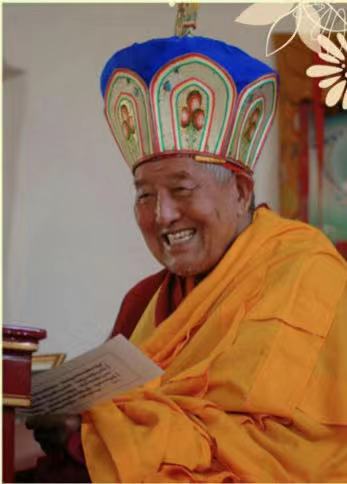
Currently, Lama Sherap Tenzin Rinpoche is the head of the monastery.  He was born in 1953 C.E. and has received extensive religious training and has been trained in the science of Tibetan medicine.

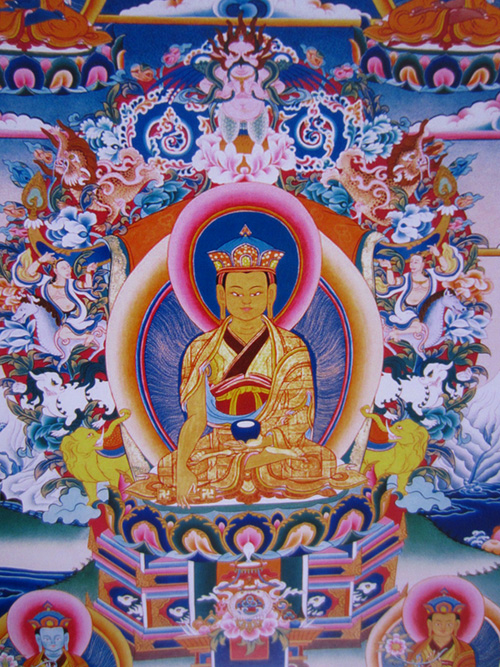
Left: H.E. Menri Ponlop Yangtön Thrinley Nyima Rinpoche, Center: H.H. 33rd Menri Trizin Rinpoche, Right: Yangtön Lama Sherap Tenzin Rinpoche. Photo credit: Unknown.

Nine Ways has a new Shop! Click the tap at the top of this page to see what practice support items are available. Currently, the Nine Ways Shop is fundraising in support of a memorial chorten that will be built in Tsarka Dolpo, Nepal for Yangtön Lama Tashi Gyaltsen. For more information about this chorten, go to this article: https://ravencypresswood.com/2025/10/18/in-support-of-a-memorial-chorten-for-yangton-lama-tashi-gyaltsen-rinpoche/

Raven Cypress Wood ©All Rights Reserved. No content, in part or in whole, is allowed to be used without direct permission from the author.

Did you enjoy this content? This article is made possible by generous donors who want content like this to continue to be available. Don’t want to miss a post? Scroll to the bottom and click “Follow this blog.”
Join the mandala of Nine Ways supporters by donating through one of the services listed below.

The Sharp Point of Wisdom

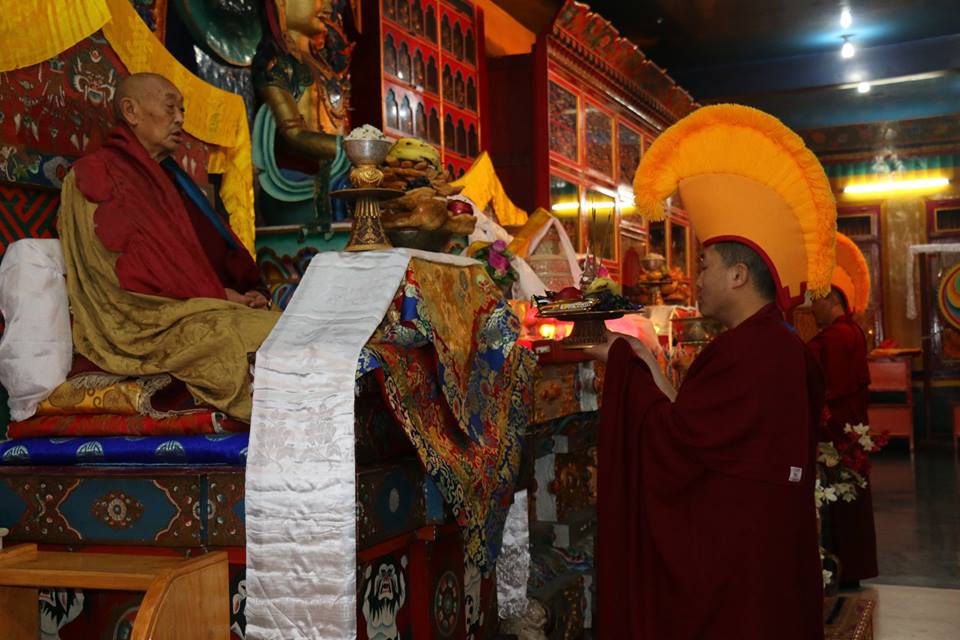
Monks debating at Nangzhig Monastery. Photo credit: Unknown

Fire Offering for the Holy Physical Remains of a Realized Being

Some of the many Fire Offering Ritual items to be burned with the holy remains. Photo credit: Menri Monastery

During the early morning hours of October 2, 2017, the holy physical remains of His Holiness 33rd Menri Trizen Lungtok Tenpé Nyima Rinpoche will be cremated during an elaborate fire offering ritual at Menri Monastery in Dolanji, India. For the past five days, concluding at 3:30 a.m. prior to the beginning of the actual cremation ceremony, the monks have been performing the Kün Rik Le Zhi Gyü Nga, The Full Cycle of the Four Activities and the Five Tantras with cycles for each of the four kinds of enlightened activity which are classified as peaceful, expansive, powerful and wrathful.

Cremation chorten for HH 33rd Menri Trizen Rinpoche at Menri Monastery. Photo credit: Lee Hartline

In preparation for the cremation, a special cremation chorten has been constructed near the gompa and the butter lamp house. This cremation chorten (Sanskrit: stupa), built under the guidance of Khedup Gyatso who is a treasure of knowledge in the Yungdrung Bön community and a relative of His Holiness 33rd Menri Trizen Rinpoche, will be where the holy remains will be taken for cremation. This chorten has been constructed exactly to the dimensions of the sand mandalas of the Kün Rik cycle that will be burned with the holy remains. After the cremation ash has been collected, this chorten will be torn down.

Extensive offerings for the fire offering ritual for HH 33 Menri Trizen Rinpoche. Photo credit: Menri Monastery

The Kü Dung, or holy physical remains, will take up to three hours to burn. After that, it will take an additional day to offer and burn the vast array of offerings that are housed inside the gompa at Menri Monastery. Everything is made clean through prayer, and cleansing with pure water and incense. Among the many offerings are prayers of aspiration that have been written in pure gold and silver and placed upon tall wooden boards that will be read aloud and then offered to the sacred fire. This vast array of offerings are not given as a support for His Holiness 33rd Menri Trizen Rinpoche.  Rather, his sacred activity of having attained realization is taken as an auspicious opportunity to generate great benefit for all sentient beings.

Prayers of aspiration written in precious gold and silver.

During the time of the Fire Offering Ritual, lay people continuously circumambulate the sacred site. It will take many days for the cremation ashes to cool. At that time, the monks will collect the sacred ash and also look for kü dung ringsel. These kü dung ringsel, or relics of the holy physical remains, can appear in the cremation ash of realized beings and take many forms including the appearance of sacred images on small bone fragments or small, pearl-like spheres. The cremation ash will be made into tsa tsa and placed within a special memorial chorten dedicated to His Holiness 33rd Menri Trizen Rinpoche.

Some of the many offerings for the Fire Offering Ritual dedicated to His Holiness 33rd Menri Trizen Rinpoche. Photo credit: Menri Monastery