Category Archives: Prayer and Ritual

The Field of Accumulation: The Yidams

Tsok zhing according to Menri

Tsok zhing according to MenriThe Yungdrung Bon Merit Field of the Menri Tradition

In the Yungdrung Bön tradition, the place where the deities and objects of veneration are gathered is called the “Tsok Zhing”, the “Field of Accumulation”.  It is also sometimes translated as the “Field of Merit” or the “Merit Field” because what is being accumulated by paying homage and making offerings to this place is merit, or virtue.  This is the Merit Field according to the Menri Tradition from a drawing done by the great master and scholar HE Yongdzin Tenzin Namdak Rinpoche.

Yidams are deities who have their own individual cycles of practice with the aim of acquiring the qualities and blessings of the yidam being meditated upon.  In general, these cycles of practice are centered around an individual retreat in which the practitioner focuses upon self-transformation into the deity, recitation of the deity’s mantra, along with any other ritual or meditation specific to the deity which support the attainment of the deities qualities and blessings.  There are yidams specific to a family lineage, to monastic lineages as well as personal yidams.  Some of the vows associated with yidam practice are general to all, and some vows are specific to each yidam.  Some yidams are represented more than once to signify their different tantric cycles.

#2-4, 14 & 18: The Five Supreme Embodiments of the Father Tantra (See previous post:https://ravencypresswood.com/2016/06/05/the-five-supreme-embodiments/)

1. Zhiwa Künnang Khyappa: This yidam represents all peaceful yidams

2. Trowo Tsochok Khagying: This yidam is an embodiment of the Enlightened Mind of Buddha Tönpa Shenrap Miwoche.

3. Walsé Ngampa: This yidam is an embodiment of the Enlightened Body of Buddha Tönpa Shenrap Miwoche.

The Yidam Walse Ngampa, Embodiment of the Enl ightened Body

4. Lhago Tokpa: This yidam is an embodiment of the Enlightened Speech of Buddha Tönpa Shenrap Miwoche.

5. Sangwa Ying Rol

6. Tséwang Rikdzin: As a long life deity, this yidam is white in color.

7. Magyü Sangchok Tartuk: This yidam is the principal deity of the Mother Tantra and is also known as Tukjé Galpo.

8. Drenpa Namkha

9. Bumpa

10. Rampa

11. Rolpa

12. Dütsi Yungdrung Khyilwa

13. Takla Pudri Marpo

14. Gekho Sangwa Drakchen:  This yidam is the embodiment of the Enlightened Qualities of Buddha Tönpa Shenrap Miwoche.

15. Trowo Druksé Chempa: This yidam is the Embodiment of the Enlightened Activities of Buddha Tönpa Shenrap Miwoche.

16. Meri Walchen Gekho

17. Chidul Yidam Gyatso Trogyal Raksha Khagying

18. Sangpur

19. Walsé Khyungnak Trowo Karpo

20.Wal Khyung Marpo

Yidams of the Other Tantras

#22-#25 The Four Principal Enlightened Ones (See previous post https://ravencypresswood.com/2016/08/20/the-four-principal-enlightened-ones/)

21. Gyepa Kunnang Khyapa

22. Tönpa Shenrap Miwo

23. Sipa Sangpo Bumtri

24. Lhachen Shenlha Ökar

25. Yumchen Satrik Érsang

26. Shenrap Nampar Gyalwa

27. Namdak

28. Jamma

29. Mélha

30. Kéngtsé Lenmé

31. Sherab Mawé Séngé

The Yidam Mawe Senge

32. Dülchok Tönpa Tritsuk Gyalwa

33. Jamma

34. Namdak

35. Mönlam Taye

36. Menlha

37. Künying

38. Gényen Tékpa Lha

39. Jamden

40. Dükhor

41. Künrik

42. Gyalwa Gyatso

43. Namjom
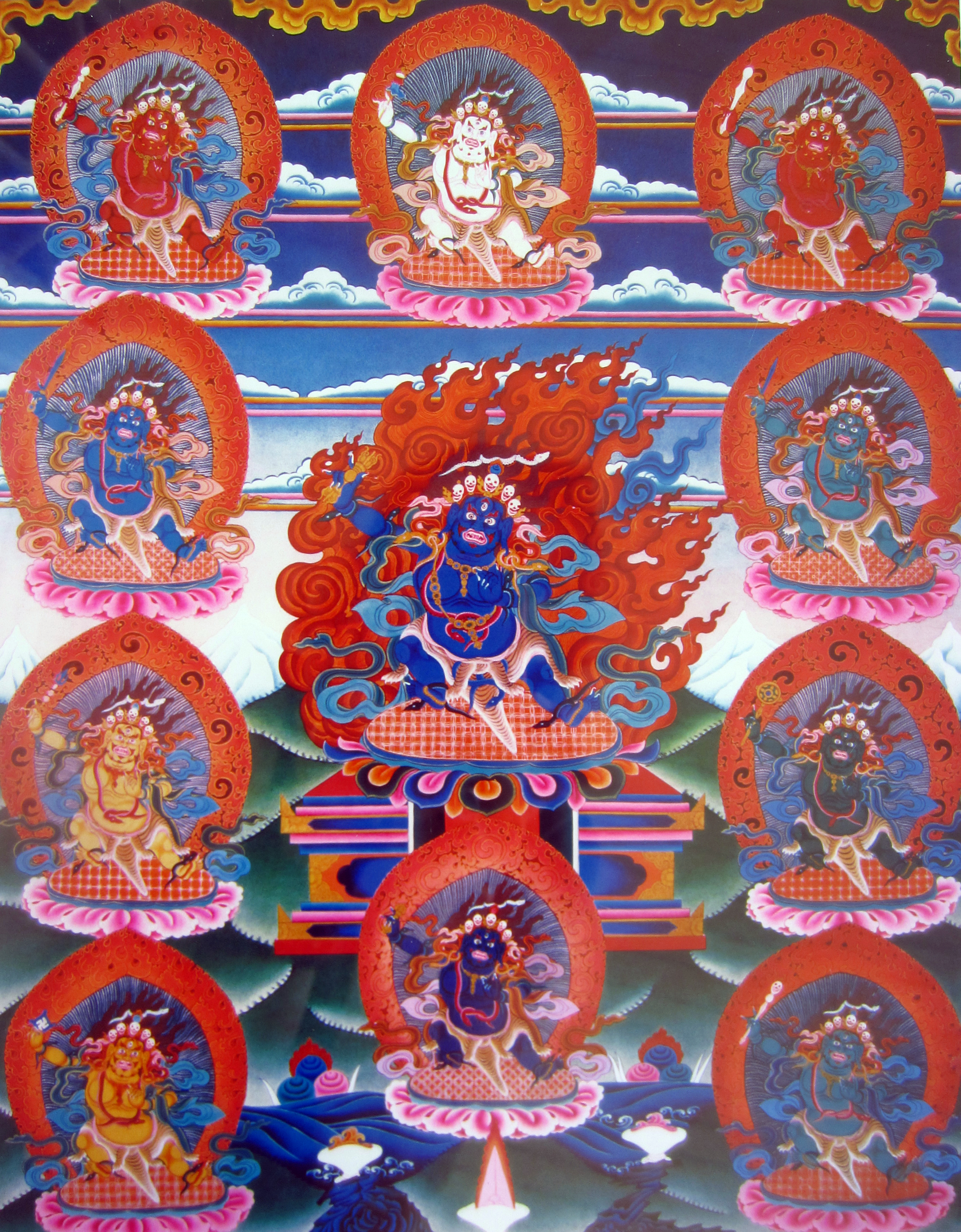
The Yidam Namjom, aka Nampar Jompa, and his emanations.

Celebrating the Sacred

HE Menri Lopon Trinley Nyima Rinpoche lights candles on a cake celebrating the birth of Lord Tonpa Shenrap Miwoche. Photo credit: Unknown

Sacred Gathering

Monks during a festival at Triten Norbutse Monastery near Kathmandu, Nepal. Photo credit Andrzej Nieckula
Adding Virtue to Everyday Actions

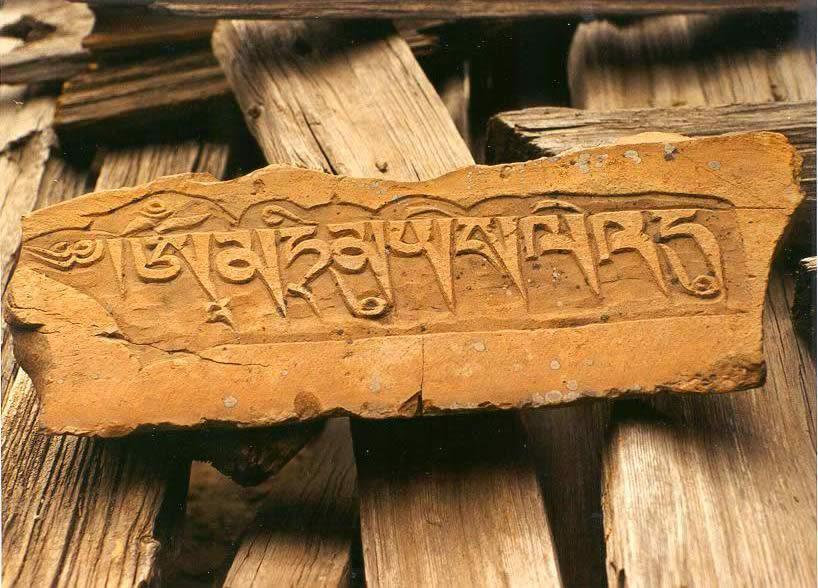
MA TRI mantra above a doorway. Photo credit: Unknown

From the Dechok Rinchen Dronma’i Phen Yön, The Benefits of the Recitation Practice of the Precious Lamp, also known as The Thirty-two Benefits of the MA TRI Mantra:

“(6) This recitation practice is a precious lamp.  Anyone who has generated the mind of compassion, if they write out the mantra and put it above the doorway of the retreat place or throughout the community, then just by entering these places one will attain liberation.  Entering practice is the benefit of this precious lamp.”

~Translation from Tibetan to English by Raven Cypress Wood ©All Rights Reserved

The MA TRI mantra is one of the three essence mantras of the Yungdrung Bön tradition. The complete mantra is:་OM MA TRI MU YÉ SA LÉ DU.


Mandala of the Divine: The Yungdrung Bön Altar

menri-shrine-edit

Special ceremony altar at Menri Monastery in Dolanji, India. Photo credit: Unknown.

In the Yungdrung Bön religious tradition, the principal altar is referred to as the ‘Mandala of the Divine’, or the ‘Upper Mandala.’  Once properly established, the altar becomes the sacred place in which to host the majestic presence and blessings of the deities.  In this way, it becomes a powerful support for spiritual practice and the development of the practitioner.  From the Benefits of the Recitation Practice which is a Precious Lamp:

“Whoever goes before a lama, a lopon or one of the three supports (statue, text or chorten) and recites the MA TRI mantra while prostrating or circumambulating, their aspiration will be quickly accomplished.”

Regardless of the size of the altar display, the practitioner imagines the offerings and the presence of the deities as boundless and unlimited.  It is important that the area be clean and be respected as a sacred place even if the altar is a single butter lamp,

Traditionally, the altar is located in a higher place such as the top most floor of a building.  Ideally, the altar faces East and is seen as one enters the room where it is located.  If facing East is not possible, South is second best although sometimes West or North are the only available options.  Ideally, the altar has three, four or five levels.  Whatever is placed upon the altar should be clean, undamaged and have a sacred purpose.  The altar is sometimes painted and sometimes covered with silk.  Although there are specific rituals that specify the use of white or black cloths, in general the colors of white, black and green are not appropriate for the altar.  When the text specifies placement of items to the ‘left’ or ‘right’, the perspective is always that of the deities.  Therefore, ‘left’ becomes the practitioner’s ‘right’ when facing the altar.  For example, according to the text the protectors red offering of tea or rakta is placed on the left and the white offering of alcohol is placed on the right.  However, for the practitioner facing the altar, the red offering of tea or rakta is to their right, and the white offering of alcohol is to their left.  Below, ‘right’ and ‘left’ are from the perspective of the practitioner facing the altar.

HH 33rd Menri Trizen. Behind him and to the left are texts wrapped in red cloth on shelves above the deity statues. Photo Credit: Unknown.

The Higher Levels of the Altar: It is important to have representations of enlightened Body, Speech and Mind on the altar.  Enlightened Body is represented by statues and images such as thangkas, enlightened Speech is represented by texts, and enlightened Mind is represented by the chorten. Yungdrung Bön scriptural texts are always placed in the highest possible position with nothing on a level above them.  They are considered even more important than an image of the Buddha because they contain the actual teachings and guidance that leads sentient beings out of their suffering.  Sometimes they are placed on the same level with the deity statues due to limited space.

The Elegant Yungdrung Bon Chorten

Generally, statues and yidam torma are placed on the level below the texts.  Images of high lamas are placed below the statues.  If there is only a single lama image, it should be placed in the center.  If there is more than one lama image, the image of the highest status lama is placed to the practitioner’s left and the second highest status lama is placed to the right.  The third highest status lama image is placed to the left of the first image, etc.

The Lower Levels of the Altar: Offerings to the deities are placed on the lower levels of the altar.  Most important are the five daily offerings of butter lamps, incense, clean water, food and flowers.  (See previous post The Five External Daily Offerings https://ravencypresswood.com/2017/01/14/the-five-daily-offerings/.)  Mandala rings are ritually filled with dry barley or rice and placed as an offering.  If there is only one mandala, it is placed in the center.  If there are two mandalas, they are placed to the left and right.  Flowers are placed to the side of the altar and burning incense is placed below.

Mandala offering with the unique Yungdrung Bon square top. Photo credit: Unknown.

Once everything has been properly established, the altar is ritually cleansed with the sprinkling of clean water and the smoke of pure incense together with their respective mantra.  Everything is imagined as being completely pure.  The practitioner then performs at least three prostrations of body, speech and mind with a heart of devotion.  At this time, the altar has been ‘opened’.  From this time until it is ‘closed’ in the evening, one must perform prostrations before approaching the altar.  Out of respect, whenever approaching the altar when it is ‘open’, the mouth is covered as a way to keep it completely pure and clean.

According to the texts, the altar is opened in the morning ‘when the birds leave their nest’ and closed in the afternoon when ‘the birds return to their nest.’  This is generally considered to be dawn and late afternoon before sunset.  When acquiring items for the altar, setting it up, and opening and closing it each day, one imagines that by engaging in this virtuous activity, that the five poisons of ignorance, anger, attachment, pride and jealousy are purified.

Raven Cypress Wood ©All Rights Reserved