 Each of the letters of the Tibetan alphabet are associated with one of the five elements according to their inherent sound. The letters associated with the space element are AH, KA, KHA, GA NGA, and HA.
Category Archives: Five Elements
Sounds of Space
The Elegant Yungdrung Bön Chorten
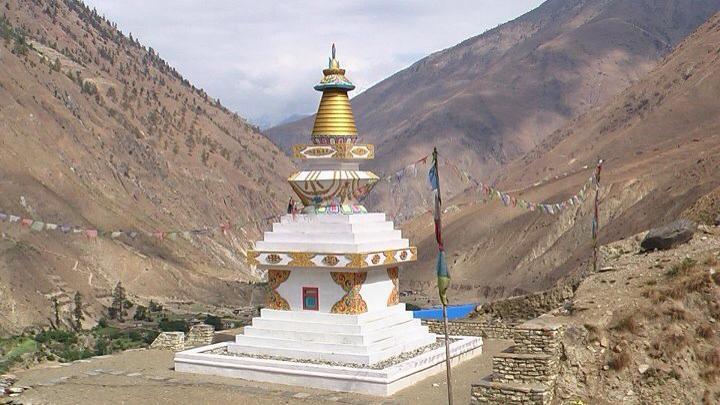
The Elegant Yungdrung Bön Chorten located in the village of Dunai in Dolpo, Nepal. Photo credit: Unknown
According to the Zi Ji, there are one hundred and twenty different kinds of physically manifested chorten (Sanskrit: stupa) within the Yungdrung Bön tradition. The ritual preparation, dimensions, materials, and ornamentation are all defined in great detail. Each of these aspects has multiple meanings. The chorten physically represents the path to enlightenment from the base to the flame of wisdom of absolute reality at the very top.

The Enlightened Teacher and founder of the Yungdrung Bön tradition, Tönpa Shenrap Miwoche, gave detailed instructions for the very first Elegant Yungdrung Bön Chorten to be built during the course of teaching the Fifth Way of Yungdrung Bön, The Way of the Virtuous Lay Practitioner.
Zhang Zhung Element Syllables

Here, the seed syllables of the five elements of space, air, fire, water and earth are written in the Zhang Zhung mar chen script. From left to right, the seed syllables are AH, YANG, RAM, MANG, AND KHAM.
The Twelve Animals of Tibetan Astrology: The Tiger
 In Tibetan astrology, there is a twelve year cycle. Each of these years is characterized by a different animal and associated with one of the five elements. Therefore, a full cycle of the twelve animals being associated with each of the five elements takes sixty years. The twelve animals according to the Yungdrung Bön texts are the Rat, Elephant, Tiger, Rabbit, Dragon, Horse, Snake, Sheep, Garuda, Monkey, Dog and Pig. Each animal has an associated element for its life-force and a direction which is determined by the life-force element. Not only are these twelve animals associated with a particular year, they are also associated with particular months, days and hours.
2010 was the year of the Tiger. Therefore, people born during this year would be a Tiger and would have an emphasis of the specific qualities associated with Tiger. (It is important to remember that this year corresponds with the Tibetan lunar calendar which begins somewhere between February and mid-March each year.) 2010 was also governed by the element of Metal and was a male year. So, people born during this year would be Male Metal Tigers. The element which governs the life-force of the Tiger is Wood and its direction is East. So, if a Tiger person wanted to strengthen their life-force, they would focus upon strengthening the element of Wood internally and externally. Their positive direction is East. So, facing this direction while meditating, doing healing rituals or just relaxing and taking deep breaths is beneficial.
 In general, the Tiger is considered to be courageous, independent, unpredictable, artistic and passionate. The Tiger tends to go after life with passion and daring. Making its own path, it tends to gravitate towards unconventional lifestyles and avoids following traditions or social conventions simply because they are ‘supposed to’. The Tiger is a fierce and determined leader that can be quick-tempered and protective of its ego. The Tiger wants to live life to the fullest in its own way, and without being told what to do.
The Tiger‘s soul day is Thursday and the life-force day is Saturday. These are the best days for beginning new projects and activities that are meant to increase or develop something. The obstacle day is Friday. This day is best for cleansing and letting things go. It is not a favorable day for beginning new things.
Tiger years include: 1926, 1938, 1950, 1962, 1974, 1986, 1998, and 2010
If you were born during a previous year of the Tiger, this year as well as other Tiger years are considered a time of vulnerability to obstacles. This same astrological principal applies for all of the other eleven animal signs during their associated year. Therefore, it is recommended to engage in practices that support vitality, good fortune and spiritual merit such as hanging prayer flags, having a soul and life-force retrieval ritual performed, restoring any deterioration or violation of one’s spiritual commitments or any damaged relationship with one’s spiritual brothers and sisters, and/or performing prayers and rituals to remove obstacles. In general, making an effort to engage more with virtuous activities of body, speech and mind and committing to engage less with non-virtuous activities is supportive. According to the words of Buddha Tönpa Shenrap Miwoché, the practice of developing sincere unbiased and unlimited compassion is the greatest of all protections.
A common prayer within the Yungdrung Bön tradition that is used to remove obstacles is the Bar Che Lam Sel, The Spontaneous Wish-fulfillment of Removing Obstacles from the Path. The English, Spanish and Portuguese translations of this prayer are offered free for personal use on the Nine Ways Publications page. Click on the Publications tab above and scroll down to the download links for the prayer.
Raven Cypress Wood© All Rights Reserved
Don’t want to miss a post? Scroll to the bottom and click “Follow this blog.”
The Five Elements: Space
 The element of Space is called namkha in Tibetan. It is symbolized by the shape of a circle and the color white. The unique vibration of this element is the sound ‘AH’. It is associated with the center. In general, Space allows for the many varied manifestations of the other elements without interfering or being damaged in any way.
Environmentally, the sky allows the manifestation of many types of weather, planets, stars, animals, etc. Everything that exists, exists within Space. Everything that has ever happened, that is happening right now, or that will happen in the future, happens within the element of Space. Among the five elements, Space is the strongest because it is indestructible. Although anything can happen in Space, nothing diminishes or damages it in any way.
Within our bodies, the element of Space is associated with our awareness. It is also associated with the heart. When the element of Space is balanced within us, we are aware of ourselves and our surroundings without losing ourselves or being overwhelmed by events or experiences. Even in the midst of difficult circumstances, we do not lose ourselves or feel constricted with worry. We are open to experience without being vulnerable to it.
However, if the element of Space is in excess, we are literally ‘spacey’. Rather than being grounded in Space, we drift from one thing to another without connecting to anything. We lose track of ourselves and our purpose. We become lost in Space and easily distracted.
If the Space element is deficient, we feel as if we are being suffocated by life. We feel as though there are too many demands, too many obligations, too much ‘out there’ and not enough of ‘us’. We begin to say to ourselves and to others, “I need some space!” We have lost contact with the Space within ourselves.
In order to bring the element of Space back into balance, there are specific yogic exercises within the Yungdrung Bön tradition which use the focus of the mind together with the breath and movement of the physical body to balance and strengthen each of the elements within us. To learn more about these yogic exercises see Healing with Form, Energy and Light by Tenzin Wangyal Rinpoche.
As the other four elements are brought into balance, the Space element naturally becomes balanced as well. Allowing Space for experiences rather than struggling with them develops the relationship with the indestructible quality of the element of Space.
In the more advanced teachings of Yungdrung Bön, Space is the most important element. Recognizing and becoming familiar with the pure, luminous, boundless Space of the mind is the practice of wisdom. This Space is the basis for all things that arise, including all of the phenomena of the other four elements. Many people are uncomfortable with too much Space. This is clear by the seemingly endless things that we use to distract and entertain ourselves. However, we can develop more comfort and familiarity with the Space element by minimizing these distractions and developing our capacity to relax into the stillness of our body, the silence of not talking, and the spaciousness of our mind that has taken a break from worry and emotional upset. This kind of taking a break from constant movement and thought is the best medicine for physical, emotional and spiritual well being.
 Nine Ways