Author Archives: Raven Cypress Wood

Discovery from an Ancient Kingdom

gzi found in Ngari region of Western Tibet

Zi bead found in Western Tibet. Photo credit: Unknown

Recently, an archaeology professor working in the Ngari region of Western Tibet, South of the Ganges River, discovered an ancient zi from a gravesite. This was the area of the ancient kingdom of Zhang Zhung.

The original article can be read in full at the Himalaya Bon Tibetan language website: http://himalayabon.com/news/2015-04-10/574.html

Iconography: Defining Space

Illustration from the book “Tibetan Thangkha Painting, Methods & Materials” by David & Janice Jackson

Before the artist begins sketching out the images that will appear on the thangkha, they must first determine the division of space on the canvas.  First, by using chalk lines and a compass, the true center of the canvas must be found.  Second, both the horizontal and the vertical axis must be established.  In this way, the artist can allocate space to the images according to hierarchy and the number of images that need to be represented.

outline guide for center and 4 directions for thangkha

Diagram 1: Common positions when depicting a central image and 4 retinue

Diagram 2: Common positions when depicting a central image and 8 retinue


These diagrams show the most common designations of space although there are variations.  However, even with variations, the position of the retinue in relation to one another remains the same.  The retinue are positioned according to their association with the directions.  In the text, the detail of the deities position begins with the center and is then listed the Bön way, or counter-clockwise, beginning with the East.  Referencing the diagrams above: 1=Center, 2=East, 3=North, 4=West, 5=South, 6=Southeast, 7=Northeast, 8=Northwest, and 9=Southwest.  Most often, but not always, the deities are the color associated with the direction.  East=yellow, North=green, West=red and South=blue.

The Deities of the Five Buddha Families

Here, the deities of the Five Buddha Families are positioned according to diagram 1 above.  In the center is the Enlightened One, Künang Kyapa and consort.  In the east is the Enlightened One, Salwa Rangjung and consort.  In the north is the Enlightened One, Gélha Garchuk and consort.  In the west is the Enlightened One, Jedrak Ngomé and consort.  And in the south is the Enlightened One, Gawa Döndrup and consort.

Developing the Five Elements

landscape of prayer flags in Nepal

Each of the five colors of prayer flags correspond with the five elements.  Hanging them in clean, high places where the wind activates their qualities is a way to develop and strengthen the five elements within one’s own body, speech and mind.

The Field of Accumulation: The Lineage of the Three-fold Cycle of Dzogchen Proclamations

Tsok zhing according to Menri

Tsok zhing according to MenriThe Yungdrung Bon Merit Field of the Menri Tradition

In the Yungdrung Bön tradition, the place where the deities and objects of veneration are gathered is called the “Tsok Zhing”, the “Field of Accumulation”.  It is also sometimes translated as the “Field of Merit” or the “Merit Field” because what is being accumulated by paying homage and making offerings to this place is merit, or virtue.  This is the Merit Field according to the Menri Tradition from a drawing done by the great master and scholar HE Yongdzin Tenzin Namdak Rinpoche.

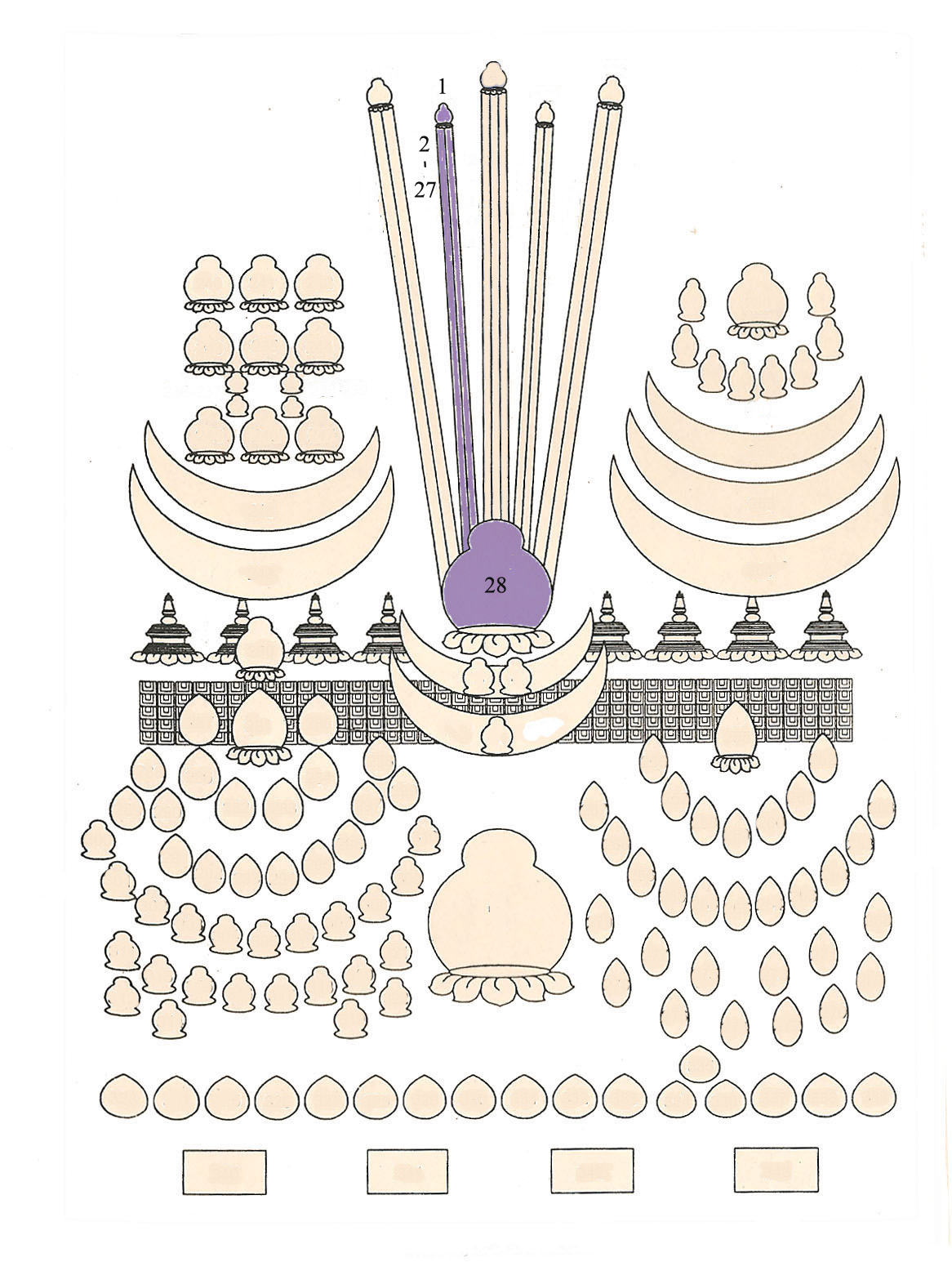
Outline guide for tsok zhing Dzogchen Drakpa Korsum

Diagram highlighting the placement of the Dzogchen Lineage within the Merit Field thangkha.

#1-28 depicts the Lineage of the Three-fold Cycle of Dzogchen Proclamations. In Tibetan, the Dzogchen Drakpa Korsum Gyü.

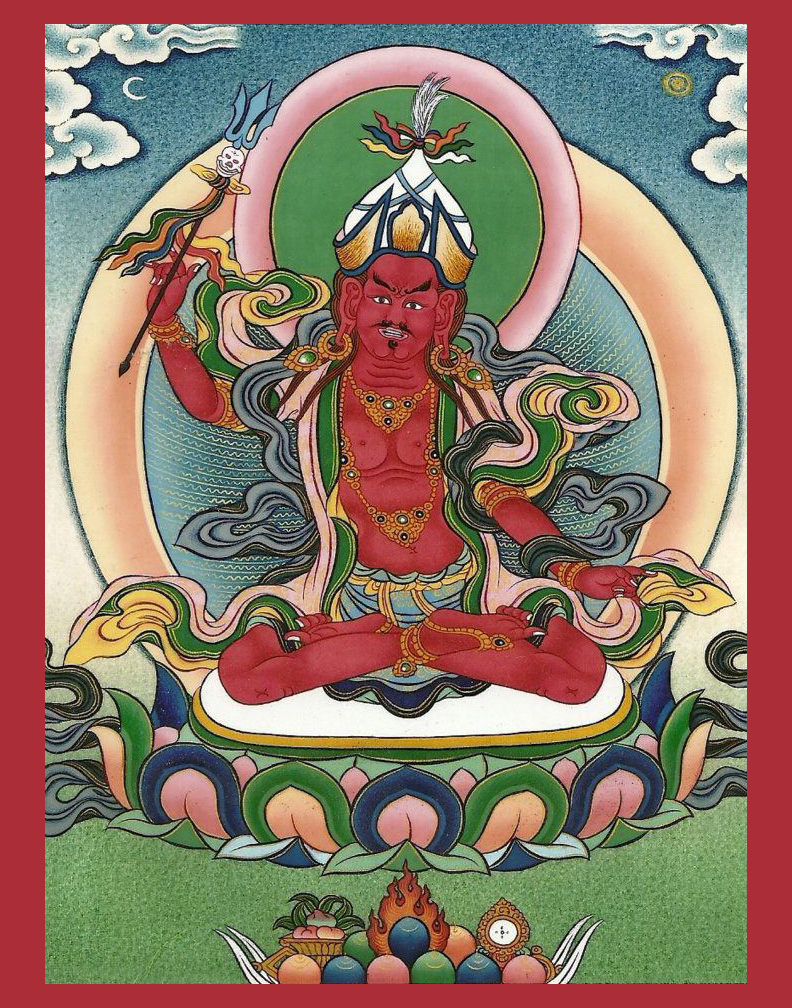
1. The source of the lineage, the White Light Deity, Shenlha Ökar.  He appears in the form of dzok ku, the enlightened Body of the Perfected Qualities and wears the corresponding ornaments.  His compassion is all-pervasive.

2. The Five Victorious Families who have gone beyond bliss, aka The Five Buddha Families.

3. Chimé Tsukphü.  He was the previous existence of the enlightened Lord Tönpa Shenrab Miwoche immediately before descending from heaven to earth.

4. Lhashen Yongsu Dakpa.  He was the shen of the gods who received the teachings from Chimé Tsukphü.

5. Milu Samlek.  He was the shen of the humans who received the teachings from Chime Tsukphü. He was born a prince in the ancient land of Tazik as his father, the king, was about to die.  He was known for his intelligence even as a young man.

#6-10  The Transmission of the Changeless Sages

6. Lushen Yeshé Nyingpo.  He is the shen of the lu, aka nagas, who received the teachings from Chime Tsukphü.

7. Ödzer Pakmé.  He was a master from Tazik.

8. Münpo Künsal

9. Trulshen Nangden

10. Sangwa Düpa.  He was a chief disciple of Chimé Tsukphü. He was born a prince of Tazik.
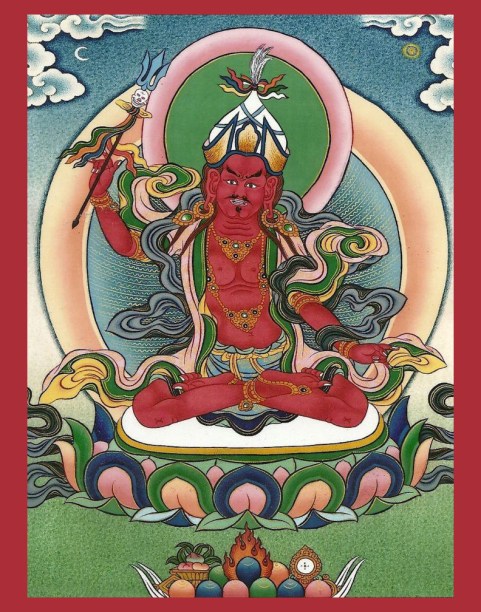
Translator and great yogi, Lama Tonggyung Tuchen

#11-14 The Transmission of the Scholarly Translators

11. Tonggyung Tüchen

12. Sé Bön Shari Uchen 

13. Chétsa Kharbu

14. Nyachen Lishu Taring.  A king and queen found a beautiful young girl in a forest. They named her Takza Liwer. Some time later, through the performance of ritual, she transformed herself into a man. However, she was still female when she wrote the root text for The Three-fold Cycle of Dzogchen Proclamations in the 8th century.  As a male, he became heir to the kingdom and was called Nyachen Lishu Taring.

15. Dé Bön Gyimtsa Machung  

16. Drupchen Chogye

17. Choza Bönmo

18. Zhotön Ngödrup Drakpa. He was an emanation of Lishu Taring and a tertön, or treasure revealer,  who rediscovered hidden texts behind a statue of Vairochana in Lhodrak that were hidden by Lishu Taring during a time of persecution for the Yungdrung Bön.

19. Gyaton Jodé

20. Zhikpo Nangseng

21. Kyotön Ngakpal

22. Yotön Lhunpal

23. Sengé Drukdra

24. Bönzhik Lodé

25. Tokden Yungrin

26. Khetsün Sherdrüp

27. Yonten Sengé

28. The Second Victor and founder of Tashi Menri Monastery, Nyammé Sherap Gyalsten 1356-1415.

Direct Descendants of the Enlightened Lord Tönpa Shenrap Miwoché

Over 18, 000 years ago, in the ancient realm of Olmo Lungrik, the founder of the Yungdrung Bön spiritual tradition was born.  The enlightened Lord Tönpa Shenrap Miwoche was born into the human realm as a prince.  He later adopted the life as a monastic in order to display the path of renunciation to his followers.  However, prior to this, he was married and had sons and daughters.  The direct descendants of this Shen lineage have continued until this very day.  Currently, there are two sons who are direct descendants of Lord Tönpa Shenrap.

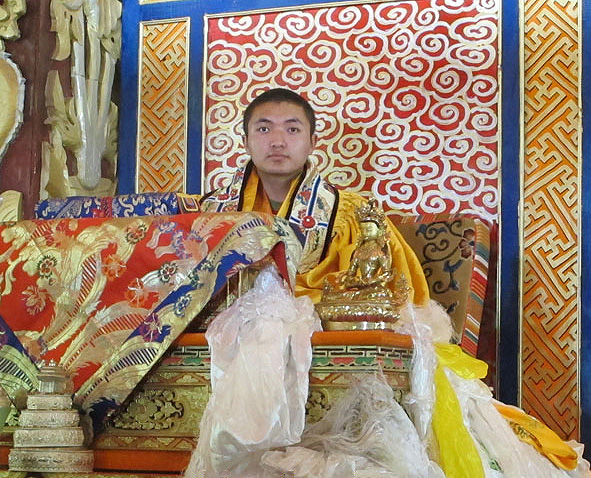
Heir to the Shen Lineage, Tsukpu Namdrol Rinpoche, during a visit to the Yungdrung Bon monastery of Gangru Dargye located in Khyungpo, Tibet

Lamas of the Shen lineage

The two sons of the Shen lineage who are direct descendants of the Lord Tonpa Shenrap.

In November of 2014, His Holiness, the supreme 33rd Menri Trizen Lungtok Tenpé Nyima offered prayers to both descendants.

Shen Tsukpu Namdrol Rinpoche

Shen Tsukpu Namdrol Gyaltsen Rinpoche

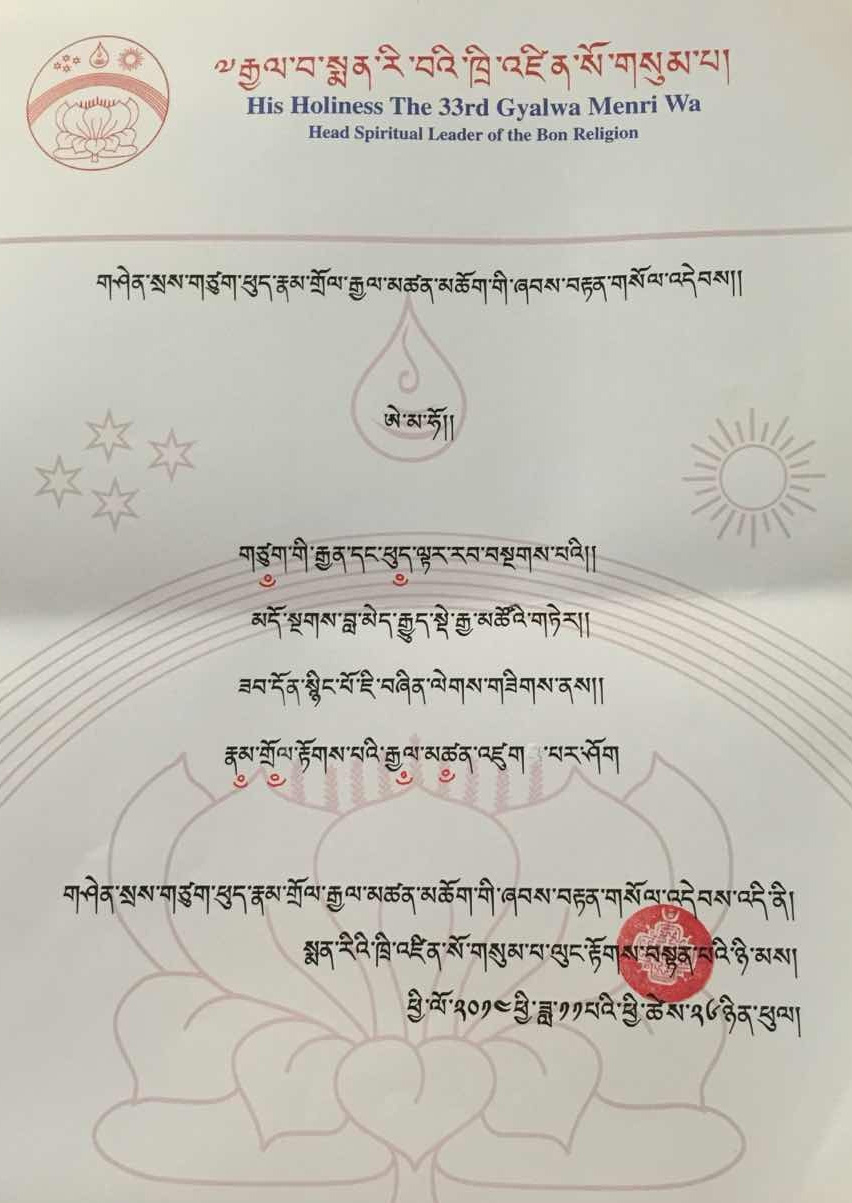
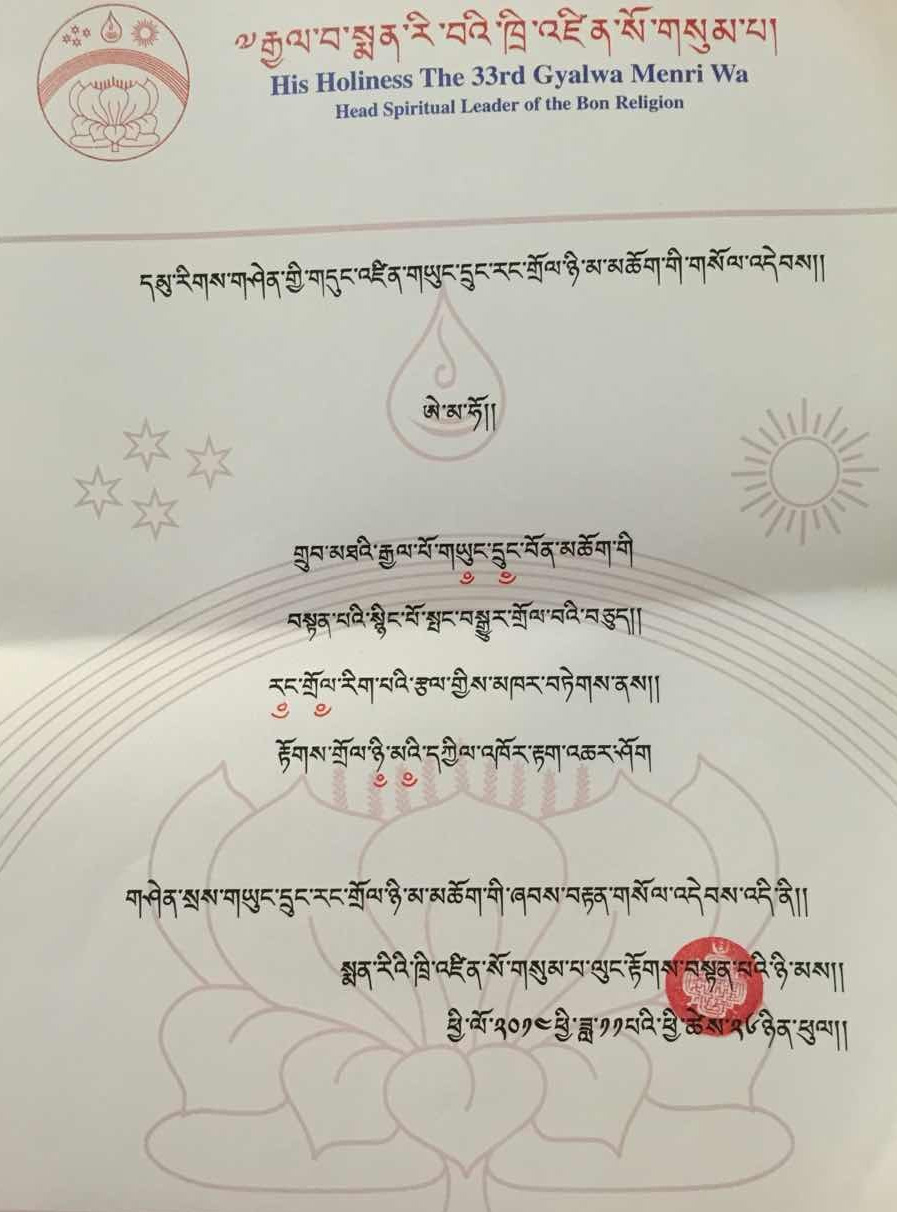
prayer to Shen Tsukpu namdrol Gyaltsen written by 33 Menri trizen 2

Prayer of Stability for the Shen Heir, the Supreme Tsukpu Namdrol Gyaltsen

EMAHO!

Highest praise for the best of crown ornaments,

   Storehouse of the ocean of sutra, tantra and unsurpassed division of teachings,

From the proper understanding of the profound meaning of the innermost essence,

May the victory banner of liberation and realization be established!

Murik Shen Yungdrung Nyima

Murik Shen Yungdrung Rangdrol Nyima Rinpoche

Shen prayer to Yungdrung Nyima

Prayer for the Shen Heir, the Supreme Murik Shen Yungdrung Rangdrol Nyima

EMAHO!

Essence of the king of doctrines, the supreme Yungdrung Bön,

Distilled essence of the teachings of renunciation, transformation and liberation,

Having raised a stronghold through the dynamic energy of self-liberated awareness,

May the sun disc of realization and liberation eternally appear!

Composed by 33rd Menri Trizen Luntok Tenpé Namdak Rinpoche on the Western date of 11/26/2014

Translated by Raven Cypress Wood

The original article first appeared on the Tibetan language website Himalayan Bön and can be viewed here: http://www.himalayabon.com/article/poem/2015-01-02/518.html