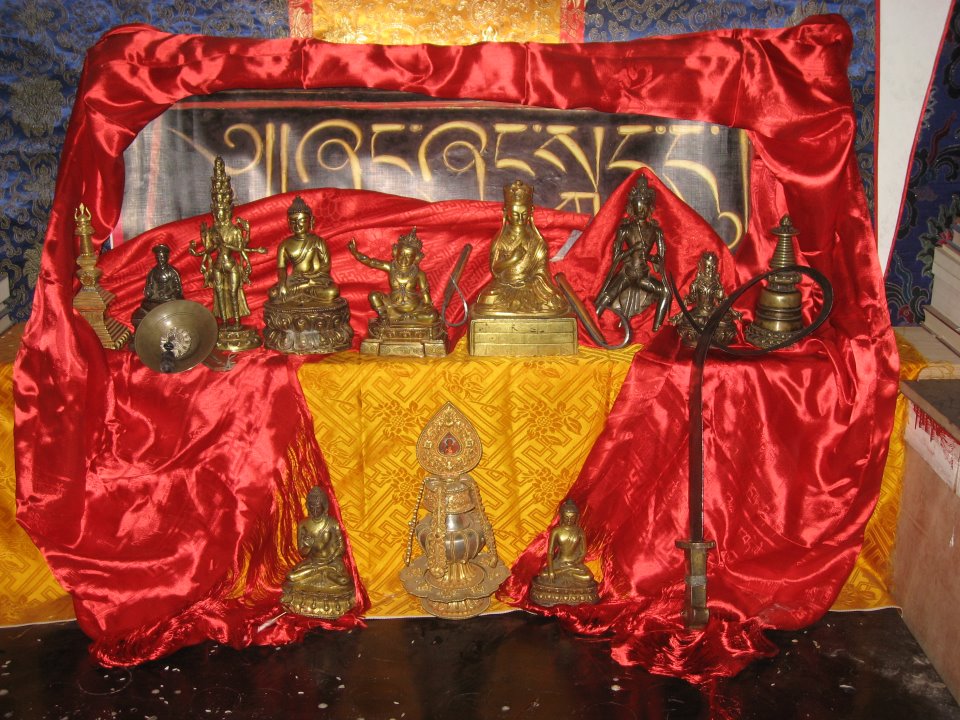
A Collection of Sacred Yungdrung Bon Objects. Photo credit: Unknown
A Collection of Sacred Yungdrung Bon Objects. Photo credit: Unknown

HE Menri Lopon Thrinley Nyima Rinpoche prepares to perform a consecration ritual. Photo credit: Raven Cypress Wood

Gyaltsen or Sign of Victory
As one of the Eight Auspicious Symbols, the gyaltsen or sign of victory, symbolizes victory over all obstacles especially the demon of ignorance.

Special ceremony altar at Menri Monastery in Dolanji, India. Photo credit: Unknown.
In the Yungdrung Bön religious tradition, the principal altar is referred to as the ‘Mandala of the Divine’, or the ‘Upper Mandala.’ Once properly established, the altar becomes the sacred place in which to host the majestic presence and blessings of the deities. In this way, it becomes a powerful support for spiritual practice and the development of the practitioner. From the Benefits of the Recitation Practice which is a Precious Lamp:
“Whoever goes before a lama, a lopon or one of the three supports (statue, text or chorten) and recites the MA TRI mantra while prostrating or circumambulating, their aspiration will be quickly accomplished.”
Regardless of the size of the altar display, the practitioner imagines the offerings and the presence of the deities as boundless and unlimited. It is important that the area be clean and be respected as a sacred place even if the altar is a single butter lamp,
Traditionally, the altar is located in a higher place such as the top most floor of a building. Ideally, the altar faces East and is seen as one enters the room where it is located. If facing East is not possible, South is second best although sometimes West or North are the only available options. Ideally, the altar has three, four or five levels. Whatever is placed upon the altar should be clean, undamaged and have a sacred purpose. The altar is sometimes painted and sometimes covered with silk. Although there are specific rituals that specify the use of white or black cloths, in general the colors of white, black and green are not appropriate for the altar. When the text specifies placement of items to the ‘left’ or ‘right’, the perspective is always that of the deities. Therefore, ‘left’ becomes the practitioner’s ‘right’ when facing the altar. For example, according to the text the protectors red offering of tea or rakta is placed on the left and the white offering of alcohol is placed on the right. However, for the practitioner facing the altar, the red offering of tea or rakta is to their right, and the white offering of alcohol is to their left. Below, ‘right’ and ‘left’ are from the perspective of the practitioner facing the altar.
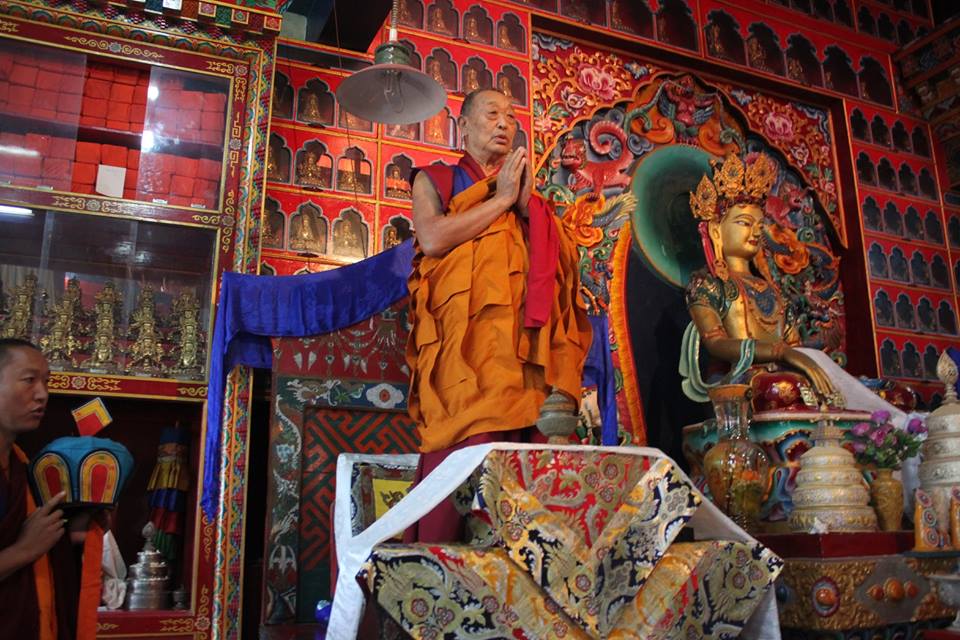
HH 33rd Menri Trizen. Behind him and to the left are texts wrapped in red cloth on shelves above the deity statues. Photo Credit: Unknown.
The Higher Levels of the Altar: It is important to have representations of enlightened Body, Speech and Mind on the altar. Enlightened Body is represented by statues and images such as thangkas, enlightened Speech is represented by texts, and enlightened Mind is represented by the chorten. Yungdrung Bön scriptural texts are always placed in the highest possible position with nothing on a level above them. They are considered even more important than an image of the Buddha because they contain the actual teachings and guidance that leads sentient beings out of their suffering. Sometimes they are placed on the same level with the deity statues due to limited space.
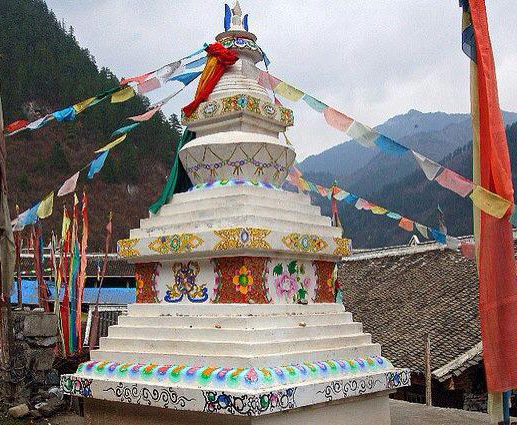
The Elegant Yungdrung Bon Chorten
Generally, statues and yidam torma are placed on the level below the texts. Images of high lamas are placed below the statues. If there is only a single lama image, it should be placed in the center. If there is more than one lama image, the image of the highest status lama is placed to the practitioner’s left and the second highest status lama is placed to the right. The third highest status lama image is placed to the left of the first image, etc.
The Lower Levels of the Altar: Offerings to the deities are placed on the lower levels of the altar. Most important are the five daily offerings of butter lamps, incense, clean water, food and flowers. (See previous post The Five External Daily Offerings https://ravencypresswood.com/2017/01/14/the-five-daily-offerings/.) Mandala rings are ritually filled with dry barley or rice and placed as an offering. If there is only one mandala, it is placed in the center. If there are two mandalas, they are placed to the left and right. Flowers are placed to the side of the altar and burning incense is placed below.
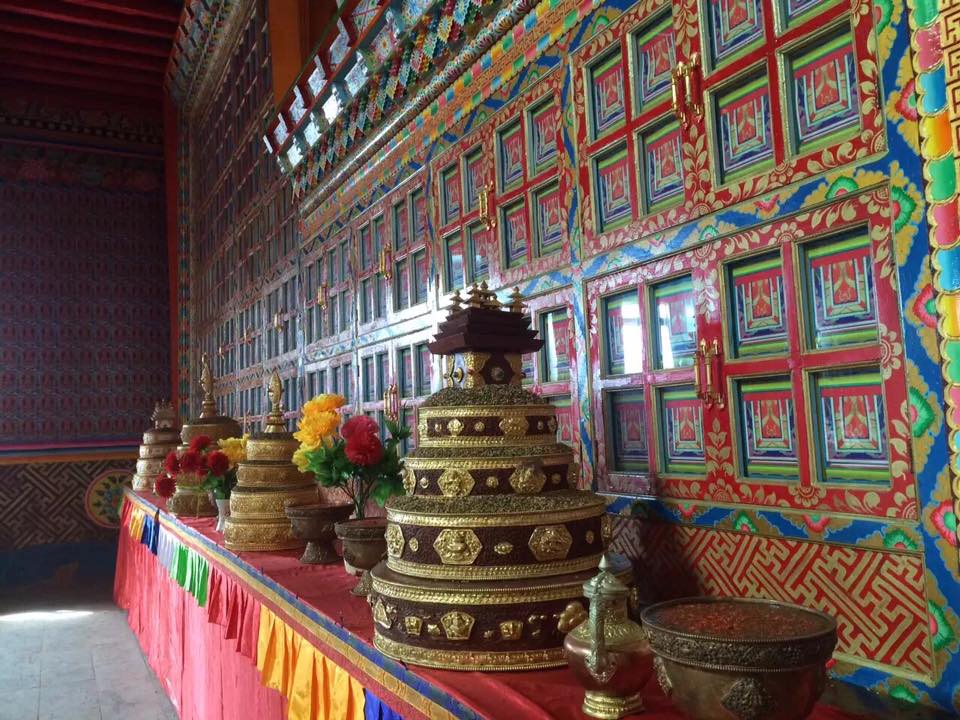
Mandala offering with the unique Yungdrung Bon square top. Photo credit: Unknown.
Once everything has been properly established, the altar is ritually cleansed with the sprinkling of clean water and the smoke of pure incense together with their respective mantra. Everything is imagined as being completely pure. The practitioner then performs at least three prostrations of body, speech and mind with a heart of devotion. At this time, the altar has been ‘opened’. From this time until it is ‘closed’ in the evening, one must perform prostrations before approaching the altar. Out of respect, whenever approaching the altar when it is ‘open’, the mouth is covered as a way to keep it completely pure and clean.
According to the texts, the altar is opened in the morning ‘when the birds leave their nest’ and closed in the afternoon when ‘the birds return to their nest.’ This is generally considered to be dawn and late afternoon before sunset. When acquiring items for the altar, setting it up, and opening and closing it each day, one imagines that by engaging in this virtuous activity, that the five poisons of ignorance, anger, attachment, pride and jealousy are purified.
Raven Cypress Wood ©All Rights Reserved
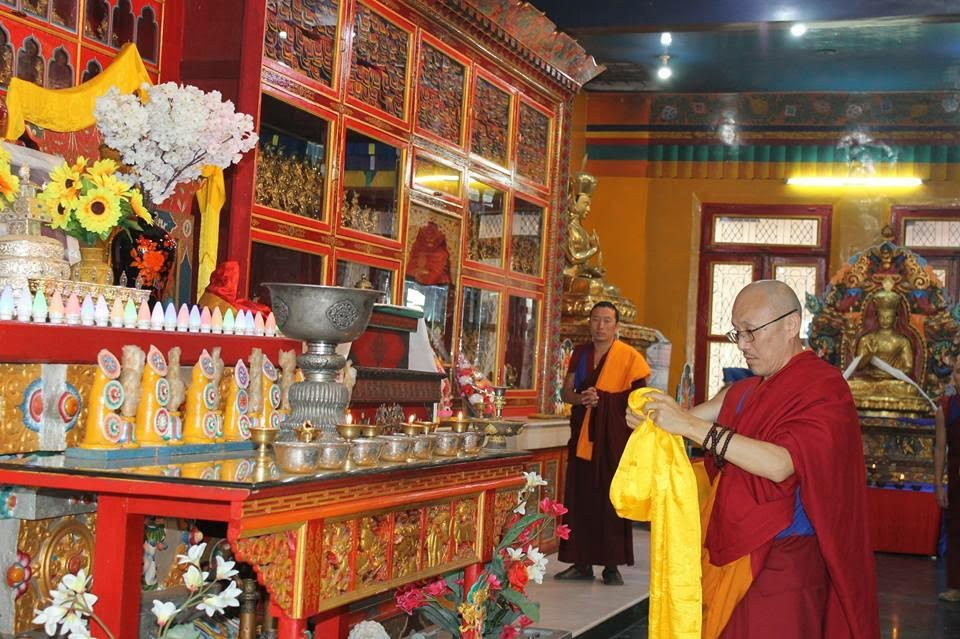
Khenpo Tenpa Yungdrung Rinpoche, Abbott of Triten Norbutse Monastery, offering a khata to an altar containing the five daily offerings. Photo credit: Unknown
In the Yungdrung Bön tradition, there are Five External Daily Offerings that are placed upon the main altar. These five offerings are butter lamps, pure water, food, incense and flowers. Each morning, traditionally at dawn, these items are placed on the altar as offerings to the higher beings. All of them must be clean and pleasing in their presentation. In general, the altar will have three, four, or five levels. These five offerings are placed on the lower levels with the incense placed below and the flowers to the side. The offerings are placed according to height. In front are the water offering bowls, behind are the butter lamps, and behind them are the taller food offering torma and the standing incense. Sometimes, the butter lamps are placed between each of the water bowls.
If one is unable to offer the substantial form of these offerings, one can instead offer the mantra and mudra representative of each of them. Or, if one is unable to offer the complete seven butter lamps or seven bowls of pure water, one can offer fewer according to the circumstances. However, limitation of the offerings should not be determined because of feelings of greed. By offering with feelings of open generosity and devotion, the practitioner generates merit and engages in the practice of virtue. More specifically, each individual offering has its own benefits related to each of the five realms of rebirth within cyclic existence. (The god realm is not included here.)
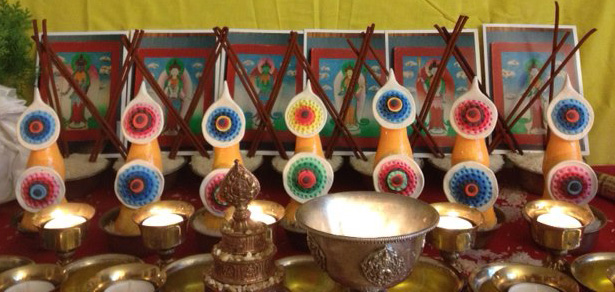
Yungdrung Bon altar with yellow, ornamented food offering torma. Photo credit: Raven Cypress Wood
Butter Lamp Offering: In Tibetan, mar mé. The essence of this offering is the offering of light. Therefore, although the traditional offering is seven butter lamps, one can also offer seven candles. The butter lamps or candles are placed in a straight line and centered nicely upon the altar. The butter lamps or candles are lit from left to right. In the evening if they need to be extinguished, they are put out from right to left. The specific benefit of offering butter lamps is the elimination of the suffering of the hot and cold hells. The light offering helps to dispel the darkness of ignorance. The mantra for the butter lamp offering is: OM NE TENG CHO CHO LAM LAM YÉ SOHA.

Butter lamp mudra. This represents the flame.
Incense: In Tibetan, pö. The best incense is made from the three hundred sixty medicinal ingredients. Incense can be offered in two ways: 1) sticks of incense placed standing and elegantly crossed in small bowls of clean rice, and 2) burning incense placed below the altar so that the smoke rises up and passes over it. The benefit of offering incense is to eliminate the suffering of the hungry ghost realm which is primarily hunger and thirst. Offering incense helps to eliminate the affliction of desire. The mantra for the incense offering is: OM ZHIM ZHIM DRAM DRAM BUN NÉ TIM TIM YÉ SOHA.
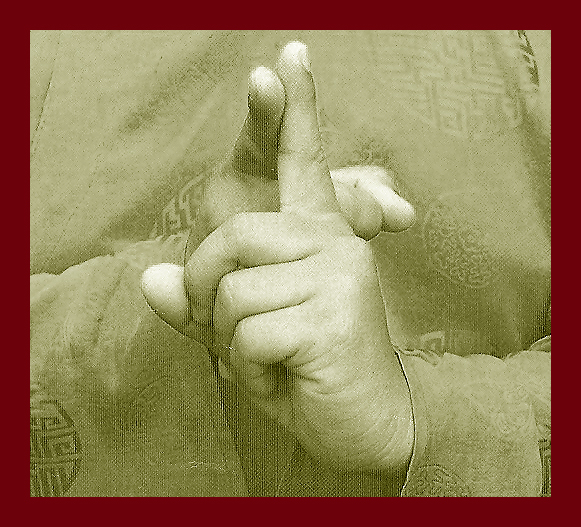
Incense mudra. This represents two crossed sticks of incense.
Water: In Tibetan, yon chap. The water that is offered must be clean. Traditionally, it is offered in seven bowls that are made of precious metal and ornamented with auspicious symbols. At the least, the bowls should be of good quality, clean and without cracks or defects of any kind. The bowls are placed in a straight line and centered nicely upon the altar. The bowls should not touch but not be too far apart. According to the scriptures, they should be separated by the space measured as the width of a grain of rice. In the morning, the bowls are filled from left to right. The water is filled near to the top of the bowl but not so full that it spills or overflows. In the evening, the bowls are emptied from right to left and the water is offered to a clean place outside. Ideally, the bowls are wiped and leaned upside down one upon the other. An empty water bowl is never left right side up. The water offering helps to dispel the suffering of the animal realm which is ignorance as well as being enslaved to work for others. The mantra for the water offering is: OM SHUDO SHUDO KU SHUDO YA SA LÉ SANG NGÉ YÉ SOHA.

Water offering mudra. This represents two water bowls.
Food Offering: In Tibetan, zhal zé. Traditionally, this is represented with seven food offering tormas. These torma are made of clean, roasted barley flour, called tsampa. The size of the torma is determined by the size of the altar, but should not be too small. Because these are a peaceful type of torma, the base is round and they are painted yellow with butter or food coloring. They are ornamented with colorful butter sculptures resembling flowers. If the practitioner has not been taught to make these torma, food items such as special cookies, cake, sweets or fruit are examples of what can be offered instead. When offering food, the very first portion or piece is considered the best and it is this that is offered to the higher beings. The offering of food is related to the human realm and helps to eliminate the suffering of being destitute. The mantra for the food offering is: OM YA YEN RANG ZHI YÉ SOHA.
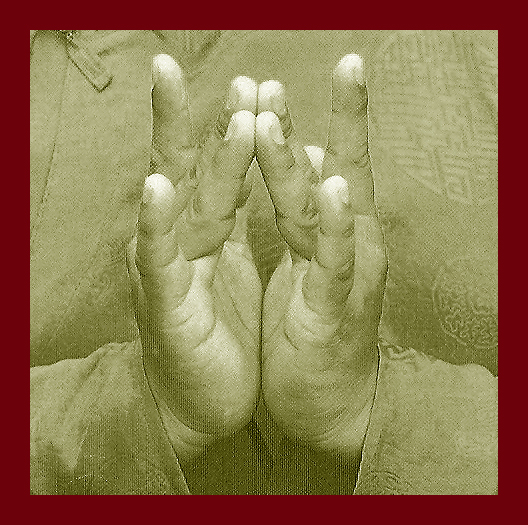
Food offering mudra. This represents the food offering torma.
Flowers: In Tibetan, metok. Flowers are placed to the sides of the altar. Flowers that are either from poisonous plants or that have thorns should not be offered. The flower offering is related to the demi-god realm and helps to eliminate the suffering of war and conflict. The mantra for the flower offering is: OM NE RA DE DE CHO CHO YÉ SOHA.
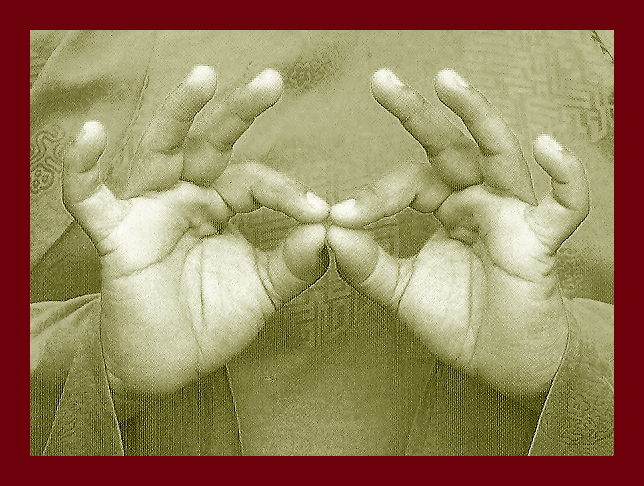
Flower mudra. This represents the open petals of a flower.
Five External Offerings as torma: In other contexts such as offering to yidam deities, the five offerings can be represented as torma made from tsampa. Although each of the five offerings are individually represented, they are always placed together and offered as a single torma. Because this is a peaceful offering, the base of each is round, they are yellow in color and ornamented with butter. The placement is as follows: Center is the flower torma, East (front) is the butter lamp torma, North is the incense torma, West is the water torma, and South is food torma.

The Five External Offerings represented as torma.
Copyright Raven Cypress Wood© All Rights Reserved
 Nine Ways