Author Archives: Raven Cypress Wood

Protection for Travelers


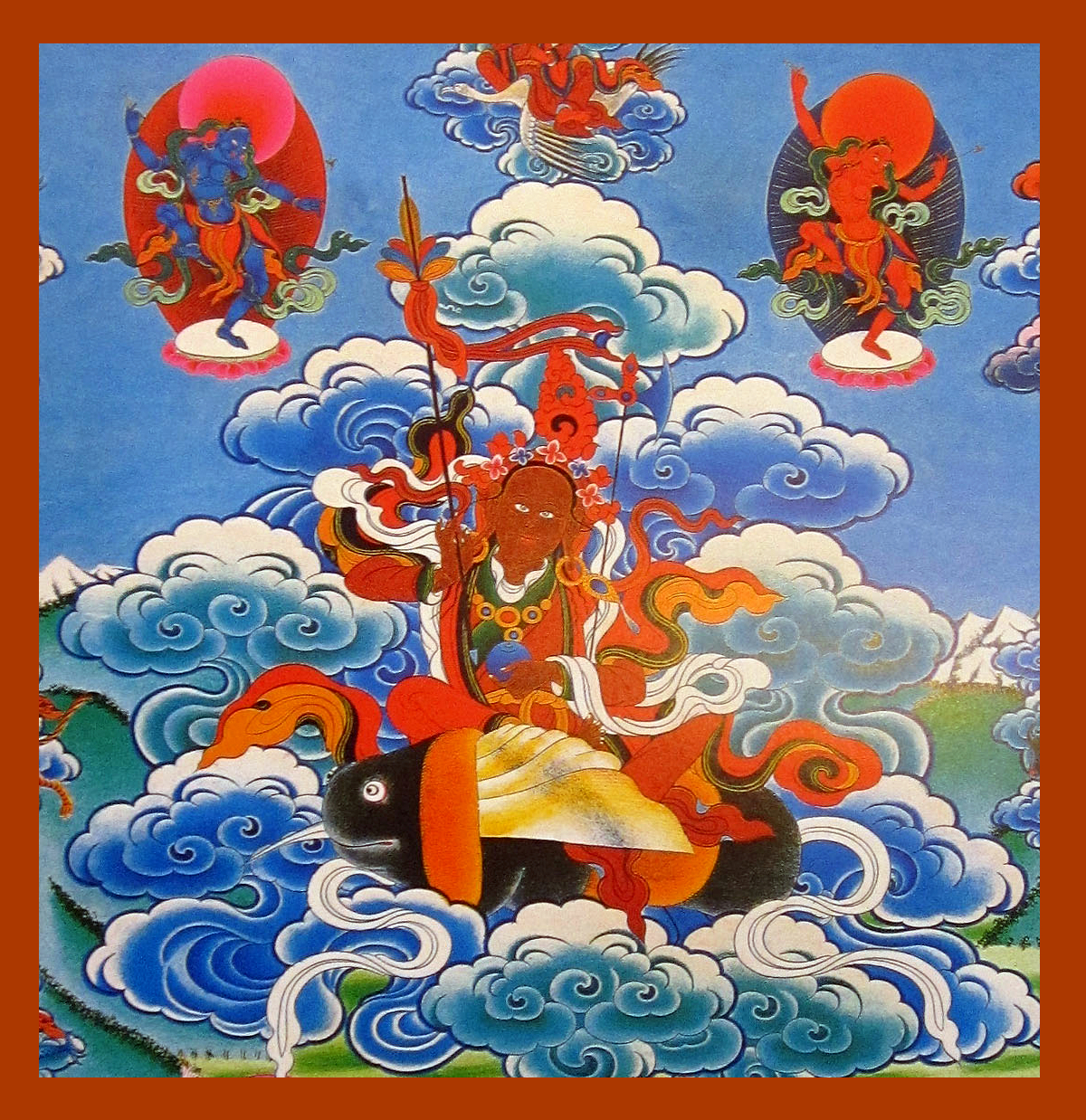
When traveling, one can specifically include the Goddess of Travel, Chammo Lamlha, in the morning smoke offering, and also offer her torma in the evening, while asking for her protection. Although there are longer invocations of her and her retinue, this is a concise invocation that was written by His Holiness 23rd Menri Trizen Nyima Tenzin Rinpoche when he saw her in a vision at the age of thirteen.

SO!  Within a mandala of luminous and beautiful jewels,

Seated upon a golden hornet,

Is the majestic and youthful goddess,

Chammo Lam Lha, together with her retinue.

Come here now and keep your protection vow!

Please accept these offerings of smoke and torma.

Act as my companion.

Expel the causes for harm and obstacles.

Please act to accomplish this entrusted activity!

Translation Raven Cypress Wood ©2015 All Rights Reserved. No publication permitted.


Pacifying Suffering and Misery

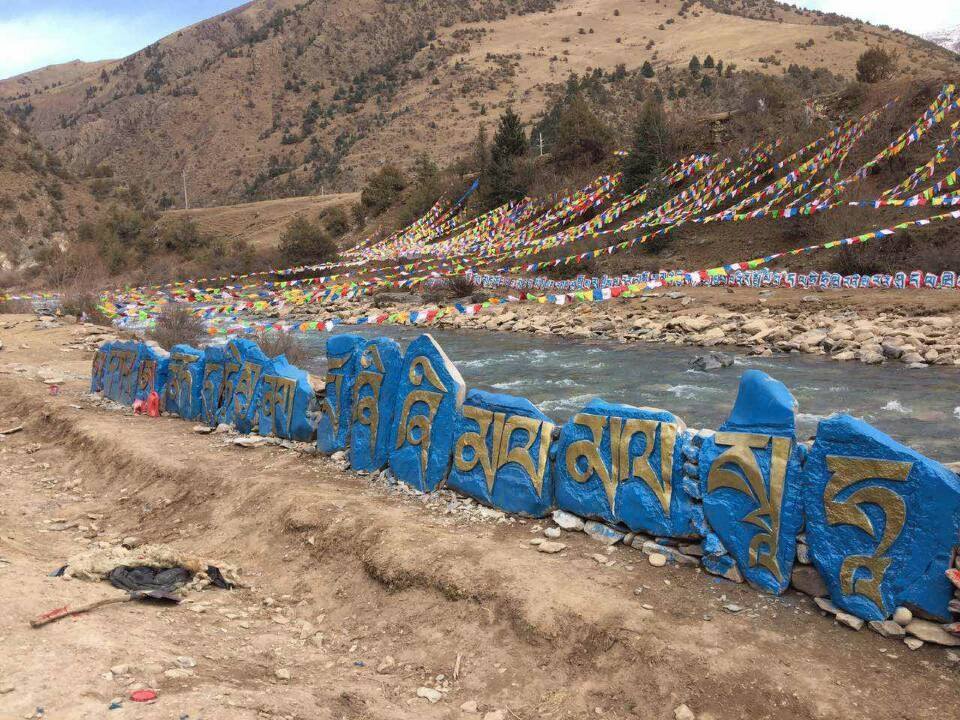
The DU TRI SU essence mantra blessing the environment. Photo credit: Unknown

“This heart mantra pacifies suffering and misery. Having overturned the depths of the lower realms of cyclic existence, may all beings be liberated into the space of absolute reality!”

From Praise of the DU TRI SU Mantra

Translation: Raven Cypress Wood

The Ninth Way: The Unsurpassed Way

The Tibetan syllable AH surrounded by the five lights in a field of dark blue is often used as a meditative support in dzogchen training.

Among the Nine Ways of Bön, The Ninth Way is the highest. It is the practice of dzogchen, the great perfection. Here, everything is spontaneously perfected and there is no activity to be performed. The view is unbounded and beyond subject and object. Because everything is spontaneously perfected and complete, it is beyond needing the effort of a generating stage and perfection stage. It is beyond the extremes of existence and nonexistence, and without beginning or end. Although it is ineffable, the enlightened Lord Tönpa Shenrap has given guidance using words for those disciples who need instruction. Therefore, this Way is often classified and explained in three parts: the foundation, the path, and the result, or the view, the meditation, and the behavior.

According to the Lord Tönpa Shenrap Miwoche:

“If it is divided into each separate aspect, it has 84,000 elaborations. Condensed inward, it is one essence, a single tiklé.”

Furthermore:

“It cannot be lost. It is not created from a cause, nor is it destroyed by circumstance.”

Although the dzogchen view is the highest and is beyond the dualistic concepts of good and bad, the dzogchen practitioner is not beyond these concepts until they have completely realized the fruit of the teachings, which is buddhahood. Therefore, even if a disciple has a vast and high view, Lord Tönpa Shenrap advises that they maintain behavior according to the path of the two accumulations of virtue and wisdom.  Although dzogchen is about knowing and being aware rather than performing any particular behavior or ritual, there are specifics practices that are prescribed  to be applied to whatever cause or condition is blocking or interrupting awareness. Central to the practice of dzogchen is the development of the mind of enlightenment, doubtless refuge, and indestructible devotion to one’s root lama who points out the true nature of the disciples mind and gives them advice along the path.

Raven Cypress Wood© 2018


The Shining Light of Kailash

Chogyal Namkha’i Norbu Rinpoche. Photo credit: Unknown

On the  17th day of the 8th Tibetan Month, Western date September 27,  2018, the esteemed dzogchen master and scholar, Chogyal Namkha’i Norbu Rinpoche passed away. Although he was a Nyingma lineage holder, he had close ties with many Yungdrung Bön lamas. Through his years of research, he often verified the validity of Bönpo religious and historical accounts. In 1983, he and a group of his students traveled to Dolanji, India and received teachings and transmissions of the Zhang Zhung Nyen Gyü from His Eminence Yongdzin Tenzin Namdak Rinpoche. In 1988, having been invited by Namkha’i Norbu Rinpoche to his Merigar Retreat Center in Italy, Geshe Tenzin Wangyal Rinpoche taught his first dzogchen retreat to Westerners.

Namkha’i Norbu Rinpoche and his students with HE Yongdzin Tenzin Namdak Rinpoche and Geshe Tenzin Wangyal in Dolanji, India. 1983. Photo credit: Unknown

Namkha’i Norbu Rinpoche was a prolific writer and authored many books, including the well known “The Crystal and the Way of Light,” and “The Cycle of Day and Night.” He also wrote a three volume study of Zhang Zhung and Tibetan history which has been eloquently translated and edited by Donatella Rossi entitled, “The Light of Kailash, A History of Zhang Zhung and Tibet.”

Chogyal Namkhai Norbu Rinpoche with HE Yongdzin Tenzin Namdak Rinpoche in 2016. Photo credit: Unknown

When a realized lama passes, it is appropriate to fervently practice guru yoga, imagining the master merged with all masters and enlightened beings, to perform aspiration prayers, to perform acts of virtue, and to sponsor the performance of tsog offerings by the monastic community. For students, it is especially important to purify and renew commitments they have made with the master, and to zealously apply the master’s spiritual guidance until achieving realization for themselves and others.

Raven Cypress Wood ©2018
A Mandala of Offerings

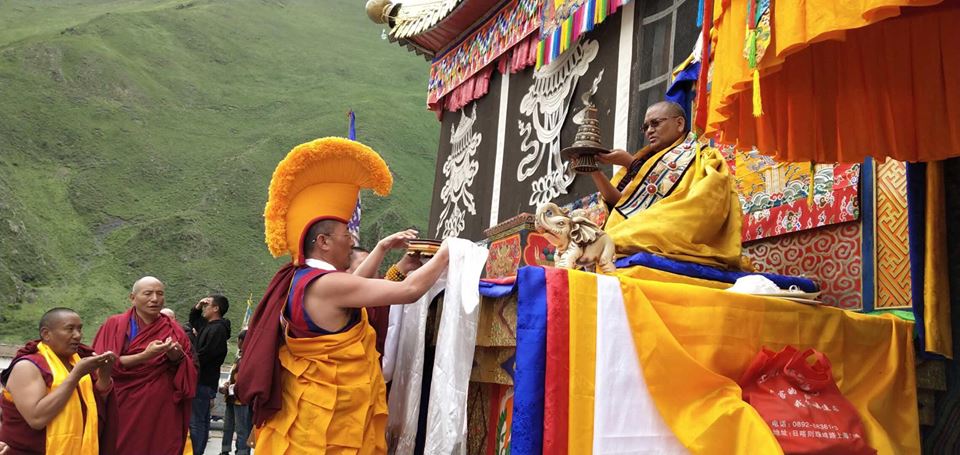
His Eminence Menri Ponlop Yangton Trinley Nyima Rinpoche being offered the mandala in Kham, Tibet. Photo credit: Unknown.