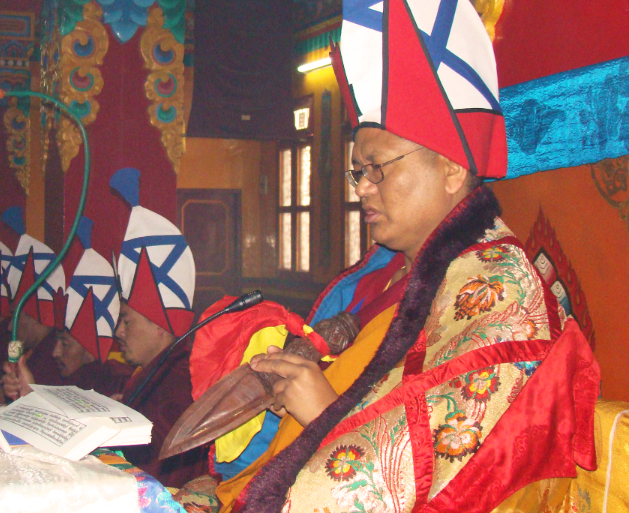
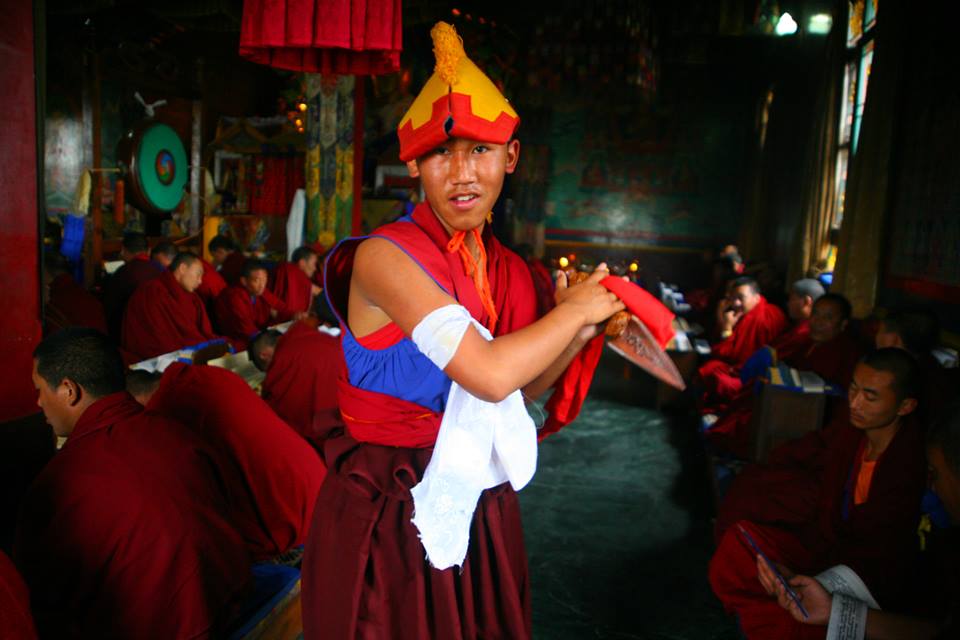
Each year during the 23rd-29th lunar days of the 11th lunar month, monks at Menri Monastery undergo a seven-day intensive retreat for the enlightened fierce deity and tantric yidam Wal Phur Nakpo. In 2026, these dates coincide with January 11th-17th. This deity is the black-colored manifestation of Phurba.
From the Father Tantra, there is a group of five yidams, or meditational deities, that are collectively known as the Sé Khar Chok Nga, The Five Supreme Citadels or The Five Supreme Embodiments. Collectively, these dzok ku deities are the manifestation of Buddha Tönpa Shenrap’s enlightened body, speech, mind, quality, and activity. The manifestation of enlightened activity is embodied by Walsé Chempa who is also known as Phurba. Because he is the yidam of enlightened activity, he automatically becomes the yidam deity of every Menri Trizin. (For more information about the Sé Khar Chok Nga, see previous article: https://ravencypresswood.com/2016/06/05/the-five-supreme-embodiments/)
The term phurba has most often been translated as dagger or sacred dagger. However, it is more precisely a sacred stake or peg that is used to suppress or overpower negative forces and obstacles. From a commentary regarding the meaning of the Wal Phur Nakpo practice:
“Regarding the meaning of being called Phur: because all impure karma and afflictive emotions are staked within the pure enlightened body and its complete non-conceptual wisdom, he is called Phur, The Stake.
The yidam Wal Phur Nakpo has three faces, six arms, and each hand holds a phurba. He and his consort’s body are joined below the waist and form a single phurba adorned with snakes. The top of the phurba has a four-cornered wisdom-knot. Below the knot is a crocodile with a protruding, vicious face that symbolizes the destruction of all impure karma and afflictive emotions. Below that, the enlightened body, speech, and mind of the yidam are inseparably united as the symbolic three edged, pointed blade. The three blades terminating into a single, sharp point represent the apex of completely fulfilling the four kinds of enlightened activity: peaceful enlightened activity, expansive enlightened activity, powerful enlightened activity, and wrathful enlightened activity.
The term wal has multiple meanings. The most relevant meanings in this context are that of (1) sharp, bladed, pointed and (2) fierce, wrathful, forceful. From the same commentary as mentioned above,
“Regarding the meaning of being called Wal: externally, he is called Wal because he is the point from which arises the external, common accomplishment of piercing and incinerating every enemy and obstructer that would interfere with manifesting external activity. Internally, he is called Wal because of being the point of great wisdom and performing the uncommon and meaningful activity of incinerating and overcoming all erroneous conceptuality. Therefore, he is called Wal, The Pointed.
Both the yidam and his consort have wings. The retinue includes many assistants and messengers that are winged or actually manifest as hawks.

“With a magical display of activity and movement that arises from an immovable state, you subdue misleading enemies and obstructers.
Fierce Wal Phur, you directly manifest the enlightened activity of the Wal deities.
Praise for the Wal deity whose divine appearance self-arises from the vast expanse of space in order to quickly accomplish fierce enlightened activity!”
— From The Concentrated Essence of Wal Phur translated from the Tibetan by Raven Cypress Wood
When performing the rites of Wal Phur Nakpo, the scriptures give specific instructions regarding the many items and substances that are needed, how to use them, proper measurements for making a phurba, how to establish the mandala of the yidam, the types of offerings that are needed and how to arrange them, and so forth. The image of the mandala, a representation of the sacred architecture of the spontaneously arising palace for the deity, is either made with colored sand or printed and placed on or near the shrine. Once all the materials have been prepared and properly arranged, everything is ritually purified.
On the first day of the retreat, the yidam Wal Phur Nakpo along with his consort and vast retinue are formally invited to take a seat upon the throne in the center of the mandala palace. From this moment until the conclusion of the retreat, no one is allowed to interact with the mandala or the offerings placed upon it except during the formal ritual activities during the retreat. In this way, The Phurba practitioners transforms their ordinary body, speech, and mind into the enlightened body, speech, and mind of the deity and therefore make themselves a proper vessel for the blessings and enlightened qualities of the yidam.

Raven Cypress Wood ©All Rights Reserved. No content, in part or in whole, is allowed to be used without direct permission from the author.
Did you enjoy this content? This article is made possible by generous donors who want content like this to continue to be available. Don’t want to miss a post? Scroll to the bottom and click “Follow this blog.”
Join the mandala of Nine Ways supporters by donating through one of the services listed below.

Discover more from Nine Ways
Subscribe to get the latest posts sent to your email.
 Nine Ways
Dear Raven Cypress Wood, thank you for your tireless efforts! Will you be publishing your translation of the rites of Wal Phur Nakpo? This deity has come into my life strongly lately and I wish to know more.
Kuntuzangpo! Kevin Lay
Thank you so much for sharing the precious knowledge
Dear Aleksander, I’m glad to hear that you are benefiting from the website. Warmly, Raven
Hi Kevin, thank you for your kind message. How wonderful that you are feeling a connection to Wal Phur Nakpo. At present, I have not translated the complete text for the rites of Wal Phur Nakpo. Perhaps in the future. Warmly, Raven